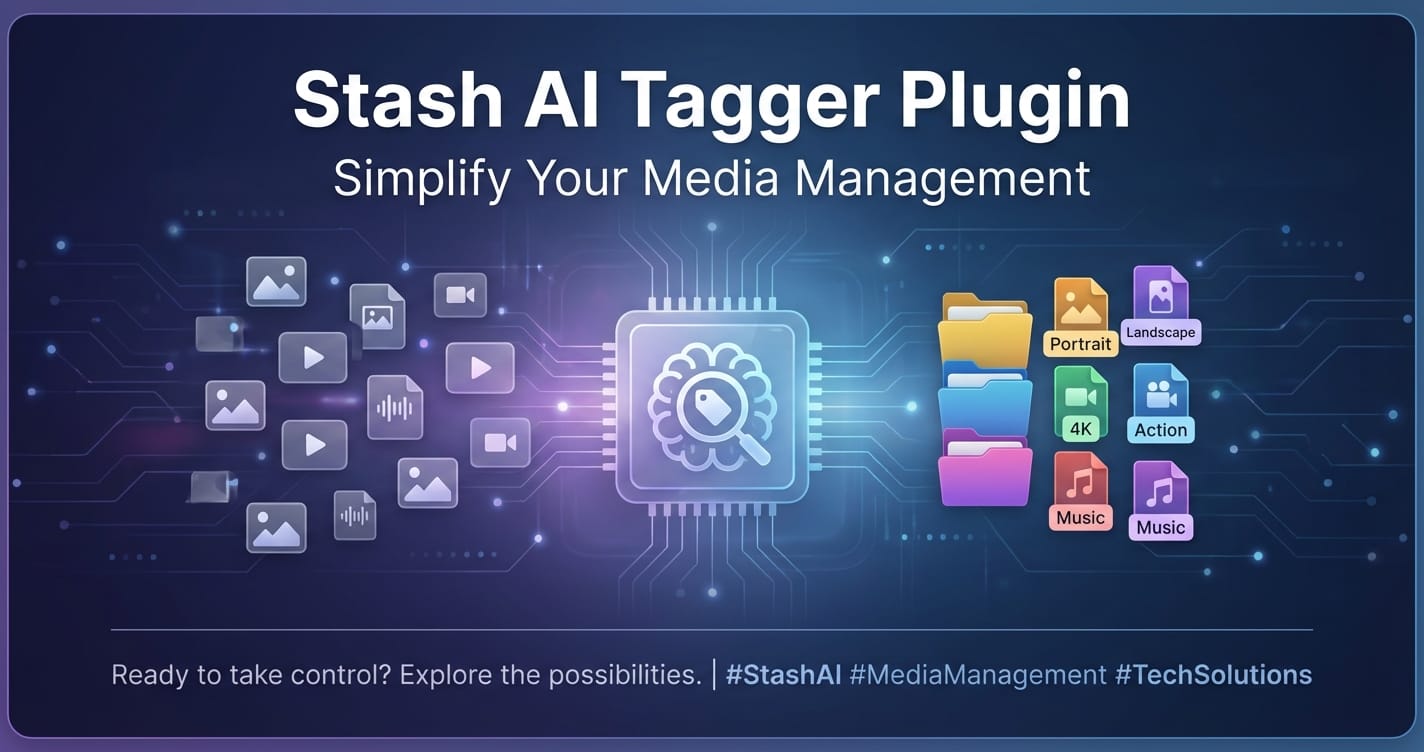
Stash AI Tagger Plugin: Simplify Your Media Management


The digital age has ushered in an unprecedented era of content creation and consumption. From personal photographs and family videos to professional media assets and vast archival collections, individuals and organizations alike find themselves grappling with an ever-expanding deluge of digital media. Managing this explosion of data presents a formidable challenge. The sheer volume makes manual organization a Herculean task, often leading to files being lost in the digital ether, undiscoverable amidst countless others, or tagged inconsistently, rendering them practically useless for efficient retrieval. This widespread predicament highlights a critical need for intelligent, automated solutions that can not only handle the scale but also bring a new level of precision and semantic understanding to media management.
Enter the Stash AI Tagger Plugin – a revolutionary tool designed to transform the chaotic landscape of digital media into a meticulously organized, easily navigable, and highly searchable repository. By harnessing the power of advanced artificial intelligence, this plugin automates the arduous process of tagging and categorizing media, offering a sophisticated layer of intelligence to your Stash instance. It moves beyond simplistic filename searches or rudimentary folder structures, delving deep into the content of your media to identify objects, scenes, activities, and even subtle nuances, thereby enriching your entire collection with intelligent metadata. This automation not only liberates users from countless hours of manual labor but also unlocks new possibilities for discovering, curating, and leveraging media assets. In doing so, the Stash AI Tagger Plugin doesn't just simplify media management; it redefines it, paving the way for a future where every digital asset is intelligently understood and effortlessly accessible, underpinned by robust backend systems like an AI Gateway, LLM Gateway, and a sophisticated Model Context Protocol that ensure seamless interaction with diverse AI models.
The Problem of Manual Media Management: A Deep Dive into Digital Chaos
Before we celebrate the solutions, it's crucial to fully appreciate the depth and breadth of the problems that manual media management perpetuates. This isn't merely about inconvenience; it's about significant resource drain, missed opportunities, and the eventual decay of valuable digital archives into unusable data graveyards.
The Time Consumption Quandary
At the most fundamental level, manual media management is an enormous time sink. Imagine a photographer with thousands of event photos, a videographer with hours of raw footage, or a family with decades of memories captured across various devices. Each image, each video segment, potentially requires human review, identification of key elements, and then the laborious entry of descriptive tags. If one were to meticulously tag even a modest collection of 10,000 items, spending just one minute per item—a conservative estimate given the need for thoughtful, consistent tagging—that equates to over 166 hours of dedicated work. For larger collections, such as those maintained by professional studios or content archives which can number in the hundreds of thousands or even millions, this figure quickly escalates into years of continuous effort. This monumental investment of time detracts from more creative or strategic endeavors, turning what should be an empowering act of organization into a soul-crushing chore. The sheer scale makes it virtually impossible for individuals or even small teams to keep pace with the influx of new media, leading to a perpetual backlog and a sense of being constantly overwhelmed.
The Scourge of Human Error and Inconsistency
Beyond the time factor, human involvement introduces inherent vulnerabilities: error and inconsistency. Manual tagging is subjective. What one person identifies as "cityscape" might be "urban panorama" to another, or "downtown scene" to a third. Such variations, seemingly minor in isolation, accumulate across a large dataset to create a fragmented and unreliable indexing system. Misspellings, forgotten tags, or the omission of crucial descriptive details are common occurrences, often due to fatigue or lack of standardized guidelines. Over time, these inconsistencies render search queries less effective; a user might search for "beach sunset" and miss stunning photos tagged only with "ocean horizon" or "evening shore." Furthermore, as media collections grow and evolve, and as different individuals or teams contribute to the tagging process, maintaining a unified and coherent metadata strategy becomes an insurmountable challenge, eroding the integrity of the entire archive and making comprehensive retrieval a matter of luck rather than precision.
Scalability Issues: A Growing Tsunami
The problem of manual management isn't static; it exacerbates with growth. As digital cameras become ubiquitous, storage costs plummet, and content creation tools become more accessible, the volume of media generated continues to swell at an exponential rate. Traditional, human-centric approaches simply do not scale. A system that might be manageable for a few hundred files collapses under the weight of tens of thousands, let alone millions. The infrastructure for manual tagging—be it dedicated personnel, software interfaces, or review processes—cannot expand rapidly enough to match the pace of media ingestion. This leads to an ever-growing proportion of "dark data"—media that exists but cannot be effectively utilized or retrieved due to lack of proper indexing. For businesses, this translates into lost intellectual property, duplicated efforts, and missed opportunities to repurpose valuable assets. For individuals, it means treasured memories remain locked away, inaccessible and uncherished.
The Frustration of Difficulty in Retrieval
The ultimate purpose of organizing any collection is ease of retrieval. When media is poorly tagged or untagged, the ability to find specific items becomes an exercise in frustration. Imagine needing to locate "that video of Aunt Susan's 50th birthday party where she's blowing out the candles," but knowing only that it's somewhere among hundreds of untagged videos from five years ago. Without descriptive metadata—tags for "birthday," "Aunt Susan," "cake," "candles," "party"—the search devolves into a tedious, frame-by-frame, file-by-file review. This difficulty doesn't just consume time; it fosters a sense of helplessness and can actively discourage users from engaging with their own media libraries. The inability to quickly pinpoint a specific asset diminishes its value, turning a potential resource into a digital burden.
Lack of Standardized Metadata: A Tower of Babel
A core tenet of effective data management is standardization. For media, this means a consistent schema for metadata. Manual processes rarely adhere to robust standards, leading to what can be described as a "Tower of Babel" scenario for tags. Different people use different terminology, different hierarchical structures, and different levels of granularity. One person might tag "Dog," another "Golden Retriever," and another "Pet." While all are technically correct, their lack of uniformity makes unified querying impossible without complex, often error-prone, aliasing rules. This absence of a coherent metadata framework hinders interoperability with other systems, complicates data migration, and ultimately undermines the long-term utility and integrity of the media collection. It prevents the kind of sophisticated data analysis and cross-referencing that could unlock deeper insights from the media itself.
These challenges collectively paint a stark picture: manual media management is not sustainable, efficient, or reliable in the face of today's digital realities. It is against this backdrop of pervasive digital chaos that intelligent, AI-driven solutions like the Stash AI Tagger Plugin emerge as not just desirable, but absolutely essential.
Introducing the Stash AI Tagger Plugin: Bridging the Gap to Intelligent Automation
The realization that traditional methods are failing has spurred the development of advanced tools, and the Stash AI Tagger Plugin stands at the forefront of this evolution. It represents a paradigm shift from reactive, labor-intensive organization to proactive, intelligent automation, fundamentally transforming how users interact with their media.
What is Stash? Your Digital Media Hub
To understand the plugin, one must first understand its host environment: Stash. Stash is an open-source, web-based media organizer designed specifically for large and complex media libraries. It provides a robust framework for cataloging, browsing, and managing video, image, and audio files. Users can create custom categories, apply tags, manage performers, and build intricate relationships between different media items. Stash's strength lies in its ability to offer a centralized, powerful interface for private media collections, giving users fine-grained control over their vast digital archives. Its architecture is built for extensibility, allowing community-driven plugins to augment its core functionalities, which is precisely where the AI Tagger Plugin comes into play. Without Stash providing the foundational platform for media storage and display, the AI Tagger Plugin would lack the integrated environment it needs to operate effectively.
What is the AI Tagger Plugin? Its Core Function
The Stash AI Tagger Plugin is an extension that seamlessly integrates with the Stash ecosystem, designed with one primary objective: to automatically analyze and tag your media content using artificial intelligence. At its core, the plugin offloads the cognitive burden of identifying and labeling visual and auditory elements within your files from the human user to sophisticated AI models. Instead of you painstakingly typing out "man, woman, dog, park, tree, sunny, afternoon" for a photograph, the AI Tagger Plugin intelligently "sees" these elements and applies relevant tags, often with a level of detail and consistency that far surpasses manual efforts. It acts as an intelligent assistant, constantly working in the background to enrich your media metadata, making every item in your collection inherently more descriptive and therefore, infinitely more discoverable. This core function is not just about adding tags; it's about adding intelligence and semantic understanding to raw data.
How it Integrates with Stash: A Synergistic Relationship
The integration of the AI Tagger Plugin with Stash is designed for fluidity and minimal user friction. Once installed, the plugin becomes an active component within your Stash instance. It typically operates in a few key ways:
- On-Demand Scanning: Users can trigger a scan of their existing media library or specific sections of it. The plugin then processes the designated media, sending it (or relevant data derived from it) to AI services for analysis.
- Automated New Media Processing: For new media added to Stash, the plugin can be configured to automatically initiate AI analysis as part of the ingestion workflow. This ensures that every new item immediately benefits from intelligent tagging, preventing the accumulation of untagged backlogs.
- Metadata Injection: Once the AI models have analyzed the media and generated a set of suggested tags, these tags are seamlessly injected directly into Stash's database, becoming part of the item's official metadata. This means that all of Stash's powerful search, filtering, and categorization tools can immediately leverage the AI-generated tags. The plugin often includes settings for confidence thresholds, allowing users to control how aggressively tags are applied based on the AI's certainty, further refining the quality of the metadata.
- User Interface Integration: The plugin often provides an intuitive interface within Stash itself, allowing users to configure settings, review AI suggestions, accept or reject tags, and even trigger re-analysis. This ensures that while the process is automated, the human user retains ultimate control and can fine-tune the AI's behavior to match their specific needs and preferences.
This synergistic relationship ensures that the plugin doesn't just exist alongside Stash; it enhances and extends Stash's capabilities, making it a truly intelligent media management platform.
The Shift from Manual to Intelligent Automation: A Fundamental Transformation
The introduction of the AI Tagger Plugin signifies a fundamental transformation in media management philosophy. It marks a decisive shift from:
- Reactive to Proactive: Instead of reacting to a growing backlog of untagged media, the plugin proactively enriches new content as it arrives.
- Labor-Intensive to Intelligence-Driven: It reallocates human effort from tedious manual tagging to higher-value activities like curating, refining, and strategizing.
- Subjective to Consistent: By relying on trained AI models, the tagging process becomes far more consistent and less prone to individual biases or errors.
- Limited to Scalable: The AI can process vast quantities of media concurrently, making the system inherently scalable to collections of any size.
- Descriptive to Semantic: The AI doesn't just describe what's literally present; it can often infer context and meaning, adding a deeper layer of semantic metadata.
This shift is not just an incremental improvement; it's a foundational change that fundamentally redefines the possibilities of media organization. It empowers users to harness the full potential of their digital archives, turning unwieldy collections into invaluable, searchable resources.
Core Technology Behind the AI Tagger Plugin: Unveiling the Machine's Mind
The magic of the Stash AI Tagger Plugin isn't magic at all; it's the culmination of decades of research and development in the field of artificial intelligence and machine learning. To truly appreciate its power, one must delve into the technological bedrock upon which it is built.
Artificial Intelligence at its Heart: Perceiving the Unseen
At the very core of the AI Tagger Plugin lies sophisticated artificial intelligence, specifically in the domains of computer vision and, increasingly, audio processing. When you upload a video or an image, the AI doesn't "see" it as a human does. Instead, it processes the media as raw data – pixels, sound waves, and temporal sequences.
- Computer Vision for Image and Video Analysis: For visual media, the plugin leverages state-of-the-art computer vision models. These models are essentially highly complex neural networks trained on massive datasets of images and videos, learning to identify patterns, objects, and scenes.
- Object Recognition: This allows the AI to detect and classify individual objects within a frame, such as "car," "person," "tree," "dog," or "building." The models are trained to be robust, recognizing objects even with variations in lighting, angle, occlusion, or scale.
- Scene Understanding: Beyond individual objects, AI can analyze the overall context to understand the scene. Is it an "outdoor park," an "indoor office," a "beach," or a "mountain landscape"? This contextual understanding provides richer metadata.
- Activity Recognition: For videos, AI can go a step further, identifying actions and activities. Is someone "walking," "running," "swimming," "eating," or "talking"? This temporal analysis is crucial for describing dynamic content.
- Facial Recognition (Optional/Configurable): Some advanced integrations might include facial recognition capabilities, allowing the AI to identify known individuals within the media. This is often an opt-in feature due to privacy concerns.
- Optical Character Recognition (OCR): If there's text present in an image or video frame (e.g., a street sign, a book title, a billboard), OCR models can extract this text, adding it as searchable metadata.
- Audio Processing for Sound Recognition: For video and pure audio files, the plugin can integrate audio analysis AI. This involves:
- Speech-to-Text (STT): Transcribing spoken words into text, making the audio content searchable. This is invaluable for interviews, lectures, or narrated videos.
- Sound Event Detection: Identifying specific sounds like "music," "laughter," "applause," "animal sounds," "environmental noises" (e.g., "rain," "traffic"). This adds another layer of descriptive metadata that isn't visually apparent.
These AI models operate by breaking down complex media into features, comparing these features against patterns learned during training, and then assigning probabilities to various classifications. The higher the probability, the more confident the AI is in its tag suggestion.
Machine Learning Principles: The Engine of Improvement
The AI models employed by the plugin are built upon robust machine learning principles. This means they are not explicitly programmed for every possible scenario but instead learn from data.
- Training Data: The core of any machine learning model is its training data – vast datasets of labeled images, videos, and audio clips. For example, a model learning to identify "cats" would be fed millions of images, each meticulously labeled as containing or not containing a cat. Through iterative adjustments, the model learns the distinguishing features that define a "cat."
- Deep Learning: Many of the most advanced AI models used today, particularly for computer vision, leverage deep learning architectures, specifically convolutional neural networks (CNNs) for images and recurrent neural networks (RNNs) or transformers for sequential data like video and audio. These "deep" networks have multiple layers that learn increasingly abstract representations of the input data, allowing them to detect complex patterns.
- Continuous Improvement and Transfer Learning: While the plugin itself might not directly retrain the base AI models (these are usually external services), the effectiveness of the plugin can improve. For instance, user feedback (accepting or rejecting tags) can be used to fine-tune the plugin's internal logic, adjust confidence thresholds, or even contribute to future iterations of the underlying models via transfer learning if the plugin vendor has access to the model training pipeline. Transfer learning is particularly important: instead of training a model from scratch, existing pre-trained models (which have learned general features from vast datasets) are adapted for specific tasks, making them efficient and powerful for new applications.
The Role of an AI Gateway: Orchestrating Intelligence (Keyword: AI Gateway)
For a plugin like Stash AI Tagger, which needs to interact with various specialized AI models for different tasks (e.g., one model for object detection, another for facial recognition, a third for speech-to-text), the concept of an AI Gateway becomes not just beneficial, but absolutely critical. An AI Gateway acts as an intelligent intermediary, a single point of entry and control for all interactions between the Stash plugin and the diverse array of backend AI services it consumes.
Here’s why an AI Gateway is indispensable:
- Abstracting Complexity: Different AI models from different providers might have varying APIs, authentication methods, and data formats. The AI Gateway normalizes these interactions. The Stash plugin sends a standardized request to the gateway, and the gateway handles the translation and routing to the appropriate AI backend, abstracting away the underlying complexities. This simplifies development for the plugin and makes it more robust against changes in individual AI service APIs.
- Managing Multiple AI Services: A single plugin might need to use Google's Vision AI for object detection, Microsoft Azure's Cognitive Services for facial recognition, and an open-source model for specific niche tagging. An AI Gateway allows the plugin to orchestrate these various services seamlessly. It can intelligently route requests based on the type of media, the desired analysis, or even cost considerations.
- Ensuring Efficient and Secure Communication: The gateway can implement features like request queuing, load balancing across multiple instances of an AI service, and rate limiting to prevent individual services from being overwhelmed. It also enforces security policies, handling API keys and authentication securely, and potentially encrypting data in transit to and from the AI services.
- Cost Management and Optimization: By acting as a central proxy, the AI Gateway can monitor usage patterns for each AI service, helping users track costs, enforce budgets, and even implement smart routing to cheaper alternatives if performance criteria are met. This centralized oversight is crucial for managing operational expenses associated with AI consumption.
- Centralized Logging and Monitoring: All requests and responses passing through the gateway can be logged, providing invaluable data for troubleshooting, performance analysis, and auditing. This unified observability across all AI interactions is a significant advantage.
In this context, a powerful and flexible solution like APIPark (ApiPark) exemplifies the capabilities of an advanced AI Gateway. APIPark offers an open-source AI gateway and API management platform that can quickly integrate over 100 AI models with a unified management system for authentication and cost tracking. It standardizes the request data format across all AI models, ensuring that changes in AI models or prompts do not affect the application, thereby simplifying AI usage and maintenance. For a plugin like Stash AI Tagger, using an underlying platform like APIPark would mean the plugin developers could focus purely on the Stash integration and user experience, while the complexities of interacting with a diverse, evolving landscape of AI models are expertly handled by the gateway. This greatly accelerates development, improves reliability, and provides a scalable foundation for future AI enhancements.
How the Stash AI Tagger Plugin Works: A Deep Dive into its Workflow
Understanding the high-level concepts is one thing, but truly grasping the utility of the Stash AI Tagger Plugin requires a detailed examination of its operational workflow. From the moment media is introduced to the system until intelligent tags are securely stored, a series of intricate steps unfold, orchestrated to deliver precise and actionable metadata.
1. Media Ingestion and Pre-processing: Preparing for Analysis
The journey begins when new media is introduced into your Stash library, or when you initiate a scan of existing media. This could involve adding a new folder of videos, importing a batch of photos, or choosing to re-analyze specific files.
- File Detection: The Stash system, augmented by the AI Tagger Plugin, detects the presence of new or selected media files within the configured directories. It identifies their file types (e.g., .jpg, .mp4, .mov, .mp3) to determine the appropriate AI analysis pipeline.
- Metadata Extraction (Basic): Before AI analysis, the plugin may extract basic, readily available metadata from the file itself. This includes creation dates, file sizes, dimensions, duration (for video/audio), and potentially EXIF data from images (e.g., camera model, GPS coordinates if present). While not AI-generated, this initial data provides foundational context.
- Media Preparation: For optimal AI analysis, the raw media often needs to be pre-processed.
- Thumbnails/Keyframes: For videos, it's often inefficient to send the entire video stream to an AI model for initial tagging. Instead, the plugin might extract a series of representative keyframes (thumbnails) at regular intervals or at scene changes. These static images are then sent for visual analysis, which is significantly faster and less resource-intensive.
- Audio Sampling: For audio analysis, only specific segments might be sampled, or the audio track might be isolated from a video.
- Downscaling/Compression: High-resolution images or videos can be computationally expensive to process. The plugin might intelligently downscale images or compress video segments to a lower resolution that is still sufficient for accurate AI detection, reducing bandwidth and processing costs without sacrificing too much detail crucial for tagging.
- Data Serialization: The prepared media data (e.g., image bytes, audio samples, video keyframes) is then serialized into a format suitable for transmission to the AI Gateway and subsequent AI services.
2. AI Analysis Phase: The Machine's Perception
Once pre-processed, the prepared media data is dispatched for intelligent analysis. This is where the core AI capabilities are brought to bear.
- Routing via AI Gateway: The pre-processed data, along with specific instructions (e.g., "analyze for objects," "transcribe audio," "identify faces"), is sent to the configured AI Gateway. As discussed earlier, this gateway acts as the smart traffic controller, directing the request to the most appropriate and available AI service (e.g., a dedicated object detection model, a speech-to-text service). This ensures efficient load distribution and leverages specialized models.
- Detailed AI Processing: Each AI service then performs its specialized analysis:
- Computer Vision Models: For images and video keyframes, these models scan the visual data pixel by pixel. They employ deep learning techniques to identify boundaries, textures, colors, and shapes that correspond to known objects (e.g., "cat," "car," "tree," "person"), scenes (e.g., "beach," "forest," "city," "indoors"), and even actions (e.g., "running," "jumping," "eating"). They provide bounding boxes for objects and confidence scores for each identification.
- Audio Analysis Models: For audio tracks, Speech-to-Text (STT) models convert spoken language into text transcripts, while sound event detection models identify non-speech sounds like "music," "laughter," "vehicle noise," or "animal sounds."
- Specific Detectors: If configured, specialized models might run, such as facial detection (identifying faces) or even facial recognition (matching faces to known individuals if a database is provided and permissions allow).
- Raw AI Output: The output from these AI services is typically a structured data format (e.g., JSON) containing a list of detected entities, their classifications, bounding box coordinates (for visual objects), timestamps (for video/audio events), and, crucially, a confidence score (e.g., "cat: 0.98," "dog: 0.65," "tree: 0.99").
3. Tag Generation and Refinement: From Raw Data to Meaningful Metadata
The raw output from the AI models is highly technical and needs to be translated into user-friendly, actionable tags for Stash.
- Confidence Thresholds: The plugin applies configurable confidence thresholds. For instance, you might set a threshold of 0.8 (80%). Any tag with a confidence score below this threshold would be discarded, preventing the generation of low-quality or speculative tags. This helps maintain the integrity and accuracy of your metadata.
- Filtering and Normalization: The plugin can include rules to filter out unwanted tags (e.g., generic tags like "picture" or "image"), or to normalize synonyms (e.g., mapping "automobile," "vehicle," and "car" all to "car").
- Hierarchical Tagging: Advanced configurations might allow for hierarchical tagging. If a "Golden Retriever" is detected with high confidence, the plugin might also automatically add the broader tag "Dog" and "Animal."
- User-Defined Taxonomies: Users can often provide custom dictionaries or taxonomies. For example, if your organization uses specific terminology, the plugin can be configured to map AI-generated tags to your internal vocabulary.
- Sentiment Analysis/Semantic Tagging (via LLM Gateway): For textual content derived from speech-to-text or OCR, or even for interpreting a collection of visual tags, the plugin might leverage an LLM Gateway (which we'll discuss in more detail later). This would allow it to send the gathered tags or transcribed text to a Large Language Model (LLM) for more semantic interpretation, summarization, or even sentiment analysis, yielding even richer, context-aware tags or descriptions. For example, if a video transcript contains many positive words about a product, an LLM could generate a tag like "positive review" or "product endorsement."
4. Integration with Stash Database: Storing the Intelligence
Once the refined, actionable tags are generated, they are written directly into the Stash database.
- Database Entry: Each tag is associated with its respective media item. Stash's robust database structure ensures that these tags are indexed, making them immediately available for search and filtering operations.
- Performer Recognition (if applicable): If facial recognition was enabled and a match was found, the recognized performer's ID is associated with the media.
- Descriptive Text: Beyond simple tags, the plugin might also generate short, AI-summarized descriptions of the media, utilizing the combined output of all AI analysis. This human-readable text can also be stored in the Stash database.
5. User Review and Customization: The Human in the Loop
While automation is key, the Stash AI Tagger Plugin doesn't eliminate human oversight; it empowers it.
- Review Interface: Stash's UI can display the AI-generated tags alongside the media. Users can quickly review these suggestions.
- Accept/Reject/Edit: Users have the power to accept all suggested tags, reject erroneous ones, or edit existing tags to improve accuracy or add personal context. This feedback loop is crucial for refining the quality of the metadata and tailoring it to individual preferences.
- Manual Override: Users can always manually add tags that the AI might have missed or couldn't infer (e.g., subjective tags like "favorite," "nostalgic").
- Learning and Adaptation (Implicit/Explicit): While the base AI models are external, the plugin itself can learn from user interactions. If a user consistently rejects a certain AI-generated tag for a specific type of media, the plugin might internally adjust its confidence threshold for that tag or even suggest it less frequently in the future. This makes the system more personalized and accurate over time.
This comprehensive workflow ensures that the Stash AI Tagger Plugin is not just a simplistic auto-tagger, but an intelligent, adaptive, and deeply integrated solution that brings the full power of modern AI to media management, all while maintaining user control and flexibility.
Key Features and Benefits in Detail: Unlocking the Full Potential of Your Media
The seamless integration of AI into Stash via the AI Tagger Plugin translates into a myriad of tangible benefits and powerful features, fundamentally changing the landscape of media organization for both casual users and seasoned professionals.
Automated Tagging: Speed, Scale, and Consistency
The most immediate and impactful feature is automated tagging, a cornerstone of intelligent media management.
- Unprecedented Speed and Scale: Manually tagging a vast library of media is not merely slow; it's often a multi-month or even multi-year endeavor that most individuals or small teams never complete. The AI Tagger Plugin demolishes this bottleneck. It can process thousands, tens of thousands, or even millions of media items in a fraction of the time a human would require. This isn't just about faster processing; it's about achieving a level of organization that was previously unattainable, allowing users to leverage their entire archive rather than just a small, hand-curated portion. The ability to process media in parallel, leveraging cloud AI services through an AI Gateway, means that even gigabyte-heavy video files or large image batches can be analyzed concurrently, delivering results with remarkable efficiency.
- Guaranteed Consistency Across Vast Libraries: Human tagging, as we've established, is prone to inconsistency due to fatigue, subjective interpretation, and varying skill levels among multiple taggers. AI, once trained, applies its classifications with unwavering consistency. If it identifies a "cat" in one image, it will use the same "cat" tag for a similar object in another, regardless of which individual image it's processing. This standardization creates a unified, reliable metadata layer across your entire collection, eliminating the "Tower of Babel" effect and ensuring that search queries yield predictable and comprehensive results. This consistency extends to the granularity of tags and the naming conventions used.
- Significantly Reduced Human Effort and Resource Reallocation: The primary goal of automation is to free up human resources from repetitive, low-value tasks. By automating the bulk of the tagging, the plugin allows users to reallocate their precious time and cognitive energy to higher-level activities. Instead of spending hours labeling photos of "trees" or "buildings," they can focus on creative projects, strategic planning, content generation, or simply enjoying their media. For professionals, this means more time dedicated to editing, client work, or artistic endeavors, boosting overall productivity and job satisfaction. For personal users, it means less time managing and more time experiencing their memories.
Enhanced Searchability: Precision, Discovery, and Deep Queries
The true value of robust tagging lies in its ability to transform search capabilities.
- Unrivaled Precision in Queries: With a rich tapestry of AI-generated tags, search queries become incredibly precise. Instead of just searching by filename or date, users can combine multiple descriptive tags. Imagine searching for "beach sunset with dog and family," or "cityscape at night with reflections and cars." The AI's ability to identify numerous elements in each media item means that such nuanced searches, previously impossible, now yield highly relevant results with accuracy that human-generated tags often cannot match. This granularity means finding the exact media you need, even if it's buried deep within a massive archive.
- Discovering Hidden Gems: Often, manually tagged collections only capture the most obvious aspects of media. AI, however, meticulously scans for everything it's trained to recognize. This means it can unearth "hidden gems" – media that contains elements you weren't explicitly looking for but that become discoverable through a broader array of tags. A video about a family trip might suddenly become discoverable for its incidental footage of a rare bird, or an architectural detail you never bothered to tag manually. This expanded search horizon fosters serendipitous discovery and helps users fully understand the breadth and depth of their own collections.
- Cross-Referencing and Relationship Building: Advanced search capabilities allow for complex cross-referencing. For example, you could find all images containing "person" and "water" taken during "summer," and then further filter by specific "colors" or "moods" if the AI has generated such tags. This ability to layer and combine criteria allows users to build intricate relationships between media items based on shared content, facilitating more sophisticated analysis and thematic grouping, much like building a knowledge graph of your media.
Improved Organization: Logical Categorization and Smart Collections
Beyond simple tagging, the plugin empowers a higher level of structural organization within Stash.
- Logical and Contextual Categorization: With consistent and comprehensive tags, media can be logically grouped into meaningful categories that extend far beyond simple folder structures. Instead of placing a photo in a "Vacation 2023" folder, it can be dynamically categorized as "Beach," "Family," "Sunny," "Outdoor," and "Travel." This allows a single item to belong to multiple virtual categories simultaneously, reflecting its multifaceted nature.
- Dynamic Smart Collections and Filters: The Stash AI Tagger Plugin truly shines when combined with Stash's ability to create "smart collections" or dynamic filters. These are essentially saved search queries that automatically update as new media is added or new tags are applied. For example, you could create a smart collection for "All videos containing dogs and children," or "All photos tagged with 'mountain' from the last year." As the AI processes new media, any items matching these criteria will automatically appear in the respective smart collections, ensuring your organization is always up-to-date and requires no manual maintenance.
- Standardization of Metadata and Interoperability: By enforcing a consistent set of AI-generated tags, the plugin contributes to the standardization of metadata across your entire collection. This not only benefits internal organization but also improves interoperability. If you ever need to migrate your metadata or integrate with other systems, having a uniform set of descriptive tags makes the process far smoother and less error-prone. This standardized data becomes a more valuable asset in itself.
Customizable Tagging Rules: Tailoring AI to Your Needs
The plugin isn't a "set it and forget it" black box; it offers significant configurability to align with individual preferences and unique media types.
- Blacklists and Whitelists: Users can define lists of tags to either explicitly exclude (blacklist) or explicitly include (whitelist). For example, if the AI frequently generates overly generic tags like "sky" or "tree" that you deem unhelpful, you can blacklist them. Conversely, if you want to ensure specific, critical tags are always present if detected, a whitelist can enforce this. This allows users to refine the AI's output to match their specific organizational philosophy.
- Conditional Tagging Logic: More advanced implementations might allow for conditional rules. For instance, "if tag 'X' is present and tag 'Y' is present, then also add tag 'Z'." This enables the creation of more complex, inferred metadata based on the AI's initial detections, bringing an element of human-like reasoning to the automated process.
- User-Defined Taxonomies and Mappings: For users with existing, specific taxonomies (e.g., professional archives, scientific research data), the plugin can be configured to map AI-generated tags to these predefined terms. If the AI detects "Golden Retriever," the user can map it to their internal tag "Canine_Domestic_Golden." This ensures the AI's output integrates seamlessly into established organizational structures and vocabulary.
- Confidence Threshold Adjustments: As mentioned, users can adjust the confidence threshold for tags. A higher threshold will result in fewer, but generally more accurate, tags, while a lower threshold will yield more tags, some of which might be less accurate but potentially reveal subtle details. This granular control allows users to balance quantity and quality according to their needs.
Multi-Modal Analysis: A Holistic Understanding of Media
True intelligence in media analysis requires understanding not just one aspect, but the interplay of various sensory inputs.
- Comprehensive Media Content Analysis: The plugin, by leveraging different AI models, can perform multi-modal analysis. For a video, it can analyze both the visual content (objects, scenes, faces) and the audio content (speech-to-text, sound events). This holistic approach provides a far richer and more nuanced understanding of the media than analyzing visual or audio in isolation. For instance, a video of a dog barking (audio) while chasing a ball (visual) would be tagged more comprehensively than just "dog" or "barking" alone.
- Integration of Diverse AI Models: This multi-modal capability relies heavily on the AI Gateway to seamlessly integrate and orchestrate various specialized AI models. A visual recognition model for frames, an audio transcription model for speech, and a sound event detection model for background noise can all run in parallel, and their outputs are then synthesized by the plugin to create a unified set of metadata. This ensures that every layer of information within your media is intelligently processed.
Scalability for Large Collections: Future-Proofing Your Archive
The AI Tagger Plugin is built with scale in mind, addressing one of the most significant challenges of modern media management.
- Processing Hundreds of Thousands or Millions of Files: Whether you have a personal collection of 50,000 photos or a professional archive of millions of video clips, the plugin is designed to handle it. Its reliance on external, often cloud-based, AI services (orchestrated via an AI Gateway) means that the processing power can scale on demand, without requiring significant local hardware upgrades. This ensures that your media library, no matter how vast it becomes, can remain fully organized and searchable.
- Efficient Resource Utilization: By leveraging technologies like keyframe extraction and intelligent downscaling, the plugin minimizes the amount of data sent to AI services, optimizing bandwidth and processing time. Furthermore, intelligent caching mechanisms can prevent redundant analysis, ensuring efficient use of resources and cost-effectiveness over time. This makes the system robust and performant even with very large datasets.
Time-Saving for Enthusiasts and Professionals: Quantifiable Impact
Ultimately, the confluence of these features translates into a massive saving of time and effort for every type of user.
- For Personal Enthusiasts: Imagine being able to instantly find "all photos of the kids playing in the snow last Christmas" or "all videos from the family vacation to Hawaii." The hours previously spent sifting through folders are now reclaimed for enjoying those memories or pursuing other hobbies. The plugin transforms a daunting chore into an effortless reality, making personal archives genuinely accessible.
- For Creative Professionals (Photographers, Videographers, Designers): For these individuals, time is money. Quickly finding the exact stock footage of a "drone shot over a forest at sunrise" or "close-up of a model smiling" can mean the difference between meeting a deadline and falling behind. The plugin reduces asset discovery time from hours to seconds, boosting efficiency, enabling faster project turnaround, and allowing creative professionals to focus on their craft rather than administrative tasks. This directly impacts their bottom line and creative output.
- For Researchers and Educators: Cataloging visual data for studies, lectures, or historical archives becomes significantly more streamlined. Finding specific instances of phenomena in environmental footage, identifying historical artifacts in archival images, or locating relevant visual aids for educational content can be done with unparalleled speed and accuracy. This accelerates research, improves teaching materials, and ensures valuable data is readily available for analysis.
This detailed examination reveals that the Stash AI Tagger Plugin is far more than a simple automation tool. It is a comprehensive, intelligent system that fundamentally redefines media management, turning chaotic collections into powerfully organized, easily searchable, and deeply understood digital assets.
APIPark is a high-performance AI gateway that allows you to securely access the most comprehensive LLM APIs globally on the APIPark platform, including OpenAI, Anthropic, Mistral, Llama2, Google Gemini, and more.Try APIPark now! 👇👇👇
Leveraging Advanced AI Concepts within the Plugin's Ecosystem
The Stash AI Tagger Plugin, while seemingly focused on a singular task, operates within a broader, sophisticated AI ecosystem. To achieve its full potential and remain adaptable to future advancements, it implicitly or explicitly relies on advanced architectural concepts like the LLM Gateway and a robust Model Context Protocol. These elements are crucial for expanding beyond basic object recognition to more semantic understanding and nuanced interaction with diverse AI models.
LLM Gateway: Unlocking Semantic Understanding and Contextual Enrichment (Keyword: LLM Gateway)
While traditional computer vision models are excellent at identifying what is in an image or video, they often struggle with why it's there, the context, or generating human-like descriptive text. This is where an LLM Gateway becomes invaluable for a sophisticated media management plugin. An LLM Gateway serves as a specialized proxy for interacting with Large Language Models (LLMs), which are powerful AI models capable of understanding, generating, and manipulating human language.
Here’s how an LLM Gateway enhances the Stash AI Tagger Plugin:
- Semantic Tagging and Inferential Metadata: After the initial computer vision models identify objects and scenes (e.g., "beach," "person," "sunset"), this raw data can be fed through an LLM Gateway to a powerful LLM. The LLM can then interpret these tags in combination to infer more semantic meaning. For example, if it sees "person," "beach," "sunset," and "happy expression," the LLM might generate tags like "romantic," "relaxing vacation," or even propose a short descriptive caption like "A person enjoying a serene sunset on the beach." This moves beyond mere identification to understanding the potential narrative or mood of the media.
- Description Generation and Summarization: Instead of just a list of tags, the plugin could leverage an LLM Gateway to generate coherent, human-readable descriptions or summaries of the media. For a video, the sequence of visual and audio events, combined with extracted transcripts, could be fed to an LLM to produce a concise textual summary of the video's content, greatly enriching its metadata. For a photo, the LLM could craft a caption that goes beyond simple object naming.
- Multilingual Support for Tags and Descriptions: If the Stash user base is global, an LLM Gateway can facilitate easy translation of AI-generated tags and descriptions into multiple languages. By routing the generated text through an LLM capable of translation, the plugin can offer localized metadata, improving accessibility and searchability for diverse users.
- Prompt Encapsulation and Management: LLMs are highly sensitive to the "prompts" they receive. An LLM Gateway can standardize and manage these prompts. Instead of the plugin directly crafting complex prompts for different LLMs (e.g., "describe this image as a photographer would," vs. "summarize this video for a child"), the gateway can encapsulate these prompt engineering best practices, making it easier for the plugin to get consistent and high-quality outputs from various LLMs. This is similar to how APIPark allows users to quickly combine AI models with custom prompts to create new APIs, such as sentiment analysis or translation APIs, which is a powerful feature for extending the capabilities of the Stash plugin.
- Model Selection and Optimization: An LLM Gateway can intelligently route requests to different LLMs based on cost, performance, or specific capabilities (e.g., a smaller, faster model for simple tag generation, a larger, more nuanced model for creative description writing). This flexibility ensures efficient resource utilization and allows the plugin to leverage the best available LLM for each task without needing to integrate directly with every LLM provider.
The integration of an LLM Gateway allows the Stash AI Tagger Plugin to transition from merely "seeing" to "understanding" and "explaining," adding a layer of sophisticated semantic intelligence to your media organization.
Model Context Protocol: Standardizing Communication for Precision (Keyword: Model Context Protocol)
The efficiency and accuracy of a plugin that interacts with multiple AI models (both general AI and LLMs) heavily depend on how well it communicates with them. This is where the concept of a Model Context Protocol becomes paramount. It's not just about sending data; it's about sending the right data in the right format with the right context for each specific AI model to perform optimally. A Model Context Protocol is essentially a standardized way of packaging requests and interpreting responses when interacting with various AI models.
Consider the challenges:
- Diverse Input Requirements: Different AI models have distinct input expectations. A computer vision model might need a base64 encoded image, specific image dimensions, and a list of desired detection categories. An LLM might require a textual prompt, a specified response length, and a "temperature" setting for creativity.
- Contextual Information: AI models often perform better when provided with relevant context beyond the raw data. For example, when analyzing a photo, knowing the user's preferred language, the general theme of their collection (e.g., "nature" vs. "architecture"), or even previous tags applied to related media could significantly improve the AI's accuracy or relevance of suggestions.
- Standardized Output Interpretation: Similarly, AI models produce varied outputs. Some might return confidence scores, others bounding box coordinates, and yet others sentiment labels. A protocol ensures the plugin can consistently parse and utilize these diverse outputs.
A robust Model Context Protocol would address these by:
- Unified Request Format: Defining a standardized request structure that the plugin sends to the AI Gateway. This structure would include:
media_payload: The actual media data (e.g., image bytes, video keyframes, audio segments).analysis_type: What kind of analysis is requested (e.g., "object_detection," "speech_to_text," "semantic_tagging").model_preferences: Any specific model preferences (e.g., "use high-accuracy model," "use fastest model").contextual_parameters: Crucial contextual data like user ID, language, specific categories to prioritize, exclusion lists, or even previous AI analysis results that might inform subsequent model decisions.callback_info: Where the results should be sent.
- Dynamic Context Injection: The protocol ensures that the AI Gateway (or the plugin itself, before sending to the gateway) can dynamically inject relevant contextual information into the request before it reaches the specific AI model. This might involve:
- Translating user preferences into model-specific parameters.
- Adding domain-specific knowledge to prompts for LLMs.
- Providing bounding box coordinates of pre-detected objects to a facial recognition model, telling it exactly where to look for faces, rather than scanning the entire image.
- Standardized Response Format: Defining a unified structure for how the AI Gateway returns results to the plugin, abstracting away the idiosyncrasies of individual AI service responses. This would include:
generated_tags: A list of standardized tags.confidence_scores: Associated confidence levels.additional_metadata: Any generated descriptions, summaries, or specific object details.error_codes: For clear error handling.
This Model Context Protocol works in concert with the AI Gateway. The gateway enforces this protocol, ensuring that all communications are well-formed and that the appropriate context is applied. It makes the entire AI interaction layer more robust, scalable, and manageable. This not only improves the immediate accuracy of the Stash AI Tagger Plugin but also future-proofs it, making it easier to integrate new AI models, adapt to evolving AI capabilities, and ensure a consistent, high-quality output regardless of the underlying AI service used. It represents a mature approach to AI integration, moving beyond ad-hoc API calls to a structured, intelligent system design.
Practical Use Cases and Scenarios: Transforming Everyday Media Management
The theoretical benefits and technological underpinnings of the Stash AI Tagger Plugin come to life in its diverse practical applications, transforming how various users interact with their digital media.
Personal Archives: Reclaiming and Reliving Memories
For the average individual, a personal digital archive often grows into a sprawling, unmanageable behemoth of photos and videos.
- Organizing Decades of Family Photos: Imagine a collection spanning decades, with images from childhood birthdays, school events, holidays, and family gatherings. Manually sifting through these to find "all photos of Grandma at the lake" would be a monumental undertaking. The AI Tagger Plugin can automatically identify faces (if configured), locations (via GPS data and visual cues), events (e.g., "birthday cake," "Christmas tree"), and objects (e.g., "boat," "fishing rod"). With these tags, finding specific memories becomes instantaneous. Users can then create smart albums like "All Summer Vacations with Kids," "Grandparents' Visits," or "Pet Adventures," which automatically update as new media is added. This shifts the focus from managing to reliving and sharing precious memories.
- Cataloging Home Videos: Home videos, often poorly labeled or completely untagged, are prime candidates for AI enhancement. The plugin can transcribe spoken dialogue (via STT), identify significant events (e.g., "first steps," "graduation ceremony," "sports game"), and tag participants. This allows users to search for specific quotes, find clips of particular family members, or quickly compile highlight reels of important life events, making these often-neglected video archives genuinely usable and cherished.
- Simplifying Media for Sharing: When sharing media with family or friends, precise tagging makes it easy to select only relevant content. Instead of manually curating individual files, users can apply filters based on AI-generated tags ("only photos with Aunt Mary and Uncle John") and share a curated selection, ensuring privacy and relevance.
Creative Professionals: Streamlining Workflows and Unleashing Creativity
Photographers, videographers, graphic designers, and content creators constantly work with vast libraries of assets. Time spent searching is time not spent creating.
- Accelerating Asset Discovery for Photographers: A wedding photographer might have tens of thousands of raw images from various events. When a client requests "all candid shots of the bride laughing" or "images of floral arrangements in natural light," manually reviewing every photo is impractical. The AI Tagger Plugin can automatically tag expressions ("happy," "smiling"), objects ("bouquet," "rings," "cake"), lighting conditions ("indoor," "outdoor," "low light"), and even specific themes ("ceremony," "reception"). This allows photographers to quickly pull up relevant shots, saving countless hours and ensuring client satisfaction.
- Efficient Footage Management for Videographers: For a videographer working on a documentary or commercial, managing terabytes of raw footage is a nightmare. The plugin can analyze video clips to identify scenes ("interview," "drone shot," "B-roll"), objects ("camera," "microphone," "car"), locations ("forest," "city street"), and spoken dialogue. This enables editors to instantly find "all footage of the CEO discussing Q3 earnings," "exterior shots of the building," or "clips showing specific product features," dramatically reducing editing time and allowing them to focus on storytelling.
- Organizing Design Assets: Graphic designers and web developers often maintain libraries of stock photos, icons, textures, and illustrations. The AI Tagger Plugin can tag these assets by subject matter, style, color palette, or even artistic elements, making it simple to find "minimalist vector icons," "dark abstract backgrounds," or "images with a vintage filter," accelerating design processes and ensuring brand consistency.
Researchers and Educators: Cataloging and Analyzing Visual Data
Academics, historians, scientists, and educators frequently deal with large volumes of visual and auditory data for analysis, presentation, and archival purposes.
- Cataloging Scientific Imagery: In fields like biology, geology, or astronomy, researchers collect vast numbers of images (microscope slides, satellite imagery, telescopic views). The plugin can automate the identification of specific cells, geological formations, celestial bodies, or even anomalies, providing precise metadata for each image. This allows researchers to quickly retrieve specific data points for analysis, comparison, and publication, speeding up scientific discovery.
- Managing Historical Archives: Historians and archivists working with historical photographs, films, or audio recordings face the immense challenge of describing content that often lacks original metadata. The AI Tagger Plugin can help identify historical figures (if facial recognition is trained), architectural styles, period clothing, vehicles, and social events, bringing old archives to life and making them searchable for future generations of scholars.
- Enhancing Educational Resources: Educators can use the plugin to organize vast libraries of educational videos, images, and audio clips. Finding specific examples of a biological process, historical event, or mathematical concept for lectures or online courses becomes effortless, enriching teaching materials and making learning more engaging.
Content Creators: Streamlining Production and Maximizing Reach
Bloggers, YouTubers, podcasters, and social media managers can leverage the plugin to manage their creative output more effectively.
- Rapid Asset Discovery for YouTube Videos: A YouTuber creating daily content needs quick access to b-roll, sound effects, and previous video clips. The plugin allows them to find "footage of outdoor markets," "sound of applause," or "clips from previous collaborations" instantly, speeding up editing and maintaining a consistent content calendar.
- Optimizing SEO for Visual Content: By generating rich and accurate tags, the plugin can inadvertently help with SEO for visual content. If the Stash instance is linked to a public-facing gallery, the detailed metadata can improve image search rankings on platforms like Google Images. The tags can also inform the text descriptions and hashtags used on social media platforms, extending content reach.
- Managing Audio for Podcasters: Podcasters with extensive archives of interviews and discussions can use the speech-to-text functionality to create searchable transcripts. This allows them to quickly find specific topics discussed in past episodes, extract quotes, or repurpose content more efficiently, making their archives a valuable resource for future content creation.
Anyone with a Large Digital Media Library: The Universal Solution
Ultimately, the Stash AI Tagger Plugin offers a universal solution to anyone struggling with the sheer volume of their digital memories or assets. From a passionate hobbyist collecting rare films to a small business managing marketing collateral, the plugin provides the tools to transform media from a burden into a highly accessible and valuable resource. The common thread across all these use cases is the transformation of chaotic, inaccessible data into intelligently organized, discoverable, and actionable information, thereby enhancing productivity, fostering creativity, and enriching personal experiences.
Configuration and Best Practices: Maximizing Your AI Tagger Experience
While the Stash AI Tagger Plugin brings powerful automation to media management, optimizing its performance and ensuring its accuracy requires thoughtful configuration and adherence to best practices. This isn't a "set it and forget it" tool; it's a dynamic system that benefits from user input and strategic deployment.
1. Installation Guide (General Steps): Getting Started
The exact installation process may vary slightly based on the plugin's version and your Stash setup, but generally follows these steps:
- Stash Installation: Ensure you have a working Stash instance installed and configured. The plugin operates within this environment.
- Plugin Acquisition: Download the AI Tagger Plugin from its official repository or community hub. This often involves cloning a Git repository or downloading a compressed archive.
- Placement in Stash Plugin Directory: Place the plugin files into the designated Stash plugin directory. Stash typically has a folder structure where community plugins reside.
- Stash Restart: Restart your Stash application. This allows Stash to detect and load the newly installed plugin.
- Initial Configuration via Stash UI: Navigate to Stash's settings or plugin management interface. Here, you'll find the AI Tagger Plugin's specific settings. This is where you connect it to external AI services.
- API Key Entry: You will likely need to enter API keys or credentials for the external AI services you wish to use (e.g., Google Cloud Vision, Azure Cognitive Services, OpenAI API for LLMs). These keys authenticate your plugin's requests to the AI providers, often managed securely by an AI Gateway if you are leveraging one like APIPark for unified access.
- Service Selection: Choose which specific AI models or services you want to enable. You might have options for object detection, scene recognition, facial detection, speech-to-text, or specific LLM functionalities.
- Initial Scan: Once configured, you can initiate an initial scan of your entire Stash library or a subset of it to begin the AI tagging process.
2. Optimizing Performance: Hardware, Parallelism, and Cost-Effectiveness
Achieving maximum efficiency from the AI Tagger Plugin involves more than just enabling it; it requires an understanding of the underlying resource demands.
- Hardware Considerations (Local Processing): If the plugin supports any local AI models (less common for advanced tagging but possible for basic tasks), ensure your Stash server has adequate CPU, GPU (if AI model can leverage it), and RAM. However, most advanced AI tagging relies on external cloud services.
- Leveraging Parallel Processing: The plugin (and more specifically, the AI Gateway orchestrating requests) can significantly speed up processing by sending multiple media items for analysis concurrently. Ensure your Stash server and network connection can handle these parallel outgoing requests and incoming responses without becoming a bottleneck.
- Strategic Use of an AI Gateway: Using an AI Gateway like APIPark is not just for abstraction; it's crucial for performance optimization. APIPark’s performance rivals Nginx, capable of over 20,000 TPS with an 8-core CPU and 8GB of memory, and supports cluster deployment to handle large-scale traffic. This ensures that even when your Stash plugin sends a massive volume of requests for AI analysis, the gateway efficiently manages and routes them, preventing bottlenecks and maximizing throughput. The gateway can also implement load balancing across multiple AI service instances, further enhancing speed and reliability.
- Cost Management through Thresholds and Sampling: AI services typically charge per API call or per unit of data processed.
- Confidence Thresholds: Configure high confidence thresholds initially. This might mean fewer tags, but they will be more accurate, reducing the need for manual corrections and potentially saving on subsequent analysis if only high-confidence tags are stored.
- Keyframe Extraction & Downscaling: For video, intelligently extracting only a few representative keyframes per minute (rather than analyzing every frame) can drastically reduce costs without significant loss of visual information. Similarly, downscaling images to a smaller resolution (while maintaining sufficient detail for AI) before sending them for analysis can reduce data transfer costs.
- Selective Tagging: Consider if you need every type of AI analysis for every piece of media. Perhaps for some categories, only object detection is needed, while for others, speech-to-text is paramount. Configure the plugin to run only the necessary analyses.
- Batch Processing vs. Real-time: For large existing libraries, batch processing during off-peak hours can be more cost-effective and less disruptive. For new media, near real-time processing as it's ingested might be preferred. Configure the plugin's scheduling accordingly.
3. Maintaining Accuracy: Periodic Review and Refinement
AI is powerful, but not infallible. Regular human oversight is essential to maintain high-quality metadata.
- Regular Review of AI-Generated Tags: Periodically review a sample of AI-generated tags. Pay attention to items with low confidence scores or tags that seem incorrect or irrelevant.
- Correcting Errors and Providing Feedback: When you encounter incorrect tags, use Stash's interface to remove them. When important tags are missing, add them manually. Some plugins might implicitly learn from your corrections, or you might be able to explicitly mark good/bad tags to refine future suggestions. This "human in the loop" approach continuously improves the quality of your metadata.
- Custom Blacklists/Whitelists: Refine your custom blacklists for generic or unwanted tags, and whitelists for critical, domain-specific tags that you always want the AI to prioritize or normalize.
- Adjusting Confidence Thresholds: Based on your review, you might adjust the global or per-tag confidence thresholds. If you find too many irrelevant tags, raise the threshold. If you're missing too many relevant but lower-confidence tags, lower it carefully.
- Updating AI Models/Plugin: Keep your Stash AI Tagger Plugin updated to the latest version. AI models and the plugin itself are continuously improved, often incorporating new features, better accuracy, and performance optimizations.
4. Security and Privacy Considerations: Protecting Your Data
When sending your media (or representations of it) to external AI services, security and privacy are paramount.
- Understanding Data Transmission: Know what data is being sent to external AI services. Is it the raw media file, or just a small representation (e.g., hash, keyframe, audio snippet)? Understand if these services store your data, and for how long.
- Choosing Reputable AI Providers: Select AI service providers (e.g., Google, Azure, AWS, OpenAI) with strong data privacy policies and robust security measures. Review their terms of service carefully.
- Secure API Keys and Credentials: Treat your API keys as sensitive credentials. Ensure they are stored securely, not hardcoded in publicly accessible files, and ideally managed centrally by your AI Gateway (like APIPark, which offers unified management system for authentication and security policies for each tenant). APIPark allows for activation of subscription approval features, ensuring callers must subscribe to an API and await administrator approval before invocation, preventing unauthorized API calls and potential data breaches.
- Local Processing vs. Cloud AI: If the plugin offers options for local AI models, consider using them for highly sensitive media, though these often lack the advanced capabilities of cloud-based services. For most users, the benefits of cloud AI outweigh the minimal risks associated with reputable providers, especially when data is anonymized or processed fleetingly.
- Tenant Isolation (for Enterprise Users with APIPark): If using APIPark in an enterprise setting, leverage its multi-tenant capabilities. APIPark enables the creation of multiple teams (tenants), each with independent applications, data, user configurations, and security policies, while sharing underlying infrastructure to improve resource utilization and reduce operational costs. This ensures that different departments' media and AI analysis are strictly segregated.
- Detailed API Call Logging and Data Analysis (with APIPark): APIPark provides comprehensive logging capabilities, recording every detail of each API call. This allows businesses to quickly trace and troubleshoot issues in API calls, ensuring system stability and data security. Furthermore, powerful data analysis from APIPark can analyze historical call data to display long-term trends and performance changes, helping businesses with preventive maintenance before issues occur. This logging and analysis capability is critical for auditing security and understanding usage patterns.
By thoughtfully configuring the Stash AI Tagger Plugin and adhering to these best practices, users can unlock its full potential, achieving highly accurate, efficient, and secure media management, all while maintaining control over their valuable digital assets.
The Future of Media Management with AI: Beyond Just Tagging
The Stash AI Tagger Plugin is a powerful tool for current media management challenges, but it also offers a glimpse into a much grander future. As artificial intelligence continues its rapid evolution, particularly in areas like generative AI and more sophisticated reasoning models, the landscape of how we interact with and manage our digital media is poised for even more profound transformations. The current capabilities are merely the foundational layer for an intelligent media ecosystem that will be far more intuitive, proactive, and deeply integrated into our digital lives.
Predictive Tagging: Anticipating Your Needs
Beyond simply identifying what's present, future iterations of AI taggers will likely incorporate predictive capabilities. Instead of just suggesting tags based on content, they might analyze your past tagging habits, search patterns, and even your calendar or communication data (with explicit consent and privacy safeguards) to predict what tags would be most useful to you for new media.
- Contextual Inference: Imagine uploading photos from a weekend trip. The AI could integrate information from your smartphone's calendar (e.g., "Family Hike at Grand Canyon"), your location data, and even recent text messages discussing the trip. It could then not only tag "canyon," "hiking," and "family" but also suggest tags like "adventure," "scenic," and "travelogue" based on the broader context and your personal interest profile.
- Personalized Recommendations: Over time, the AI could learn your personal aesthetic or specific needs. If you're a photographer specializing in macro nature shots, the system could prioritize highly granular tags for flora and fauna and even recommend similar shots from your collection that you might have overlooked. This moves from generic tagging to highly personalized, anticipatory metadata generation.
Generative AI for Metadata Enrichment: Crafting Narratives
The rise of advanced Large Language Models (LLMs) means that AI can do more than just generate tags; it can generate compelling narratives and rich descriptions.
- Automated Storytelling and Captioning: Instead of a list of tags, the AI could generate full, grammatically correct, and engaging captions or short stories for your media. For a video of a birthday party, it might generate a caption like: "A heartwarming celebration filled with laughter, delicious cake, and cherished moments as we gathered to honor [Name]'s special day." This turns raw media into compelling narratives, enhancing its emotional and informational value.
- Summarization of Complex Media: For lengthy videos or audio recordings, generative AI could provide concise, intelligent summaries. Imagine an hour-long lecture being distilled into a few key bullet points or a short paragraph, highlighting the main topics and takeaways. This would revolutionize how educational and archival video content is processed and consumed.
- Creative Metadata Generation: Beyond factual descriptions, generative AI could even produce metadata related to mood, style, or potential uses. For a visually striking image, it might suggest "moody," "dramatic," "suitable for magazine cover," adding a layer of creative and practical utility to the tags. This is where an LLM Gateway becomes even more critical, ensuring seamless and efficient interaction with these powerful generative models.
Personalized Media Recommendations: The Smart Curator
The AI-tagged library will evolve into a smart curator, proactively suggesting media you might want to revisit or use.
- "Remember This Day" Features: Leveraging AI-identified dates, locations, and participants, the system could proactively present "memories from this day in previous years," much like social media platforms do, but with deeper, more accurate tagging.
- Context-Aware Suggestions: If you're working on a presentation about "sustainable architecture," the system could automatically suggest all relevant images and videos from your collection, even those you might not have explicitly tagged with that term but where the AI has identified architectural elements and natural materials.
- Discovery of Thematic Collections: The AI could identify emerging themes or patterns within your media that you hadn't explicitly recognized, suggesting new ways to group and explore your collection, fostering new creative insights or personal reflections.
Integration with Broader Smart Ecosystems: The Connected Home and Beyond
The future of media management will not exist in isolation but will be deeply integrated into a larger smart ecosystem.
- Smart Home Integration: Imagine an AI-powered media library connected to your smart home. When guests arrive, it could automatically suggest displaying a photo album of past visits. When you're reminiscing about a trip, it could project relevant videos onto your smart TV. Voice commands like "Show me photos of the kids playing in the snow last winter" would instantly retrieve and display media.
- Cross-Platform Media Sync and Access: With robust metadata, seamless synchronization and access across devices and platforms will become even more fluid. The AI-generated tags will act as a universal language for organizing media, regardless of where it's stored or accessed.
- Ethical AI and User Control: As AI becomes more pervasive, the emphasis on ethical AI development, user control, and data privacy will intensify. Future systems will offer even more transparent control over what data is processed, how it's used, and the ability to easily manage or revoke consent.
The Role of Open-Source Projects like Stash in Driving Innovation
Open-source platforms like Stash are absolutely vital in this future. By providing an extensible, community-driven foundation, they empower developers and users to experiment, innovate, and collectively push the boundaries of what's possible. The Stash AI Tagger Plugin itself is a testament to this collaborative spirit. Open-source fosters:
- Rapid Development and Iteration: Community contributions accelerate the pace of feature development and bug fixes.
- Transparency and Trust: The open nature allows users to inspect the code, fostering trust and ensuring data privacy is genuinely upheld.
- Customization and Flexibility: Users can adapt and modify the tools to precisely fit their unique needs, a flexibility often unavailable in proprietary solutions.
- Democratization of Technology: Advanced AI capabilities, often expensive in commercial solutions, become accessible to a wider audience through open-source integrations.
The Stash AI Tagger Plugin stands at the vanguard of a movement towards deeply intelligent, user-centric media management. It's not merely about organizing files; it's about unlocking the full potential of our digital lives, transforming inert data into vibrant, searchable, and meaningful memories and assets, all driven by the relentless progress of artificial intelligence.
Conclusion: Mastering Your Media with AI-Powered Precision
In an era defined by the exponential growth of digital content, the challenge of managing vast media libraries has become an increasingly daunting task. From personal photo albums swelling with years of memories to professional archives bursting with terabytes of invaluable footage, the traditional methods of manual organization are simply no longer sustainable. They consume precious time, breed inconsistency, and ultimately bury valuable assets in a digital wilderness, rendering them effectively lost and unusable. The human element, while indispensable for creativity and curation, becomes a bottleneck when faced with the sheer scale and complexity of modern media collections.
The Stash AI Tagger Plugin emerges as a pivotal solution to this pervasive problem, representing a fundamental paradigm shift in how we approach media management. By seamlessly integrating the cutting-edge capabilities of artificial intelligence directly into the robust Stash platform, it transforms media organization from a tedious, reactive chore into a dynamic, proactive, and deeply intelligent process. This plugin isn't just an incremental upgrade; it's a transformative tool that imbues your entire media library with a new layer of understanding, making every item uniquely discoverable and accessible.
The core strength of the Stash AI Tagger Plugin lies in its ability to automate the arduous process of metadata generation. Leveraging advanced computer vision and audio analysis models, it meticulously scans your images and videos, identifying objects, recognizing scenes, detecting faces, transcribing speech, and pinpointing significant sound events. This intelligent perception allows the plugin to generate rich, consistent, and highly descriptive tags at a speed and scale that is simply impossible for human hands. This automation liberates users from countless hours of manual labor, freeing them to focus on creative endeavors, strategic planning, or simply enjoying their digital memories.
Beyond basic automation, the plugin's ecosystem taps into advanced AI architectural concepts that ensure its power, flexibility, and future adaptability. The integration of an AI Gateway (exemplified by robust platforms like APIPark) is crucial for orchestrating seamless, efficient, and secure communication with a diverse array of specialized AI services. This gateway abstracts away the complexities of interacting with multiple vendors and models, standardizes data formats, and ensures optimal resource utilization, making the underlying AI operations transparent and reliable. Furthermore, the concept of an LLM Gateway unlocks deeper semantic understanding, allowing the plugin to move beyond mere identification to generate nuanced descriptions, summarize complex content, and even infer contextual meaning from the collective output of various AI analyses. This transition to an LLM-driven layer elevates the metadata from simple labels to rich, human-like narratives. Finally, a well-defined Model Context Protocol ensures that all interactions with these disparate AI models are precise, providing each model with the exact context it needs for optimal performance and ensuring consistent interpretation of its diverse outputs. This structured approach to AI interaction future-proofs the plugin, allowing it to seamlessly integrate new advancements and adapt to evolving AI capabilities.
The benefits of deploying the Stash AI Tagger Plugin are multifaceted and profound. It dramatically enhances searchability, allowing for incredibly precise queries that can unearth hidden gems within vast collections. It fosters improved organization through dynamic smart collections and consistent categorization, turning chaos into order. Customizable tagging rules empower users to fine-tune the AI's behavior, ensuring the generated metadata aligns perfectly with their specific needs and taxonomies. From personal enthusiasts seeking to relive cherished memories to creative professionals streamlining their asset workflows, and researchers meticulously cataloging data, the plugin provides a universal solution to the perennial challenge of media management. It translates into tangible time savings, increased productivity, and the unlocking of previously untapped value from digital assets.
Looking ahead, the Stash AI Tagger Plugin is merely the stepping stone into an even more intelligent future of media management. We can anticipate predictive tagging that anticipates user needs, generative AI that crafts compelling narratives and creative descriptions, and personalized recommendation systems that act as smart curators, guiding users through their digital world. This ongoing evolution, strongly supported by open-source initiatives like Stash, promises to make our interactions with digital media more intuitive, meaningful, and effortless than ever before.
In essence, the Stash AI Tagger Plugin is more than just a tool; it's a strategic investment in the longevity, accessibility, and utility of your digital legacy. It transforms your media from a burdensome collection of files into an intelligently organized, infinitely searchable, and deeply understood resource, ensuring that every image, video, and audio clip can be found, appreciated, and leveraged to its fullest potential. Embrace the power of AI, and redefine your media management experience today.
Frequently Asked Questions (FAQ)
Here are 5 common questions about the Stash AI Tagger Plugin and its underlying technologies:
1. How does the Stash AI Tagger Plugin handle user privacy when sending media to external AI services? The plugin's approach to privacy is paramount and depends heavily on its configuration and the chosen external AI services. Generally, reputable AI service providers (like those from major cloud vendors) have strict data privacy policies, often processing data fleetingly without storing it long-term or using it to train their models without explicit consent. The plugin itself can be configured to only send representations of the media (e.g., lower-resolution images, extracted keyframes, or audio snippets) rather than full, original files. Furthermore, if you're using an AI Gateway like APIPark, it provides a crucial layer of control. APIPark allows for unified authentication and access control, ensuring that only authorized requests are made and often supports features like anonymization or tenant isolation to segregate data. Users should always review the privacy policies of the AI services they enable and configure the plugin's settings to match their comfort level, for instance, by adjusting what types of media data are sent for analysis.
2. Can the AI Tagger Plugin improve its accuracy over time based on my corrections? Yes, in many cases, the plugin can improve its performance, although the exact mechanism depends on its design. While the core AI models (e.g., Google Vision AI) are external and not directly "retrained" by your individual corrections, the plugin itself often incorporates intelligent features to refine its tagging behavior. This can include: * Confidence Threshold Adjustments: If you consistently reject tags below a certain confidence score, the plugin might learn to only present tags above a higher threshold in the future. * Blacklists and Whitelists: Your explicit blacklisting of unwanted generic tags or whitelisting of preferred terminology directly influences future tag suggestions. * User-Defined Mappings: If you map an AI-generated tag (e.g., "Golden Retriever") to your preferred internal tag ("Canine_Domestic_Golden"), the plugin learns to apply this mapping consistently. * Feedback Loops (Advanced): Some advanced plugins might use accepted/rejected tags as implicit feedback to adjust internal weighting for certain tag categories or even contribute (anonymously) to further training of specific, specialized models if that capability is provided by the plugin developer. The "human in the loop" remains a critical element for fine-tuning the system to your specific needs.
3. What is the difference between an AI Gateway and an LLM Gateway, and why are both important for a media management plugin? An AI Gateway is a broader concept, acting as a central proxy for interacting with any type of AI model or service (e.g., computer vision, speech-to-text, natural language processing, machine learning models). It handles generic concerns like authentication, routing, load balancing, cost tracking, and API normalization across diverse AI providers. An LLM Gateway, on the other hand, is a specialized type of AI Gateway specifically tailored for Large Language Models (LLMs). It manages the unique complexities of LLM interaction, such as prompt engineering, selecting the optimal LLM for a given task, handling streaming responses, and managing context windows for conversational AI. Both are important for a media management plugin like Stash AI Tagger because: * The AI Gateway manages the fundamental interactions with basic perception AI (e.g., identifying objects in images, transcribing audio) which are core to initial tagging. * The LLM Gateway then takes these initial perceptions and elevates them to semantic understanding. It can generate richer descriptions, infer moods, summarize content, or even translate tags, adding a layer of human-like intelligence that traditional vision or audio AI alone cannot provide. Together, they enable a comprehensive, multi-layered approach to media understanding and metadata generation.
4. How does the "Model Context Protocol" ensure accurate and consistent results from various AI models? The Model Context Protocol is a standardized communication agreement that ensures AI models receive precisely what they need to perform optimally and that their outputs are consistently understood. It addresses accuracy and consistency by: * Standardizing Inputs: It defines a uniform format for sending data to different AI models, ensuring each model receives the necessary payload (e.g., image, audio) along with specific parameters (e.g., desired output format, language, specific categories to look for). This prevents errors due to mismatched inputs. * Injecting Relevant Context: The protocol ensures that supplementary contextual information (e.g., user preferences, previously detected objects, domain-specific knowledge) is dynamically added to the request before it reaches the AI model. This additional context helps the AI make more informed and accurate decisions, reducing ambiguity. For example, telling a facial recognition model where faces are in an image (from a prior object detection step) makes it more efficient and accurate. * Normalizing Outputs: It provides a consistent framework for interpreting the diverse outputs from different AI models. Regardless of how an AI model returns its results (e.g., different JSON structures, confidence score scales), the protocol ensures the plugin can reliably parse and integrate this information, leading to consistent tags and metadata across your collection.
5. How difficult is it to set up and manage the Stash AI Tagger Plugin for a large media library, especially considering external AI services? The initial setup difficulty can vary, but modern plugins and AI gateways are designed for ease of use. * Installation: Installing the Stash AI Tagger Plugin itself is typically straightforward, often involving placing files in a directory and a quick restart of Stash. * API Key Configuration: The primary "difficulty" lies in obtaining and configuring API keys for external AI services. This usually involves creating accounts with cloud providers (e.g., Google Cloud, Azure, OpenAI), setting up billing, and generating API keys. * Management with AI Gateway: For large libraries and complex deployments, using an AI Gateway like APIPark significantly simplifies management. Instead of configuring each individual AI service's API key and settings within the plugin, you configure them once in APIPark. The plugin then only needs to communicate with APIPark's unified API. APIPark handles the underlying complexity, including: * Unified Access: A single point of integration for over 100 AI models. * Cost Tracking: Centralized monitoring of AI service usage and costs. * Traffic Management: Load balancing, rate limiting, and performance optimization for thousands of requests per second. * Security: Centralized authentication and access control for all AI interactions. This centralized management makes scaling to large libraries much more manageable and efficient for both technical and financial aspects.
🚀You can securely and efficiently call the OpenAI API on APIPark in just two steps:
Step 1: Deploy the APIPark AI gateway in 5 minutes.
APIPark is developed based on Golang, offering strong product performance and low development and maintenance costs. You can deploy APIPark with a single command line.
curl -sSO https://download.apipark.com/install/quick-start.sh; bash quick-start.sh

In my experience, you can see the successful deployment interface within 5 to 10 minutes. Then, you can log in to APIPark using your account.

Step 2: Call the OpenAI API.