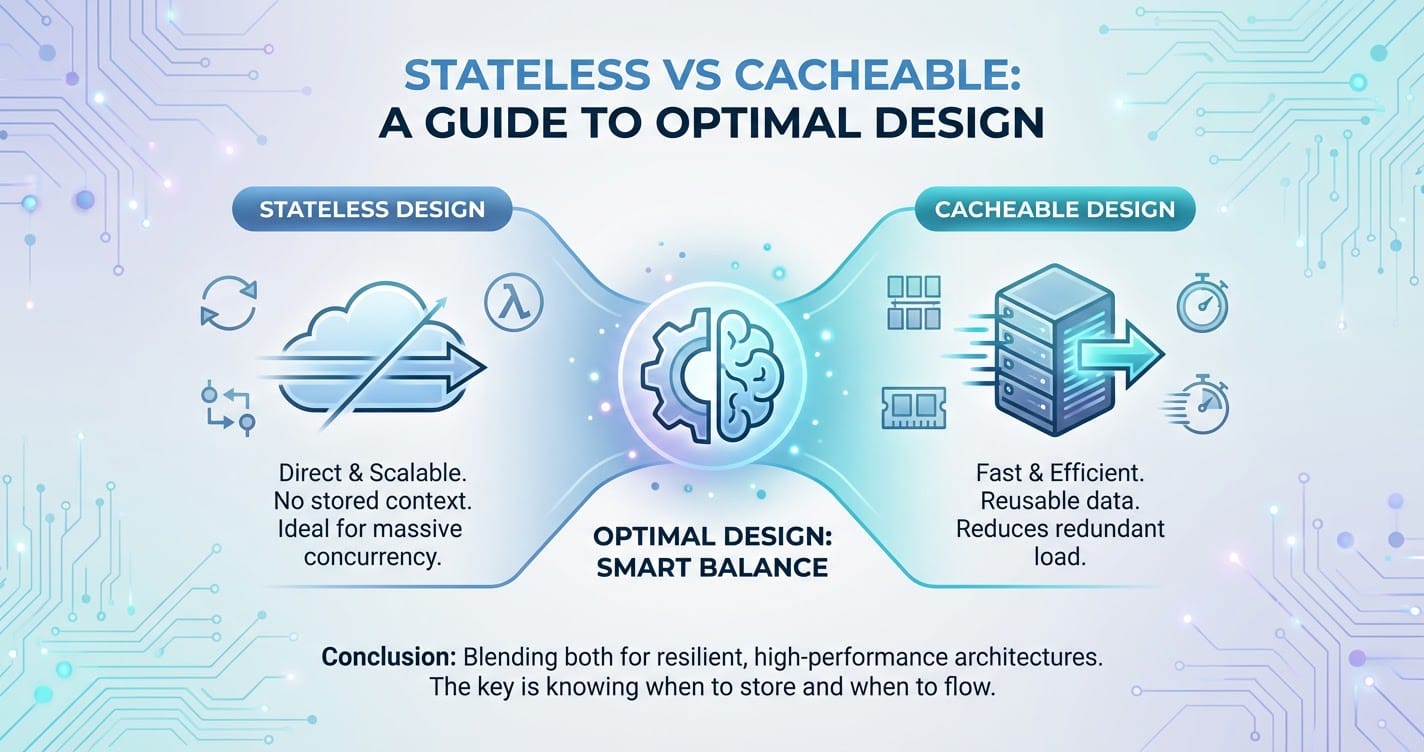
Stateless vs Cacheable: A Guide to Optimal Design


In the vast and intricate landscape of modern software architecture, where systems are expected to be infinitely scalable, resilient, and performant, two fundamental design paradigms frequently emerge as pillars of robust construction: statelessness and cacheability. These concepts, though distinct in their primary objectives, often work in concert to forge systems capable of meeting the rigorous demands of today's digital world. From microservices that power global applications to sophisticated AI Gateway solutions managing complex machine learning inferences, understanding the nuances of stateless design and the strategic application of caching is paramount for any architect or developer striving for optimal system performance, scalability, and maintainability. This comprehensive guide will delve deep into the principles, advantages, disadvantages, and practical applications of statelessness and cacheability, ultimately illustrating how their thoughtful combination can lead to truly optimal and future-proof system designs. We will explore their implications in various contexts, including the critical role they play in the efficiency of LLM Gateway and general gateway architectures, providing a blueprint for building high-performing, resilient, and cost-effective distributed systems.
The Foundation of Flexibility: Understanding Statelessness
At its core, a stateless system is one that does not store any client context on the server between requests. Each request from a client to the server contains all the necessary information for the server to fulfill that request, without relying on any previous interactions or session data stored on the server side. This fundamental principle is critical for building highly scalable and resilient applications, particularly in distributed environments. The server treats every request as an independent transaction, processing it based solely on the data provided within that request itself.
Defining Statelessness: A Deeper Dive
Imagine a conversation where every sentence you speak is a complete thought, independent of the preceding ones. A stateless server operates similarly. When a client sends a request—be it an API call, a web page request, or a database query—that request must carry all the data needed for the server to understand and act upon it. The server does not maintain any "memory" of previous requests from that particular client. This means that if a client sends a request, and then a subsequent request moments later, the server will process the second request without any knowledge or reliance on the state established by the first.
This stands in stark contrast to stateful systems, where the server retains information about a client's ongoing interaction, often in the form of sessions. In stateful systems, a client might log in once, and the server then remembers this authenticated state for subsequent requests, identifying the client by a session ID. While stateful systems can simplify certain interactions by reducing repetitive data transmission, they introduce significant complexity in distributed environments, particularly concerning scalability and fault tolerance.
The Immutable Advantages of Stateless Design
The benefits of embracing statelessness are numerous and profound, making it a cornerstone of modern system design:
- Exceptional Scalability: This is perhaps the most significant advantage. Because no client-specific data is stored on any particular server, any server in a pool can handle any request at any time. This allows for horizontal scaling – simply add more servers to handle increased load without worrying about transferring session data or maintaining sticky sessions. Load balancers can distribute incoming requests across all available servers indiscriminately, maximizing resource utilization and ensuring responsiveness even under heavy traffic. For an AI Gateway or an LLM Gateway, which might face unpredictable surges in requests for computationally intensive AI inferences, this ability to scale horizontally and dynamically is absolutely crucial.
- Enhanced Reliability and Fault Tolerance: In a stateless architecture, if a server fails, it doesn't lose any critical client-specific state. Other servers can immediately pick up subsequent requests without interruption, as each request is self-contained. This dramatically improves system resilience and simplifies recovery processes. There's no need for complex session replication or state synchronization mechanisms across multiple servers, which are common points of failure and performance bottlenecks in stateful systems.
- Simplified Development and Deployment: Stateless components are inherently simpler to reason about. Developers don't need to manage complex session states or worry about race conditions arising from concurrent modifications to shared state. This reduces debugging effort and makes component development more modular and independent. Deployment also becomes easier; any server can be restarted or replaced without impacting ongoing user sessions, facilitating continuous deployment practices.
- Improved Load Balancing Efficiency: Without the need for "sticky sessions" (where a client must always be routed to the same server that holds its session state), load balancers can distribute requests much more effectively across all available server instances. This leads to more even resource utilization and better overall system throughput. For a high-performance gateway handling millions of requests, efficient load balancing is non-negotiable.
- Easier Caching Integration: While seemingly contradictory at first glance, statelessness simplifies the integration of caching mechanisms. Since each request is independent, responses generated by a stateless service can often be cached at various layers (client, proxy, CDN) without concerns about stale server-side state. We will explore this synergy in detail later.
The Practical Hurdles of Statelessness
Despite its myriad advantages, stateless design is not without its considerations:
- Increased Request Payload Size: For every request, the client must send all necessary context, which might include authentication tokens, user preferences, or other relevant data. This can lead to slightly larger request sizes compared to stateful systems where such information might be implied by a session ID. However, with modern network bandwidths and efficient serialization formats, this overhead is often negligible for most applications.
- Potential for Redundant Processing: In scenarios where certain common data or computationally expensive results are frequently requested, a purely stateless server might re-process the same request logic multiple times. This is where caching becomes a vital complement, providing a layer to store and retrieve previously computed results, thus mitigating this potential inefficiency.
- State Management Delegation: Statelessness doesn't eliminate state; it merely delegates its management to other layers or services. Client-side storage (cookies, local storage), databases, or external distributed state stores (like Redis or Memcached) become responsible for persisting user-specific data. This requires careful consideration of data consistency, security, and the reliability of these external state managers.
Statelessness in Action: HTTP and REST
The most ubiquitous example of a stateless protocol is HTTP (Hypertext Transfer Protocol), the foundation of the World Wide Web. Every HTTP request (GET, POST, PUT, DELETE, etc.) is designed to be independent. When you browse a website, each time your browser requests a page, image, or script, it sends a full request to the server. The server processes it without remembering your previous clicks unless specific mechanisms (like cookies, which are client-side state managers) are employed to simulate session state.
RESTful APIs (Representational State Transfer) are another prime example. REST principles explicitly advocate for stateless communication between client and server. Resources are identified by URIs, and interactions are done through standard HTTP methods. The client holds the application state, not the server. This statelessness is a primary reason for REST's immense popularity in building scalable web services and microservices, where an AI Gateway or LLM Gateway often exposes AI capabilities as RESTful endpoints.
The Art of Efficiency: Understanding Cacheability
While statelessness addresses scalability and resilience, cacheability focuses squarely on performance and efficiency. Caching is the process of storing copies of data or computational results so that future requests for that data can be served faster than by re-computing or re-fetching the original data. It's a fundamental optimization technique employed at virtually every layer of a computing system, from CPU caches to Content Delivery Networks (CDNs).
Defining Cacheability: A Deeper Dive
A system or resource is "cacheable" if its data or the result of its computation can be stored temporarily and reused without needing to regenerate it for every subsequent request. The core idea is to trade off memory or storage space for reduced latency and computation time. When a request for a cached item comes in, the system first checks its cache. If the item is found (a "cache hit"), it's returned immediately. If not (a "cache miss"), the system fetches or computes the data from its original source, serves it to the client, and then stores a copy in the cache for future use.
The effectiveness of caching hinges on several factors:
- Data Access Patterns: Caching is most effective for frequently accessed data that changes infrequently.
- Latency of Original Source: The greater the latency or computational cost of fetching/generating the original data, the more beneficial caching becomes.
- Cache Size and Eviction Policies: The capacity of the cache and how it decides which items to remove when it's full (e.g., Least Recently Used (LRU), Least Frequently Used (LFU)) are crucial for performance.
- Cache Invalidation Strategy: Ensuring that cached data remains fresh and consistent with the original source is one of the most challenging aspects of caching.
The Performance Perks of Cacheable Design
Incorporating caching strategically yields significant benefits:
- Dramatic Performance Improvement (Reduced Latency): By serving data from a fast, local cache instead of a slower, remote origin (like a database or an external API), caching drastically reduces response times. This directly translates to a snappier user experience and improved throughput for systems. For an LLM Gateway serving repetitive prompts, caching could mean the difference between sub-second responses and several seconds of waiting for a complex model inference.
- Reduced Load on Origin Servers: Every cache hit means one less request to the origin server. This offloads a substantial amount of work from databases, application servers, and external services, allowing them to focus on unique or write-heavy operations. This can lead to significant cost savings in terms of infrastructure and operational expenses. An AI Gateway that intelligently caches common inference results or pre-computed embeddings can protect expensive AI models from unnecessary invocations.
- Improved System Stability and Resilience: By reducing the load on origin servers, caching helps prevent them from becoming overloaded and crashing. In scenarios where an origin server is temporarily unavailable or slow, a robust cache can continue serving stale (but still useful) data, acting as a buffer and improving overall system resilience.
- Lower Network Bandwidth Usage: When data is served from a local cache or a CDN edge node, it reduces the amount of data that needs to travel across the wider network. This can lower bandwidth costs and improve performance for geographically dispersed users.
The Intricacies and Challenges of Caching
While powerful, caching introduces its own set of complexities:
- Cache Invalidation (The Hard Problem): This is often cited as one of the two hardest problems in computer science. How do you ensure that cached data is always up-to-date with the source? Stale data can lead to incorrect application behavior or misleading information for users. Strategies include:
- Time-To-Live (TTL): Data expires after a set period.
- Version-based (ETags, Last-Modified): Clients and proxies can use these HTTP headers to conditionally revalidate cached resources.
- Event-driven Invalidation: The origin system explicitly signals caches to invalidate specific data when it changes.
- Write-through/Write-back: Different database caching strategies impacting consistency.
- Increased System Complexity: Implementing and managing caching adds layers to the architecture. Deciding where to cache, what to cache, for how long, and how to invalidate it requires careful thought and often introduces new components like dedicated cache servers (e.g., Redis, Memcached).
- Cache Coherency and Consistency: In distributed systems with multiple caches, ensuring all caches hold the same, consistent view of data can be extremely challenging. Different consistency models (strong, eventual) must be chosen based on application requirements.
- Cache Eviction Policies: When a cache reaches its capacity, it must decide which items to remove. Poor eviction policies can lead to "cache thrashing," where frequently needed items are constantly being removed and re-fetched, negating the benefits of caching.
Types of Caching in Distributed Systems
Caching can occur at various layers, each with its own scope and advantages:
- Client-Side Caching: Browsers cache web assets (HTML, CSS, JS, images) based on HTTP headers (Cache-Control, Expires). This is the fastest form of caching as it avoids network roundtrips.
- Proxy Caching: Intermediate proxies (like Nginx, Squid) or CDNs (Content Delivery Networks) cache responses closer to the user, reducing latency and offloading origin servers.
- Application-Level Caching: Within an application, frequently accessed data (e.g., configuration settings, user profiles, AI model weights) can be stored in memory or in local caches (e.g., Guava Cache in Java).
- Distributed Caching: For large-scale distributed systems, dedicated cache servers (like Redis, Memcached) provide a shared, scalable cache layer accessible by multiple application instances.
- Database Caching: Databases themselves employ various caching mechanisms (buffer pools, query caches) to speed up data retrieval.
The Synergy: Statelessness and Cacheability for Optimal Design
The true power of these two paradigms unfolds when they are strategically combined. Statelessness provides the foundational agility and horizontal scalability necessary for modern distributed systems, while cacheability injects the much-needed performance and efficiency. They are not opposing forces but complementary strategies.
How They Work Together
Consider a web application built on microservices, where a central gateway orchestrates requests to various backend services.
- Statelessness as the Enabler for Scaling: Each microservice is designed to be stateless. This allows any instance of a service to handle any request. When traffic increases, more instances of the service can be spun up, and a load balancer can distribute requests without concern for session affinity. This inherent scalability forms the bedrock.
- Cacheability as the Performance Accelerator: On top of this stateless foundation, caching layers are introduced.
- The browser caches static assets from the UI service.
- A CDN caches frequently accessed public content.
- The gateway itself might cache common responses from backend services to reduce latency and load.
- Within microservices, distributed caches might store database query results or the outputs of expensive computations.
For example, an AI Gateway that manages calls to various large language models (LLMs) and other AI services benefits immensely from this combination. The gateway itself can be designed to be stateless, allowing it to scale effortlessly to handle millions of requests from diverse clients. Each request to an LLM for a specific prompt can be treated as an independent operation. However, generating responses from LLMs can be computationally intensive and time-consuming. This is where cacheability becomes vital. If the LLM Gateway identifies that a common prompt is being repeatedly queried, it can cache the LLM's response for that prompt. Subsequent requests for the same prompt can then be served from the cache almost instantaneously, dramatically reducing latency, computational cost, and the load on the underlying LLM inference engines.
This synergistic approach means that the system can handle a massive number of unique, dynamic requests through its stateless design, while simultaneously accelerating responses for frequently accessed, idempotent operations through intelligent caching.
Design Patterns for Synergy
- Read-Heavy Workloads: Systems predominantly involved in retrieving data (e.g., social media feeds, product catalogs, read-only AI inference results) are prime candidates for extensive caching. The stateless nature of the backend services ensures they can handle a high volume of reads, while aggressive caching at multiple layers significantly reduces the load and improves response times.
- Write-Heavy Workloads: While writes are generally harder to cache due to consistency concerns, statelessness is still paramount. Write operations must be handled by stateless services that can be scaled to absorb high transaction volumes. Caching might still be applied to read-after-write operations with appropriate invalidation strategies or eventual consistency models.
- Idempotent Operations: Operations that produce the same result regardless of how many times they are performed (e.g.,
GETrequests, orPUTrequests that update a resource to a specific state) are excellent candidates for caching. A stateless API design naturally encourages idempotent operations, which simplifies caching.
Challenges and Trade-offs in Combining Them
While powerful, combining statelessness and cacheability effectively requires careful navigation of inherent challenges:
- Cache Coherency in Distributed Stateless Systems: Ensuring that all distributed caches eventually reflect the most current state of data, especially when updates occur in a stateless service, is complex. Strategies like write-through caching, cache invalidation messages (pub/sub), or time-to-live (TTL) expiration policies need to be chosen and implemented carefully.
- Balancing Performance vs. Data Freshness: Aggressive caching leads to better performance but increases the risk of serving stale data. A less aggressive caching strategy ensures fresher data but might lead to higher latency and increased load. The optimal balance depends entirely on the specific requirements of the application. For real-time stock tickers, freshness is paramount; for static blog posts, staleness is less critical.
- Complexity of Cache Management: A multi-layered caching strategy, while powerful, introduces significant operational complexity. Monitoring cache hit ratios, managing invalidation events, and scaling cache infrastructure all require dedicated attention.
- Security Considerations: Caching sensitive user data, even temporarily, requires robust security measures to prevent unauthorized access. Authentication tokens or user-specific data passed in stateless requests should not be blindly cached without careful consideration of scope and expiry.
APIPark is a high-performance AI gateway that allows you to securely access the most comprehensive LLM APIs globally on the APIPark platform, including OpenAI, Anthropic, Mistral, Llama2, Google Gemini, and more.Try APIPark now! 👇👇👇
Practical Applications and Implementation Strategies
Let's examine how these principles manifest in real-world scenarios, particularly within the context of API management and AI infrastructure.
API Design: Crafting Robust and Efficient Interfaces
- RESTful Principles and HTTP Caching: Adhering to REST principles naturally leads to stateless API designs. Leveraging HTTP caching headers (
Cache-Control,Expires,ETag,Last-Modified) allows clients, proxies, and CDNs to cache API responses effectively. For instance, aGET /products/123request can includeCache-Control: public, max-age=3600, instructing intermediaries to cache the response for one hour. If the product data doesn't change frequently, this significantly reduces the load on the product service. - Idempotency: Designing APIs to be idempotent is crucial for statelessness and caching. A
PUTrequest to update a user's profile should yield the same result whether it's called once or multiple times. This simplifies retries and prevents unintended side effects in a distributed, stateless environment. - API Versioning: How APIs are versioned can impact caching. Changing an API version often means existing cached responses for the old version are no longer valid for the new, requiring careful invalidation or a strategy of parallel deployment.
Microservices Architecture: Decentralized Powerhouses
In a microservices world, individual services are often stateless to maximize their independence and scalability.
- Service Discovery and Load Balancing: Stateless services can be registered with a service discovery mechanism (e.g., Consul, Eureka) and easily scaled up or down. Load balancers (e.g., Nginx, Envoy) can then distribute requests uniformly, without concern for state.
- Distributed Caching Solutions: Services often rely on external distributed caches (e.g., Redis, Memcached) for shared, high-speed data access. Instead of each microservice managing its own in-memory cache, they can use a central, resilient cache layer for common data or session management (where sessions are stored externally, not on the microservice instance).
Cloud-Native Environments: Embracing Ephemeral Infrastructure
Cloud platforms strongly favor stateless architectures.
- Containerization (Docker, Kubernetes): Containers are typically designed to be immutable and stateless. If a container needs to be restarted or scaled, a new identical instance can be brought up without losing state specific to that container, as any persistent state is externalized (e.g., mounted volumes, external databases).
- Serverless (AWS Lambda, Azure Functions): Serverless functions are inherently stateless. Each invocation is an independent event, making them ideal for high-scale, event-driven architectures where caching might occur at the API Gateway layer or within an external data store.
AI/ML Workloads and Gateways: Specialized Optimizations
This is where the concepts of statelessness and cacheability become particularly impactful, especially for an AI Gateway or an LLM Gateway.
- Compute-Intensive Inference: AI model inference, especially with large models like LLMs, can be very resource-intensive and time-consuming. A purely stateless model server would re-compute every request from scratch.
- The Role of the Gateway: An AI Gateway or LLM Gateway serves as the critical intermediary between client applications and the underlying AI models. This gateway can leverage both statelessness for scale and cacheability for performance.This is where a product like ApiPark demonstrates its value. As an open-source AI Gateway and API management platform, APIPark is designed to simplify the integration and deployment of AI and REST services. By providing features like quick integration of over 100 AI models and a unified API format for AI invocation, it inherently supports a stateless design for consuming diverse AI capabilities. Furthermore, its ability to encapsulate prompts into REST APIs allows for the creation of standardized, cacheable endpoints for AI functionalities like sentiment analysis or data extraction. For instance,
APIPark's performance rivaling Nginx (achieving over 20,000 TPS with modest hardware) speaks directly to its highly optimized, likely stateless, architecture, enabling efficient request handling. This allows organizations to run their AI services at scale. Additionally,APIPark's detailed API call logging and powerful data analysis features are invaluable for identifying frequently accessed AI prompts or patterns that are ideal candidates for caching, and for monitoring the effectiveness of these caching strategies. Its end-to-end API lifecycle management capabilities also assist in regulating API management processes, including traffic forwarding, load balancing, and versioning of published APIs, all of which benefit from stateless underlying services and strategic caching.- Stateless Gateway: The gateway itself can be stateless, allowing it to easily scale horizontally to handle a massive influx of API calls to various AI services. Its primary job is routing, authentication, and rate limiting, none of which strictly require per-request server-side state.
- Caching AI Responses: The gateway can implement intelligent caching for AI inference results. For instance, if a common prompt for an LLM is received multiple times within a short period, the LLM Gateway can cache the response. Subsequent requests for the same prompt can then be served directly from the cache, bypassing the expensive LLM inference engine. This drastically reduces latency, improves user experience, and significantly cuts down on GPU compute costs. The decision of what to cache (e.g., exact prompts, common entities recognized by an NLU model) and how long (e.g., based on the volatility of the underlying data or model updates) becomes a critical design choice for the AI Gateway.
- Prompt/Query Standardisation: A key feature for caching in an LLM Gateway is the ability to standardize prompts. If different clients send slightly varied prompts that essentially ask the same question, the gateway might normalize them before querying the LLM, increasing the cache hit rate. This unified API format, as offered by an AI Gateway like APIPark, can simplify caching strategies significantly.
Advanced Considerations and Future Trends
The landscape of system design is ever-evolving, and so are the applications of statelessness and cacheability.
Edge Caching and CDNs
As systems become more globally distributed, edge caching and Content Delivery Networks (CDNs) are becoming indispensable. CDNs are essentially vast networks of proxy caches strategically located around the world. By caching static and even dynamic content closer to the end-users (the "edge"), they dramatically reduce latency and offload origin servers, embodying both stateless routing and pervasive caching.
Serverless Architectures
Serverless computing thrives on statelessness. Functions (like AWS Lambda) are ephemeral; they execute, return a result, and then often disappear. Any persistent state must be managed externally in databases, object storage, or managed cache services. This forces developers into a stateless mindset, which naturally aligns with scalability and cost efficiency in the cloud.
GraphQL vs. REST: Caching Challenges
While REST, with its resource-based structure and HTTP methods, aligns well with caching, GraphQL presents a different challenge. GraphQL queries are often highly dynamic and can request arbitrary combinations of data. This makes traditional HTTP caching more difficult. Client-side GraphQL caches often operate on an entity-by-entity basis rather than full query responses, requiring more sophisticated client-side logic to manage.
Observability for Caching and Stateless Systems
Understanding the performance and behavior of stateless and cached systems requires robust observability. Monitoring cache hit/miss ratios, cache eviction rates, latency metrics for both cached and uncached requests, and the health of individual stateless service instances is crucial. Tools that provide detailed API call logging and data analysis, such as those found in APIPark, become invaluable for pinpointing bottlenecks, verifying caching effectiveness, and ensuring optimal system operation. This level of insight allows businesses to perform preventive maintenance and optimize their AI workloads more effectively.
Conclusion: Crafting Optimal Systems with Intentional Design
In the complex symphony of modern software architecture, statelessness and cacheability stand as two distinct yet harmonious movements. Statelessness provides the foundational rhythm of scalability, resilience, and simplicity, enabling systems to expand effortlessly and withstand failures without losing their stride. Cacheability, on the other hand, introduces the melody of performance, dramatically reducing latency and offloading computational burden, allowing systems to sing with unparalleled efficiency.
An optimal design is rarely one that adheres rigidly to one principle to the exclusion of the other. Instead, it is a thoughtful, strategic synthesis. It understands that a highly scalable, stateless gateway — be it a general API gateway, an AI Gateway, or a specialized LLM Gateway — serves as the perfect canvas upon which intelligent caching layers can be painted. The stateless nature of the core services ensures that resources are always available and interchangeable, while the judicious application of caching ensures that frequently requested data or computationally expensive results are delivered with lightning speed.
Navigating the trade-offs between data freshness and performance, managing cache invalidation, and establishing robust observability are the challenges that define mastery in this domain. By embracing these principles, leveraging modern tools and platforms like ApiPark for streamlined API management and AI integration, and continuously analyzing system behavior, architects and developers can construct systems that are not only performant and scalable but also resilient, maintainable, and adaptable to the ever-evolving demands of the digital age. The journey towards optimal design is continuous, but with statelessness and cacheability as guiding stars, the path becomes clearer, leading to more robust, efficient, and user-centric applications.
Frequently Asked Questions (FAQs)
1. What is the fundamental difference between a stateless and a stateful system? A stateless system does not store any client-specific information on the server between requests; each request contains all necessary context. Conversely, a stateful system maintains client session data on the server, relying on previous interactions to process subsequent requests. Stateless systems are generally easier to scale horizontally and offer better fault tolerance, while stateful systems can sometimes simplify interaction patterns by reducing redundant data transmission.
2. Why is statelessness so important for cloud-native and microservices architectures? Statelessness is crucial for cloud-native and microservices architectures because it enables horizontal scalability, resilience, and independent deployment. In these environments, services are often containerized and dynamically scaled. If a service is stateless, any instance can handle any request, allowing load balancers to distribute traffic efficiently and ensuring that server failures do not lead to data loss or session disruption, as state is externalized to databases or distributed caches.
3. How does caching interact with statelessness, and can they be used together? Yes, statelessness and cacheability are highly complementary. Statelessness allows for easy horizontal scaling of backend services, ensuring high availability and throughput. Caching then enhances this by reducing the load on these stateless services and improving response times for frequently accessed data or computationally expensive operations. A stateless system can produce responses that are easily cacheable at various layers (client, proxy, gateway), optimizing overall performance without reintroducing server-side state.
4. What are some common challenges when implementing caching in a distributed system? The most significant challenge is cache invalidation – ensuring that cached data remains consistent with the original source when changes occur. Other challenges include managing cache coherency across multiple distributed caches, selecting appropriate cache eviction policies, determining the optimal Time-To-Live (TTL) for cached items, and handling the increased operational complexity of monitoring and maintaining the cache infrastructure.
5. How do AI Gateways and LLM Gateways leverage statelessness and caching for optimal performance? AI Gateways and LLM Gateways are designed to be largely stateless themselves, allowing them to scale horizontally to manage high volumes of API requests to AI models without retaining client-specific session data on the gateway instances. They then strategically apply caching for computationally intensive AI inference results. For instance, if the same prompt is frequently sent to an LLM, the LLM Gateway can cache the response. This drastically reduces the load on the expensive AI models, lowers latency for clients, and cuts down on inference costs by serving identical requests from the cache instead of re-running the model. Products like ApiPark exemplify this by offering high-performance, scalable API management for AI services, complemented by features that enable intelligent caching strategies and provide insights into their effectiveness.
🚀You can securely and efficiently call the OpenAI API on APIPark in just two steps:
Step 1: Deploy the APIPark AI gateway in 5 minutes.
APIPark is developed based on Golang, offering strong product performance and low development and maintenance costs. You can deploy APIPark with a single command line.
curl -sSO https://download.apipark.com/install/quick-start.sh; bash quick-start.sh

In my experience, you can see the successful deployment interface within 5 to 10 minutes. Then, you can log in to APIPark using your account.

Step 2: Call the OpenAI API.