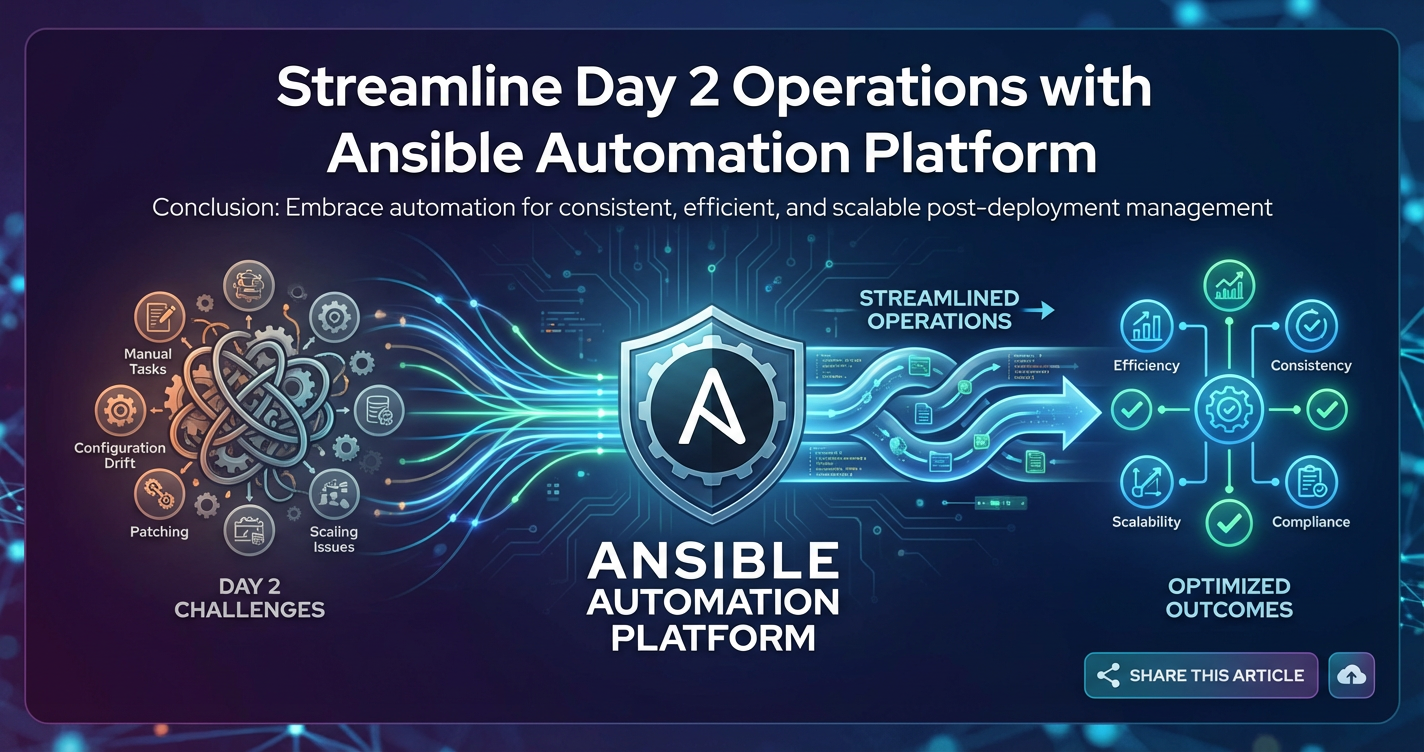
Streamline Day 2 Operations with Ansible Automation Platform


The modern IT landscape is a pulsating, ever-evolving ecosystem where the initial triumph of deploying a new application or infrastructure component quickly gives way to the enduring challenge of its sustained operation. This subsequent phase, often referred to as "Day 2 Operations," encompasses everything that happens after the initial rollout: monitoring, maintenance, patching, scaling, security, compliance, and optimization. While Day 1 operations focus on provisioning and deployment, Day 2 operations are about ensuring continuous stability, performance, and efficiency in a world where downtime is costly and change is constant. In this complex environment, manual processes are no longer merely inefficient; they are a significant liability, fostering errors, increasing costs, and hindering agility.
Enter Ansible Automation Platform (AAP), a comprehensive, enterprise-grade solution designed to revolutionize how organizations approach Day 2 operations. AAP transcends the traditional scripting approach, offering a powerful, agentless, and human-readable automation engine that can orchestrate workflows across diverse IT domains—from bare metal servers and virtual machines to cloud instances, network devices, and container platforms. This article will delve deeply into how Ansible Automation Platform empowers organizations to not just manage but truly streamline their Day 2 operations, transforming reactive firefighting into proactive, intelligent, and scalable automation. We will explore its foundational principles, key features, specific use cases, and best practices, demonstrating how it acts as the cornerstone for operational excellence in an increasingly automated world.
Understanding the Intricacies of Day 2 Operations: A Labyrinth of Challenges
Before we unpack Ansible Automation Platform's capabilities, it's crucial to fully grasp the multifaceted challenges that define Day 2 operations. These aren't isolated issues but interconnected hurdles that can severely impact an organization's bottom line, security posture, and ability to innovate.
The Challenge of Scale and Complexity
Modern IT environments are rarely monolithic. They are typically hybrid, multi-cloud, and distributed, comprising a heterogeneous mix of operating systems, applications, databases, network devices, and specialized infrastructure. As organizations grow, so does the sheer volume and diversity of their infrastructure. Manually managing hundreds or thousands of servers, intricate network configurations, and a sprawling array of applications becomes an impossible task, prone to inconsistencies and errors. Each new service, such as a specialized api gateway routing traffic or an AI Gateway facilitating access to machine learning models, adds another layer of complexity that must be meticulously configured, secured, and maintained. Without automation, the operational overhead can quickly become unsustainable.
Cost Pressures: The Relentless Burden of OpEx
Operational expenditure (OpEx) related to Day 2 activities can be staggering. A significant portion of IT budgets is often consumed by manual labor for routine tasks like patching, monitoring, troubleshooting, and compliance reporting. The cost isn't just in staff salaries; it extends to the economic impact of human error, which can lead to outages, security breaches, and prolonged downtime. Investing in automation is a strategic move to reduce these ongoing operational costs, freeing up valuable human capital to focus on innovation rather than repetitive, low-value tasks.
Security and Compliance Mandates: Constant Vigilance
In an era of increasing cyber threats and stringent regulatory requirements (GDPR, HIPAA, PCI DSS, etc.), security and compliance are non-negotiable. Day 2 operations demand continuous vigilance. Systems must be regularly patched, configurations audited against security baselines, access controls enforced, and every change meticulously documented. Manual security checks are often infrequent, inconsistent, and error-prone, leaving organizations vulnerable to exploits and hefty fines. The complexity further escalates when dealing with specialized components that handle sensitive data or processes, such as the robust security configurations required for an api gateway or ensuring secure access to an LLM Gateway.
Drift and Inconsistency: The Erosion of Stability
Configuration drift is an insidious problem in Day 2 operations. Over time, servers and services that were once identically configured begin to diverge due to manual changes, hotfixes, or human oversight. This drift leads to inconsistent environments, making troubleshooting a nightmare and undermining the reliability of applications. An application that works perfectly in a staging environment might fail unexpectedly in production because of a subtle configuration difference. Maintaining a desired state across the entire infrastructure is a perpetual battle without robust automation.
Skill Gaps and Burnout: The Human Factor
The rapid pace of technological advancement means IT teams are constantly learning new tools and technologies. A single administrator might be responsible for Linux, Windows, virtualization, cloud platforms, networking, and security. This breadth of responsibility, coupled with repetitive manual tasks, can lead to skill gaps in specialized areas and, critically, staff burnout. Automation alleviates this pressure by codifying operational knowledge, standardizing procedures, and reducing the need for constant, manual intervention in routine tasks.
Reactive vs. Proactive Management: Shifting Paradigms
Traditional Day 2 operations often operate in a reactive mode: waiting for an alert to trigger, then scrambling to diagnose and fix the problem. This "firefighting" approach is stressful, inefficient, and disruptive. The goal of modern Day 2 operations is to shift towards a proactive stance, where automation anticipates issues, enforces desired states, and even self-heals, preventing problems before they impact users. This transformation is pivotal for maintaining high availability and a positive user experience.
These interconnected challenges underscore the critical need for a powerful, flexible, and scalable automation solution that can address the full spectrum of Day 2 operational demands.
Ansible Automation Platform: The Cornerstone for Day 2 Success
Ansible Automation Platform (AAP) is not just another automation tool; it’s a strategic platform designed to address the complexities of Day 2 operations head-on. It extends beyond the capabilities of the open-source Ansible Engine by providing a hardened, supported, and scalable framework for managing automation at an enterprise level.
What is Ansible Automation Platform?
AAP is a robust suite of tools that includes: * Automation Controller (formerly Ansible Tower): A web-based UI and REST API for managing, controlling, and monitoring Ansible automation. It provides role-based access control (RBAC), auditing, scheduling, and centralized logging, crucial for enterprise-scale operations. * Private Automation Hub: A centralized repository for managing and sharing Ansible content, including Collections, roles, and modules, both custom and Red Hat-provided. It ensures consistency, version control, and security for automation assets. * Automation Mesh: A distributed architecture that allows automation to scale across diverse environments, from data centers to edge locations, providing resiliency and localized execution. * Execution Environments: Containerized, portable, and reproducible environments for running Ansible playbooks, ensuring consistent execution results regardless of where the automation is run. * Ansible Content Collections: Pre-built, opinionated sets of Ansible content (playbooks, roles, modules, plugins) that provide reusable automation for specific domains or technologies, simplifying complex tasks.
Key Principles of Ansible: Fueling Day 2 Efficiency
At its core, Ansible's effectiveness stems from several foundational principles: * Simplicity and Readability: Ansible uses YAML, a human-readable data serialization language, for its playbooks. This makes automation logic easy to understand, even for those not deeply entrenched in scripting, fostering collaboration across IT teams (SysAdmins, Network Engineers, Developers). * Agentless Architecture: Unlike many other automation tools, Ansible operates agentlessly. It communicates with managed nodes (servers, network devices, cloud APIs) over standard SSH or WinRM protocols, eliminating the need to install and maintain agents on every target system. This reduces overhead, simplifies deployment, and minimizes the attack surface. * Declarative Language: Ansible playbooks describe the desired state of a system rather than a sequence of imperative steps. You tell Ansible what you want the system to look like, and it figures out how to get there. This makes automation more robust and easier to manage. * Idempotency: A core tenet of Ansible is that running a playbook multiple times will result in the same system state without causing unintended side effects. If a resource is already in the desired state, Ansible will take no action. This is invaluable for Day 2 operations, ensuring consistency and preventing configuration drift.
Bridging the Gap: AAP's Impact on Day 2 Problems
Ansible Automation Platform effectively bridges the gap between the complex realities of Day 2 operations and the need for simplified, scalable management. By centralizing automation, providing robust control mechanisms, and offering a human-friendly approach to complex tasks, AAP allows organizations to: * Standardize Processes: Enforce consistent configurations, security policies, and deployment procedures across the entire infrastructure. * Reduce Human Error: Automate repetitive tasks, eliminating manual mistakes that often lead to outages or security vulnerabilities. * Increase Agility and Speed: Accelerate IT processes, from infrastructure provisioning to application updates, enabling faster response to business needs. * Enhance Security and Compliance: Proactively enforce security baselines, automate vulnerability management, and provide comprehensive audit trails. * Improve Operational Efficiency: Reduce time spent on routine tasks, allowing IT teams to focus on strategic initiatives and innovation.
In essence, AAP transforms Day 2 operations from a manual, reactive struggle into a streamlined, proactive, and highly efficient workflow, empowering IT teams to deliver reliable services consistently.
Key Pillars of Ansible Automation for Day 2 Operations
Ansible Automation Platform's versatility allows it to address virtually every aspect of Day 2 operations. Let's explore the critical pillars where AAP delivers transformative value.
A. Infrastructure Provisioning and Configuration Management
Maintaining a consistent and well-configured infrastructure is fundamental to stable Day 2 operations. Ansible excels here, ensuring that environments remain homogeneous and adhere to defined standards from initial deployment onwards.
Homogeneous Environments and Scalability
Ansible enables organizations to define infrastructure configurations as code, meaning servers, network devices, and cloud resources are provisioned and configured in a repeatable, consistent manner. Whether spinning up virtual machines, deploying cloud instances (AWS EC2, Azure VMs, Google Cloud instances), or configuring container hosts, Ansible playbooks ensure that every resource adheres to the golden image and configuration standards. This eliminates the "snowflake server" syndrome, where each server is unique and hard to manage, significantly reducing troubleshooting time and improving reliability. When scaling out, new resources are automatically configured to match existing ones, ensuring seamless integration and performance.
Managing Network Infrastructure
Modern networks are incredibly complex, and manual configuration of switches, routers, firewalls, and load balancers is a common source of errors and security vulnerabilities. Ansible provides a powerful array of network modules that can automate tasks such as: * VLAN creation and assignment. * Firewall rule management across multiple vendors. * Load balancer configuration for optimal traffic distribution. * OS upgrades and patch management for network devices. Crucially, Ansible can automate the deployment and configuration of api gateways. These gateways are often the first point of contact for external services and applications, routing traffic, enforcing security policies, and managing API versions. An Ansible playbook can ensure an api gateway is correctly deployed, its routing rules are meticulously configured to direct traffic to the right backend services, its security policies are robustly applied (e.g., rate limiting, authentication), and its load-balancing settings are optimized. This automation ensures that the gateway functions reliably, providing a secure and performant interface for critical applications.
Operating Systems and Middleware
Beyond network devices, Ansible is a workhorse for managing operating systems (Linux, Windows) and middleware (web servers, application servers, databases). It automates tasks such as: * Installation and configuration of software packages. * User and group management, including SSH key deployment. * Service management (starting, stopping, restarting services). * File system and directory management. * Applying patches and security updates consistently across fleets of servers, a vital Day 2 activity.
By codifying these configurations, Ansible enforces a desired state, automatically correcting any drift and ensuring that every system maintains its intended configuration, bolstering reliability and security.
B. Compliance and Security Automation
Security is not a feature; it's a continuous process, especially in Day 2 operations. Ansible Automation Platform provides the tools to embed security and compliance into every operational workflow, shifting from reactive audits to proactive enforcement.
Proactive Compliance Audits and Automated Remediation
Organizations face immense pressure to comply with various regulatory standards and internal security policies. Ansible playbooks can automatically audit system configurations against predefined security baselines (e.g., CIS benchmarks, STIGs, ISO 27001). For instance, a playbook can check if specific ports are closed, if password policies are enforced, or if critical services are running with appropriate permissions. When deviations are identified, Ansible doesn't just report them; it can automatically remediate them. This capability transforms compliance from a periodic, labor-intensive audit into a continuous, automated process. This drastically reduces the window of vulnerability and ensures a continuously compliant posture, providing audit trails for every automated action.
Vulnerability Management and Patching
Patch management is a tedious but critical Day 2 task. Ansible automates the entire lifecycle of vulnerability management: * Discovery: Integrating with vulnerability scanners to identify systems requiring patches. * Staging and Testing: Orchestrating patch deployment in test environments before production. * Deployment: Rolling out patches across heterogeneous systems (Linux, Windows) in a controlled and consistent manner, minimizing downtime. * Verification: Confirming that patches were successfully applied and systems are functioning correctly. This automated approach ensures that systems are kept up-to-date with the latest security fixes, significantly reducing the attack surface.
Role-Based Access Control (RBAC) and Secrets Management
Within AAP, the Automation Controller provides granular Role-Based Access Control (RBAC). This ensures that only authorized personnel can execute specific automation tasks or access sensitive resources. For instance, a developer might be allowed to deploy their application, but only a security engineer can run a playbook that modifies firewall rules or accesses sensitive credentials. For managing credentials and other sensitive data, Ansible integrates seamlessly with external secrets management tools like HashiCorp Vault, CyberArk, or cloud key management services. This ensures that sensitive information—like database passwords, API keys, or credentials for an AI Gateway or LLM Gateway—is never stored in plain text within playbooks. When an automation task needs to interact with an AI Gateway to fetch model responses or connect to an LLM Gateway to leverage large language models, Ansible securely retrieves the necessary API keys or tokens from the vault at runtime, protecting them from unauthorized exposure and enhancing the overall security posture of AI-driven applications. This layered approach ensures that automation itself is secure and that the credentials it uses are protected throughout the Day 2 operational lifecycle.
C. Application Deployment and Lifecycle Management
After infrastructure is provisioned and secured, applications must be deployed and continuously updated. Ansible Automation Platform provides the consistency and control needed for reliable application lifecycle management in Day 2.
Standardized and Repeatable Deployments
Ansible ensures that applications are deployed consistently across all environments (development, testing, staging, production). Playbooks define the precise steps for deploying an application, including installing dependencies, configuring application servers, setting up database connections, and configuring front-end web servers. This eliminates environmental discrepancies that often cause "works on my machine" issues and ensures that deployments are repeatable and reliable, regardless of who initiates them.
Rollbacks and Updates
Day 2 operations invariably involve application updates and, occasionally, the need for rollbacks. Ansible automates both with precision. Playbooks can be designed to perform rolling updates, gradually deploying new versions across a fleet of servers while ensuring service continuity. If an issue arises during an update, Ansible can automate the rollback process, reverting systems to a previous, stable version with minimal downtime. This capability is crucial for maintaining high availability and minimizing the impact of unforeseen problems. For applications that interact with external services or expose their own, Ansible can manage the deployment of application components that might reside behind an api gateway or consume services from an AI Gateway. It can ensure the application's configuration correctly points to these gateways, and that any necessary firewall rules or network paths are open for seamless communication, making the entire application delivery chain robust.
Container and Kubernetes Management
In containerized environments, Ansible extends its reach to manage Kubernetes clusters and deploy containerized applications. It can: * Provision and configure Kubernetes clusters (e.g., using kubeadm or cloud-managed services). * Deploy Kubernetes manifests for applications, services, and ingresses. * Manage persistent storage for containers. * Automate scaling operations for pods and deployments. This integration allows organizations to use a single automation platform for both traditional and cloud-native infrastructure, streamlining Day 2 operations across their entire IT estate.
D. Incident Response and Remediation
When incidents inevitably occur, speed and accuracy in response are paramount. Ansible Automation Platform transforms reactive firefighting into proactive, automated incident management.
Automated Diagnostics and Self-Healing Infrastructure
Upon receiving an alert from a monitoring system (e.g., "CPU utilization high," "disk space low," "service down"), Ansible can be triggered to automatically run diagnostic playbooks. These playbooks can gather critical information: system logs, process lists, network statistics, and resource utilization data. This automated data collection significantly reduces the Mean Time To Identify (MTTI) the root cause. Furthermore, for common and well-understood issues, Ansible can enable self-healing infrastructure. For example, if a non-critical service crashes, an Ansible playbook could be triggered to automatically restart it. If a disk approaches its capacity, Ansible could trigger an automated cleanup of temporary files or a request for additional storage. This proactive remediation minimizes service disruption and frees up human operators from repetitive, low-level incident resolution.
Orchestrated Runbooks
Ansible Automation Platform allows IT teams to codify incident response procedures into "orchestrated runbooks." These are sequences of automated tasks designed to address specific types of incidents consistently and efficiently. Instead of relying on manual checklists and individual expertise, an orchestrated runbook ensures that every step of the incident response (e.g., diagnose, notify, attempt fix, escalate) is executed flawlessly, every time. This not only reduces errors but also significantly improves the Mean Time To Resolution (MTTR), bringing services back online faster.
E. Orchestration of Complex Workflows
The true power of Ansible Automation Platform in Day 2 operations lies in its ability to orchestrate complex, multi-step workflows that span disparate IT domains and tools.
Cross-Domain Automation
Modern IT tasks rarely confine themselves to a single domain. Provisioning a new application often involves: 1. Spinning up a virtual machine (compute). 2. Configuring network interfaces and firewall rules (network). 3. Allocating storage (storage). 4. Installing an operating system (OS). 5. Deploying middleware and the application itself (application). 6. Integrating with a ticketing system (ITSM). Ansible's ability to automate across compute, network, storage, security, and cloud infrastructure with a single, consistent language is a game-changer. It acts as the central nervous system for IT operations, orchestrating these disparate tasks into a single, cohesive workflow. This unification simplifies management, reduces integration overhead, and eliminates silos between different IT teams.
End-to-End Service Delivery
From a Day 2 perspective, this means automating the entire lifecycle of a service. For example, onboarding a new employee could involve: * Creating user accounts in Active Directory. * Provisioning a new laptop with standard software. * Setting up access to various applications and resources, including VPN access and access to internal dashboards that might draw data through an api gateway. All these steps, often managed by different teams, can be orchestrated by a single Ansible workflow, ensuring consistency and drastically reducing the time it takes to onboard new staff or deploy new services.
Integration with IT Service Management (ITSM)
Ansible Automation Platform integrates seamlessly with existing IT Service Management (ITSM) tools like ServiceNow, Jira, and Remedy. This allows automation to be triggered directly from service requests or incident tickets. For example, a user requesting a new server via an ITSM portal can have that request automatically fulfilled by an Ansible playbook, with all status updates pushed back to the ITSM system. This closes the loop between self-service and automated fulfillment, creating a truly efficient and auditable operational process.
By mastering the orchestration of complex workflows, AAP elevates Day 2 operations from a series of disjointed tasks into a strategically managed, highly efficient, and integrated service delivery engine.
Deep Dive into Specific Day 2 Use Cases with AAP
To illustrate the tangible impact of Ansible Automation Platform, let's examine specific, real-world Day 2 use cases where its capabilities shine.
Multi-Cloud Resource Management
The proliferation of hybrid and multi-cloud strategies introduces significant management complexity. Each cloud provider (AWS, Azure, GCP) has its own APIs, console, and management paradigms. Manually managing resources across these disparate environments is a recipe for inconsistency and error. Ansible provides cloud-specific modules that allow organizations to: * Provision Instances: Spin up virtual machines or containers consistently across different clouds using a single playbook. * Manage Networking: Configure Virtual Private Clouds (VPCs), subnets, security groups, and route tables in a cloud-agnostic manner. * Administer Storage: Create and attach block storage, manage object storage buckets, and configure backup policies across clouds. * Enforce Security Policies: Ensure consistent security group rules or network access control lists (NACLs) are applied to instances regardless of their cloud location. This unified approach reduces operational overhead, ensures policy adherence, and provides consistent Day 2 management across the entire multi-cloud footprint.
Database Operations
Databases are the backbone of most applications, and their Day 2 operations are critical yet often complex and sensitive. Ansible can automate a wide range of database tasks for various platforms (e.g., MySQL, PostgreSQL, Oracle, SQL Server): * Patching and Upgrades: Automate the application of security patches and minor version upgrades, including pre-checks, backup, actual update, and post-checks. * Backup and Recovery: Schedule and execute automated database backups, ensuring data integrity and facilitating quick recovery in case of failure. * Replication Setup: Configure database replication (master-slave, active-passive) for high availability and disaster recovery purposes. * User and Permission Management: Standardize the creation of database users, assign specific roles, and manage access permissions according to security policies. * Performance Tuning: Automate the modification of database configuration parameters based on performance monitoring insights. By automating these tasks, Ansible reduces the risk of human error in critical database operations, ensures data consistency, and frees up DBAs for more strategic work.
Network Automation
Network devices, as mentioned, are a crucial part of the infrastructure. Beyond basic api gateway configuration, Ansible's network automation capabilities delve deeper into: * VLAN Configuration: Automate the creation, modification, and deletion of VLANs across multiple switches, ensuring network segmentation. * Firewall Rule Management: Consistently apply and update firewall rules across multiple devices, adhering to security policies and compliance requirements. * Load Balancer Setup: Configure and modify load balancer pools, virtual servers, and health monitors to ensure application availability and performance. * Routing Protocol Configuration: Automate the setup and management of dynamic routing protocols like OSPF or BGP. This level of network automation removes manual intervention from often error-prone network changes, leading to greater stability, security, and agility in network operations.
Security Operations
Beyond compliance and patching, Ansible supports a broader range of security operations: * Implementing Least Privilege: Automate the enforcement of least privilege access by configuring user permissions, Sudo rules, and application access controls. * Intrusion Detection System (IDS) / Intrusion Prevention System (IPS) Configuration: Automate the deployment and configuration of IDS/IPS rules and policies across network devices and servers. * Certificate Management: Automate the deployment, renewal, and revocation of SSL/TLS certificates across web servers and load balancers, preventing certificate expiry-related outages. * Log Management Configuration: Ensure that all systems are configured to send logs to a centralized logging solution (e.g., ELK Stack, Splunk), critical for security monitoring and forensics. These automated security measures enhance an organization's defense posture, allowing for faster response to emerging threats and ensuring continuous security hygiene.
Leveraging Automation for AI/ML Workloads
While Ansible itself is not an AI tool, it is instrumental in managing the foundational infrastructure that supports AI and Machine Learning (ML) workloads. The efficient operation of AI/ML pipelines in Day 2 depends heavily on robust infrastructure management. Ansible can automate the provisioning and configuration of specialized compute environments required for AI/ML, such as: * GPU-Accelerated Instances: Deploying and configuring servers with NVIDIA GPUs or other accelerators, installing necessary drivers, CUDA toolkits, and deep learning frameworks (TensorFlow, PyTorch). * Data Science Platforms: Automating the setup of JupyterHub, MLflow, or Kubeflow environments. * Data Lake Infrastructure: Configuring storage solutions like HDFS or object storage buckets optimized for large datasets. This ensures that data scientists and ML engineers have readily available, correctly configured, and scalable environments to train and deploy their models.
Crucially, these AI/ML applications often interact with specialized gateways. For example, a deployed machine learning model might expose its inference endpoint through an AI Gateway, or an application might consume responses from an LLM Gateway to integrate large language model capabilities. Ansible can ensure the network paths are correctly configured, necessary security policies are applied, and credentials are securely managed for applications that interact with these specialized gateways. It can also manage the lifecycle of the services that host or consume these gateways, ensuring their underlying infrastructure is robust and performant.
For organizations building and consuming AI services, managing access and integration can be complex. Tools like APIPark, an open-source AI Gateway and API Management Platform, provide crucial functionality. APIPark simplifies the integration of 100+ AI models, offers a unified API format for AI invocation, and allows prompt encapsulation into REST APIs. Ansible can streamline the deployment and configuration of the underlying infrastructure that hosts such powerful gateways, ensuring they are integrated seamlessly into the broader IT ecosystem. This includes managing network configurations, security policies, and resource allocation for platforms that might leverage APIPark's capabilities for quick integration of 100+ AI models or prompt encapsulation into REST API. By automating the setup of the environments where APIPark operates, organizations ensure that their AI and API management infrastructure is robust, secure, and ready to scale, facilitating seamless Day 2 operations for their AI initiatives. This demonstrates how Ansible acts as the orchestrator for the entire IT stack, including innovative platforms that handle specialized API and AI traffic.
Advanced Features of AAP for Enhanced Day 2 Operations
Beyond its core automation capabilities, Ansible Automation Platform offers advanced features that significantly enhance its utility for complex Day 2 operations, particularly at enterprise scale.
Automation Mesh
In distributed environments, a centralized automation controller can become a bottleneck or introduce latency when managing remote sites or numerous cloud regions. Automation Mesh addresses this by enabling a distributed automation architecture. It allows organizations to deploy execution nodes closer to the managed infrastructure, whether at edge locations, in different data centers, or across various cloud providers. This provides: * Scalability: Distributes the automation workload, allowing AAP to manage a vast number of nodes without performance degradation. * Resiliency: Reduces single points of failure, ensuring that automation can continue even if parts of the network or specific nodes become unavailable. * Reduced Latency: Executes automation closer to the target, improving speed and reliability for latency-sensitive tasks. * Security: Allows automation to stay within network boundaries, reducing the need to open broad firewall rules to a central controller. Automation Mesh is critical for Day 2 operations in hybrid cloud and edge computing scenarios, ensuring automation reaches every corner of the IT estate efficiently.
Private Automation Hub
The Private Automation Hub is a centralized, on-premises or private cloud repository for all Ansible content. It acts as an internal marketplace for automation, allowing organizations to: * Curate and Share Content: Store and distribute Ansible Collections, roles, and modules developed internally or downloaded from external sources (like Ansible Galaxy). * Version Control Automation: Ensure that all teams are using approved, version-controlled automation content, preventing inconsistency and errors. * Security and Compliance: Scan automation content for vulnerabilities or policy violations before it's used in production, and control access to sensitive content. * Offline Access: Provide access to Ansible content in air-gapped or restricted network environments. For Day 2 operations, the Private Automation Hub ensures that all operational automation is standardized, secure, and easily discoverable, fostering collaboration and consistency across teams and projects.
Execution Environments
Execution Environments are pre-built, containerized images that package all the necessary dependencies (Ansible core, Python libraries, collections, plugins) required to run Ansible playbooks. They offer several benefits: * Consistency: Guarantee that automation will run identically regardless of where it's executed, eliminating "it works on my machine" issues. * Portability: Easily move automation between different environments (development, CI/CD pipelines, production) without worrying about host dependencies. * Reproducibility: Ensure that automation results are consistent over time, even as underlying host environments change. * Isolation: Isolate automation runs from the host system, preventing conflicts between different automation projects or host system configurations. Execution Environments simplify dependency management for Day 2 automation, making it more robust and reliable, especially in complex, multi-tool environments.
Automation Controller
As the central nervous system of AAP, the Automation Controller (formerly Ansible Tower) provides the enterprise-grade management interface for Ansible automation. Key features include: * Web-based UI and REST API: Offers intuitive management and programmatic integration with other IT systems. * Role-Based Access Control (RBAC): Fine-grained control over who can access, modify, and execute specific automation tasks, crucial for compliance and security. * Centralized Logging and Auditing: Provides a comprehensive audit trail of every automation run, including who ran what, when, and the outcomes, essential for troubleshooting and regulatory compliance. * Scheduling and Workflow Visualizer: Allows for automated task scheduling and visual creation of complex, multi-step workflows that span different projects and teams. * Dashboards and Reporting: Offers real-time visibility into automation status, success rates, and resource utilization, enabling data-driven operational decisions. The Automation Controller transforms raw Ansible playbooks into a managed, auditable, and scalable automation service, which is indispensable for large-scale Day 2 operations.
Ansible Content Collections
Ansible Content Collections are the standard for packaging and distributing Ansible content. They allow vendors and the community to provide: * Domain-Specific Automation: Collections for specific technologies (e.g., community.general, vmware.vsphere, cisco.ios, kubernetes.core). * Reusable Modules and Plugins: Provide tested, supported, and versioned modules, roles, and plugins. * Faster Development: Enable users to leverage pre-built, robust automation rather than reinventing the wheel. For Day 2 operations, Collections accelerate the adoption of automation for new technologies and standardize automation best practices, allowing IT teams to quickly implement reliable solutions for diverse infrastructure components.
The combination of these advanced features makes Ansible Automation Platform a truly powerful and comprehensive solution for tackling the full spectrum of Day 2 operational challenges at enterprise scale.
APIPark is a high-performance AI gateway that allows you to securely access the most comprehensive LLM APIs globally on the APIPark platform, including OpenAI, Anthropic, Mistral, Llama2, Google Gemini, and more.Try APIPark now! 👇👇👇
Best Practices for Implementing Ansible in Day 2 Operations
Successfully leveraging Ansible Automation Platform for Day 2 operations requires more than just technical implementation; it demands a thoughtful approach and adherence to best practices.
Start Small, Scale Incrementally
Resist the temptation to automate everything at once. Begin by identifying "low-hanging fruit"—repetitive, error-prone, or time-consuming manual tasks that have a clear, measurable impact when automated. This could be something as simple as patching a specific set of servers or restarting a service. Successful small projects build confidence, demonstrate value, and generate momentum for broader adoption. Once confidence is built, gradually expand automation to more complex workflows.
Adopt an Automation-First Mindset
Implementing Ansible is as much a cultural shift as it is a technical one. Foster an "automation-first" mindset across all IT teams. Encourage operators to think about how tasks can be automated before resorting to manual methods. This often means breaking down silos between development, operations, network, and security teams, encouraging them to collaborate on defining and codifying operational procedures. Management support is crucial in driving this cultural transformation.
Version Control Everything (GitOps Principles)
Treat all Ansible playbooks, roles, inventories, and configuration files as code. Store them in a version control system (like Git) from day one. This enables: * Tracking Changes: A complete history of who made what changes, when, and why. * Collaboration: Multiple team members can work on automation concurrently without conflicts. * Rollbacks: Easily revert to previous, stable versions of automation if an issue arises. * Auditing: Provides a clear audit trail for compliance and security purposes. Adopting GitOps principles, where the Git repository is the single source of truth for desired state, significantly enhances the reliability and manageability of Day 2 automation.
Implement Robust Testing
Automation is only as good as its reliability. Implement a comprehensive testing strategy for all Ansible content: * Syntax and Linting: Use tools like ansible-lint to check playbooks for syntax errors and adherence to best practices. * Unit Testing: Test individual roles and tasks to ensure they perform their intended function correctly. * Integration Testing: Test entire playbooks against non-production environments that mimic production as closely as possible. * Idempotency Testing: Verify that running a playbook multiple times produces the same result without unintended side effects. Continuous testing integrated into a CI/CD pipeline ensures that new or modified automation does not introduce regressions or new issues into Day 2 operations.
Documentation is Key
Well-documented automation is essential for maintainability and knowledge transfer. Document: * Playbook Purpose: Clearly explain what each playbook does and why. * Variables and Parameters: Define all variables, their purpose, and expected values. * Assumptions and Prerequisites: Outline any assumptions about the target environment or prerequisites for running the automation. * Troubleshooting Steps: Provide guidance on how to diagnose and resolve common issues. Clear documentation empowers new team members to quickly understand and use existing automation, and helps experienced operators troubleshoot problems efficiently.
Continuous Improvement
Automation is not a "set it and forget it" activity. Regularly review and refactor existing automation to ensure it remains efficient, relevant, and secure. As technologies evolve and operational needs change, playbooks may need to be updated. Establish a feedback loop where operators report issues or suggest improvements to existing automation, fostering a culture of continuous optimization. This iterative approach ensures that Day 2 operations become progressively more efficient and robust over time.
Training and Upskilling
Empower your teams by providing adequate training on Ansible and automation best practices. Invest in upskilling existing staff to become "automation specialists" who can develop, maintain, and troubleshoot playbooks. This not only increases the internal capacity for automation but also boosts team morale by enabling them to work on more strategic and less repetitive tasks. A well-trained team is the most valuable asset in an automated Day 2 operations environment.
By adhering to these best practices, organizations can maximize their investment in Ansible Automation Platform, transforming Day 2 operations into a lean, efficient, and resilient powerhouse.
Measuring Success and Return on Investment (ROI)
Justifying any significant IT investment requires demonstrating tangible value. For Ansible Automation Platform in Day 2 operations, the ROI can be quantified through various metrics and qualitative benefits.
Quantifiable Metrics
- Reduced Mean Time To Resolution (MTTR): Automation in incident response (diagnostics, self-healing) directly impacts how quickly issues are resolved. Track the average time from incident detection to resolution before and after implementing Ansible for key operational tasks. A significant reduction indicates improved service availability and efficiency.
- Increased Deployment Frequency and Speed: Measure how often applications are deployed and how quickly infrastructure is provisioned. Faster, more frequent, and reliable deployments (e.g., deploying new versions of an api gateway) enable faster time-to-market for new features and services.
- Lower Operational Costs (OpEx): Calculate the number of FTE hours saved by automating repetitive tasks (patching, configuration changes, compliance checks). This translates directly into cost savings or allows staff to be reallocated to higher-value, innovative projects.
- Improved Compliance Scores: Track compliance audit results. Automated enforcement of security baselines and continuous auditing should lead to higher compliance scores and fewer audit findings, reducing the risk of fines and reputational damage.
- Fewer Security Incidents and Vulnerabilities: Automation in vulnerability management and security configuration hardening directly contributes to a stronger security posture. Monitor the number of security incidents and identified vulnerabilities over time.
- Reduced Configuration Drift: Track the percentage of systems that deviate from their desired configuration. Ansible's idempotent nature and desired state enforcement should drastically reduce this metric.
Qualitative Benefits
Beyond the numbers, Ansible Automation Platform delivers significant qualitative benefits that contribute to overall organizational health and efficiency: * Increased Team Morale and Reduced Burnout: By automating tedious and repetitive tasks, IT staff are freed from mundane work, allowing them to focus on more challenging, strategic, and rewarding projects. This reduces burnout, improves job satisfaction, and helps retain talent. * Faster Innovation Cycles: With stable, automated infrastructure and faster deployment pipelines, developers can iterate more quickly, bringing new features and innovations to market faster. * Enhanced Service Reliability: Consistent configurations, automated remediation, and proactive management lead to fewer outages and more stable services for end-users. * Improved Collaboration: A common automation language (YAML) and centralized platform foster better collaboration between development, operations, network, and security teams, breaking down traditional silos. * Standardization and Knowledge Transfer: Operational knowledge is codified in playbooks, reducing reliance on individual expertise and making it easier for new team members to get up to speed.
By tracking both quantitative metrics and acknowledging qualitative improvements, organizations can build a compelling case for the sustained investment and expansion of Ansible Automation Platform in their Day 2 operations strategy. The ROI is not just financial; it's about building a more resilient, agile, and innovative IT organization.
Overcoming Common Challenges
Implementing a powerful platform like Ansible Automation Platform for Day 2 operations is a transformative journey, but like any significant change, it comes with its own set of challenges. Recognizing and preparing for these hurdles is key to successful adoption.
Initial Learning Curve
While Ansible is known for its simplicity, there's still a learning curve, especially for teams accustomed to traditional scripting or GUI-based management tools. Operators need to learn YAML syntax, Ansible concepts (playbooks, roles, modules, inventory), and best practices. * Solution: Invest in comprehensive training and certification programs. Provide access to official documentation, online courses, and community resources. Start with small, manageable automation projects to build confidence and practical experience. Pair experienced automators with newcomers to facilitate knowledge transfer.
Dealing with Legacy Systems
Many organizations operate a mix of modern and legacy infrastructure. Automating older systems, especially those without SSH or WinRM access, or those with highly customized configurations, can be challenging. * Solution: Ansible often provides modules for older systems or allows for custom scripting where native modules are not available. Focus on automating the interfaces that are available. For deeply embedded legacy systems, prioritize automating their interactions with newer systems rather than trying to fully manage the legacy system itself. For instance, automate the deployment of middleware that connects to a legacy database, rather than trying to automate the database itself directly. Gradually modernize where feasible.
Integrating with Existing Toolchains
Modern IT environments rely on a diverse ecosystem of tools for monitoring, ticketing, CMDB, security, and more. Integrating Ansible Automation Platform with these existing toolchains is crucial for end-to-end automation but can be complex. * Solution: Leverage AAP's extensive REST API to build integrations. Many Ansible Collections provide modules for popular IT tools (e.g., ServiceNow, Splunk, Jira). Prioritize integrations that provide the most immediate value, such as triggering automation from ITSM tickets or sending automation outcomes to monitoring dashboards. Create a phased integration plan, starting with simple data exchange and gradually building more complex workflows.
Organizational Resistance
Perhaps the most significant challenge is organizational resistance to change. Staff may fear that automation will make their jobs obsolete, or they may be reluctant to adopt new workflows and tools. * Solution: Communicate clearly and openly about the purpose of automation: not to replace jobs, but to augment human capabilities, eliminate tedious tasks, and enable focus on higher-value work. Involve teams in the automation process from the beginning, allowing them to contribute to playbook development and provide feedback. Celebrate early successes and highlight how automation benefits individuals and the organization. Provide reskilling opportunities so employees can evolve their roles alongside the automation initiatives. Demonstrate how automation can free up time for strategic planning, architectural improvements, or specialized tasks that require human ingenuity, such as refining prompts for an LLM Gateway or optimizing the API designs managed by an api gateway.
By proactively addressing these common challenges, organizations can navigate the path to comprehensive Day 2 operations automation more smoothly, ensuring that Ansible Automation Platform delivers its full transformative potential.
The Future of Day 2 Operations with Ansible Automation Platform
As technology continues its relentless march forward, Day 2 operations will only grow more complex, distributed, and critical. Ansible Automation Platform is not merely keeping pace; it's actively shaping the future of IT operations, laying the groundwork for more intelligent, autonomous, and resilient systems.
AI/ML Integration and AIOps
The convergence of automation with Artificial Intelligence (AI) and Machine Learning (ML) is giving rise to AIOps—a paradigm that leverages AI to enhance IT operations. While Ansible is an automation engine, not an AI engine, it plays a vital role in AIOps: * Automating Data Collection: Ansible can automatically collect vast amounts of operational data (logs, metrics, configurations) from diverse sources, feeding it into AI/ML platforms for analysis. * Automated Remediation Triggered by AI: AIOps platforms can analyze data to predict or detect anomalies. When an anomaly is detected, Ansible can be triggered to automatically execute diagnostic playbooks or self-healing actions, transforming predictive insights into proactive remediation. * Managing AI Infrastructure: As discussed, Ansible will continue to be crucial for provisioning and managing the underlying infrastructure for AI/ML workloads, including specialized AI Gateways and LLM Gateways. It ensures these critical components are always available, secure, and performant, ready to serve AI-driven applications. The future will see more seamless integration, where an AI Gateway might even inform Ansible of optimal configurations or scaling needs based on learned patterns.
Edge Computing Automation
The expansion of computing to the "edge"—remote locations, IoT devices, retail stores—presents unique Day 2 challenges related to connectivity, limited resources, and security. Ansible, particularly with its agentless architecture and Automation Mesh, is ideally suited for edge automation: * Remote Provisioning and Configuration: Automate the setup and configuration of edge devices and micro-data centers, often with intermittent connectivity. * Distributed Patch Management: Securely push updates and patches to geographically dispersed edge devices. * Local Automation Execution: Automation Mesh allows execution environments to run locally at the edge, reducing latency and reliance on central connectivity. The future of Day 2 operations at the edge will heavily rely on Ansible to maintain consistency, security, and operational efficiency in these highly distributed environments.
Further Cloud-Native Integration
The cloud-native ecosystem, dominated by Kubernetes and serverless functions, is constantly evolving. Ansible will continue to deepen its integration with these technologies: * Advanced Kubernetes Management: More sophisticated modules for managing complex Kubernetes resources, operators, and custom resource definitions (CRDs). * Serverless Function Deployment: Automating the deployment and configuration of serverless functions and their triggers across various cloud platforms. * GitOps for Cloud-Native: Reinforcing GitOps principles for managing cloud-native infrastructure and applications, where Ansible serves as the reconciliation engine.
Self-Healing and Proactive IT: Towards Autonomous Operations
The ultimate goal for Day 2 operations is to move towards increasingly autonomous systems. Ansible will be a core enabler of this vision: * Sophisticated Self-Healing: More intelligent and context-aware self-healing playbooks, capable of resolving a broader range of complex issues without human intervention. * Predictive Maintenance: Leveraging AIOps insights, Ansible will be triggered to perform maintenance tasks before a predicted failure occurs, ensuring uninterrupted service. * Policy-Driven Automation: Automation driven directly by high-level business policies, with Ansible translating these policies into executable infrastructure configurations.
Ansible Automation Platform, with its robust features and active community development, is strategically positioned to remain a foundational pillar in the evolving landscape of Day 2 operations. It will empower IT organizations to not only adapt to future challenges but also to proactively build intelligent, resilient, and highly efficient operational environments, ensuring that critical services, whether they involve traditional applications or emerging technologies like AI Gateways and LLM Gateways, are managed with unparalleled precision and control.
Conclusion: Empowering IT with Intelligent Automation
In a world defined by rapid technological change, escalating complexity, and relentless demands for agility and reliability, the meticulous management of Day 2 operations is no longer optional—it is absolutely critical for organizational survival and growth. Manual processes are simply unsustainable, leading to spiraling costs, increased errors, security vulnerabilities, and stifled innovation. The challenge lies in transforming these reactive, labor-intensive tasks into proactive, consistent, and efficient workflows.
Ansible Automation Platform stands out as the comprehensive solution engineered to meet this formidable challenge head-on. Its core tenets of simplicity, agentless architecture, declarative language, and idempotency provide a robust foundation for automating virtually every aspect of ongoing IT operations. From the consistent provisioning and configuration of diverse infrastructure—including the intricate deployment and security of critical api gateways—to the proactive enforcement of security and compliance policies, automated application lifecycle management, and rapid incident response, AAP empowers organizations to achieve unprecedented levels of operational excellence.
The platform's advanced features, such as Automation Mesh for distributed scalability, Private Automation Hub for centralized content management, and Execution Environments for consistent execution, elevate enterprise automation to new heights. These capabilities allow IT teams to orchestrate complex, cross-domain workflows with ease, integrating seamlessly with existing toolchains and transforming disparate tasks into cohesive, auditable, and resilient operational processes. The ability to manage environments that host cutting-edge solutions like AI Gateways and LLM Gateways further underscores Ansible's adaptability and future-proof nature, ensuring that even the most specialized components of a modern IT stack can be brought under consistent, automated control, enabling seamless integration with platforms like APIPark.
By embracing Ansible Automation Platform and adhering to best practices, organizations can quantify substantial returns on investment through reduced MTTR, lower operational costs, improved security postures, and faster innovation cycles. More profoundly, it fosters a cultural shift towards an "automation-first" mindset, alleviating burnout, upskilling teams, and empowering IT professionals to focus on strategic initiatives rather than repetitive toil.
In essence, Ansible Automation Platform is not just a tool; it is a strategic imperative that transforms Day 2 operations from a burden into a competitive advantage. It empowers IT to move beyond mere maintenance, fostering an environment where consistency, security, and agility are inherent, ensuring that the IT infrastructure remains a reliable and dynamic engine for business success in the digital age.
FAQ
1. What exactly are "Day 2 Operations" and why are they so challenging? Day 2 Operations refer to everything that happens after the initial deployment or provisioning of IT infrastructure and applications. This includes ongoing maintenance, monitoring, patching, scaling, security enforcement, compliance, troubleshooting, and optimization. They are challenging due to the sheer scale and complexity of modern hybrid and multi-cloud environments, the constant need for security updates and compliance adherence, the problem of configuration drift leading to inconsistencies, the high cost of manual labor, and the rapid pace of technological change that demands continuous adaptation.
2. How does Ansible Automation Platform address configuration drift? Ansible Automation Platform addresses configuration drift primarily through its declarative language and idempotency. Playbooks define the desired state of a system. When a playbook is run, Ansible checks if the system already matches that desired state. If it does, no action is taken. If there's a deviation (drift), Ansible automatically applies the necessary changes to bring the system back into compliance. Running these playbooks regularly ensures that systems consistently adhere to their defined configurations, preventing drift and maintaining uniformity across the infrastructure.
3. Can Ansible Automation Platform manage multi-cloud and hybrid environments? Absolutely. Ansible Automation Platform is designed for heterogeneous environments. It includes extensive Collections and modules for major cloud providers like AWS, Azure, and Google Cloud, as well as virtualization platforms like VMware, and on-premises Linux and Windows servers. This allows organizations to use a single, consistent automation language and platform to manage, provision, and configure resources across their entire hybrid and multi-cloud footprint, streamlining Day 2 operations regardless of where the infrastructure resides.
4. How does Ansible Automation Platform contribute to IT security and compliance? AAP contributes significantly to IT security and compliance by enabling automated security audits against established benchmarks (e.g., CIS, STIGs), automatically remediating identified vulnerabilities or misconfigurations, and orchestrating comprehensive patch management across the infrastructure. Its Automation Controller provides Role-Based Access Control (RBAC) to restrict who can execute sensitive automation, and offers detailed logging and auditing capabilities that provide a complete, immutable record of all automation activities, which is critical for compliance reporting and incident forensics. Ansible can also integrate with external secrets management tools to securely handle sensitive credentials for services, including those interacting with AI Gateways or LLM Gateways.
5. What is the role of Ansible Automation Platform in supporting AI/ML workloads and API management, especially with products like APIPark? While Ansible does not directly perform AI/ML tasks, it plays a crucial role in managing the infrastructure that underpins these advanced workloads. Ansible can automate the provisioning and configuration of specialized compute resources (e.g., GPU servers), networking, and foundational software required for AI/ML development and deployment platforms. For API management, Ansible can automate the deployment, configuration, and security of API Gateways that expose application endpoints. For products like APIPark, an open-source AI Gateway and API Management Platform, Ansible can streamline the setup of the underlying servers, networking, and security policies that host APIPark. This ensures that the platform is deployed consistently, integrated seamlessly into the existing IT ecosystem, and managed securely throughout its operational lifecycle, enabling organizations to leverage APIPark's capabilities for AI model integration and API lifecycle management efficiently in their Day 2 operations.
🚀You can securely and efficiently call the OpenAI API on APIPark in just two steps:
Step 1: Deploy the APIPark AI gateway in 5 minutes.
APIPark is developed based on Golang, offering strong product performance and low development and maintenance costs. You can deploy APIPark with a single command line.
curl -sSO https://download.apipark.com/install/quick-start.sh; bash quick-start.sh

In my experience, you can see the successful deployment interface within 5 to 10 minutes. Then, you can log in to APIPark using your account.

Step 2: Call the OpenAI API.