TPROXY vs. eBPF: Understanding the Key Differences
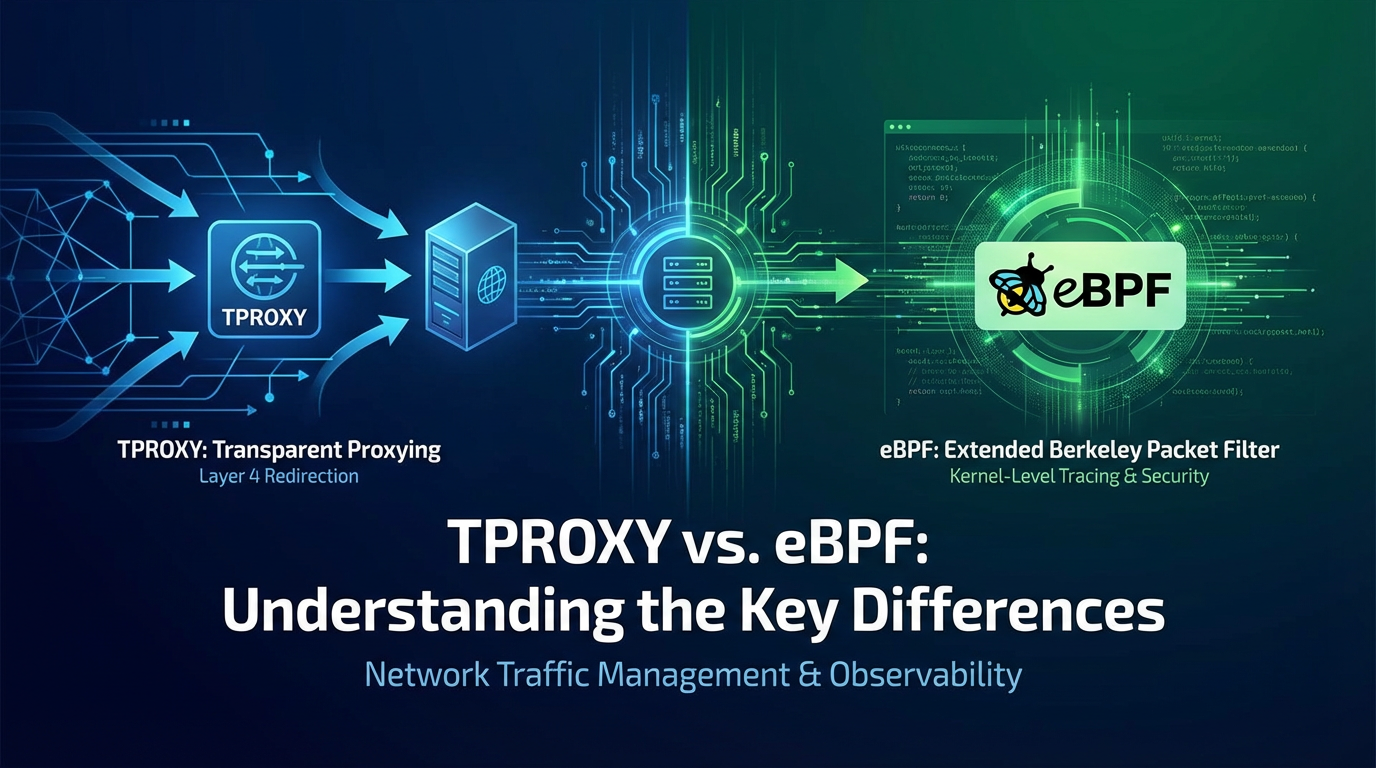


The digital arteries of our modern world are constantly under pressure, demanding ever-increasing speed, security, and flexibility. At the very heart of this intricate network infrastructure, operating often unseen yet profoundly impactful, lie technologies that dictate how data flows, how applications communicate, and ultimately, how efficiently our digital services can scale. Among these foundational technologies, TPROXY and eBPF stand out as powerful, albeit distinct, mechanisms for manipulating network traffic and extending kernel capabilities within Linux systems. While both aim to optimize and control data streams, their approaches, operational layers, and underlying philosophies diverge significantly, each offering unique strengths tailored to different challenges.
Understanding the key differences between TPROXY and eBPF is not merely an academic exercise; it is crucial for architects, network engineers, and developers striving to build resilient, high-performance, and secure systems, from low-level network appliances to sophisticated, distributed cloud-native applications and even the advanced infrastructure supporting an AI Gateway. This deep dive will unravel the intricacies of each technology, compare their operational paradigms, highlight their respective advantages and limitations, and explore their broader implications in a landscape increasingly defined by the need for robust api gateway solutions and the burgeoning demands of protocols like Model Context Protocol.
I. Introduction: The Unseen Engines of Modern Networking
In the sprawling landscape of Linux networking, where packets traverse countless layers and decisions are made in microseconds, two powerful paradigms, TPROXY and eBPF, offer distinct yet equally compelling ways to interact with and augment the kernel's network stack. These technologies, though operating at different conceptual levels and with varying degrees of flexibility, are fundamental to constructing the high-performance and secure foundations upon which modern internet services, including crucial components like an api gateway, are built. The evolution of network requirements, particularly with the advent of cloud-native architectures, microservices, and the demanding workloads of artificial intelligence, has continuously pushed the boundaries of what is possible within the operating system's core.
TPROXY, a seasoned veteran in transparent network redirection, allows applications to intercept and manipulate traffic without the client or server needing to be aware of the intermediary. It’s a mechanism deeply rooted in the Linux Netfilter framework, leveraging iptables rules to divert packets for processing by a proxy application. Its strength lies in its simplicity and effectiveness for specific use cases where transparent interception is paramount, enabling services like load balancers, caching proxies, and security appliances to operate seamlessly in the network path. However, its capabilities are largely fixed by the Netfilter architecture, offering limited programmability beyond predefined rules.
On the other side of the spectrum is eBPF, or extended Berkeley Packet Filter, a revolutionary technology that has fundamentally transformed how we interact with the Linux kernel. No longer confined to packet filtering, eBPF has evolved into a powerful in-kernel virtual machine that allows users to run custom, sandboxed programs directly within the kernel without altering its source code or loading potentially unstable kernel modules. This unprecedented level of programmability opens up a vast array of possibilities, from ultra-high-performance networking (e.g., XDP) and sophisticated security policies to deep system observability and dynamic runtime tracing. eBPF's flexibility and performance characteristics make it a game-changer for building highly optimized and adaptive infrastructure, capable of addressing the complex demands of modern distributed systems, including those powering an AI Gateway handling diverse Model Context Protocol implementations.
While seemingly disparate, both TPROXY and eBPF contribute to the overarching goal of efficient and controlled data flow. TPROXY offers a well-understood, transparent redirection mechanism, ideal for established proxy patterns. eBPF provides a dynamic, programmable, and highly performant alternative, pushing the boundaries of what kernel-level networking can achieve. Understanding their respective roles, operational mechanisms, and design philosophies is essential for making informed architectural decisions in a world where network efficiency and adaptability are no longer luxuries but absolute necessities. This article will meticulously dissect each technology, offering a granular view of their internal workings, before drawing a comprehensive comparison that illuminates their strengths, limitations, and the scenarios where one might be preferred over the other, ultimately connecting these low-level innovations to the high-stakes world of api gateway and AI Gateway deployments.
II. TPROXY: The Art of Transparent Redirection
Transparent proxying is a network technique where an intermediary device or software intercepts and forwards network traffic without the client or server being explicitly aware of its presence. For the client, it appears as though it's communicating directly with the destination server, and for the server, it appears as though the traffic is coming directly from the original client. This seamless interception is incredibly powerful for a variety of network functions, from security to performance optimization. TPROXY, within the Linux kernel, is a specific mechanism designed to achieve this transparency, primarily for TCP and UDP traffic.
A. What is Transparent Proxying? Core Concept and Motivation
The fundamental motivation behind transparent proxying stems from the desire to insert network services into the data path without requiring application-level configuration changes on clients or servers. Imagine a scenario where you want to cache web content, filter malicious traffic, or perform load balancing for a set of backend servers. Traditionally, clients would need to be configured to use a proxy server, explicitly pointing their traffic towards it. This introduces configuration overhead, can be difficult to enforce universally, and might break applications not designed to work with proxies. Transparent proxying elegantly bypasses these issues by making the interception invisible.
When a client sends a packet, it's destined for a specific IP address and port. In a transparent proxying setup, a network device (often the Linux kernel itself, with TPROXY) intercepts this packet before it reaches its intended destination. Instead of dropping or forwarding it normally, the kernel redirects the packet to a local proxy application. Crucially, when this redirection happens with TPROXY, the original destination IP and port are preserved, as is the original source IP and port. This means the proxy application receives the packet with its original sender and receiver information, allowing it to process the traffic as if it were the true endpoint or an invisible intermediary. After processing, the proxy can then establish a new connection to the real destination server, often impersonating the original client, thus maintaining end-to-end transparency.
This capability is particularly valuable for: * Security: Intercepting traffic for deep packet inspection (DPI), intrusion detection/prevention systems (IDS/IPS), or content filtering without altering client configurations. * Performance Optimization: Implementing caching proxies that can serve content directly without burdening origin servers, or optimizing connections for specific protocols. * Load Balancing: Distributing client requests across multiple backend servers, making the entire server farm appear as a single, highly available service. * Network Address Translation (NAT) with a twist: While NAT changes IP addresses, TPROXY ensures the application sees the original addresses, which is crucial for many proxy services.
B. Historical Context and Evolution: How the Need for Transparency Arose
The concept of proxying predates TPROXY, with traditional explicit proxies being commonplace for decades (e.g., HTTP proxies configured in browsers). However, the limitations of explicit proxies, especially in enterprise environments with diverse client software or the need for network-wide enforcement, quickly became apparent. The desire for a "man-in-the-middle" that was both powerful and invisible drove the development of transparent proxying.
Early forms of transparent proxying often involved simple REDIRECT rules in iptables, which would change the destination port of an incoming packet to a local proxy port. While this worked for some protocols, it had a critical flaw: the proxy would see the connection as coming from itself (the loopback address), not the original client. This broke many applications and made accurate logging or policy enforcement difficult. The proxy would then have to rely on X-Forwarded-For headers for HTTP, which isn't universally applicable or reliable.
The need to preserve the original destination IP and port, as well as the original source IP, for the proxy application itself became evident. This led to the development of TPROXY as an iptables target specifically designed to address these requirements, allowing the proxy application to "see" the original packet information directly in its socket, thereby achieving true transparency from the application's perspective. It provided a robust and generic solution that went beyond simple port redirection, laying the groundwork for more sophisticated network services within the Linux ecosystem.
C. The Mechanics of TPROXY: A Deep Dive
TPROXY's operation is intricately woven into the fabric of the Linux networking stack, primarily leveraging the Netfilter framework and iptables to achieve its magic. Understanding these components is key to grasping how TPROXY functions.
1. Linux Networking Stack Overview: Positioning TPROXY
The Linux kernel's networking stack is a complex hierarchy of layers, each responsible for specific aspects of packet processing. When a packet arrives at a network interface, it traverses various stages: from the physical layer up through the data link, network (IP), and transport (TCP/UDP) layers. Netfilter is a framework within the kernel that provides hooks at various points in this packet traversal, allowing modules (like iptables) to inspect, modify, or drop packets.
TPROXY operates within the Netfilter framework, specifically leveraging the mangle table and the PREROUTING chain for incoming packets, and potentially the OUTPUT chain for locally generated packets, to redirect traffic.
2. iptables and Netfilter: The Rules of the Game
iptables is the userspace tool for configuring Netfilter rules. These rules are organized into tables (filter, nat, mangle, raw, security), each serving a different purpose. Within each table, there are chains (PREROUTING, INPUT, FORWARD, OUTPUT, POSTROUTING) that represent different stages of a packet's journey through the kernel.
TPROXY rules are typically configured in the mangle table, because mangle is where packets can be altered before routing decisions are made (in PREROUTING) or before being sent out (in OUTPUT). The TPROXY target is distinct because it doesn't just modify packet headers; it instructs the kernel to look up a local socket that has explicitly bound to a specific IP address and port and accept the incoming packet for that socket, even if the packet's destination IP/port doesn't match the local interface's address.
A typical TPROXY iptables rule might look like this:
# Mark packets destined for port 80 (HTTP) to be redirected
iptables -t mangle -A PREROUTING -p tcp --dport 80 -j MARK --set-mark 1

# Redirect marked packets to a local proxy on port 8080
iptables -t mangle -A PREROUTING -p tcp --dport 80 -j TPROXY --on-port 8080 --tproxy-mark 1
Here, MARK is used to flag packets, and then TPROXY acts on those marked packets, redirecting them to port 8080 on the local machine.
3. REDIRECT vs. TPROXY: Key Differences and Why TPROXY is Special
It's important to distinguish TPROXY from the simpler REDIRECT iptables target. * REDIRECT: Changes the destination IP address of an incoming packet to the local machine's IP address (typically 127.0.0.1) and optionally changes the destination port. The proxy application then sees the connection originating from the client, but destined for the local machine's IP. The original destination IP is lost. * TPROXY: Does not change the destination IP address of the incoming packet. Instead, it instructs the kernel to redirect the packet to a local socket while preserving the original destination IP and port. Furthermore, TPROXY allows the proxy application to establish outgoing connections as if it were the original source IP, maintaining complete transparency. This is its key advantage.
4. IP Packet Manipulation: Source and Destination Address Rewriting
While TPROXY itself preserves the original destination IP and port for the proxy application, achieving full transparency (where the backend server also sees the original client IP) often requires additional steps. When the proxy application forwards the connection to the actual backend server, it needs to bind its outgoing connection to the original client's source IP address. This is achieved using the IP_TRANSPARENT socket option in conjunction with policy-based routing.
When a TPROXY-enabled application creates a socket and sets the IP_TRANSPARENT option, it signals to the kernel that it intends to send packets with arbitrary source IP addresses, even if those addresses are not assigned to the local machine's interfaces. This is crucial for the proxy to impersonate the original client.
5. Routing Table Interaction: Ensuring Packets Reach Their Intended Proxy
For TPROXY to work effectively, the Linux kernel's routing decisions must be carefully configured. When a TPROXY rule redirects a packet to a local proxy, the packet's original destination IP is preserved. This means that if the local machine itself is the intended destination for that IP (e.g., if it hosts a web server on the original destination IP), the packet might be handled by the kernel's normal input path, bypassing the proxy.
To prevent this, TPROXY typically requires policy routing rules. These rules dictate that packets with a specific mark (set by iptables MARK target, as shown above) should be routed through a special routing table. This routing table usually contains a default route that points back to the local loopback interface or ensures the packet is handled locally by the proxy, rather than being forwarded further. This ensures that marked packets are always directed to the proxy application that has bound to the specified transparent port.
6. Socket Options (IP_TRANSPARENT): How Applications Become Transparent
The final piece of the TPROXY puzzle lies within the proxy application itself. For a proxy to accept connections redirected by TPROXY and maintain transparency, it must: 1. Bind to a non-local address/port: The proxy application needs to listen on the port specified by --on-port in the TPROXY rule (e.g., 8080). 2. Set IP_TRANSPARENT socket option: When creating its listening socket, the proxy must set the IP_TRANSPARENT socket option (setsockopt(..., SOL_IP, IP_TRANSPARENT, ...)). This tells the kernel that the socket is permitted to accept incoming connections where the destination IP address does not match any local interface and to send outgoing connections from source IP addresses not assigned to the local machine. 3. Retrieve original destination: Once a connection is accepted, the proxy can retrieve the original destination IP and port of the client's request using getsockopt with SO_ORIGINAL_DST. 4. Connect to backend transparently: When the proxy establishes a new connection to the backend server, it uses the connect call, and if it also sets IP_TRANSPARENT on this new socket, it can bind the outgoing connection to the original client's source IP address. This is how the backend server sees the original client, completing the transparency.
D. Common Use Cases and Implementations
TPROXY's capabilities make it invaluable for a range of networking tasks:
1. HTTP/S Proxies (e.g., Squid, HAProxy with TPROXY)
One of the most common applications is for transparent web proxies. A server running Squid or HAProxy, configured with TPROXY, can intercept all HTTP/S traffic from clients on a network segment. Clients simply connect to their intended websites, unaware that their traffic is being routed through the proxy for caching, content filtering, or access control. For HTTPS, this often involves SSL/TLS interception, which requires the proxy to generate certificates on the fly, introducing a security consideration.
2. Load Balancing: Distributing Traffic Without Client Awareness
Load balancers use TPROXY to distribute incoming requests across a farm of backend servers. The load balancer receives traffic destined for a virtual IP (VIP) address, uses TPROXY to redirect it to its own local process, and then forwards the request to one of the healthy backend servers. Because of TPROXY, the backend server sees the connection originating from the original client's IP, which is crucial for applications that rely on client IP for session management or logging. This approach simplifies client configuration, as they don't need to know about the load balancer's internal workings.
3. Intrusion Detection/Prevention Systems (IDPS)
Security appliances often sit in the network path to monitor and potentially block malicious traffic. TPROXY allows an IDPS to transparently intercept all relevant traffic, perform deep packet inspection for threats, and then forward legitimate traffic while dropping or alerting on suspicious packets. This deployment model ensures that all traffic is scrutinized without requiring explicit configuration on end devices.
4. Traffic Interception for DPI (Deep Packet Inspection)
Beyond security, DPI can be used for various purposes like Quality of Service (QoS), traffic shaping, or application performance monitoring. TPROXY facilitates the interception of traffic at the kernel level, allowing specialized applications to analyze packet payloads and headers for specific patterns, protocols, or content, thereby enabling intelligent network management decisions.
E. Advantages of TPROXY: Simplicity, Transparency, Widespread Support
- True Transparency: The primary advantage is its ability to make a proxy truly transparent, preserving both source and original destination IPs for the proxy application and potentially for the backend server.
- No Client Configuration: Eliminates the need to configure clients to use a proxy, simplifying network management and ensuring universal application of policies.
- Standard Linux Kernel Feature: TPROXY is a mature and well-integrated feature of the Linux kernel and
Netfilter, with extensive documentation and community support. - Application Compatibility: Because it preserves original network information, TPROXY generally works well with applications that rely on client IP addresses.
F. Limitations and Challenges: Performance Overhead, Kernel Module Dependency, Complexity for Advanced Logic
- Performance Overhead: While efficient, TPROXY involves
Netfilterrule processing and requires context switching between kernel space (for redirection) and userspace (for the proxy application). For extremely high-throughput scenarios, this overhead can be noticeable. - Kernel Module Dependency: TPROXY is tied to the
Netfilterframework. While stable, any limitations ofNetfilterbecome TPROXY's limitations. - Limited Programmability: TPROXY itself is a redirection mechanism. Any advanced logic (e.g., complex routing decisions based on application-layer data, sophisticated security policies, dynamic load balancing algorithms) must be implemented in the userspace proxy application.
iptablesrules are powerful for matching and marking but are not a Turing-complete programming language. - Complexity for Advanced Logic: While TPROXY is simple in concept, correctly configuring
iptablesrules, policy routing, and ensuring the userspace application correctly handlesIP_TRANSPARENTcan be complex and error-prone. - SSL/TLS Interception Challenges: For HTTPS or other TLS-encrypted traffic, transparent proxying requires the proxy to perform SSL/TLS termination and re-encryption. This raises significant security and certificate management issues, as the proxy effectively becomes a man-in-the-middle, requiring clients to trust the proxy's certificates.
In summary, TPROXY is a robust and widely used mechanism for achieving transparent network redirection in Linux. It's a cornerstone for many traditional network services, offering simplicity and reliability for established proxy patterns. However, its architectural reliance on Netfilter and the division of labor between kernel redirection and userspace application logic present inherent limitations in terms of raw performance for specific workloads and the flexibility required for highly dynamic and programmable network functions, areas where eBPF truly shines.
III. eBPF: Revolutionizing the Linux Kernel
eBPF, or extended Berkeley Packet Filter, represents a paradigm shift in how we interact with and extend the capabilities of the Linux kernel. Evolving from its humble beginnings as a simple packet filtering mechanism, eBPF has transformed into a highly flexible and efficient in-kernel virtual machine, allowing users to run custom, sandboxed programs directly within the kernel. This capability has profound implications for networking, security, observability, and beyond, offering unparalleled performance and programmability without the risks associated with traditional kernel module development.
A. Beyond Traditional Kernel Modules: The Motivation for In-Kernel Programmability
Historically, extending the Linux kernel's functionality required developing kernel modules. While powerful, kernel modules come with significant drawbacks: * Stability Risks: A bug in a kernel module can crash the entire system (kernel panic), compromising stability and data integrity. * Security Vulnerabilities: Malicious or poorly written modules can introduce severe security holes, granting unauthorized access or privileges. * Development Complexity: Writing kernel modules is a complex task, requiring deep kernel knowledge, specific toolchains, and careful memory management. * Compatibility Issues: Modules are often tied to specific kernel versions, requiring recompilation or adjustments with every kernel update. * Deployment Challenges: Loading custom kernel modules often requires elevated privileges and can be difficult to manage in large-scale, dynamic environments like cloud-native clusters.
The motivation behind eBPF was to overcome these limitations by providing a safe, efficient, and dynamic way to extend kernel functionality. Instead of loading arbitrary code that runs with full kernel privileges, eBPF allows for small, event-driven programs to be executed at specific "hook points" within the kernel, all under the strict supervision of a verifier. This approach marries the performance benefits of kernel execution with the safety and flexibility typically associated with userspace applications.
B. What is eBPF? A Safe, Programmable Virtual Machine in the Kernel
At its core, eBPF is a highly optimized, event-driven virtual machine residing within the Linux kernel. It allows developers to write programs that attach to various kernel hook points, such as network interfaces, syscalls, kernel functions, and tracepoints. When an event occurs at a hook point (e.g., a packet arrives, a system call is made), the attached eBPF program is executed.
Key characteristics of eBPF: * In-Kernel Execution: Programs run directly within the kernel, benefiting from kernel-level access and avoiding costly context switches to userspace. * Safety First: Every eBPF program must pass a rigorous verification step before being loaded into the kernel. The eBPF verifier statically analyzes the program's bytecode to ensure it terminates, doesn't contain infinite loops, doesn't access invalid memory, and doesn't violate security policies. This prevents system crashes and unauthorized operations. * Just-In-Time (JIT) Compilation: Once verified, eBPF programs are compiled by a JIT compiler into native machine code for the host architecture. This ensures near-native execution speed, minimizing overhead. * Event-Driven: Programs are triggered by specific events, making them highly efficient as they only execute when relevant. * Programmable: eBPF programs can implement complex logic, manipulate data, and interact with kernel resources through a set of defined helper functions. * Maps for State: eBPF programs can share state with each other and with userspace applications through various data structures known as eBPF maps. These maps can be used for counters, hash tables, arrays, and more.
C. eBPF Architecture and Components
The robustness and versatility of eBPF stem from its well-designed architecture, comprising several key components:
1. The BPF Virtual Machine: Execution Environment
The heart of eBPF is a simple, 64-bit RISC-like virtual machine. eBPF programs are written in a restricted C-like language, compiled into BPF bytecode, which is then executed by this VM. It has a limited number of registers, a stack, and access to a restricted set of memory.
2. The BPF Verifier: Ensuring Safety and Preventing Crashes
This is arguably the most critical component. Before an eBPF program is loaded, the verifier performs a static analysis of its bytecode. It checks for: * Termination: Ensures the program will always finish and not get stuck in an infinite loop. * Memory Safety: Verifies that the program only accesses valid memory within its allocated stack and map regions, preventing out-of-bounds access. * Resource Limits: Checks that the program does not exceed instruction limits or stack limits. * Privilege Escalation: Ensures the program cannot perform operations that would escalate privileges or compromise system security. If a program fails any of these checks, it is rejected and not loaded.
3. JIT Compiler: Speeding Up Execution
Once verified, the eBPF bytecode is translated into native machine code by a Just-In-Time (JIT) compiler. This step is crucial for performance, as it allows eBPF programs to run at near-native CPU speeds, minimizing the overhead of interpretation. Different architectures (x86, ARM, RISC-V) have their own JIT compilers.
4. eBPF Maps: Storing and Sharing State
eBPF programs are stateless by design, executing for a specific event and then exiting. However, they often need to maintain state, share data with other eBPF programs, or communicate with userspace applications. This is where eBPF maps come in. Maps are key-value data structures stored in kernel memory. Different types of maps exist, such as: * Hash Maps: For efficient key-value lookups. * Array Maps: Simple arrays indexed by integers. * LRU Hash/Array Maps: For caching frequently accessed data. * Per-CPU Maps: For high-performance, per-CPU data aggregation. * Ring Buffer Maps: For efficient communication of event data to userspace. Userspace applications can create, update, and read from these maps, providing a powerful interface for configuration, data aggregation, and monitoring.
5. eBPF Helper Functions: Interacting with the Kernel
eBPF programs interact with the kernel through a predefined set of "helper functions." These are specific, stable kernel functions that eBPF programs can call to perform tasks like: * Reading kernel memory (e.g., accessing packet data). * Looking up/updating eBPF maps. * Generating random numbers. * Getting current time. * Sending packets (e.g., with XDP). * Logging messages. The verifier ensures that eBPF programs only call approved helper functions with correct arguments, maintaining security and stability.
6. Hook Points: Where eBPF Programs Attach
eBPF programs can attach to a wide variety of predetermined hook points within the kernel. These include: * Network Events: * XDP (eXpress Data Path): Earliest possible point for packet processing on network devices. * tc (Traffic Control): Ingress/egress queueing disciplines. * Socket filters: Filtering traffic for specific sockets. * System Call Events: * kprobes / kretprobes: Dynamically attach to any kernel function entry/return. * uprobes / uretprobes: Dynamically attach to any userspace function entry/return. * Tracepoints: Statically defined, stable instrumentation points in the kernel. * perf_events: Hardware performance counters, software events. * Control Groups (cgroups): Enforcing policies for processes or network traffic associated with a cgroup. * LSM Hooks (Linux Security Modules): For enforcing security policies.
D. Key eBPF Program Types and Applications
The versatility of eBPF stems from its ability to attach to different hook points and implement various program types:
1. XDP (eXpress Data Path): High-Performance Packet Processing
XDP programs are among the most exciting applications of eBPF, operating at the earliest possible point in the network driver's receive path, before the packet even enters the main network stack. This "zero-copy" approach allows for extremely fast packet processing.
- How it works: When a packet arrives, the network interface card (NIC) driver places it into a ring buffer. An XDP program can be attached to this point. The program receives the raw packet data and can make immediate decisions:
XDP_PASS: Allow the packet to proceed normally into the Linux network stack.XDP_DROP: Discard the packet immediately.XDP_TX: Transmit the packet back out of the same NIC (e.g., for DDoS reflection attacks).XDP_REDIRECT: Redirect the packet to another NIC or to a different CPU for processing.
- Use cases:
- DDoS Mitigation: Dropping malicious traffic at line speed, before it can consume significant system resources.
- High-Performance Load Balancing: Distributing incoming connections across multiple backend servers with minimal latency, like Facebook's Katran.
- Fast Packet Forwarding: Implementing custom router-like logic directly in the kernel for specialized network appliances.
2. Traffic Control (tc): Ingress/Egress Packet Manipulation
eBPF programs can also be attached to the Linux traffic control subsystem (tc). These programs execute later in the packet's journey than XDP, but still within the kernel, allowing for more complex queueing, shaping, and classification logic.
- How it works:
tcprograms can be attached to both ingress (incoming) and egress (outgoing) points of a network interface. They have access to thesk_buff(socket buffer) structure, which provides more metadata about the packet compared to XDP's raw packet access. - Use cases:
- Advanced Routing and Forwarding: Implementing sophisticated routing policies that go beyond standard routing tables, based on granular packet criteria.
- Quality of Service (QoS): Prioritizing specific types of traffic (e.g., VoIP, gaming) or throttling others.
- Network Policy Enforcement: Implementing fine-grained firewall rules or network segmentation policies dynamically.
3. Tracing & Observability: kprobes, uprobes, Tracepoints, Perf Events
eBPF's ability to attach to almost any kernel or userspace function makes it an unparalleled tool for deep system observability and performance analysis.
- How it works:
kprobes/kretprobes: Attach to the entry or return of any kernel function.uprobes/uretprobes: Attach to the entry or return of any userspace function (e.g., within a library or application binary).- Tracepoints: Statically defined points in the kernel code that provide stable APIs for tracing specific events.
perf_events: Access hardware performance counters and software events.
- Use cases:
- Performance Monitoring: Analyzing latency, CPU usage, I/O patterns, and network traffic at a granular level, pinpointing bottlenecks without intrusive instrumentation.
- Debugging: Understanding complex system interactions, function call stacks, and data flows in real-time.
- Security Auditing: Monitoring suspicious system calls, file access patterns, or network connections.
4. Security: Cgroup Programs, LSM Hooks
eBPF offers new frontiers for implementing robust security policies directly within the kernel.
- How it works: eBPF programs can be attached to cgroups, applying policies to all processes within that group. They can also integrate with Linux Security Modules (LSM), acting as powerful enforcement points.
- Use cases:
- Runtime Security Enforcement: Implementing fine-grained access control policies for file systems, network connections, or system calls, effectively a dynamic in-kernel firewall or sandbox.
- Process Sandboxing: Restricting the capabilities of specific processes or containers based on their cgroup membership.
- Network Micro-segmentation: Enforcing network policies for individual containers or pods in a Kubernetes cluster, ensuring that only authorized communication occurs.
E. Advantages of eBPF: Performance, Flexibility, Safety, Dynamic Updates, Minimal Overhead
- Exceptional Performance: By executing programs directly in the kernel and leveraging JIT compilation, eBPF minimizes context switching overhead, achieving near-native execution speeds. XDP, in particular, offers unprecedented packet processing rates.
- Unmatched Flexibility and Programmability: eBPF provides a Turing-complete (within kernel constraints) programming environment, allowing for highly sophisticated and custom logic at kernel level. This flexibility is far superior to fixed
iptablesrules. - Kernel Safety and Stability: The eBPF verifier is a cornerstone, ensuring that programs are safe, terminate correctly, and don't destabilize the kernel. This mitigates the risks associated with traditional kernel modules.
- Dynamic Updates and Hot-Patching: eBPF programs can be loaded, updated, and unloaded dynamically without requiring kernel recompilation or system reboots. This enables agile development and deployment of kernel-level functionality.
- Minimal Overhead: The event-driven nature and JIT compilation ensure that eBPF programs only consume resources when relevant events occur, and their execution is highly optimized.
- Rich Ecosystem and Tooling: A growing ecosystem of tools, libraries (e.g., libbpf, Cilium), and higher-level languages (e.g., Go with ebpf-go, Rust with Aya) makes eBPF development more accessible.
F. Challenges and Complexity: Steep Learning Curve, Toolchain Maturity, Security Considerations for Program Development
- Steep Learning Curve: Developing eBPF programs requires understanding kernel internals, the eBPF instruction set, map types, helper functions, and the verification process. It's a low-level programming paradigm.
- Toolchain Maturity (Improving): While rapidly maturing, the eBPF toolchain and debugging capabilities are still evolving compared to traditional userspace development.
- Security Concerns for Developers: Although the verifier ensures safety, developers must still be mindful of potential vulnerabilities in their eBPF code that could be exploited if not carefully designed. The power of eBPF also means that a flawed program, even if verified, could lead to unexpected behavior.
- Limited Debugging Capabilities: Debugging eBPF programs in the kernel can be more challenging than userspace applications, often relying on printk-like helpers or specific tracing tools.
- Kernel Version Dependency: While better than kernel modules, some eBPF features or helper functions might require specific kernel versions, necessitating careful deployment planning.
In essence, eBPF is a powerful and transformative technology that brings unprecedented programmability and performance to the Linux kernel. It allows for the creation of highly efficient, dynamic, and safe solutions for networking, security, and observability challenges, making it a cornerstone for modern cloud-native infrastructure and the sophisticated demands of future digital services, including the underlying machinery for a high-performance AI Gateway.
IV. TPROXY vs. eBPF: A Comparative Analysis
When contrasting TPROXY and eBPF, it's essential to recognize that they are not direct competitors but rather tools designed for different scopes and with fundamentally distinct approaches to manipulating network traffic within the Linux kernel. TPROXY is a specialized mechanism for transparent redirection, deeply integrated into the Netfilter framework. eBPF is a general-purpose, programmable in-kernel virtual machine, capable of far broader applications, including but not limited to advanced networking. Their differences paint a clear picture of when to choose one over the other, or how they might even coexist in specific, layered architectures.
A. Fundamental Differences:
1. Operational Layer: Userspace/Kernel Interface vs. In-Kernel Program
- TPROXY: Primarily a kernel-level redirection mechanism that shunts traffic to a userspace application. While the redirection logic (via
iptables) runs in the kernel, the actual proxying logic (e.g., HTTP parsing, load balancing decisions) resides in a userspace process. This involves context switching between kernel and userspace. - eBPF: Allows entire programs to run directly within the kernel, eliminating the need for context switches for the core logic. While userspace applications can load and manage eBPF programs and communicate with them via maps, the performance-critical operations are executed entirely in kernel space.
2. Programmability & Flexibility: Fixed iptables Rules vs. Turing-Complete Programs
- TPROXY: Its "programmability" is limited to what
iptablesand Netfilter rules can express: matching packets based on headers (IP, port, protocol) and applying predefined targets likeMARKorTPROXY. Complex application-level logic must be handled by the userspace proxy application. - eBPF: Offers a high degree of programmability, allowing developers to write custom C-like programs that execute arbitrary logic within the kernel. These programs can access packet data, manipulate headers, interact with eBPF maps, and call helper functions, making them effectively Turing-complete within the kernel's safety constraints. This enables much more sophisticated and dynamic network functions.
3. Performance Characteristics: Context Switching vs. Direct Kernel Execution
- TPROXY: Incurs overhead due to the necessity of moving packets from kernel space to a userspace proxy application and then back into the kernel for forwarding. Each packet processing involves at least two context switches (kernel-to-userspace, userspace-to-kernel) and memory copies.
- eBPF: Designed for maximum performance. Programs execute directly in kernel space, often at the earliest possible point (e.g., XDP), minimizing context switches and memory copies. JIT compilation ensures near-native execution speed, making it suitable for line-rate packet processing.
4. Complexity of Implementation: iptables Configuration vs. C/Rust/Go with BPF Tools
- TPROXY: While conceptually straightforward, proper implementation requires careful configuration of
iptablesrules, policy routing, and specific socket options (IP_TRANSPARENT) in the userspace proxy. Debugging network flow can be challenging. - eBPF: Development involves writing programs in a restricted C-like language (or higher-level languages like Go, Rust with specific libraries), compiling them into BPF bytecode, and using tools to load them. The eBPF verifier adds a layer of complexity during development, but ensures safety. The learning curve is significantly steeper.
5. Use Case Alignment: Transparent Redirection vs. General-Purpose Kernel Extension
- TPROXY: Specifically designed for transparently redirecting network traffic to a userspace proxy while preserving original connection information. Its use cases are generally confined to this specific task.
- eBPF: A versatile kernel extension mechanism applicable to a vast array of problems beyond networking, including security, observability, and tracing. Its networking applications are broad, encompassing advanced load balancing, firewalling, routing, and QoS.
6. Safety & Stability: Kernel Modules vs. Verifier-Guaranteed Safety
- TPROXY: Relies on the stability of the
Netfilterframework and the userspace application. An issue in the userspace proxy won't crash the kernel, but aniptablesmisconfiguration could disrupt network services. - eBPF: Its most significant safety feature is the eBPF verifier, which statically analyzes every program before loading to guarantee safety, termination, and memory access integrity. This virtually eliminates the risk of kernel panics caused by eBPF programs, a distinct advantage over traditional kernel modules.
B. Where They Excel:
1. TPROXY's Niche: Simple Transparent Proxying and Redirection
TPROXY excels in scenarios where: * Simple transparent interception is required for HTTP/S proxies, basic load balancers, or traffic visibility. * Existing userspace proxy applications (like Squid, HAProxy) are already in use and can be configured to use IP_TRANSPARENT. * The performance requirements do not necessitate line-rate packet processing at the kernel's earliest stages. * Network architects are familiar with iptables and prefer to leverage this established framework.
2. eBPF's Domain: High-Performance Networking, Advanced Security, Deep Observability
eBPF is the superior choice for: * Extremely high-performance networking tasks like DDoS mitigation, line-rate load balancing (e.g., XDP-based solutions), and custom packet forwarding where every microsecond counts. * Dynamic and sophisticated network policies that require application-aware routing, advanced QoS, or custom firewall logic that iptables cannot easily express. * Deep observability and troubleshooting where granular insights into kernel functions, system calls, network events, and application behavior are needed without modifying application code or recompiling the kernel. * Cloud-native environments (e.g., Kubernetes) where dynamic, programmable network policies, service meshes, and enhanced security are critical (e.g., Cilium's use of eBPF for networking and security). * Implementing new network protocols or highly customized packet manipulation logic directly in the kernel for specialized appliances.
C. Potential for Synergy: Do They Ever Work Together?
While TPROXY and eBPF are distinct, the Linux networking stack is layered, and it's conceptually possible for them to operate in different parts of the stack, though direct collaboration in a single use case is rare. For instance, an eBPF program might classify traffic before Netfilter (e.g., using XDP or tc) and then pass certain packets to the traditional stack, where iptables rules (potentially including TPROXY) could then further process or redirect them.
However, in most modern high-performance or programmable networking scenarios where TPROXY might traditionally be used, eBPF often provides a more performant and flexible alternative that can accomplish the same goals (transparent load balancing, traffic manipulation) entirely within the kernel or with significantly reduced userspace interaction. Solutions built on eBPF, like Cilium, frequently replace or supersede the need for iptables-based mechanisms like TPROXY for advanced network services.
Table 1: TPROXY vs. eBPF - Key Differentiators
| Feature/Aspect | TPROXY (Transparent Proxy) | eBPF (extended Berkeley Packet Filter) |
|---|---|---|
| Operational Layer | Kernel (redirection via Netfilter) to Userspace (proxy application) |
Purely In-Kernel (programs execute in kernel VM) |
| Programmability | Limited; iptables rules for matching/redirection; application logic in userspace. |
High; Custom C-like programs with helper functions; Turing-complete. |
| Performance | Good for general use; involves kernel-userspace context switches & data copies. | Excellent; Near-native speed via JIT; minimizes context switches; XDP for line-rate. |
| Safety | Relies on Netfilter stability; userspace proxy errors don't crash kernel. |
Extremely high; BPF Verifier guarantees safety, termination, and memory access. |
| Flexibility | Specific to transparent redirection and proxying. | General-purpose; Networking, Security, Observability, Tracing. |
| Complexity | Moderate; iptables, routing, userspace socket options. |
High; Kernel internals, BPF bytecode, specific toolchains, verifier. |
| Deployment | iptables rules, running userspace proxy. |
Loading BPF programs, maps, often via userspace tools/libraries. |
| Key Use Cases | Transparent HTTP/S proxies, simple load balancers, traffic interception. | High-perf load balancing, DDoS mitigation, network security policies, deep observability, service mesh. |
| Evolution/Trend | Mature, established; less active development. | Rapidly evolving, driving innovation in cloud-native networking/security. |
This comparison highlights that while TPROXY offers a robust and effective solution for specific, well-defined transparent proxying tasks, eBPF represents a more fundamental and versatile shift in kernel interaction, providing unparalleled performance, programmability, and safety for the increasingly complex demands of modern infrastructure.
V. The Broader Impact: From Kernel to Cloud-Native Services
The innovations at the kernel level, whether through established mechanisms like TPROXY or revolutionary technologies like eBPF, don't exist in a vacuum. Their impact ripples upwards, fundamentally shaping the capabilities and performance of higher-level services and platforms, particularly in the realm of api gateways and AI Gateways. As enterprises move towards more distributed, cloud-native architectures, the efficiency, security, and flexibility provided by the underlying network infrastructure become paramount for delivering reliable and scalable services.
A. The Foundation for High-Performance API Gateways
An api gateway is a critical component in modern microservice architectures, acting as a single entry point for client requests to various backend services. It handles tasks such as routing, load balancing, authentication, authorization, rate limiting, caching, and monitoring. The performance and reliability of an api gateway directly impact the user experience and the overall system's scalability.
1. Demands of Modern Distributed Systems: Low Latency, High Throughput
Modern distributed systems, especially those built on microservices, generate an enormous volume of API calls. Each request must be processed with minimal latency, and the api gateway must handle exceptionally high throughput. This places immense pressure on the underlying network stack and the operating system's ability to process packets efficiently. Any bottleneck at the kernel level can translate into significant performance degradation at the application layer.
2. How TPROXY/eBPF-like Principles Contribute to api gateway Efficiency
Even if an api gateway doesn't directly use TPROXY or eBPF in its immediate forwarding path, the principles and capabilities they represent are crucial: * Transparent Interception: The ability to transparently intercept and redirect traffic, as embodied by TPROXY, allows api gateways to be deployed in a non-intrusive manner. This ensures that clients don't need to be reconfigured, simplifying deployment and ensuring all traffic flows through the gateway for policy enforcement. While modern api gateways often sit explicitly in the request path, the concept of efficiently directing traffic to them without altering the original packet headers for internal routing (a TPROXY-like concern) remains relevant. * High-Performance Packet Processing: The sheer speed and efficiency with which eBPF can manipulate packets directly in the kernel (especially with XDP) provide the foundational performance that high-throughput api gateways demand. For instance, an api gateway might sit behind an eBPF-powered load balancer that rapidly directs incoming requests, filtering out malicious traffic, and ensuring optimal distribution without adding significant latency. The ability of eBPF to implement custom routing logic, fine-grained load balancing algorithms, and even basic L4 firewalling directly in kernel space offloads work from the api gateway itself, allowing it to focus on application-level concerns. * Observability: eBPF's unparalleled tracing capabilities are vital for monitoring the performance of an api gateway. Developers and operations teams can use eBPF tools to gain deep insights into network latency, system call performance, socket behavior, and even application function calls, pinpointing bottlenecks and ensuring the gateway operates optimally. This detailed visibility is critical for troubleshooting and proactive performance tuning.
3. The Necessity of Robust Network Foundations for Scalable api gateways
A scalable api gateway is only as robust as the network infrastructure it relies upon. If the kernel's network stack struggles to keep up with packet rates, or if its routing and filtering mechanisms introduce significant overhead, the api gateway will inevitably become a bottleneck. Technologies that optimize kernel-level networking, whether through transparent proxying capabilities or advanced in-kernel programmability, directly contribute to the api gateway's ability to handle massive scale, maintain low latency, and enforce complex policies efficiently. They lay the groundwork for a responsive and resilient service mesh.
B. Addressing the Challenges of AI Gateways and Model Context Protocol
The emergence of Artificial Intelligence (AI) and Large Language Models (LLMs) introduces a new layer of complexity and demand on network infrastructure. An AI Gateway is a specialized form of api gateway designed to manage access to AI models, handle diverse model APIs, ensure security, and optimize performance for AI inference. These gateways face unique challenges, especially with the proliferation of various models and the development of specialized communication protocols.
1. The Unique Requirements of AI Gateways: Diverse Models, Dynamic Workloads, Specialized Protocols
AI Gateways must contend with: * Diverse Model APIs: Different AI models (GPT-x, Llama, Claude, etc.) often have distinct API interfaces, requiring the gateway to abstract and unify them. * Dynamic Workloads: AI inference can have highly variable resource demands, with bursts of requests and varying payload sizes. * Specialized Protocols: Beyond standard REST, AI Gateways might need to handle streaming protocols, long-polling, or custom binary formats optimized for AI data transfer. * Context Management: Managing the conversational context across multiple turns with an LLM is a complex task for an AI Gateway. * Cost Optimization: Tracking and optimizing token usage and model invocations across various providers.
2. The Emerging Landscape: Handling Protocols like Model Context Protocol Efficiently
As AI models become more sophisticated, so do their interaction patterns. A Model Context Protocol (MCP) might emerge as a standardized way for applications to manage and transmit conversational context, system prompts, user inputs, and model outputs efficiently between clients, AI Gateways, and AI models. Such a protocol would likely be optimized for minimizing token usage, reducing latency, and handling large, sequential data streams.
An AI Gateway handling Model Context Protocol would require: * Protocol Awareness: The ability to parse, interpret, and potentially modify the MCP payload. * High Throughput for Context Data: Efficiently transferring potentially large context windows. * Low Latency for Interactive AI: Ensuring real-time responsiveness for conversational AI. * Security for Sensitive Data: Protecting the proprietary models and potentially sensitive conversational data flowing through the protocol.
3. How Advanced Kernel-Level Networking Can Optimize AI Gateway Performance and Adaptability
The underlying kernel capabilities are critical for an AI Gateway handling evolving protocols like Model Context Protocol: * eBPF for Protocol Optimization: eBPF's programmability allows for the dynamic implementation of new parsing and filtering rules for emerging protocols like MCP, directly in the kernel. This means an AI Gateway could potentially leverage eBPF programs to: * Accelerate MCP Processing: Quickly identify and route MCP packets based on specific headers or payload patterns at line speed (using XDP or tc). * Implement Custom Load Balancing: Distribute MCP requests to specific AI models or instances based on model type, context size, or even token cost, with minimal overhead. * Enforce Security Policies: Filter out malformed or malicious MCP requests early in the network stack, protecting backend AI models. * Monitor MCP Traffic: Gain deep insights into MCP traffic patterns, latency, and throughput for performance tuning and cost analysis. * Reduced Overhead for AI Workloads: By offloading complex networking tasks to eBPF programs in the kernel, the AI Gateway application in userspace can dedicate more CPU cycles to AI-specific logic (e.g., prompt engineering, response parsing, context management), leading to better overall performance. * Dynamic Adaptability: The ability to dynamically update eBPF programs allows AI Gateways to adapt quickly to changes in Model Context Protocol specifications or new AI model requirements without requiring system reboots or complex network stack reconfigurations.
4. Mentioning APIPark: An Example of a Robust AI Gateway Solution
The complexities of managing a myriad of AI models and ensuring their secure, high-performance delivery through unified interfaces necessitate robust solutions. Platforms like ApiPark, an open-source AI gateway and API management platform, address these needs by offering quick integration of diverse AI models, unified API formats for invocation, prompt encapsulation into REST APIs, and comprehensive API lifecycle management. Such platforms abstract away many underlying networking complexities, providing a layer of efficiency and control that is indirectly supported by the robust kernel-level capabilities discussed earlier. APIPark, by simplifying the integration and management of AI models and their associated APIs, benefits from a performant and flexible underlying network stack. While not directly leveraging TPROXY or eBPF in its core application, the efficiency and security of platforms like APIPark are ultimately enhanced by the general advancements in kernel networking that these technologies represent, enabling it to deliver high TPS (transactions per second) and ensure system stability for critical AI workloads, including those that might leverage specialized communication protocols like the Model Context Protocol.
C. eBPF in Cloud-Native Ecosystems: Kubernetes, Service Meshes (Cilium)
eBPF's impact is particularly pronounced in cloud-native environments, becoming a cornerstone for modern infrastructure.
- Kubernetes Networking: eBPF offers significant advantages over traditional
kube-proxy(which heavily relies oniptables). Projects like Cilium use eBPF for high-performance networking, replacingkube-proxyfor faster service load balancing, network policy enforcement, and efficient data path routing within Kubernetes clusters. This dramatically reduces latency and improves throughput for inter-pod communication. - Service Meshes: Service meshes like Istio or Linkerd traditionally use sidecar proxies (e.g., Envoy) to inject networking and security policies. While sidecars are powerful, they introduce latency and resource overhead. eBPF is paving the way for "sidecarless" service meshes, where much of the proxy logic (observability, security, traffic management) is moved into the kernel via eBPF programs. Cilium's Service Mesh, for instance, leverages eBPF to implement many service mesh functionalities directly in the kernel, significantly improving performance and reducing resource consumption compared to userspace proxies.
- Enhanced Security: eBPF provides unparalleled capabilities for enforcing security policies at the kernel level. It can monitor and filter system calls, restrict container capabilities, and implement network segmentation with extreme granularity and performance, going beyond what traditional firewalls or simple container security mechanisms can achieve.
- Observability for Microservices: In complex microservice architectures, debugging and monitoring can be challenging. eBPF provides deep, low-overhead observability into every aspect of the system—network, CPU, memory, I/O, and application calls—without requiring code changes or application restarts, making it indispensable for cloud-native operations.
In essence, kernel-level innovations like TPROXY and, more significantly, eBPF, are not just about raw packet processing. They are foundational technologies that enable the creation of highly efficient, secure, and adaptable higher-level services. For api gateways, they provide the necessary performance and control. For AI Gateways, they offer the flexibility and speed required to handle the diverse and evolving demands of AI models and their specialized protocols, contributing to robust platforms like APIPark that drive the next generation of intelligent applications.
VI. Future Outlook: The Evolving Landscape of Kernel-Level Innovation
The trajectory of kernel-level networking and system interaction is undeniably influenced by the ongoing advancements in technologies like eBPF, promising a future where our digital infrastructure is even more efficient, secure, and dynamically adaptable. While TPROXY remains a reliable tool for its specific niche, the momentum is firmly with the programmable kernel paradigm.
A. Continued Dominance of eBPF in Kernel Development
eBPF is not just a passing trend; it has become a fundamental pillar of Linux kernel development. Its adoption is accelerating across a vast range of use cases, from core networking components to security modules and comprehensive observability platforms. The community around eBPF is vibrant, with continuous contributions from major tech companies and open-source enthusiasts. This ensures its ongoing evolution, with new program types, helper functions, and map types constantly being integrated into the kernel. The ability to innovate and deploy new features directly in the kernel without compromising stability is a powerful driver for its sustained dominance. Expect to see eBPF integrated into even more subsystems, further solidifying its role as the primary mechanism for extending kernel functionality safely and efficiently.
B. Integration with Emerging Technologies (e.g., QUIC, WebAssembly)
The flexibility of eBPF makes it an ideal candidate for rapidly integrating and optimizing support for emerging network protocols and computational paradigms. * QUIC: As QUIC (Quick UDP Internet Connections) gains traction as a successor to TCP for many internet applications, eBPF can play a crucial role in offloading QUIC packet processing, connection management, and even cryptographic operations directly into the kernel or smart NICs. This would significantly improve QUIC's performance and efficiency, especially for high-throughput and low-latency applications that are common in AI workloads. * WebAssembly (Wasm): The concept of running WebAssembly modules in kernel space, potentially via eBPF, is an intriguing area of research. Wasm offers a safe, sandboxed, and portable execution environment. If Wasm modules could be compiled to eBPF bytecode or executed within an eBPF-like framework in the kernel, it could open up new possibilities for writing kernel-level logic in a wider array of languages and with potentially faster development cycles, while maintaining eBPF's safety guarantees. This could simplify the creation of highly customized AI Gateway functionalities or Model Context Protocol handlers. * Hardware Offloading: The trend of hardware offloading, where network interface cards (NICs) become "smart" (SmartNICs or DPU/IPUs), is perfectly aligned with eBPF. XDP programs can already run directly on some NICs. In the future, more complex eBPF logic, including security policies and advanced routing, will be offloaded to these specialized hardware components, further reducing CPU utilization and maximizing network throughput.
C. The Growing Importance of Observability and Security at Scale
As systems become more distributed, dynamic, and complex (especially with the advent of AI services), observability and security become increasingly challenging yet critical. * Unified Observability: eBPF is at the forefront of providing deep, unified observability across the entire software stack, from hardware counters and kernel functions to userspace applications and microservices. Its ability to collect granular metrics, traces, and events with minimal overhead makes it indispensable for understanding the behavior of complex systems, including the performance characteristics of api gateways and AI Gateways, especially when dealing with nuanced protocols like Model Context Protocol. The future will see more sophisticated eBPF-based observability platforms that can correlate data from various sources to provide comprehensive insights. * Proactive Security: eBPF's programmability allows for highly dynamic and context-aware security policies. Instead of static firewall rules, eBPF can implement adaptive security measures that react to real-time events, detect anomalies, and enforce micro-segmentation with unparalleled precision. This shifts security from a reactive to a proactive stance, crucial for protecting sensitive data and AI models. Future eBPF-based security solutions will integrate more deeply with threat intelligence and machine learning to offer autonomous protection against evolving cyber threats. * Serverless and Edge Computing: The minimal resource footprint and dynamic loading capabilities of eBPF make it highly suitable for serverless functions and edge computing environments, where resources are constrained, and latency is paramount. eBPF could enable highly efficient network processing and security enforcement at the edge, crucial for real-time AI inference in distributed settings.
In conclusion, the future of kernel-level innovation is bright, with eBPF leading the charge towards a more performant, secure, and flexible foundation for all digital services. These advancements will continue to underpin the capabilities of high-level platforms, ensuring that api gateways, AI Gateways, and emerging protocols like Model Context Protocol can scale to meet the ever-growing demands of the modern internet.
VII. Conclusion: Choosing the Right Tool for the Task
Navigating the intricate landscape of Linux networking requires a nuanced understanding of the tools available, their strengths, and their limitations. TPROXY and eBPF, while both powerful, represent distinct philosophies and offer solutions tailored to different classes of problems.
TPROXY stands as a testament to the enduring utility of the Linux Netfilter framework. It provides a straightforward, robust, and well-understood mechanism for achieving transparent network redirection, an essential capability for a variety of network services such as traditional HTTP/S proxies, basic load balancers, and traffic inspection systems. Its simplicity of concept and integration with familiar iptables make it a go-to solution when the primary requirement is invisible traffic interception and the processing logic can effectively reside in userspace. For many established api gateway implementations that operate at the application layer and require a reliable method for upstream traffic forwarding without client re-configuration, TPROXY's principles remain relevant, underpinning the transparent nature of many network appliances.
In contrast, eBPF embodies a paradigm shift, bringing unparalleled programmability and performance directly into the Linux kernel. By allowing custom, sandboxed programs to execute at critical hook points, eBPF revolutionizes networking, security, and observability. Its ability to process packets at line speed (via XDP), implement dynamic network policies, provide deep system visibility, and enhance security with minimal overhead makes it the technology of choice for modern, high-performance, and adaptable infrastructures. For api gateways demanding extreme throughput and low latency, or AI Gateways that must navigate the complexities of diverse AI models and evolving protocols like Model Context Protocol with utmost efficiency, eBPF offers the granular control and performance necessary to meet these demanding requirements. It enables a new generation of cloud-native solutions, providing a flexible and performant foundation that abstracts away the underlying complexities for platforms like ApiPark, which in turn empower developers and enterprises to manage and deploy AI and REST services with greater ease and confidence.
The choice between TPROXY and eBPF is not always an "either/or" dilemma, but rather a reflection of the specific problem domain, performance requirements, and desired level of programmability. For simple, transparent redirection, TPROXY remains a viable and effective option. However, for building the highly performant, dynamically adaptable, and deeply observable network infrastructure required by today's sophisticated cloud-native applications, api gateways, and especially the demanding landscape of AI Gateways processing complex Model Context Protocols, eBPF has clearly emerged as the leading, future-proof technology. Understanding both empowers engineers to select the most appropriate tool, ensuring the construction of robust, efficient, and secure digital foundations for the challenges of today and the innovations of tomorrow.
VIII. FAQ
1. What is the fundamental difference in how TPROXY and eBPF operate within the Linux kernel? TPROXY primarily works by redirecting network packets from the kernel's Netfilter framework to a userspace proxy application while preserving the original source and destination IP addresses. The heavy lifting of proxying logic (e.g., HTTP parsing, load balancing) is done in userspace, involving context switches. eBPF, on the other hand, allows custom programs to run directly inside the kernel at various hook points (e.g., network drivers, syscalls). This eliminates context switches for core logic, enabling much higher performance and arbitrary kernel-level programmability, verified for safety before execution.
2. When would I choose TPROXY over eBPF for a networking task? You would typically choose TPROXY for simpler, transparent network redirection scenarios where: a) You need to use an existing userspace proxy application (e.g., Squid, HAProxy) that already supports transparent mode. b) Your performance requirements are not extreme, and the overhead of kernel-to-userspace context switching is acceptable. c) You are already familiar with iptables and Netfilter for network configuration. TPROXY is well-suited for established transparent proxy patterns and traffic interception where the primary goal is redirection without client configuration changes.
3. What are the key advantages of eBPF, especially in modern cloud-native environments? eBPF offers numerous advantages: a) Exceptional Performance: Near-native speed by running programs directly in the kernel, minimizing context switching. b) Unmatched Flexibility: Programmable in-kernel logic allows for highly custom networking, security, and observability solutions. c) Kernel Safety: A built-in verifier guarantees program safety, preventing kernel crashes. d) Dynamic Updates: Programs can be loaded/unloaded without kernel recompilation or reboots. e) Deep Observability: Unrivaled insights into system and application behavior with minimal overhead. In cloud-native environments like Kubernetes, eBPF powers high-performance service meshes (e.g., Cilium), advanced network policies, and robust security enforcement, going beyond the capabilities of traditional iptables-based solutions.
4. How do technologies like TPROXY and eBPF relate to high-level services like an api gateway or AI Gateway? While api gateways and AI Gateways operate at higher application layers, their performance, security, and scalability are fundamentally dependent on the underlying network infrastructure provided by the kernel. Technologies like TPROXY and eBPF contribute by: a) Optimizing Traffic Flow: Providing efficient mechanisms for routing, load balancing, and traffic manipulation at the kernel level, reducing latency and increasing throughput for the gateway. b) Enhancing Security: Implementing robust network policies and traffic filtering at the earliest possible stage, protecting the gateway and backend services. c) Enabling Observability: Offering deep insights into network and system behavior, which is crucial for monitoring and troubleshooting gateway performance. For specialized AI Gateways managing diverse AI models and emerging protocols like Model Context Protocol, eBPF's programmability offers the flexibility to rapidly adapt to new protocol requirements and optimize data flow for AI inference. Platforms like ApiPark leverage these foundational efficiencies to provide seamless AI integration and API management.
5. Is eBPF expected to completely replace TPROXY in the future? While eBPF offers more advanced capabilities and often provides more performant and flexible alternatives for tasks historically handled by TPROXY, it's unlikely to completely replace TPROXY overnight. TPROXY remains a stable, mature, and simpler option for specific transparent redirection use cases, especially in environments where iptables familiarity is high and extreme performance isn't the primary driver. However, for greenfield development, cloud-native deployments, and scenarios demanding cutting-edge performance, dynamic programmability, or deep observability, eBPF is increasingly the preferred and more future-proof choice, gradually superseding older Netfilter-based approaches for complex networking tasks.
🚀You can securely and efficiently call the OpenAI API on APIPark in just two steps:
Step 1: Deploy the APIPark AI gateway in 5 minutes.
APIPark is developed based on Golang, offering strong product performance and low development and maintenance costs. You can deploy APIPark with a single command line.
curl -sSO https://download.apipark.com/install/quick-start.sh; bash quick-start.sh

In my experience, you can see the successful deployment interface within 5 to 10 minutes. Then, you can log in to APIPark using your account.

Step 2: Call the OpenAI API.