Unify Fallback Configuration for Enhanced Reliability
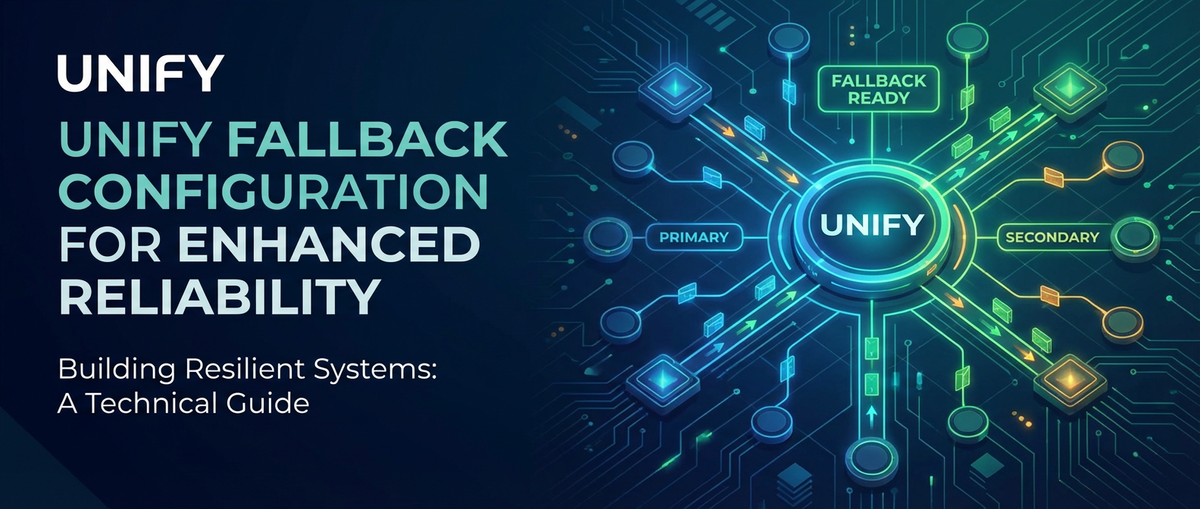


I. Introduction: The Unyielding Quest for Reliability in Distributed Systems
In the relentless march of technological progress, modern software systems have evolved into intricate tapestries of interconnected services, distributed across ephemeral cloud infrastructures. The age of monolithic applications, while simpler in some regards, has largely yielded to the agility and scalability offered by microservices architectures, serverless functions, and diverse cloud-native deployments. This paradigm shift, however, introduces a new frontier of challenges, paramount among them being the inherent unreliability of distributed systems. Networks inevitably experience latency spikes, services occasionally degrade under heavy load, resource exhaustion can strike without warning, and dependent systems can fail in myriad unpredictable ways. In such a volatile landscape, the ability of a system to continue functioning gracefully, even in the face of partial failures, is not merely a desirable feature but an existential necessity.
Reliability, at its core, underpins user experience, ensures business continuity, and safeguards an organization's hard-earned reputation. A system that frequently falters, even briefly, erodes user trust and can lead to significant financial and operational losses. To combat this pervasive fragility, software architects and engineers have long relied on a suite of resilience patterns, collectively known as fallback configurations. These mechanisms, ranging from circuit breakers to retry strategies, timeouts, and bulkheads, are designed to prevent cascading failures, isolate problems, and allow systems to degrade gracefully rather than collapsing entirely. They act as sophisticated safety nets, catching errors before they become catastrophic.
However, the proliferation of services and development teams often leads to a disjointed, ad-hoc approach to implementing these fallback mechanisms. Each team might adopt its own resilience library, configure parameters independently, or even overlook crucial aspects of failure handling. This fragmentation results in a tangled mess of inconsistent behaviors, configuration drift, and an alarming lack of system-wide predictability when failures inevitably occur. Debugging becomes a nightmare, operational burden skyrockets, and the very goal of enhanced reliability is undermined by the haphazard application of resilience principles.
The solution, therefore, lies not just in deploying individual fallback mechanisms, but in unifying fallback configuration across the entire system. This article delves deep into the critical imperative of such unification, exploring its underlying principles, practical strategies, advanced implementations, and the profound impact it has on systematic enhancement of reliability. From the foundational concepts of resilience to the pivotal role of an api gateway and the emerging capabilities of an AI Gateway, we will chart a comprehensive path towards building truly robust and self-healing distributed systems. By harmonizing how our applications react to adversity, we move closer to a future where resilience is an inherent architectural property, not an afterthought.
II. Deconstructing the Pillars of System Resilience: Essential Fallback Mechanisms
Before embarking on the journey of unification, it is crucial to first thoroughly understand the individual components that form the bedrock of any resilient system. Each fallback mechanism addresses a specific facet of system fragility, and their intelligent combination, when unified, creates a formidable defense against failure.
A. Circuit Breakers: Preventing Cascading Failures
The concept of a circuit breaker in software resilience draws a direct analogy from electrical engineering. Just as an electrical circuit breaker trips to prevent damage from an overload or short circuit, a software circuit breaker isolates a failing service to prevent its problems from propagating and causing a cascade of failures throughout the system. When a downstream service becomes unhealthy, the circuit breaker "trips," preventing further requests from being sent to it for a defined period. This gives the failing service time to recover and prevents the upstream service from wasting resources on calls that are doomed to fail, thereby maintaining its own stability.
A typical circuit breaker operates in three primary states: 1. Closed: This is the default state. Requests are passed through to the downstream service. The circuit breaker monitors for failures (e.g., exceptions, timeouts). 2. Open: If the failure rate exceeds a predefined threshold within a specific monitoring window (e.g., 70% failure rate over 100 requests), the circuit breaker "trips" open. All subsequent requests are immediately rejected or routed to a fallback logic without attempting to call the unhealthy service. This state prevents further strain on the failing service and frees up resources in the caller. 3. Half-Open: After a configurable recovery timeout (e.g., 30 seconds) in the Open state, the circuit breaker transitions to Half-Open. A limited number of test requests (e.g., 1 or 2) are allowed to pass through to the downstream service. If these test requests succeed, it signals that the service might have recovered, and the circuit breaker transitions back to Closed. If they fail, it immediately reverts to Open, extending the recovery timeout.
Key configuration parameters for a circuit breaker typically include: * Failure Rate Threshold: The percentage of failed calls that will cause the circuit to open. * Sliding Window Size: The number of requests or the time duration over which the failure rate is evaluated. * Open State Duration (or Wait Duration): How long the circuit remains in the Open state before attempting to Half-Open. * Volume Threshold: The minimum number of requests required in the sliding window before the failure rate calculation begins, preventing premature tripping on low traffic.
Circuit breakers are indispensable in microservices architectures, where inter-service communication is pervasive. Without them, a single service failure can rapidly propagate, leading to widespread outages. However, challenges lie in tuning their granularity – deciding whether a circuit breaker should protect an entire service, a specific API endpoint, or even a particular database connection pool. Overly aggressive settings can lead to unnecessary trips, while too lenient settings can fail to prevent cascades.
B. Retries: Handling Transient Faults with Intelligence
Not all failures are permanent. Many are transient, meaning they are temporary and might resolve themselves if the operation is attempted again after a short delay. Network glitches, brief database lock contention, or temporary service unavailability are common examples of transient faults. Retry mechanisms are designed to automatically re-attempt failed operations, often with increasing delays, to overcome these temporary hiccups without requiring manual intervention or immediately flagging a hard failure.
The simplest retry strategy is to just re-attempt the operation a fixed number of times with a fixed delay. However, this can be problematic. If many clients retry simultaneously after a short, fixed delay, they can create a "thundering herd" effect, overwhelming the recovering service and preventing it from stabilizing. More sophisticated retry strategies include:
- Exponential Backoff: The delay between retry attempts increases exponentially. For example, delays of 1s, 2s, 4s, 8s. This helps to spread out the retries and reduce the chances of overwhelming a recovering service.
- Jitter: Randomness is introduced into the backoff delay (e.g., a random delay between 0.5s and 1.5s for a 1s target). This further helps to prevent synchronized retry storms.
- Max Retry Attempts: A hard limit on the number of times an operation will be retried. Beyond this, the operation is considered a permanent failure.
- Max Delay: An upper bound on the backoff delay to prevent excessively long waits.
Crucially, retries should only be applied to idempotent operations. An idempotent operation is one that can be executed multiple times without changing the result beyond the initial execution. For example, reading data is idempotent. Creating a new record is generally not (it might create duplicates). Performing a payment is certainly not. Retrying non-idempotent operations can lead to undesirable side effects, such as duplicate orders or multiple charges.
Pitfalls of poorly implemented retries include the aforementioned thundering herd, but also amplifying load on an already struggling service, making its recovery harder. Careful consideration of what errors are retryable (e.g., network errors, 503 Service Unavailable) versus non-retryable (e.g., 400 Bad Request, 404 Not Found) is also essential.
C. Timeouts: Defining Boundaries for Unresponsive Services
Timeouts are fundamental to preventing a system from hanging indefinitely while waiting for an unresponsive service. Without timeouts, a single slow or dead service can consume valuable resources (threads, connections, memory) in the calling service, leading to resource exhaustion and eventually, a cascading failure. Timeouts enforce a maximum duration for an operation, ensuring that resources are eventually released and the calling service can proceed with an alternative action (e.g., fallback, error propagation).
There are typically two main types of timeouts: * Connection Timeout: This defines the maximum amount of time allowed to establish a connection to a remote service. If the connection cannot be established within this duration, the operation fails. * Read (or Response) Timeout: Once a connection is established and a request is sent, this defines the maximum amount of time to receive a response. If no data is received within this period, the operation fails.
Choosing sensible timeout values is a delicate balance. Too short, and operations might fail prematurely, leading to unnecessary retries or errors even when the downstream service is only slightly slow. Too long, and resources remain tied up, impacting overall system responsiveness and capacity. Timeouts should be configured based on the expected latency of the downstream service, considering both average and typical percentile (e.g., P99) latencies, while also allowing for some buffer. They are also often layered: an API Gateway might have a longer timeout than the individual microservice calls it orchestrates internally.
D. Bulkheads: Isolating Failure Domains
The bulkhead pattern, inspired by shipbuilding, where compartments prevent a leak in one section from sinking the entire vessel, aims to isolate components of a system to prevent failures in one area from affecting others. In software, this translates to limiting the resources (e.g., thread pools, connection pools, semaphore counts) available to calls to a specific service or resource.
For example, if a microservice makes calls to three different external APIs, dedicating separate, bounded thread pools for each API client ensures that a slow or unresponsive external API cannot consume all available threads, thereby starving calls to the other two healthy APIs or other internal functions of the microservice. If the thread pool for a particular external API becomes exhausted, only calls to that specific API are affected; other parts of the system can continue to function normally.
Bulkheads are typically implemented using: * Thread Pools: Each external dependency or critical operation gets its own dedicated thread pool with a fixed maximum size. * Semaphores: Limiting the number of concurrent calls to a resource. * Queue Limits: Preventing an excessive backlog of requests waiting for a resource.
The primary benefit of bulkheads is that they provide graceful degradation. Instead of a complete system outage, only the functionality dependent on the failing component is affected, preserving the integrity and availability of other services. Designing and configuring bulkheads requires careful analysis of dependencies and potential failure modes, ensuring that sufficient resources are allocated without over-provisioning.
E. Rate Limiting: Protecting Against Overload
Rate limiting is a critical control mechanism designed to protect services from being overwhelmed by an excessive volume of requests. It restricts the number of requests a client or user can make to an API within a given timeframe. This prevents malicious attacks (like Denial-of-Service), abusive behavior, or even legitimate but overwhelming spikes in traffic from degrading the performance or availability of the backend services.
Rate limiting can be implemented at various levels: * Client-Side: Enforced by the client application itself, though this is less reliable as clients can be malicious. * Server-Side: Implemented at the gateway, api gateway, or service level. This is the most common and effective approach.
Common algorithms for rate limiting include: * Token Bucket: A bucket of tokens is filled at a fixed rate. Each request consumes one token. If the bucket is empty, the request is denied or queued. This allows for short bursts of traffic. * Leaky Bucket: Requests are added to a queue, and processed at a fixed rate. If the queue overflows, new requests are dropped. This smooths out traffic spikes. * Fixed Window Counter: A simple counter for requests within a fixed time window. * Sliding Window Log/Counter: More accurate methods that account for requests across rolling time windows.
Rate limiting is essential for preventing downstream service exhaustion, ensuring fair resource usage among clients, and managing operational costs (especially for services billed per request). Dynamic rate limits, which adapt based on real-time system load or even predictive analytics, represent an advanced form of protection.
F. Caching and Stale Data: A Trade-off for Availability
Caching is primarily known for improving performance by storing frequently accessed data closer to the consumer, thereby reducing latency and load on origin services. However, caching also plays a vital role in resilience by providing a fallback mechanism. If the primary data source becomes unavailable, a system can be configured to serve stale data from the cache, maintaining at least some level of functionality rather than presenting an error.
This approach involves a deliberate trade-off between data freshness (consistency) and availability. For many applications, especially those where immediate data consistency is not paramount (e.g., displaying product catalogs, news feeds, or user profiles), serving slightly stale data is far preferable to showing an error page.
Considerations for leveraging caching as a fallback: * Cache Invalidation Strategy: How is the cache updated? How quickly does it become stale? * Time-to-Live (TTL): How long is data considered valid in the cache before it needs to be refreshed? * Fallback to Cache Logic: Explicitly handling the scenario where the primary data source fails and instructing the system to retrieve from cache. * User Expectation Management: Clearly communicating when data might not be perfectly up-to-date.
When intelligently designed, caching transforms from a mere performance optimization into a powerful resilience pattern, ensuring continued service availability even when parts of the backend infrastructure are struggling or temporarily unreachable.
III. The Perils of Disjointed Fallbacks: Why Unification Becomes Imperative
While the individual resilience mechanisms discussed above are powerful tools, their effectiveness is severely diminished when implemented in an uncoordinated, disparate manner across a complex distributed system. The absence of a unified strategy introduces a myriad of problems that can undermine the very reliability they are intended to enhance.
A. Inconsistent Behavior and User Experience
One of the most immediate and tangible consequences of disjointed fallback configurations is an inconsistent user experience during partial system failures. Imagine a user interacting with an application composed of dozens of microservices. If one service responds with a specific error message due to a timeout, another shows a generic "service unavailable" page due to a circuit breaker trip, and a third simply hangs indefinitely, the user is left confused and frustrated. There's no predictable way the system fails.
Different teams might implement different retry policies for the same downstream dependency, leading to varying delays and success rates. Some services might aggressively retry, amplifying load, while others might give up too quickly. This inconsistency not only baffles users but also complicates any attempts to understand the overall health and failure modes of the system. Without a unified approach, there's no single source of truth for how the application is designed to react under stress, making its behavior during incidents highly unpredictable.
B. Configuration Drift and Management Overhead
As systems scale and evolve, the number of services, teams, and deployment environments proliferates. If each service independently manages its fallback settings, configuration drift becomes an inevitable and insidious problem. A timeout value might be updated in one service but forgotten in a dependent one. A circuit breaker threshold might be relaxed for a specific API but not for a similar one. These inconsistencies accumulate over time, creating a complex web of undocumented and mismatched configurations.
Managing these disparate settings manually or through ad-hoc scripts is incredibly labor-intensive and error-prone. It leads to significant operational overhead, as engineers spend countless hours auditing, synchronizing, and troubleshooting configuration issues rather than focusing on innovation. Furthermore, replicating these configurations across development, staging, and production environments becomes a monumental task, often leading to environments behaving differently under load, with production failures that were not reproducible elsewhere. The lack of a centralized, version-controlled approach to configuration makes it nearly impossible to ensure that all services adhere to a consistent resilience posture.
C. Debugging Nightmares and Incident Response Delays
When an incident occurs in a distributed system with disjointed fallbacks, debugging can quickly devolve into a nightmare scenario. Without a unified view of how resilience mechanisms are configured and behaving, it becomes incredibly difficult to trace the root cause of a failure. Did a service fail because its circuit breaker tripped, or because a timeout was too short, or because it exhausted its retry attempts? Were the fallback responses consistent across the entire transaction path?
The lack of standardized logging for fallback events further exacerbates the problem. Different services might log resilience events in different formats, to different destinations, or not at all. This fragmented observability significantly delays incident response times, as on-call engineers struggle to piece together a coherent narrative of what went wrong, where, and why. The absence of a clear, system-wide policy for failure handling means that every incident requires a fresh, often time-consuming, investigation into individual service configurations, rather than a systematic analysis against a known resilience framework.
D. Suboptimal Resource Utilization
Disjointed fallback configurations can also lead to suboptimal resource utilization, either through over-provisioning or under-provisioning for resilience. Without a unified strategy, teams might err on the side of caution and provision excessive resources (e.g., larger thread pools, more instances) to compensate for perceived fragility, leading to unnecessary operational costs. Conversely, some services might be inadvertently under-protected, lacking adequate fallback mechanisms, making them vulnerable to single points of failure that can take down larger parts of the system.
For instance, if retry policies are not coordinated, a service under stress might face an amplified load from its callers, who are all aggressively retrying, leading to a resource spiral. Without a gateway or api gateway to enforce global rate limits, individual services might implement their own, leading to inefficient distribution of capacity or missed opportunities to protect critical downstream resources. Unified fallback, conversely, allows for a more intelligent and efficient allocation of resources, as resilience is designed into the system as a whole, rather than bolted on in isolated pockets.
E. Lack of System-Wide Observability
Perhaps the most insidious peril of disjointed fallbacks is the lack of system-wide observability into the resilience posture of the entire application. It's difficult to answer fundamental questions like: "How resilient is our system to an outage in Service X?" or "Are our circuit breakers generally too aggressive or too lenient?" without a unified approach.
Each service might expose its resilience metrics in a different format, making aggregation and analysis challenging. Identifying patterns of recurring transient failures that affect multiple services, or understanding the cumulative impact of various fallback strategies on overall system health, becomes almost impossible. This blind spot prevents proactive identification of weaknesses, hinders capacity planning for resilience, and ultimately limits the ability to continuously improve the system's fault tolerance. A unified approach, on the other hand, mandates consistent metrics, logging, and tracing for resilience events, enabling a holistic view of the system's robustness.
IV. Charting the Course: Strategies for Unified Fallback Configuration
Recognizing the profound limitations of disparate fallback mechanisms, the modern approach to building resilient distributed systems demands unification. This means establishing consistent patterns, centralized control, and standardized tooling for how services react to failures. Several powerful strategies and architectural patterns can facilitate this unification.
A. Centralized Configuration Management Systems (CCMS)
At the heart of any unified approach to configuration lies a centralized configuration management system (CCMS). Instead of individual services storing their fallback parameters in local files or embedded code, these settings are externalized and managed by a dedicated system. Tools like Apache ZooKeeper, Consul, etcd, HashiCorp Vault, or even Kubernetes ConfigMaps and Secrets provide robust platforms for this purpose.
The benefits are numerous: * Dynamic Updates: Configuration changes can be pushed to services dynamically without requiring a redeployment, allowing for rapid adjustments during incidents. * Version Control and Audit Trails: Configurations are treated as code, stored in a version control system (like Git), providing a clear history of changes, who made them, and when. This greatly aids in debugging and auditing. * Single Source of Truth: A CCMS ensures that all services retrieve their fallback settings from a consistent, authoritative source, eliminating configuration drift. * Environment-Specific Overrides: While promoting global defaults, a CCMS can also support environment-specific overrides (e.g., more aggressive timeouts in production, less aggressive in testing), all managed from a central location. * Policy Enforcement: It becomes easier to define and enforce organizational policies around resilience parameters, ensuring that new services adhere to established best practices.
By centralizing configuration, operations teams gain a clear overview of the resilience posture across the entire system, simplifying management and dramatically improving consistency.
B. Standardized Resilience Libraries and Frameworks
While a CCMS handles where configurations are stored, standardized resilience libraries dictate how these configurations are applied within the application code. Instead of each development team reinventing the wheel or choosing a different library for circuit breaking or retries, the organization can adopt a common set of battle-tested libraries or frameworks.
Examples include: * Java: Resilience4j (a lightweight, functional library), Hystrix (though largely deprecated, it pioneered many concepts), Spring Cloud CircuitBreaker. * .NET: Polly (a highly popular and versatile library). * Go: go-circuitbreaker, backoff. * Node.js: opossum.
The advantages of this approach are significant: * Consistent Behavior: All services using the same library will implement circuit breakers, retries, and timeouts in a predictable and consistent manner, reducing variability in failure handling. * Reduced Learning Curve: Developers only need to learn one set of APIs and patterns for resilience, accelerating development and reducing errors. * Shared Best Practices: The libraries often encapsulate best practices, guiding developers towards robust implementations. * Easier Upgrades and Maintenance: Security patches or performance improvements to the resilience library can be applied once and benefit all services.
By mandating or strongly recommending a standard library, organizations foster a culture of consistent resilience, making it easier to reason about, test, and operate the entire system.
C. The Pivotal Role of the API Gateway as a Control Plane
For many organizations, the api gateway serves as the primary entry point for all external traffic, and often even for internal service-to-service communication. This strategic position makes the api gateway an incredibly powerful component for enforcing unified fallback configurations at a critical choke point. Acting as a central control plane, a robust gateway can offload many resilience concerns from individual microservices, simplifying their design and implementation.
A well-configured api gateway can apply a wide array of resilience policies globally or on a per-API basis: * Global Circuit Breakers: Protect downstream services from excessive requests if they become unhealthy. This can be applied to entire backend services or specific API groups. * Centralized Rate Limiting: Prevent specific clients or general traffic from overwhelming backend services, safeguarding resources. This is where the gateway truly shines in managing external client interactions. * Unified Timeouts: Enforce consistent timeouts for all incoming requests, preventing slow backend services from tying up gateway resources indefinitely. * Retry Policies for Upstream Calls: The api gateway can implement intelligent retry logic for calls it makes to backend services, handling transient network issues transparently to the client. * Fallback Responses: When a backend service fails or a circuit breaker trips, the gateway can be configured to serve a cached response, a default static response, or redirect to a degradation service, providing a consistent failure experience for consumers. * Authentication and Authorization: Beyond resilience, the api gateway is also central for unifying security policies.
By centralizing these policies at the api gateway, organizations gain a single point of control and observability over their system's resilience posture, especially for external interactions. This simplifies updates, improves security, and ensures that all inbound traffic is subjected to a consistent set of protection mechanisms. While a powerful strategy, it's crucial that the api gateway itself is highly available and scalable to avoid becoming a single point of failure.
D. Service Mesh Architectures: Network-Level Resilience
For internal service-to-service communication, service mesh architectures offer an even more transparent and comprehensive approach to unified fallback. A service mesh, typically implemented using a "sidecar" proxy (like Envoy) deployed alongside each service instance, intercepts all incoming and outgoing network traffic. A central control plane (e.g., Istio, Linkerd) then manages these proxies, injecting resilience policies directly into the network layer without requiring any changes to the application code.
Service mesh capabilities for unified fallback include: * Transparent Circuit Breaking: Automatically applying circuit breakers to all outbound calls from a service, configured and managed centrally. * Automated Retries and Timeouts: Injecting sophisticated retry logic (with exponential backoff and jitter) and connection/response timeouts for inter-service communication. * Traffic Management: Advanced routing capabilities allow for canary deployments, A/B testing, and intelligent traffic shifting away from unhealthy service instances. * Load Balancing: Smart, policy-driven load balancing that can dynamically adjust based on service health and latency. * Observability: Comprehensive metrics, logging, and distributed tracing are collected by the proxies, providing unparalleled visibility into resilience events across the entire mesh.
A service mesh standardizes and automates the application of resilience patterns at the network level, ensuring consistent behavior across all microservices regardless of their programming language or framework. It reduces the burden on developers, allowing them to focus on business logic while the mesh handles the complexities of distributed system communication and failure handling. This is particularly powerful in large, polyglot microservices environments.
E. Policy-as-Code and GitOps Principles
Regardless of whether a CCMS, API Gateway, or Service Mesh is used, the principle of "Policy-as-Code" (PaC) is essential for effective unification. This means defining all fallback configurations and resilience policies in declarative, human-readable configuration files (e.g., YAML, JSON) that are stored in a version control system (like Git).
Combined with GitOps principles, changes to these policies are made via pull requests, reviewed, and then automatically applied to the system through a CI/CD pipeline. This approach offers: * Version Control: Full history of all policy changes, allowing for easy rollbacks and auditing. * Collaboration and Review: Policy changes are subject to code review, promoting consistency and reducing errors. * Automation: Policies are automatically deployed, reducing manual intervention and increasing speed. * Auditability: Every change is recorded, providing a clear audit trail for compliance and debugging. * Consistency Across Environments: The same configuration files can be used across development, staging, and production, ensuring environment parity.
Policy-as-Code provides the necessary discipline and automation to maintain a truly unified and consistent set of fallback configurations across the entire system, regardless of its underlying complexity. It transforms resilience from an ad-hoc afterthought into a core, version-controlled aspect of the system's architecture.
APIPark is a high-performance AI gateway that allows you to securely access the most comprehensive LLM APIs globally on the APIPark platform, including OpenAI, Anthropic, Mistral, Llama2, Google Gemini, and more.Try APIPark now! 👇👇👇
V. Implementing Unified Fallback: From Design to Operation
Having understood the individual mechanisms and the strategies for unification, the next crucial step is to translate these concepts into a practical implementation. This involves adopting foundational design principles, meticulously configuring parameters, rigorously testing the resilience of the system, and establishing robust monitoring and alerting mechanisms.
A. Foundational Design Principles
Successful implementation of unified fallback configurations hinges on adhering to several core design principles that guide architectural decisions and development practices:
- Fail Fast and Fail Gracefully:
- Fail Fast: This principle dictates that services should detect failures as quickly as possible and stop processing an operation if it's likely to fail. This prevents wasting resources on doomed operations and frees them up for healthy ones. Timeouts and circuit breakers are key enablers of failing fast.
- Fail Gracefully: When a primary service fails, the system should not collapse entirely. Instead, it should degrade elegantly, providing a reduced but still functional experience. This might involve serving stale data from a cache, displaying default placeholder content, or temporarily disabling non-critical features. The
api gatewayor service mesh often plays a crucial role in orchestrating these graceful degradation strategies, presenting a consistent fallback response to the user even if internal services are struggling.
- Idempotency: As highlighted earlier, for retry mechanisms to be safe and effective, the operations they are attempting to perform must be idempotent. This means that executing the operation multiple times with the same input should produce the same result as executing it once. Developers must design API endpoints and underlying business logic with idempotency in mind, particularly for write operations or actions that trigger side effects (e.g., generating unique request IDs, using conditional updates).
- Observability: You cannot manage what you cannot measure. Robust observability is paramount for understanding the behavior of fallback mechanisms. This includes:
- Metrics: Collecting metrics on circuit breaker states (open, closed, half-open), retry counts, timeout events, fallback execution rates, and the latency of both successful and failed calls.
- Logging: Detailed, structured logs for every fallback event, including the service, the dependency, the specific fallback action taken, and any relevant error messages.
- Tracing: Distributed tracing (e.g., OpenTelemetry, Jaeger) that allows tracking a request's journey across multiple services, including when and where fallback mechanisms were triggered. This helps pinpoint bottlenecks and failure points. A unified approach to observability ensures that these insights are consistently collected and aggregated across the entire system.
- Degradation Strategies: Beyond just failing fast, systems need predefined strategies for what to do when a primary service fails. These degradation strategies might include:
- Static Fallback Response: Returning a predefined, static payload (e.g., an empty list, a default image, a cached price).
- Cache Fallback: Serving the last known good data from a local or distributed cache.
- Alternative Service: Rerouting requests to a simpler, less resource-intensive, or geographically distant alternative service.
- Feature Disablement: Temporarily turning off non-essential features (e.g., personalized recommendations, real-time analytics) to preserve core functionality.
- Partial Content: Presenting only the available parts of a page or data set. These strategies should be clearly defined as part of the unified fallback policy.
B. A Practical Approach to Unified Configuration
Translating these principles into concrete configurations requires a structured approach. A centralized system, whether it's an api gateway, a service mesh control plane, or a dedicated configuration service, will house the unified parameters. Here’s an example of how such parameters might be structured and standardized:
| Configuration Aspect | Example Parameter | Default Value | Description | Applicability Scope | Configuration Example (YAML) |
|---|---|---|---|---|---|
| Circuit Breaker | failureRateThreshold |
70% | Percentage of failed calls (errors, timeouts) over slidingWindowSize to open the circuit. |
Service, API Group, Endpoint | circuitBreaker: { failureRateThreshold: 70, ... } |
slidingWindowType |
COUNT_BASED | Strategy for the sliding window: COUNT_BASED or TIME_BASED. |
Service, API Group, Endpoint | slidingWindowType: COUNT_BASED |
|
slidingWindowSize |
100 calls | Number of calls in the window (if COUNT_BASED) or duration (if TIME_BASED). | Service, API Group, Endpoint | slidingWindowSize: 100 |
|
minimumNumberOfCalls |
10 | Minimum calls before evaluating failure rate (prevents premature trips). | Service, API Group, Endpoint | minimumNumberOfCalls: 10 |
|
waitDurationInOpenState |
30 seconds | Time before circuit attempts a HALF_OPEN state. |
Service, API Group, Endpoint | waitDurationInOpenState: 30s |
|
permittedNumberOfCallsInHalfOpenState |
1 | Number of test calls allowed in HALF_OPEN state. |
Service, API Group, Endpoint | permittedNumberOfCallsInHalfOpenState: 1 |
|
| Retries | maxAttempts |
3 | Maximum number of retry attempts for transient errors. | Service, API Group, Endpoint | retries: { maxAttempts: 3, ... } |
initialIntervalMs |
100 ms | Initial delay before the first retry. | Service, API Group, Endpoint | initialIntervalMs: 100 |
|
intervalMultiplier |
2.0 | Factor to multiply the interval by for subsequent retries (exponential backoff). | Service, API Group, Endpoint | intervalMultiplier: 2.0 |
|
maxIntervalMs |
5000 ms | Upper bound for the retry interval. | Service, API Group, Endpoint | maxIntervalMs: 5000 |
|
retryableExceptions |
[TimeoutException, SocketException] |
List of exception types or HTTP status codes that trigger a retry. | Service, API Group, Endpoint | retryableExceptions: [TimeoutException, 503] |
|
idempotentOperationsOnly |
true | Flag to enforce retries only on idempotent operations. | Service, API Group, Endpoint | idempotentOperationsOnly: true |
|
| Timeouts | connectTimeoutMs |
500 ms | Maximum time to establish a connection. | Service, API Group, Endpoint | timeouts: { connectTimeoutMs: 500, ... } |
readTimeoutMs |
2000 ms | Maximum time to receive a response after sending request. | Service, API Group, Endpoint | readTimeoutMs: 2000 |
|
totalTimeoutMs |
5000 ms | Overall timeout for the entire operation (including retries). | Service, API Group, Endpoint | totalTimeoutMs: 5000 |
|
| Rate Limiting | rateLimitPerSecond |
100 req/sec | Maximum requests allowed per second. | API, User, IP Address | rateLimiting: { rateLimitPerSecond: 100, ... } |
burstAllowance |
10 req | Maximum temporary burst over the rate limit. | API, User, IP Address | burstAllowance: 10 |
|
policyType |
TOKEN_BUCKET | Algorithm used: TOKEN_BUCKET, LEAKY_BUCKET, etc. |
API, User, IP Address | policyType: TOKEN_BUCKET |
|
| Fallback Strategy | defaultFallbackAction |
STATIC_RESPONSE | Action if primary fails: STATIC_RESPONSE, CACHE_FALLBACK, REDIRECT, ERROR. |
Service, API Group, Endpoint | fallback: { defaultFallbackAction: STATIC_RESPONSE, ... } |
staticFallbackContent |
"Service Unavailable" | Content to return for STATIC_RESPONSE. |
Service, API Group, Endpoint | staticFallbackContent: "Service Unavailable" |
|
fallbackRedirectUrl |
/fallback-page |
URL for REDIRECT fallback. |
Service, API Group, Endpoint | fallbackRedirectUrl: "/techblog/en/fallback-page" |
This table illustrates how a unified configuration might structure parameters for various fallback mechanisms. The Applicability Scope highlights that while some parameters can be global (e.g., default connectTimeoutMs), others are specific to a service, an API Gateway route, or even a particular API endpoint. This hierarchical configuration allows for both broad standardization and granular customization where necessary.
C. Testing Fallback Mechanisms: The Importance of Chaos Engineering
Implementing unified fallback is only half the battle; proving its effectiveness is the other. Traditional unit and integration tests are insufficient to validate the resilience of a complex distributed system. This is where Chaos Engineering becomes indispensable. Chaos Engineering is the discipline of experimenting on a system in production to build confidence in that system's ability to withstand turbulent conditions.
Instead of waiting for failures to occur naturally, chaos engineering deliberately injects controlled failures into the system to observe how it reacts. This includes: * Injecting Network Latency: Simulating slow network links to test timeout configurations and graceful degradation. * Causing Service Unavailability: Randomly stopping or restarting service instances to trigger circuit breakers and fallback responses. * Inducing Resource Exhaustion: Flooding services with requests or consuming CPU/memory to test bulkhead patterns and rate limits. * Simulating Dependency Failure: Making a specific downstream service or database unavailable to test its callers' fallback logic.
Tools like Chaos Monkey, LitmusChaos, Gremlin, or internal custom tooling can automate these experiments. The goal is not to break production recklessly, but to conduct these experiments in a controlled, hypothesis-driven manner. For example, "Hypothesis: If Service A's database becomes unreachable, its circuit breaker will trip, and the api gateway will serve a cached response to the user, with no impact on Service B." By regularly running these experiments, teams can identify weaknesses in their unified fallback configurations, fine-tune parameters, and build confidence in the system's ability to self-heal. This proactive approach ensures that resilience is not just theorized but battle-tested.
D. Monitoring, Alerting, and Observability for Resilience
The operational aspect of unified fallback relies heavily on robust monitoring and alerting. Without clear visibility into the state and behavior of resilience mechanisms, any unification effort will fall short.
Key areas to monitor: * Circuit Breaker States: Dashboards showing the real-time state of circuit breakers (closed, open, half-open) for critical services and api gateway routes. Alerting when a circuit breaker trips open or remains open for too long. * Retry Success/Failure Rates: Metrics on how many retries are occurring, their success rate, and whether they are ultimately successful or lead to a hard failure. Spikes in retries can indicate underlying instability. * Timeout Events: Tracking the frequency of connection and read timeouts. An increasing trend suggests performance degradation in downstream dependencies. * Fallback Execution Rates: Counting how often the system invokes a fallback mechanism (e.g., serving a cached response). A high rate might indicate consistent issues with a primary service, even if the system is still functional. * Latency Percentiles: Monitoring P90, P99, and P99.9 latencies for services and their dependencies to detect subtle performance degradations before they trigger timeouts or circuit breakers. * Resource Utilization: CPU, memory, network I/O, and connection pool utilization for services protected by bulkheads.
Alerting should be configured proactively to notify operations teams when resilience thresholds are breached (e.g., a circuit breaker opens, retry rates surge, too many timeouts). Centralized logging and distributed tracing systems, which collect consistent data from all services and gateway components, are vital for debugging incidents and understanding the precise sequence of events that led to a fallback being triggered. This continuous feedback loop of monitoring, alerting, and analysis is essential for continuous improvement of the system's unified fallback strategy and overall reliability.
VI. Elevating Resilience with Advanced Gateways: The Role of the AI Gateway
While traditional api gateway functionalities have significantly contributed to unified fallback strategies, the advent of Artificial Intelligence and its pervasive integration into applications introduces a new layer of complexity and a compelling need for even more intelligent gateway solutions. The evolution from general-purpose api gateway to specialized AI Gateway signifies a recognition of the unique challenges and opportunities in managing AI services at scale, and critically, in implementing robust, unified fallback configurations for them.
A. Beyond Traditional API Gateways: The Evolution to Intelligent Traffic Management
Traditional api gateway solutions excel at routing, rate limiting, authentication, and basic resilience patterns for conventional RESTful services. They act as the front door, enforcing policies and centralizing concerns. However, AI services—whether they are large language models, image recognition APIs, or complex predictive analytics engines—present distinct characteristics that challenge traditional gateway paradigms: * Highly Variable Latency: AI model inference times can fluctuate dramatically based on input complexity, model size, underlying hardware, and current load. * Resource Intensiveness: AI models, especially deep learning ones, are compute- and memory-intensive, making capacity planning and resource isolation critical. * Dependency on External Providers: Many AI applications rely on third-party AI APIs (e.g., OpenAI, Anthropic, Google AI), introducing external points of failure and specific rate limits. * Cost Implications: Each AI inference can incur significant costs, necessitating intelligent routing to optimize for cost, performance, or availability. * Model Versioning and Lifecycle: AI models are continuously updated, requiring seamless versioning and rollout strategies. * Complex Input/Output: AI APIs often have more complex request/response schemas, sometimes involving streaming data or binary formats.
These factors necessitate an AI Gateway – a specialized type of api gateway that understands the nuances of AI workloads and provides advanced capabilities tailored for their management and resilience.
B. Specific Resilience Challenges for AI Services
The unique characteristics of AI services translate into specific resilience challenges that require a unified and intelligent fallback approach:
- Model Inference Latency Variance: If a primary AI model experiences high latency, simply timing out might be too blunt. An
AI Gatewayneeds to intelligently decide whether to wait longer, fall back to a faster but potentially less accurate model, or serve a cached response. - Dependency on External AI Providers: When integrating with external AI APIs, the
AI Gatewaymust manage diverse authentication schemes, specific rate limits from each provider, and handle provider-specific error codes. If one provider fails, theAI Gatewayshould seamlessly reroute to an alternative provider or internal fallback model. - Resource-Intensive Nature of AI Workloads: A sudden surge in AI requests can quickly overwhelm dedicated GPU clusters or CPU resources. Adaptive rate limiting and intelligent load balancing that considers the real-time resource availability of AI inference endpoints are crucial. Bulkhead patterns become even more vital to prevent one AI model from starving resources needed by another.
- Data Consistency Challenges for AI Model Updates: As AI models are continuously trained and deployed, an
AI Gatewaymust manage seamless transitions between model versions without disrupting ongoing requests. If a new model version encounters issues, theAI Gatewayshould enable quick rollback to a stable previous version as a fallback. - Cost Optimization in Failure Scenarios: High-performance AI models are often more expensive. In a degraded state, an
AI Gatewaymight prioritize falling back to a cheaper, slightly less accurate model to maintain service while managing costs, rather than failing entirely.
C. How an AI Gateway Enhances Unified Fallback for AI-Driven Applications
An AI Gateway significantly elevates the capacity for unified fallback by integrating AI-specific intelligence and advanced management capabilities directly into the gateway layer. It acts as a sophisticated traffic cop, not just for requests, but for the very intelligence powering applications.
Here's how an AI Gateway enhances unified fallback, building upon traditional api gateway principles:
- Intelligent Routing and Load Balancing: An
AI Gatewaycan dynamically route requests based on more than just service health. It can consider:- Model Performance: Routing to the fastest available model instance or provider.
- Regional Availability: Switching to an AI model deployed in a different region if the primary region experiences an outage.
- Cost Optimization: Directing requests to a cheaper model or provider during non-critical hours or when primary models are overloaded.
- A/B Testing of Models: Routing a percentage of traffic to a new model version, with automatic rollback if performance degrades.
- Adaptive Fallback Strategies for AI Models: This is where the "AI" in
AI Gatewaytruly shines for resilience:- Fallback to Simpler/Faster Models: If a primary, highly complex AI model becomes unavailable or too slow, the
AI Gatewaycan automatically redirect requests to a pre-configured, simpler, or distilled version of the model that offers quicker (though potentially less accurate) inference, ensuring a degraded but functional experience. - Contextual Retries: The
AI Gatewaycan be configured to understand AI model-specific error codes and implement more intelligent, contextual retry policies. For instance, a temporary resource exhaustion error from an AI provider might trigger a smart retry with exponential backoff, while a semantic error in the prompt might not be retried. - Intelligent Caching for AI Responses: Beyond simple caching, an
AI Gatewaycan implement smart caching strategies for AI responses, understanding the context and validity period of AI inferences. It can serve cached AI responses as a fallback, with dynamic invalidation based on source data changes or model updates. - Adaptive Rate Limiting for Expensive AI Endpoints: The
AI Gatewaycan dynamically adjust rate limits for AI services based on real-time resource availability, credit consumption, or even predictive analytics of downstream model load, preventing over-utilization and cost overruns during periods of stress.
- Fallback to Simpler/Faster Models: If a primary, highly complex AI model becomes unavailable or too slow, the
- Unified Authentication and Access Control for AI Endpoints: Just like a traditional
api gateway, anAI Gatewaycentralizes authentication, authorization, and API key management for all AI services, simplifying security and ensuring consistent access policies, which are critical for protecting sensitive AI models and data. - Centralized Monitoring and Logging for AI Invocations: An
AI Gatewayprovides comprehensive, unified logging for all AI API calls, including input prompts, model used, response received, latency, and any fallback actions taken. This detailed telemetry is invaluable for debugging AI model performance, troubleshooting inference errors, and understanding how fallback mechanisms perform under various conditions. Powerful data analysis tools built into theAI Gatewaycan then process this historical call data to display long-term trends and performance changes, helping businesses with preventive maintenance before issues occur.
D. Introducing APIPark: An Open-Source AI Gateway for Unified Management and Fallback
In this complex landscape of AI-driven applications and the critical need for unified resilience, APIPark emerges as a powerful, open-source AI Gateway and API Management Platform. It is specifically designed to address the intricate demands of managing, integrating, and deploying both AI and traditional REST services with remarkable ease and robustness, making it an ideal platform for implementing and enforcing unified fallback configurations, especially in hybrid environments involving diverse AI models.
APIPark offers a compelling suite of features that directly contribute to enhancing reliability through unified fallback:
- Unified API Format for AI Invocation: A cornerstone of APIPark's design is its ability to standardize the request data format across a multitude of AI models. This is revolutionary for unified fallback. It means that even if an underlying AI model fails, becomes too slow, or needs to be swapped out for an alternative (e.g., a cheaper, faster, or different provider's model as a fallback), the application or microservices making the call remain entirely unaffected. This abstraction simplifies AI usage and significantly reduces maintenance costs, ensuring that fallback strategies can be implemented at the
gatewaylevel without requiring application code changes. - End-to-End API Lifecycle Management: As a comprehensive
api management platform, APIPark centrally manages traffic forwarding, load balancing, and versioning of published APIs. This means it acts as the primarygatewayfor all services. This strategic positioning allows organizations to define and enforce global fallback policies directly at the APIParkgatewaylevel. Consistent circuit breakers, intelligent retry strategies, unified timeouts, and dynamic rate limits can be applied across all integrated services, encompassing both traditional REST APIs and advanced AI models. This centralization dramatically simplifies policy deployment and ensures consistent resilience behavior. - Quick Integration of 100+ AI Models: APIPark's capability to quickly integrate a vast array of AI models with a unified management system for authentication and cost tracking directly facilitates advanced fallback strategies. If a primary AI model experiences issues, APIPark enables seamless fallback to a pre-integrated alternative model—perhaps one that is less performant but more readily available, or from a different provider—without complex configuration changes. This ensures continuous service availability for AI-powered features.
- Performance Rivaling Nginx: With its high-performance architecture, APIPark can achieve over 20,000 TPS with minimal resources, supporting cluster deployment to handle massive traffic loads. This robust foundation is essential for a
gatewaythat is expected to not only route traffic but also actively manage complex resilience policies without becoming a bottleneck itself. Its high performance ensures that fallback mechanisms are executed efficiently and without introducing additional latency. - Detailed API Call Logging and Powerful Data Analysis: APIPark provides comprehensive logging for every API call, including AI invocations. This level of detail is critical for understanding when fallback mechanisms are triggered, diagnosing their effectiveness, and troubleshooting issues. Furthermore, APIPark's powerful data analysis capabilities process this historical call data to display long-term trends and performance changes. This proactive insight helps businesses implement preventive maintenance and fine-tune fallback configurations, ensuring optimal performance and reliability before critical issues arise.
APIPark (visit ApiPark) streamlines the management of complex AI and traditional API ecosystems. By offering a unified management system, standardizing API formats, and providing robust traffic management and observability features, it serves as an invaluable tool for implementing and enforcing unified fallback configurations to achieve superior reliability for all your digital services. Its open-source nature further empowers developers with transparency and extensibility in building resilient AI-driven applications.
VII. Challenges and Nuances in Unifying Fallback
While the benefits of unifying fallback configurations are clear, the path to implementation is not without its challenges. Understanding and proactively addressing these nuances is crucial for a successful and sustainable resilience strategy.
A. Complexity vs. Simplicity: Avoiding Over-engineering
The desire for comprehensive resilience can sometimes lead to over-engineering. Introducing a centralized api gateway, a service mesh, a configuration management system, and a myriad of specific fallback policies can dramatically increase the overall architectural complexity. This complexity, if not managed carefully, can introduce its own set of vulnerabilities, make debugging harder, and increase the cognitive load on development and operations teams.
The challenge lies in finding the right balance: applying sophisticated resilience patterns where truly necessary, but keeping solutions simple and pragmatic for less critical components. Not every microservice needs an aggressive circuit breaker and five retry attempts. A unified strategy should provide a framework for defining sensible defaults but also allow for simplified configurations where appropriate, preventing the system from becoming a "resilience tax" on every new service. The goal is to maximize reliability with minimal necessary complexity.
B. Performance Overhead
Every additional layer of abstraction or component introduced into the request path carries a potential performance overhead. An api gateway or service mesh sidecar, while providing immense value for resilience and management, adds a small amount of latency to each request due to proxying, policy evaluation, and metric collection. While modern gateway and service mesh technologies are highly optimized, this overhead can become a concern in extremely low-latency, high-throughput scenarios.
Careful performance testing and benchmarking are essential to understand the impact of unified fallback mechanisms on the overall system latency and throughput. It's often a trade-off: a slight increase in average latency might be acceptable for a significant boost in fault tolerance and overall system availability. The key is to measure, understand the implications, and optimize where necessary, ensuring that the resilience mechanisms themselves do not become the performance bottleneck.
C. Cultural and Organizational Hurdles
Technological solutions are only part of the equation; organizational and cultural factors play a significant role in the success of unified fallback. Moving from disparate, team-specific resilience implementations to a standardized, system-wide approach requires developer buy-in, extensive training, and a shift in mindset. Teams accustomed to full autonomy might resist adopting common libraries or having their service's failure behavior dictated by central policies.
Overcoming these hurdles requires: * Strong Leadership and Advocacy: From architecture and engineering leadership. * Clear Communication: Explaining the "why" behind unification – the benefits for the individual teams, the system as a whole, and the business. * Comprehensive Training and Documentation: Providing developers with the tools, knowledge, and best practices to easily adopt the new approach. * Empowerment and Involvement: Allowing teams to contribute to the evolving standards and patterns, fostering a sense of ownership. * Lead by Example: Demonstrating successful implementations in critical services.
Without addressing these cultural aspects, even the most technically elegant unified fallback strategy can fail to achieve widespread adoption.
D. Distributed System Debugging Remains Hard
Even with a perfectly unified fallback configuration and comprehensive observability, debugging issues in distributed systems remains inherently complex. While unified metrics and tracing simplify the process significantly, the sheer number of interacting components, asynchronous operations, and potential failure modes means that tracing a single request's journey through multiple services, proxies, and resilience layers can still be challenging.
When a fallback mechanism is triggered, it's often a symptom of an underlying issue, not the root cause itself. Debugging requires digging deeper into the actual failure that prompted the fallback. Furthermore, the combination of multiple resilience patterns can sometimes lead to unexpected interactions (e.g., retries amplifying load when a circuit breaker is half-open). Continuous practice with incident response, leveraging sophisticated tooling, and fostering deep system knowledge are essential to navigate these complexities.
E. Evolution of Standards and Tooling
The landscape of distributed systems and cloud-native technologies is constantly evolving. New resilience patterns emerge, existing libraries are updated, and new gateway and service mesh solutions are introduced. Staying current with these advancements and adapting the unified fallback strategy accordingly can be a continuous challenge.
Organizations must establish a process for evaluating new technologies, updating existing standards, and migrating services to leverage improved resilience capabilities. This requires dedicated architectural governance, a commitment to continuous learning, and an iterative approach to evolving the unified fallback framework. While consistency is key, stagnation is not an option in a rapidly changing technological environment.
VIII. Best Practices for a Resilient Future
Achieving robust, unified fallback configurations is an ongoing journey, not a one-time project. By embracing a set of best practices, organizations can foster a culture of resilience and continuously enhance the reliability of their distributed systems.
A. Start Small and Iterate
The journey towards unified fallback can seem daunting, especially for large, complex systems. Attempting a big-bang overhaul can lead to paralysis and failure. Instead, adopt an iterative approach: * Identify Critical Services: Begin by applying unified fallback configurations to your most critical, user-facing services or those with known fragility. * Pilot a Strategy: Choose one strategy (e.g., standardizing circuit breaker usage via the api gateway or a specific library) and implement it thoroughly in a small, manageable scope. * Learn and Adapt: Gather feedback, measure results, refine the approach, and then expand to more services and additional resilience patterns. This phased adoption reduces risk, allows for practical learning, and builds momentum.
B. Document Everything
Comprehensive and accessible documentation is the backbone of a successful unified fallback strategy. This includes: * Fallback Policies: Clearly articulated organizational policies regarding default timeouts, retry strategies, circuit breaker thresholds, and degradation behaviors. * Standard Library Usage: How-to guides and examples for using the chosen resilience libraries in different programming languages. * API Gateway / Service Mesh Configuration: Documentation on how to configure resilience policies within your api gateway or service mesh control plane. * Observability Guidelines: Standardized metrics names, logging formats, and tracing instrumentation. * Runbooks for Incident Response: Detailed steps for how to respond when specific fallback mechanisms are triggered. Documentation ensures consistency, reduces reliance on tribal knowledge, and accelerates onboarding for new team members.
C. Educate Your Teams
A culture of resilience is built on knowledge. Invest in educating development, operations, and QA teams about the importance of unified fallback and how to implement it effectively. * Training Sessions: Conduct workshops on resilience patterns, chaos engineering, and the specific tools/frameworks adopted. * Internal Guilds/Communities of Practice: Create forums for engineers to share knowledge, discuss challenges, and contribute to best practices. * Continuous Learning: Encourage teams to stay updated on new resilience techniques and technologies. When everyone understands their role in building resilient systems, the entire organization benefits.
D. Continuous Monitoring and Adjustment
Reliability is not static; it requires continuous vigilance. The unified fallback configurations should be continuously monitored and adjusted based on real-world performance and evolving system needs. * Review Metrics Regularly: Analyze circuit breaker trips, retry rates, and fallback activations to identify trends and potential areas for tuning. * Post-Incident Analysis: After every incident, perform a thorough retrospective to evaluate if fallback mechanisms performed as expected, identify gaps, and implement improvements. * Capacity Planning for Resilience: Account for fallback scenarios (e.g., increased retries) when planning resource allocation. This iterative process of monitoring, analyzing, and adjusting ensures that the system's resilience remains optimized over time.
E. Embrace Chaos Engineering as a Discipline
Beyond periodic testing, integrate chaos engineering as a regular, systemic discipline within your engineering practices. * Regular Game Days: Schedule dedicated sessions where teams deliberately inject failures into non-production (and eventually, carefully, production) environments to test resilience hypotheses. * Automated Chaos Experiments: Integrate automated chaos experiments into CI/CD pipelines to continuously validate fallback mechanisms with every deployment. * Blameless Post-Mortems: When chaos experiments uncover weaknesses, focus on learning and improving the system and processes, rather than assigning blame. By actively seeking out weaknesses, organizations can proactively harden their systems against real-world failures, building true confidence in their unified fallback strategies.
IX. Conclusion: The Strategic Imperative of Unified Fallback
In the complex and dynamic world of distributed systems, the relentless pursuit of reliability is a strategic imperative for any organization aiming for sustained success. As applications fragment into microservices and embrace cloud-native paradigms, the inevitability of failure becomes a fundamental architectural consideration. While individual fallback mechanisms like circuit breakers, retries, and timeouts are powerful tools, their uncoordinated application leads to a chaotic and ultimately fragile system. The clear pathway to enhanced reliability lies in the unification of fallback configurations.
This comprehensive approach transcends individual service boundaries, establishing consistent policies, standardized tooling, and a centralized control plane for how the entire system gracefully degrades under stress. We have explored how api gateway solutions, with their strategic position at the edge, can enforce global resilience policies, offloading complexity from individual services. Furthermore, the emergence of the AI Gateway represents a critical evolution, providing specialized intelligence and management capabilities tailored to the unique challenges of AI-driven applications, allowing for adaptive fallback, intelligent routing, and advanced observability crucial for sophisticated AI workloads. Products like APIPark exemplify this next generation of AI Gateway and API Management Platforms, offering unified control over both traditional APIs and diverse AI models, streamlining the implementation of robust and consistent fallback strategies.
By embracing a unified strategy, organizations unlock a cascade of benefits: * Enhanced Reliability: Systems become inherently more resilient, capable of withstanding partial failures without compromising core functionality. * Predictable Behavior: Users experience consistent and understandable responses during degraded states, fostering trust. * Operational Efficiency: Reduced configuration drift, simplified management, and improved observability lead to faster incident response and lower operational overhead. * Accelerated Development: Developers can focus on business logic, knowing that resilience concerns are handled consistently by a central framework. * Strategic Advantage: A highly reliable system is a competitive differentiator, supporting continuous innovation and superior customer experiences.
The journey towards unified fallback is a testament to the maturation of distributed systems engineering. It requires thoughtful design, meticulous implementation, rigorous testing through chaos engineering, and a continuous commitment to monitoring and adaptation. By treating resilience as a first-class architectural concern, centrally managed and consistently applied, we move beyond merely reacting to failures and instead build systems that are inherently self-healing, robust, and truly reliable, paving the way for a more stable and dependable digital future.
X. Frequently Asked Questions (FAQ)
1. What is unified fallback configuration and why is it important for distributed systems? Unified fallback configuration refers to the practice of standardizing and centralizing the management of resilience mechanisms (like circuit breakers, retries, timeouts, and rate limits) across an entire distributed system. It's crucial because in complex microservices environments, disparate, ad-hoc fallback implementations lead to inconsistent behavior, debugging nightmares, and increased operational overhead. Unification ensures predictable system behavior during failures, simplifies management, improves system-wide observability, and ultimately enhances overall reliability and user experience.
2. How does an API Gateway contribute to unifying fallback configurations? An api gateway sits at the entry point of a system, making it an ideal central control point for enforcing unified fallback policies. It can apply global circuit breakers, consistent timeouts, centralized rate limiting, and smart retry policies for upstream services. By offloading these concerns from individual microservices, the api gateway simplifies development, ensures consistent behavior for all incoming traffic, and provides a single point of control for managing and updating resilience rules.
3. What is the difference between a traditional API Gateway and an AI Gateway in terms of resilience? A traditional api gateway provides general-purpose routing, security, and basic resilience for RESTful services. An AI Gateway is a specialized api gateway designed to handle the unique complexities of AI services (e.g., large language models, inference APIs). For resilience, an AI Gateway offers advanced capabilities like intelligent routing based on AI model performance or cost, adaptive fallback to simpler or alternative AI models, contextual retries specific to AI errors, and intelligent caching of AI responses. It provides a unified management plane specifically tailored for the dynamic nature and resource intensity of AI workloads.
4. What are some key challenges in implementing a unified fallback strategy? Key challenges include managing the architectural complexity of introducing new layers (like service meshes or advanced gateways) without over-engineering, dealing with the potential performance overhead of these layers, and overcoming cultural resistance from development teams accustomed to full autonomy. Additionally, ensuring consistent configuration across diverse environments, continuous testing of resilience mechanisms (especially with chaos engineering), and maintaining robust observability remain ongoing challenges in complex distributed systems.
5. How can APIPark help with unifying fallback configurations for AI-driven applications? APIPark, as an open-source AI Gateway and API Management Platform, is uniquely positioned to help. It standardizes the API format for AI invocation, allowing for seamless fallback to alternative AI models without application changes. Its end-to-end API lifecycle management enables centralized enforcement of traffic forwarding, load balancing, and global fallback policies (like circuit breakers, retries, and timeouts) at the gateway level for both AI and REST services. Furthermore, its high performance, detailed API call logging, and powerful data analysis features provide the essential infrastructure and insights needed to implement, monitor, and optimize unified fallback strategies effectively, especially in environments leveraging numerous AI models.
🚀You can securely and efficiently call the OpenAI API on APIPark in just two steps:
Step 1: Deploy the APIPark AI gateway in 5 minutes.
APIPark is developed based on Golang, offering strong product performance and low development and maintenance costs. You can deploy APIPark with a single command line.
curl -sSO https://download.apipark.com/install/quick-start.sh; bash quick-start.sh

In my experience, you can see the successful deployment interface within 5 to 10 minutes. Then, you can log in to APIPark using your account.

Step 2: Call the OpenAI API.