Unify Fallback Configuration for System Resilience
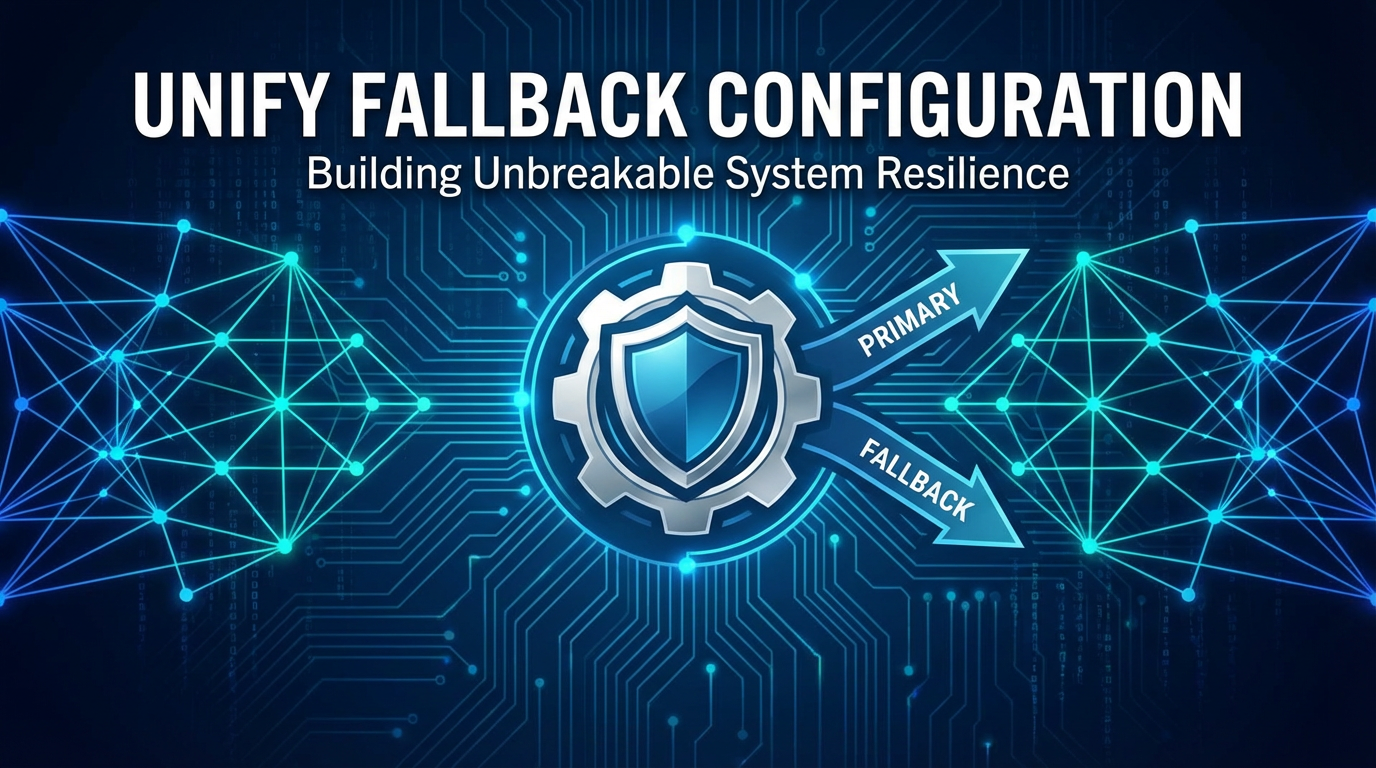


In the intricate tapestry of modern software architecture, where microservices dance across distributed systems and cloud-native paradigms dictate design, the specter of failure is not a possibility but an inevitability. Network partitions, transient service outages, resource contention, and even catastrophic hardware failures are constant threats that can unravel the most meticulously crafted applications. In this volatile environment, the concept of system resilience transcends mere best practice; it becomes a fundamental requirement for survival, directly impacting user satisfaction, operational costs, and ultimately, business continuity. At the heart of building robust, antifragile systems lies a critical yet often fragmented component: fallback mechanisms. While individual services frequently implement their own localized strategies to gracefully degrade or recover from issues, a lack of cohesive, unified fallback configuration often introduces more complexity and fragility than it solves. This comprehensive exploration delves into the profound importance of unifying fallback configurations, illuminating how such an approach not only fortifies system resilience but also streamlines management, enhances observability, and paves the way for a more predictable and robust digital infrastructure.
Chapter 1: The Imperative of System Resilience in a Connected World
The digital landscape has undergone a profound transformation, moving away from monolithic applications towards highly distributed, interconnected ecosystems. Today's applications are often composites, relying on dozens, if not hundreds, of internal microservices and external APIs, spanning cloud providers, third-party vendors, and specialized AI models. This architectural evolution, while offering unparalleled agility, scalability, and independent deployability, simultaneously amplifies the surface area for potential failures. A single hiccup in a seemingly minor downstream service can ripple through the entire system, leading to widespread outages, degraded performance, and a frustrating user experience.
Consider a large e-commerce platform during a peak shopping event. It relies on a product catalog service, a payment gateway, a recommendation engine powered by large language models, an inventory management system, and several other components. If the recommendation engine experiences a temporary outage due to an overloaded LLM Gateway or a transient issue with the underlying AI provider, an unresilient system might halt the entire checkout process, leading to lost sales and customer dissatisfaction. A truly resilient system, however, would detect the issue, apply a pre-configured fallback, perhaps by serving generic popular products or previously cached recommendations, allowing the user to proceed with their purchase uninterrupted.
Resilience, in this context, is not merely about preventing failures entirely – an often impossible task in distributed systems – but about enabling the system to recover gracefully, maintain core functionality, and adapt to adverse conditions. It encompasses concepts like fault tolerance, which allows a system to continue operating despite component failures; recoverability, the ability to restore normal operations after a failure; and graceful degradation, ensuring that critical functions remain operational even when non-essential services are impaired. The imperative for resilience stems from several key drivers:
- User Expectations: Modern users demand seamless, always-on experiences. Any disruption, however minor, erodes trust and encourages migration to competitors.
- Business Impact: Downtime translates directly into financial losses, reputational damage, and decreased productivity. For many businesses, their digital presence is their primary revenue stream.
- Complexity of Distributed Systems: The inherent complexity of microservices architectures means that failures are multivariate and often cascade in unpredictable ways. Proactive resilience strategies are essential to manage this complexity.
- Dependency on Third-Party Services: Cloud providers, payment gateways, authentication services, and specialized AI models introduce external points of failure that are beyond direct control. Resilience mechanisms must account for these external dependencies.
- Accelerated Release Cycles: DevOps methodologies and continuous delivery pipelines mean more frequent changes, increasing the potential for regressions and unexpected interactions that can trigger failures.
Building resilient systems demands a paradigm shift from reactive firefighting to proactive design. It requires embedding mechanisms into the very fabric of the architecture that anticipate, detect, and mitigate failures across various layers, from individual service instances to entire geographical regions. Without a deliberate focus on resilience, even the most innovative and performant systems remain inherently fragile, vulnerable to the slightest tremor in the vast, interconnected digital ecosystem.
Chapter 2: Understanding Fallback Mechanisms: The First Line of Defense
Fallback mechanisms are the vital safety nets woven into the fabric of a resilient system, designed to catch requests when primary operations falter. They represent a strategy of graceful degradation, ensuring that even in the face of partial or complete component failure, the system can still deliver a usable, albeit potentially reduced, experience to the end-user. Rather than crashing or returning an unhelpful error, a well-implemented fallback provides an alternative, often predefined, course of action. This might involve serving stale data, returning a default response, or routing requests to a secondary, less performant but available, service. Understanding the various types of fallback patterns and their applications is fundamental to designing a robust system.
The landscape of fallback mechanisms is rich and varied, each suited to different failure scenarios and operational contexts:
- Default Values/Static Responses: This is perhaps the simplest form of fallback. When a service cannot retrieve dynamic data, it returns a hardcoded, static value or a predefined "placeholder" message. For example, if a recommendation engine fails, instead of showing a blank section, it might display a static list of "top-selling products" or "editor's picks." While limited in its dynamism, it provides an immediate user-facing solution that prevents a broken UI.
- Cached Responses: For data that doesn't change frequently, caching is a powerful resilience pattern. If the primary data source (e.g., a database or another API) becomes unavailable, the system can serve the most recently cached version of the data. This might result in slightly stale information but ensures continuity of service. Cache-aside, read-through, and write-through patterns all support this strategy, often augmented with time-to-live (TTL) configurations to manage data freshness.
- Retry Mechanisms with Exponential Backoff: Many transient failures (e.g., network glitches, temporary service overloads) are resolved quickly. A retry mechanism allows a failed operation to be re-attempted after a short delay. Exponential backoff is crucial here, meaning the delay between retries increases exponentially (e.g., 1s, 2s, 4s, 8s), preventing a "thundering herd" problem where numerous retries exacerbate an already struggling service. However, retries must be finite and carefully considered for idempotent operations to avoid unintended side effects.
- Circuit Breakers: Inspired by electrical circuit breakers, this pattern prevents a system from repeatedly attempting an operation that is likely to fail. When a configured threshold of failures is met (e.g., 5 consecutive failures or 50% failure rate over a time window), the circuit "trips" open, and subsequent calls immediately fail or are directed to a fallback. After a timeout period, the circuit enters a "half-open" state, allowing a few test requests to pass through. If these succeed, the circuit closes; otherwise, it opens again. This protects the failing service from being overwhelmed and allows it to recover, while also saving calling services from waiting for inevitable timeouts.
- Bulkheads: This pattern isolates failing components to prevent cascading failures. Just as a ship's bulkheads contain water to a single compartment, this pattern restricts resource consumption (e.g., thread pools, connection pools) for specific dependencies. If one dependency starts misbehaving and consumes all resources, it only affects calls to that dependency, leaving other parts of the system unaffected. For example, a dedicated thread pool for a slow external API prevents it from hogging resources needed by other, healthier APIs.
- Rate Limiting: While often seen as a traffic management technique, rate limiting plays a critical role in resilience by preventing services from becoming overwhelmed. By enforcing limits on the number of requests a client or service can make within a given period, it acts as a proactive fallback, rejecting excess requests before they can degrade the service for everyone. This ensures that the service maintains a baseline level of performance even under heavy load, rather than outright failing.
- Timeouts: A fundamental resilience primitive, timeouts define the maximum duration a calling service will wait for a response from a dependency. Without timeouts, a slow or unresponsive service can indefinitely block the calling service's resources, leading to resource exhaustion and cascading failures. Timeouts ensure that operations fail fast, allowing fallback mechanisms to kick in promptly.
Implementing these mechanisms requires careful consideration. For instance, a circuit breaker might trigger a fallback to a cached response, while a timeout could initiate a retry sequence before ultimately resorting to a default value. The challenge, however, often lies not in understanding individual patterns, but in orchestrating them coherently across a complex, distributed landscape. When each team or service implements these in isolation, using different libraries, configurations, and mental models, the overall system becomes a patchwork of inconsistent and unpredictable behaviors, setting the stage for the complexities we will explore in the next chapter.
Chapter 3: The Complexity Quandary: Why Current Fallback Approaches Fall Short
The very strength of individual fallback mechanisms, when implemented in isolation, paradoxically becomes a source of significant systemic weakness. As organizations scale and their architectures evolve into sophisticated microservices ecosystems, the ad-hoc, siloed approach to resilience configuration inevitably leads to a complexity quandary. This fragmentation, where each team, service, or even individual component defines its own unique set of fallback rules, creates a labyrinth of inconsistencies that undermines the very resilience it aims to foster.
One of the most glaring issues is inconsistency in behavior. Imagine a scenario where three different microservices—Service A, Service B, and Service C—all depend on a shared external payment gateway. When the payment gateway experiences an outage: * Service A might implement a circuit breaker that immediately fails and returns a "payment unavailable" message. * Service B might have a retry mechanism with exponential backoff, eventually failing after 30 seconds to return a generic "transaction failed" error. * Service C might fallback to a cached response, allowing the user to proceed with a "pending payment" status, to be reconciled later. Each service behaves differently for the exact same underlying failure. This not only creates a fragmented user experience but also makes it incredibly difficult for operations teams to predict system behavior during an incident. When users report issues, diagnosing whether it's an upstream service problem or a specific fallback misconfiguration becomes a daunting task.
This lack of standardization also translates into a maintainability nightmare. As business requirements change or as new resilience best practices emerge, updating fallback logic across dozens or hundreds of services, each with its own implementation, library dependencies, and configuration format, becomes a monumental undertaking. This "N-times" problem significantly increases the effort and risk associated with even minor changes. Developers spend valuable time understanding existing, often undocumented, fallback logic rather than focusing on feature development.
Debugging and troubleshooting complex failure scenarios are exponentially harder in a fragmented environment. When a request traverses multiple services, each with its own fallback logic, tracing the exact path of execution, understanding where a fallback was triggered, and identifying the specific configuration that led to a particular outcome becomes a forensic challenge. Distributed tracing tools provide visibility into service calls, but they often struggle to clearly articulate the reason for a failure or the specific fallback that was activated without a unified configuration strategy that logs such events consistently. The cognitive load on engineers during an incident dramatically increases as they grapple with disparate logs and configuration files.
Furthermore, testing overhead for resilience grows prohibitively large. How can an organization confidently assert that its system will behave predictably under stress when fallback logic is scattered and inconsistent? Comprehensive testing, including chaos engineering experiments, becomes less effective when fallback behaviors are unpredictable. Ensuring that all fallback paths are correctly implemented, interact as expected, and recover gracefully is an arduous, often incomplete, process without a unified approach.
The fragmentation also leads to increased time-to-recovery (MTTR) during incidents. When an outage occurs, the lack of a centralized view or consistent application of fallback rules means that engineers must manually investigate individual service configurations, piece together the failure narrative, and then coordinate changes across multiple teams. This delays recovery, exacerbates the impact of the outage, and adds to operational stress.
Finally, the cognitive load on individual developers and the organization as a whole is significantly higher. Each developer must learn and re-learn different ways of implementing similar resilience patterns. New hires face a steep learning curve. The organization lacks a single source of truth for its resilience posture, leading to ad-hoc decisions and a reactive rather than proactive stance towards system failures. This inherent complexity not only makes the system more fragile but also stifles innovation by diverting engineering resources from value creation to managing self-inflicted architectural debt. The urgent need, therefore, is to move beyond this fragmented landscape towards a unified, consistent, and centrally managed approach to fallback configuration.
Chapter 4: The Vision of Unified Fallback Configuration
The challenges posed by disparate fallback mechanisms underscore an undeniable truth: for system resilience to be truly effective, it must be consistently applied, easily managed, and transparently observable. This is where the vision of unified fallback configuration emerges as a pivotal strategy. Unification does not imply a rigid, one-size-fits-all solution, but rather a cohesive framework that provides standardized patterns, centralized management, and consistent enforcement of resilience policies across an entire ecosystem. It's about bringing order to the chaos of individual implementations, transforming ad-hoc efforts into a strategic, architectural imperative.
At its core, "unified" means several things: * Centralized Management: Fallback rules and policies are defined and controlled from a single, authoritative source, rather than being scattered across numerous service repositories or configuration files. * Consistent Policies: Similar failure modes across different services trigger predictable and standardized fallback behaviors. The system reacts coherently, regardless of which component experiences an issue. * Standardized Interfaces: Whether configuring timeouts, circuit breaker thresholds, or retry parameters, developers interact with a consistent set of APIs or declarative formats, reducing cognitive load and improving ease of use. * Transparent Enforcement: Fallback logic is applied either transparently (e.g., via a service mesh sidecar or gateway) or through shared, well-understood libraries, ensuring that adherence to policy is automatic and verifiable.
The benefits of adopting such a unified approach are profound and transformative:
- Simplified Management and Maintenance: With fallback rules residing in a central location, updating a policy (e.g., adjusting a global retry count or circuit breaker threshold) becomes a single, atomic operation rather than a distributed, error-prone endeavor. This drastically reduces the overhead associated with maintaining resilience across a large system.
- Improved Consistency and Predictability: Users and operations teams alike benefit from a predictable system. When a component fails, the response is consistent across the application, leading to a more reliable user experience and more straightforward troubleshooting for engineers. This predictability builds trust in the system's ability to handle adversity.
- Enhanced Visibility and Observability: A unified framework allows for centralized logging and monitoring of fallback activations. Instead of piecing together disparate logs, operators can gain a holistic view of the system's resilience posture, identifying hotspots where fallbacks are frequently triggered and proactively addressing underlying issues. Dashboards can clearly indicate which services are currently operating under fallback conditions.
- Faster Incident Response: During an outage, a clear, unified understanding of fallback configurations means that teams can quickly diagnose issues, understand the system's degraded state, and implement targeted remediations. There’s no need to hunt for specific service configurations, reducing Mean Time To Recovery (MTTR) significantly.
- Reduced Development Overhead: Developers are liberated from reinventing the wheel for every service. Instead of implementing custom retry logic or circuit breakers, they can rely on standardized, pre-vetted mechanisms provided by the unified framework. This allows them to focus on core business logic, accelerating development cycles and improving code quality.
- Better Overall System Stability: By enforcing consistent resilience policies, the entire system becomes more stable and less prone to cascading failures. Weak links are identified and strengthened through standardized fallbacks, preventing minor issues from escalating into major outages.
Achieving unification hinges on several key principles: * Abstraction: Abstracting away the intricate details of resilience implementation from individual services. * Standardization: Establishing common patterns, definitions, and configuration schemas for fallback. * Centralization: Managing resilience policies from a single point of control. * Automation: Automating the deployment and enforcement of these policies wherever possible.
This strategic shift empowers organizations to move beyond reactive resilience, building systems that are inherently more robust, easier to manage, and more predictable in the face of inevitable failures. The subsequent chapters will delve into the architectural strategies and practical steps required to bring this vision of unified fallback configuration to fruition.
Chapter 5: Architectural Strategies for Unifying Fallback
Translating the vision of unified fallback configuration into a tangible reality requires deliberate architectural choices and the adoption of specific tools and patterns. The good news is that several established and emerging technologies provide robust frameworks for centralizing and standardizing resilience policies. The choice among them often depends on the existing infrastructure, the complexity of the system, and the desired level of control.
Externalized Configuration Systems
One of the foundational strategies for unification is to decouple configuration from application code. Externalized configuration systems, such as Spring Cloud Config, HashiCorp Consul, or etcd, serve as centralized repositories for all application settings, including fallback rules. * How it works: Instead of hardcoding retry counts or timeout values within each service, these parameters are stored in a central config server. Services then dynamically fetch their configurations at startup or refresh them during runtime. * Benefits: This approach provides a single source of truth for configurations, making it easy to change fallback policies without redeploying services. It promotes consistency and enables dynamic adjustments, which are critical during incident response. * Example: A payment service might retrieve its circuit breaker thresholds (e.g., failure rate threshold, sleep window) from Consul, ensuring all instances adhere to the same global policy.
Service Mesh
A service mesh, exemplified by tools like Istio, Linkerd, or Consul Connect, operates at the network layer, adding a transparent proxy (a "sidecar") alongside each service instance. These sidecars intercept all inbound and outbound network traffic, enabling the mesh to transparently inject powerful resilience patterns. * How it works: Resilience features like retries, timeouts, and circuit breakers can be configured centrally at the mesh control plane level. The sidecars then enforce these policies on behalf of the services, without requiring any changes to the service code itself. When a service makes an outbound call, its sidecar can manage the retry logic, apply the circuit breaker pattern, or enforce a timeout. * Benefits: This approach offers unparalleled transparency and consistency. Developers don't need to write resilience code; it's handled by the infrastructure. It provides powerful observability into network resilience events. Service meshes are particularly effective for inter-service communication within a cluster. * Example: A VirtualService or DestinationRule in Istio can define a global retry policy for calls to the product-catalog service, ensuring all client services adhere to the same resilience strategy.
API Gateway / AI Gateway: A Critical Unification Point
For services exposed externally, or when dealing with complex integrations with external AI models, an API Gateway or specifically an AI Gateway emerges as an exceptionally powerful and strategic location to unify fallback configurations. These gateways act as a single entry point for client requests, sitting between the clients and the backend services.
An AI Gateway (or LLM Gateway) is particularly relevant in architectures that leverage artificial intelligence and large language models. These models, often hosted by third-party providers, introduce unique resilience challenges: varying latencies, dynamic rate limits, and the potential for service disruptions from the provider. A dedicated AI Gateway can abstract away these complexities. * How it works: An LLM Gateway can manage requests to multiple LLMs, applying universal fallbacks, routing to secondary models, or returning cached/default responses upon primary model failure. For example, if the primary GPT-4 endpoint becomes unresponsive, the AI Gateway can automatically failover to a GPT-3.5 instance or even a local, less capable open-source model, ensuring that the application can still provide a response, albeit a degraded one. It can also enforce rate limits specific to AI providers or apply timeouts that prevent long-running AI inference requests from blocking upstream services. * Benefits: * Centralized Control for External Dependencies: It provides a single point to define and enforce resilience policies for all external API and AI service calls, which are often the most unpredictable. * Abstraction of AI Complexity: It hides the intricacies of multiple AI model integrations, offering a unified API interface to consuming applications. This makes it easier to implement consistent fallback logic, as the upstream services only interact with the gateway, not directly with the fluctuating AI endpoints. * Traffic Management & Load Balancing: An AI Gateway can intelligently route requests to different AI models or instances based on health checks, load, or cost, which is a prerequisite for effective failover and fallback. * Performance and Security: Beyond resilience, gateways also offer features like authentication, authorization, caching, and rate limiting, further enhancing the overall robustness and security of the system.
In this critical context, an AI Gateway like ApiPark can be instrumental in abstracting away the complexities of AI model integration and providing a centralized point for defining and applying robust fallback strategies. Its capability for quick integration of 100+ AI models and, crucially, a unified API format for AI invocation, inherently supports easier implementation of consistent fallback logic. For instance, if an application relies on a sentiment analysis model, ApiPark can manage the invocation, and if the primary model fails, its configuration can dictate routing to a secondary model or returning a predefined "neutral sentiment" fallback, all managed centrally. Furthermore, ApiPark's end-to-end API lifecycle management, detailed API call logging, and powerful data analysis features provide the necessary visibility to monitor fallback activations and understand their impact on system performance and resilience.
Shared Libraries/Frameworks
For organizations with strong internal standards and homogeneous technology stacks, distributing common fallback logic as reusable components within a shared library or framework can be effective. * How it works: Resilience patterns (e.g., custom retry logic, circuit breaker implementations) are encapsulated in a library that services can import and use. * Benefits: Ensures consistency in implementation details and behavior. Reduces boilerplate code for developers. * Drawbacks: Requires all services to adopt and regularly update the library. Changes require redeployments. Less transparent than service mesh.
Policy Engines
Advanced systems can employ dedicated policy engines that define and enforce resilience rules based on dynamic contexts. * How it works: Policies are written in a declarative language (e.g., OPA Rego) and enforced by various agents or components throughout the system. * Benefits: Highly flexible and dynamic. Can adapt policies based on real-time system state or external factors. * Drawbacks: Higher complexity in setup and management.
Each of these strategies offers distinct advantages, and often, a hybrid approach yields the best results. For instance, a service mesh might handle inter-service communication resilience, while an AI Gateway manages fallbacks for external AI dependencies, all driven by configurations stored in a central configuration system. The overarching goal remains consistent: to move fallback configuration out of individual service codebases and into a unified, manageable, and observable layer of the architecture.
APIPark is a high-performance AI gateway that allows you to securely access the most comprehensive LLM APIs globally on the APIPark platform, including OpenAI, Anthropic, Mistral, Llama2, Google Gemini, and more.Try APIPark now! 👇👇👇
Chapter 6: Deep Dive into Fallback for AI/LLM Systems
The integration of Artificial Intelligence, particularly Large Language Models (LLMs), into modern applications introduces a new layer of complexity and a heightened need for robust fallback mechanisms. While traditional microservices might face network or database issues, AI/LLM systems contend with a unique set of challenges that make unified fallback configuration not just beneficial, but absolutely critical for reliable operation.
Specific Challenges of AI/LLM Systems:
- Varying Model Performance and Latency: Different AI models, even from the same provider, can exhibit unpredictable performance characteristics. Response times can fluctuate based on model load, complexity of the prompt, or internal processing queues. A unified fallback strategy needs to account for these dynamic latencies.
- Rate Limits and Cost Considerations: Most commercial LLM providers enforce strict rate limits to manage their infrastructure. Exceeding these limits results in errors. Moreover, LLM invocations often incur costs based on token usage. Uncontrolled retries or inefficient routing can quickly lead to budget overruns.
- Model Failures and Quality Degradation: LLMs, despite their sophistication, can "fail" in various ways:
- Hallucinations: Providing factually incorrect or nonsensical responses.
- Out-of-Memory (OOM) Errors: For self-hosted models, complex prompts can exhaust computational resources.
- Invalid Inputs: Failing to process malformed or excessively long prompts.
- Provider Outages: The third-party services hosting these models can experience their own downtime or API issues.
- Performance Drift: Over time, model behavior might subtly change, leading to degraded quality of responses without outright failure.
- Security and Data Privacy: Relying on external AI services necessitates careful handling of sensitive data. Fallback strategies must not inadvertently expose or mishandle data during a failure.
Given these unique characteristics, a fragmented approach to AI resilience would quickly lead to an unmanageable system. Each application integrating an LLM might implement its own retry logic, model selection, and error handling, resulting in inconsistent user experiences, difficult debugging, and potentially significant operational costs. This is where a unified fallback strategy, typically orchestrated by an LLM Gateway or AI Gateway, becomes indispensable.
How Unified Fallback is Even More Critical Here:
A central gateway acts as an intelligent intermediary, abstracting the complexities of multiple AI providers and models from the consuming application. This allows for the definition and enforcement of comprehensive resilience policies at a single control point.
Examples of AI-Specific Fallbacks Orchestrated by an LLM Gateway:
- Switching to a Cheaper/Faster Model (Tiered Fallback):
- Scenario: The primary, high-fidelity LLM (e.g., GPT-4) is experiencing high latency or has exceeded its rate limit.
- Fallback: The LLM Gateway detects the issue and automatically routes the request to a slightly less capable but faster and cheaper model (e.g., GPT-3.5 Turbo or a smaller open-source model like Llama 3) that can still provide a reasonable response. The configuration for this tiered fallback is managed centrally within the gateway.
- Downgrading to a Simpler Model or Canned Response (Quality Degradation):
- Scenario: All advanced LLM options are unavailable or responding with extremely poor quality.
- Fallback: The gateway can be configured to downgrade to a very basic, deterministic model or even return a canned, static response ("We're experiencing high demand, please try again later" or "Basic information requested: [default response]"). This ensures a graceful degradation rather than a complete service disruption.
- Caching Previous Successful Responses for Similar Prompts:
- Scenario: A user repeatedly asks for a summary of a specific document, and the LLM service is currently struggling.
- Fallback: The LLM Gateway can implement a cache, storing successful LLM responses based on prompt hashes or semantic similarity. If the primary LLM fails, the gateway can serve a relevant, previously generated response from its cache, configured with appropriate TTLs.
- Human-in-the-Loop Fallback:
- Scenario: A critical AI decision-making process fails, and an automated fallback isn't sufficient or safe.
- Fallback: The gateway triggers an alert to a human operator or queues the request for manual review. While not instantaneous, this prevents erroneous automated actions or ensures critical tasks are eventually completed.
- Proactive Rate Limit Management:
- Scenario: The application is about to hit the LLM provider's rate limit.
- Fallback: The LLM Proxy can proactively queue requests, apply internal rate limiting, or return an immediate "too many requests" error before the external provider's limit is hit, preventing more severe errors or temporary blocks from the provider.
The role of an LLM Gateway (or LLM Proxy) is to act as an intelligent orchestrator and resilience layer, implementing these complex fallbacks across diverse models and providers. It can apply circuit breakers to specific model endpoints, manage retries with backoff strategies, and perform health checks on various AI services. By centralizing these configurations within the gateway, organizations gain a unified control plane for AI resilience, ensuring consistent behavior, optimizing costs, and significantly enhancing the reliability of AI-powered applications. Without such a unified approach, the promise of AI can quickly turn into a nightmare of unpredictable failures and escalating operational expenses.
Chapter 7: Implementing Unified Fallback: Best Practices and Practical Steps
Implementing a unified fallback configuration is a journey, not a destination. It requires a strategic mindset, incremental adoption, and continuous refinement. By adhering to best practices and following practical steps, organizations can systematically build a more resilient and manageable system.
1. Start Small, Identify Critical Paths
Attempting to unify fallback across an entire sprawling system overnight is a recipe for overwhelm. Begin by identifying the most critical business functions and their dependencies. * Practical Step: Map out your system's critical user journeys. Pinpoint the services and external APIs that are essential for these journeys. These are your initial targets for implementing unified fallback. For example, in an e-commerce application, the payment processing flow and product availability checks are high-priority. For AI-driven applications, the core LLM inference paths are paramount.
2. Standardize Data Models and Configuration Schemas
Consistency in how fallback rules are defined is foundational to unification. Without a standard schema, even centralized configurations can become unwieldy. * Practical Step: Define a common data model for your fallback configurations. This might include fields for: * service_name / api_path * failure_type (e.g., timeout, network_error, rate_limit_exceeded, provider_error) * primary_action (e.g., call_external_api, invoke_llm) * fallback_strategy (e.g., return_cached_response, route_to_secondary_model, static_default, retry_with_backoff) * fallback_parameters (e.g., cache_key, secondary_model_id, max_retries, retry_delay) * circuit_breaker_thresholds (e.g., failure_rate, sleep_window) Use a declarative format like YAML or JSON for these configurations.
3. Centralized Configuration Management
Leverage existing tools or introduce new ones to manage your standardized fallback configurations from a single source. * Practical Step: Implement an externalized configuration system (e.g., Spring Cloud Config, HashiCorp Consul, Kubernetes ConfigMaps) to store all your fallback rules. Ensure that services can dynamically fetch and update these configurations without requiring redeployments. For systems using an AI Gateway or LLM Gateway, these rules should primarily be managed within the gateway's configuration interface for external AI/API dependencies.
4. Implement Through Architectural Intermediaries
Instead of embedding fallback logic in every service, push it to architectural layers designed for cross-cutting concerns. * Practical Step: * For internal service-to-service communication: Utilize a service mesh (Istio, Linkerd) to inject and manage retries, timeouts, and circuit breakers via sidecars. Configure these centrally at the mesh control plane. * For external API and AI model interactions: Deploy an AI Gateway or LLM Gateway (like ApiPark) as the dedicated entry point for all calls to external providers. Configure all model switching, rate limiting, caching, and static fallbacks within the gateway. This centralizes the most volatile resilience logic. * For shared internal utilities: If necessary, create shared libraries for very specific, intricate fallback patterns that can't be handled by the mesh or gateway, ensuring these are rigorously tested and versioned.
5. Automated Testing is Non-Negotiable
Fallback mechanisms only provide value if they work as expected under failure conditions. Manual testing is insufficient for complex distributed systems. * Practical Step: * Unit and Integration Tests: Write tests for your gateway configurations or service mesh policies that simulate various failure modes (e.g., downstream service returning 500s, timeouts). * Chaos Engineering: Regularly run chaos experiments (using tools like Gremlin, LitmusChaos) to inject failures (e.g., network latency, CPU exhaustion, service termination) and observe how your unified fallbacks respond in a production-like environment. This is crucial for verifying the system's resilience end-to-end.
6. Robust Monitoring, Alerting, and Observability
Understanding when and how fallbacks are activated is critical for diagnosing issues and identifying areas for improvement. * Practical Step: * Metrics: Instrument your AI Gateway, service mesh, and individual services to emit metrics whenever a fallback is triggered (e.g., fallback_activated_total, fallback_strategy_type_count). Monitor these metrics on dashboards. * Alerting: Set up alerts for high rates of fallback activation, indicating an underlying problem that needs attention. Differentiate between graceful degradation and critical failures. * Logging: Ensure that detailed logs are generated when fallbacks are invoked, including the reason for the fallback and the specific strategy applied. ApiPark's detailed API call logging and powerful data analysis features can be invaluable here, providing insights into fallback patterns for AI invocations. * Distributed Tracing: Utilize distributed tracing (e.g., OpenTelemetry, Jaeger) to visualize the entire request path, explicitly showing when a fallback was engaged and how the request flow was altered.
7. Comprehensive Documentation and Training
Even with unified configurations, clarity and understanding are paramount. * Practical Step: Document your standardized fallback policies, the configuration schema, and how to implement and test them. Provide training sessions for development and operations teams to ensure everyone understands the unified approach and their role in maintaining system resilience.
8. Gradual Rollout and Iteration
Introduce unified fallbacks incrementally, validating each step. * Practical Step: Start with a few non-critical services or a new project. Monitor its performance and resilience closely. Once confident, expand the adoption to more critical components. Use A/B testing or canary deployments to test new fallback configurations in production safely. Regularly review fallback effectiveness and adjust policies as your system evolves and new failure patterns emerge.
By meticulously following these steps, organizations can move from a state of fragmented, reactive resilience to a proactive, unified, and systematically robust system, better equipped to weather the inevitable storms of distributed computing.
Chapter 8: Case Study: Protecting a Modern Retail Platform with Unified Fallback
To illustrate the tangible benefits of a unified fallback configuration, let's consider a modern retail platform built on a microservices architecture. This platform heavily relies on various internal services and external APIs, including a critical recommendation engine powered by a Large Language Model (LLM) and a third-party payment gateway.
The platform architecture includes: * Frontend Service: User interface for browsing products, adding to cart, and checkout. * Product Catalog Service: Retrieves product details from a database. * User Profile Service: Manages user authentication and preferences. * Recommendation Engine Service: Invokes an external LLM to generate personalized product recommendations. * Order Processing Service: Coordinates the checkout flow. * Payment Gateway (External API): Handles all payment transactions. * LLM Provider (External API): Provides AI inference for recommendations.
Without unified fallback, each of these services might independently handle failures, leading to the "complexity quandary" discussed earlier. However, by implementing a unified strategy leveraging a service mesh for internal communications and an AI Gateway for external AI/API interactions, the platform achieves robust resilience.
Here's how unified fallback configurations are applied:
1. Centralized Configuration for Internal Services (via Service Mesh): All internal service-to-service communication resilience policies (timeouts, retries, circuit breakers) are managed through a central service mesh control plane. Developers define these policies in YAML files that are applied globally or per service via the mesh, rather than within their application code.
2. AI Gateway for External LLM/API Resilience: An AI Gateway (similar to ApiPark) is deployed as the single point of contact for the Recommendation Engine Service to interact with the external LLM Provider and for the Order Processing Service to interact with the Payment Gateway. This gateway handles all resilience logic for these external dependencies.
Let's examine specific failure modes and their unified fallback strategies:
| Service/Component | Failure Mode | Unified Fallback Strategy Applied At | Configuration Source/Mechanism | Expected Outcome for User |
|---|---|---|---|---|
| Payment Gateway | External API Unreachable / Timeout | AI Gateway (API Gateway Functionality) | Gateway Configuration (e.g., declarative YAML) | Order Processing Service retries (3x with exp. backoff); then returns "Payment service temporarily unavailable. Please try again." |
| Product Catalog Service | Internal Database Query Timeout / Error | Service Mesh (Sidecar) | Service Mesh Policy (e.g., Istio DestinationRule) |
Frontend Service serves cached product data (stale data policy) if available; otherwise, displays a generic "Products loading..." message. |
| Recommendation Engine Service | LLM Provider A Down / Slow / Rate Limit Hit | AI Gateway (LLM Gateway Functionality) | Gateway Configuration (e.g., declarative YAML for model routing) | Frontend Service displays recommendations from LLM Provider B (if available) or generic "Popular Products" from cache. |
| User Profile Service | Authentication Service Error | Service Mesh (Sidecar) | Shared Auth Library (with circuit breaker config in mesh) | Frontend Service prevents access to personalized features, prompts for re-login with informative error. |
| Order Processing Service | Inventory Service Unresponsive (Internal) | Service Mesh (Sidecar) | Service Mesh Policy (e.g., Istio DestinationRule) |
Order Processing Service fails fast with circuit breaker, then allows order to proceed with "Inventory check pending" status. |
Detailed Walkthrough of a Recommendation Engine Failure:
- User Browses Products: The Frontend Service calls the Recommendation Engine Service to fetch personalized product suggestions.
- Request to LLM Gateway: The Recommendation Engine Service sends the user's context (e.g., browsing history, previous purchases) to the AI Gateway.
- Primary LLM Provider Fails: The AI Gateway attempts to invoke
LLM Provider A(e.g., GPT-4) for the recommendation. However,LLM Provider Ais experiencing a high error rate, or its API call times out due to network congestion. - AI Gateway Fallback:
- The AI Gateway detects the failure and immediately triggers its pre-configured fallback strategy.
- First Layer Fallback: It attempts to route the request to
LLM Provider B(e.g., GPT-3.5 Turbo), a secondary, slightly less accurate but more resilient or cost-effective model, if available. This is configured directly within the gateway's routing rules. - Second Layer Fallback (if LLM Provider B also fails): If
LLM Provider Bis also unavailable or returns errors, the AI Gateway invokes a further fallback: serving "Popular Products" from an internal cache. This cache is maintained by the gateway and populated with frequently updated, non-personalized product lists.
- Recommendation Displayed: The Frontend Service receives either recommendations from
LLM Provider Bor the cached "Popular Products" list. The user experience is preserved, albeit with potentially less personalized content, avoiding a blank or error-filled section. - Observability: The AI Gateway logs the fallback event (e.g., "LLM Provider A failed, routed to Provider B," or "Served cached recommendations"). Metrics are emitted to Prometheus (e.g.,
ai_gateway_fallback_total{strategy="route_to_secondary_model"}). This allows operations teams to monitor the health of LLM integrations and identify persistent issues.
This case study demonstrates how unified fallback configuration, enforced at appropriate architectural layers (service mesh for internal, AI Gateway for external), ensures system resilience. It transforms potential critical outages into graceful degradations, maintains a consistent user experience, and provides clear observability for operations, making the platform robust against the myriad of failures inherent in distributed systems. The role of the AI Gateway as an LLM Gateway becomes particularly prominent here, acting as the intelligent orchestration point for all AI model resilience.
Chapter 9: The Future of Resilience and Fallback Management
As software systems continue to grow in scale, complexity, and dependence on external services, the strategies for building and maintaining resilience must evolve in lockstep. The future of fallback management is not merely about consolidating existing patterns but about pioneering more intelligent, adaptive, and autonomous approaches to system stability.
One of the most exciting frontiers is AI-driven resilience. While this article has discussed using an AI Gateway to manage fallbacks for AI services, the future envisions AI managing resilience itself. Imagine systems that leverage machine learning to: * Predictive Fallbacks: Analyze historical performance data and real-time telemetry to predict potential failures before they occur. This could involve identifying anomalous latency patterns or resource exhaustion trends and proactively activating fallbacks (e.g., pre-emptively routing traffic to a secondary region, reducing load on a specific service) before an actual outage. * Self-Healing Systems: Beyond simple fallbacks, AI could orchestrate complex recovery actions, such as automatically scaling up resources, rerouting traffic based on real-time network conditions, or even adjusting application configurations in response to emerging threats. The system would become an "autonomic computing" entity, capable of self-healing. * Optimized Fallback Strategies: AI could dynamically choose the most appropriate fallback strategy based on the current context, the nature of the failure, and business priorities. For instance, in a low-traffic period, it might favor a more conservative retry strategy, whereas during peak hours, it might immediately switch to a simpler model or cached response to maintain availability.
More sophisticated policy engines will become central to future resilience. These engines will move beyond simple if-then rules to encompass complex, context-aware decision-making. They will be able to evaluate multiple factors—current system load, cost implications, user segment, data sensitivity, and the severity of the failure—to determine the optimal fallback action. For example, a policy might dictate: "If the premium LLM fails for a platinum user, try a high-performance backup LLM. If that also fails, return a personalized cached response. But for a free-tier user, immediately fallback to a generic static response to conserve resources." These engines will be highly declarative and extensible, allowing organizations to encode nuanced business logic directly into their resilience policies.
The proliferation of serverless functions and platform-level fallbacks also promises to simplify resilience for developers. Cloud providers are increasingly offering built-in resilience features for their serverless offerings (e.g., retries for Lambda invocations, dead-letter queues, automatic scaling). The future will see more advanced platform-level fallbacks that abstract away even more resilience concerns. Developers will be able to configure high-level resilience policies, and the underlying cloud infrastructure will take care of implementing and enforcing them transparently, reducing the operational burden on development teams.
Finally, there will be a continued emphasis on developer experience for configuring resilience. While the underlying mechanisms become more sophisticated, the interfaces for defining fallback rules must become simpler and more intuitive. This involves: * Domain-Specific Languages (DSLs): Providing clear, concise DSLs for defining resilience policies that are easy for developers to understand and write. * Visual Configuration Tools: Offering graphical interfaces that allow developers to visually design fallback workflows and observe their impact. * Integrated Observability: Tightly coupling resilience configuration with observability tools, so developers can immediately see the effects of their fallback rules in action.
The journey towards unified fallback configuration is a crucial step in building resilient systems today. The future, however, points towards an era where resilience is not just a configuration task but an intelligent, self-aware, and continuously optimizing attribute of the system itself, driven by the very AI it protects. This evolution will further cement the role of specialized gateways and orchestration layers as vital components in the architecture of tomorrow's robust digital services.
Conclusion
In an era defined by interconnectedness and relentless digital demands, system resilience is no longer a luxury but an existential necessity. The pervasive adoption of microservices, cloud-native architectures, and sophisticated AI models, particularly Large Language Models, introduces an unprecedented level of complexity and potential points of failure. While individual fallback mechanisms are vital, their fragmented, ad-hoc implementation has historically sown the seeds of inconsistency, operational overhead, and ultimately, fragility.
This comprehensive exploration has underscored the profound imperative of unifying fallback configurations. By centralizing management, standardizing policies, and abstracting implementation details, organizations can transform a patchwork of defensive measures into a coherent, predictable, and robust resilience framework. We've delved into the myriad challenges posed by disparate approaches, from debugging nightmares to maintainability crises, and illuminated the transformative benefits of unification: simplified management, enhanced consistency, faster incident response, and a more stable, trustworthy system overall.
Architectural strategies like externalized configuration systems, service meshes, and critically, specialized AI Gateways (or LLM Gateways) offer tangible pathways to achieve this unification. These layers provide the strategic control points necessary to define and enforce resilience policies transparently, especially for the volatile and high-stakes interactions with external APIs and AI models. An AI Gateway like ApiPark stands out as a powerful enabler in this domain, providing a centralized platform to manage the complexities of AI model integration and enforce robust, unified fallback strategies that protect applications from the inherent unpredictability of AI services.
Implementing this vision requires discipline: starting small, standardizing configurations, embracing automated testing, and establishing robust monitoring. The future promises even more intelligent, AI-driven resilience, where systems proactively adapt and heal, further cementing the role of sophisticated policy engines and simplified developer experiences.
Ultimately, resilience is a continuous journey, not a destination. Unifying fallback configurations is a pivotal step on this journey, empowering developers to build with confidence and enabling businesses to operate with unparalleled stability. By adopting a cohesive, strategic approach to fallback, organizations can move beyond merely reacting to failures, instead crafting antifragile systems that not only withstand the inevitable shocks but emerge stronger and more reliable from every challenge.
Frequently Asked Questions (FAQs)
1. What exactly does "unified fallback configuration" mean? Unified fallback configuration refers to the practice of standardizing, centralizing, and consistently applying resilience strategies (like retries, timeouts, circuit breakers, and alternative responses) across an entire software system. Instead of individual services implementing their own distinct fallback logic, a unified approach ensures that these rules are defined and managed from a single, authoritative source or enforced transparently by architectural layers, leading to predictable behavior and simplified management during failures.
2. Why is unifying fallback configurations more important now than ever? The complexity of modern distributed systems, microservices architectures, and heavy reliance on external APIs and AI models has drastically increased potential points of failure. Fragmented fallback approaches lead to inconsistent user experiences, make debugging and maintenance extremely difficult, and increase the Mean Time To Recovery (MTTR) during outages. Unification is crucial to manage this complexity, ensure predictable system behavior, and maintain operational stability in dynamic environments.
3. What role does an AI Gateway or LLM Gateway play in unified fallback? An AI Gateway (or LLM Gateway) acts as a critical control point for managing interactions with external AI models and APIs. It's an ideal location to centralize fallback configurations specific to these external dependencies. This includes strategies like routing requests to secondary AI models, serving cached AI responses, applying specific rate limits for AI providers, or gracefully degrading to simpler models when primary ones fail. By abstracting these complexities, the gateway ensures consistent and robust fallback behavior for all AI-powered features across an application.
4. What are some practical steps to begin unifying fallback configurations in an existing system? Start by identifying critical user journeys and their dependencies. Define a standardized data model for your fallback rules using a declarative format (e.g., YAML/JSON). Leverage a centralized configuration system (like Spring Cloud Config or Consul) to store these rules. For external dependencies, implement an AI Gateway to manage their fallbacks. For internal service communication, consider a service mesh. Crucially, automate testing of these fallbacks (including chaos engineering) and establish robust monitoring to track their activation and effectiveness.
5. How does unified fallback configuration benefit both developers and operations teams? For developers, it significantly reduces the cognitive load and boilerplate code by providing standardized, pre-vetted resilience patterns. They can focus on core business logic, knowing that resilience is handled by the architecture. For operations teams, unified fallbacks provide consistent system behavior during failures, making incident diagnosis faster and more predictable. Centralized logging and metrics offer clear visibility into system health and fallback activations, enabling quicker response times and more effective preventative maintenance.
🚀You can securely and efficiently call the OpenAI API on APIPark in just two steps:
Step 1: Deploy the APIPark AI gateway in 5 minutes.
APIPark is developed based on Golang, offering strong product performance and low development and maintenance costs. You can deploy APIPark with a single command line.
curl -sSO https://download.apipark.com/install/quick-start.sh; bash quick-start.sh

In my experience, you can see the successful deployment interface within 5 to 10 minutes. Then, you can log in to APIPark using your account.

Step 2: Call the OpenAI API.