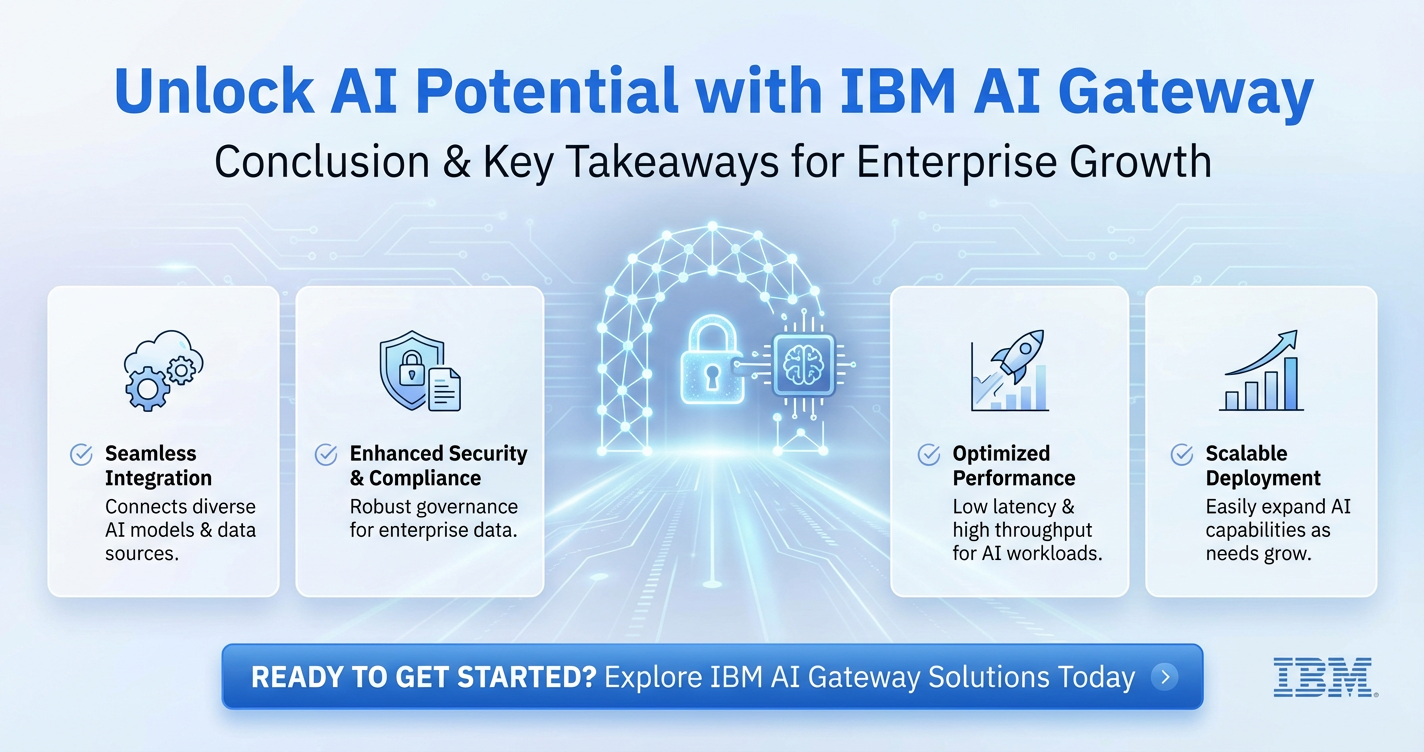
Unlock AI Potential with IBM AI Gateway


The relentless march of artificial intelligence continues to reshape industries, redefine human-computer interaction, and unlock unprecedented avenues for innovation. From automating mundane tasks to powering advanced scientific discovery, AI’s transformative potential is undeniable. However, harnessing this power within an enterprise setting presents a unique set of challenges. Organizations grapple with integrating a diverse array of AI models, ensuring their security, optimizing performance, managing costs, and maintaining compliance across complex, often hybrid, IT landscapes. This intricate orchestration often becomes a bottleneck, hindering the very agility and innovation that AI promises.
Enter the AI Gateway – a pivotal architectural component that serves as the strategic fulcrum for managing and securing an organization's AI ecosystem. More than just a traditional API Gateway, an AI Gateway is purpose-built to address the specialized requirements of artificial intelligence workloads, particularly the burgeoning field of large language models (LLMs). IBM, a long-standing pioneer in enterprise technology and AI innovation, offers a comprehensive approach to building and leveraging such gateways, empowering businesses to unlock their AI potential responsibly and at scale. This extensive exploration will delve into the critical role of the AI Gateway, illuminate IBM's strategic vision and capabilities in this space, and provide a deep dive into how these sophisticated solutions pave the way for a more intelligent, efficient, and secure future.
The Evolving Landscape of Artificial Intelligence: Complexity and Opportunity
The journey of AI has seen remarkable advancements, moving from rule-based systems to sophisticated machine learning algorithms and, more recently, to the era of deep learning and generative AI. Today's enterprise AI landscape is characterized by:
- Diversity of Models: Organizations are deploying a wide spectrum of AI models, including natural language processing (NLP) for sentiment analysis and chatbots, computer vision for object detection and facial recognition, predictive analytics for demand forecasting and fraud detection, and recommendation engines for personalized customer experiences. Each model often comes with its own unique inference requirements, data formats, and computational demands.
- Proliferation of LLMs: The emergence of Large Language Models (LLMs) has marked a significant inflection point. Models like GPT, LLaMA, and their derivatives offer unprecedented capabilities in natural language understanding, generation, summarization, and code creation. While immensely powerful, LLMs introduce novel challenges related to prompt engineering, token management, contextual memory, ethical considerations, and substantial computational costs.
- Hybrid and Multicloud Deployments: Enterprises rarely operate within a single, monolithic environment. AI models and their supporting infrastructure are often distributed across on-premises data centers, private clouds, and multiple public cloud providers. This distributed nature complicates unified management, consistent security policies, and optimized resource allocation.
- Data Gravity and Governance: AI models are inherently data-hungry. The necessity to access vast datasets, often sensitive or regulated, across different environments raises complex issues of data sovereignty, privacy, and compliance. Ensuring that data accessed for AI inference adheres to stringent governance policies is paramount.
- Rapid Innovation Cycle: The field of AI is evolving at an exhilarating pace. New models, techniques, and frameworks are released constantly. Enterprises need infrastructure that can adapt quickly, allowing for rapid experimentation, deployment, and iteration of AI solutions without disrupting existing operations.
These factors collectively underscore the imperative for a robust, intelligent intermediary layer that can abstract away much of this complexity, providing a streamlined and secure pathway for applications to consume AI services. This is precisely where the AI Gateway becomes indispensable.
Deconstructing the AI Gateway: Beyond Traditional API Management
At its core, an AI Gateway acts as a centralized entry point for all AI-related services, mediating interactions between client applications and various AI models. While it shares some fundamental characteristics with a traditional API Gateway, its specialized functionalities are tailored to the unique demands of artificial intelligence workloads.
The Foundation: Similarities with an API Gateway
Like any good API Gateway, an AI Gateway provides essential functions that are crucial for managing any set of backend services:
- Authentication and Authorization: Verifying the identity of the client application and determining its permissions to access specific AI models or endpoints. This might involve API keys, OAuth tokens, JWTs, or other enterprise-grade security protocols.
- Rate Limiting and Throttling: Preventing abuse, ensuring fair usage, and protecting backend AI inference engines from being overwhelmed by too many requests. This is particularly important for computationally intensive AI models.
- Traffic Management: Routing requests to the appropriate AI service, load balancing across multiple instances of a model, and implementing circuit breakers to prevent cascading failures.
- Logging and Monitoring: Recording every API call, collecting performance metrics, and providing observability into the health and usage patterns of the AI services. This data is critical for auditing, troubleshooting, and capacity planning.
- Protocol Translation: Standardizing the interface for clients, regardless of the underlying protocol used by the AI model (e.g., exposing a REST API for a gRPC-based inference service).
- Caching: Storing responses to frequently requested inferences to reduce latency and computational cost.
These foundational capabilities are non-negotiable for any enterprise-grade service management layer. However, the AI Gateway extends these functionalities significantly to address the specific intricacies of AI.
The Evolution: Specialized AI-Centric Capabilities
What truly differentiates an AI Gateway from a generic API Gateway are its AI-specific features designed to handle the nuances of model interaction, data processing, and operational efficiency:
- Unified Inference API: AI models often have diverse input and output formats. An AI Gateway standardizes these, providing a consistent API for applications to interact with various models (e.g., a single
/predictendpoint that intelligently routes and translates requests for different vision or NLP models). This greatly simplifies application development and reduces integration overhead. - Model Versioning and Lifecycle Management: The ability to seamlessly deploy new model versions, conduct A/B testing, perform canary releases, and roll back to previous versions without downtime is critical for iterative AI development. The gateway manages this routing and ensures clients always get the intended model version.
- Prompt Management and Orchestration (for LLMs): For LLMs, the gateway can abstract away the complexity of prompt engineering. It can store, version, and inject dynamic prompts, manage conversational context, and even chain multiple prompts or models together to achieve complex tasks. This is a core function of an LLM Gateway.
- Cost Optimization and Tracking: AI inference, especially with LLMs, can be expensive. The gateway can provide granular cost tracking per model, per user, or per application, allowing organizations to monitor spending, enforce quotas, and make data-driven decisions about resource allocation.
- AI-Specific Security and Data Governance: Beyond standard security, an AI Gateway can implement features like data anonymization or obfuscation for sensitive input data before it reaches the model, enforce policy-based access control based on data sensitivity, and detect model-specific threats like prompt injection attacks or adversarial inputs.
- Semantic Caching: For LLMs, simple key-value caching is insufficient. A semantic cache understands the meaning of the input and can return cached responses even if the exact phrasing differs, significantly reducing latency and cost for similar queries.
- Model Routing and Selection: Based on factors like performance, cost, availability, or the specific characteristics of a request, the gateway can intelligently route requests to the most appropriate AI model or inference engine. This could involve choosing between a large foundational model and a smaller, fine-tuned model.
- Guardrails and Responsible AI: The gateway can integrate with content moderation services, apply ethical filters, and implement specific guardrails to prevent harmful, biased, or inappropriate outputs from AI models, particularly LLMs.
In essence, an AI Gateway elevates traditional API management to address the unique computational, security, and operational challenges inherent in modern AI deployments, acting as an intelligent intermediary layer that streamlines access, enhances security, and optimizes the performance and cost-efficiency of AI services.
IBM's Vision for Unlocking AI Potential with an AI Gateway
IBM has a rich history in AI, from Watson's groundbreaking achievements to its continued leadership in enterprise AI, hybrid cloud, and trusted AI initiatives. IBM's strategy for an AI Gateway is not merely about providing a single product but about offering a comprehensive ecosystem of tools, platforms, and services that collectively deliver robust AI gateway functionalities tailored for the enterprise. This approach emphasizes:
- Hybrid Cloud Pervasiveness: Recognizing that AI workloads live everywhere, IBM's solutions are designed to operate seamlessly across public clouds (IBM Cloud, AWS, Azure, Google Cloud), private clouds, and on-premises environments, providing consistent management and governance.
- Trusted AI and Governance: IBM places a strong emphasis on responsible AI. Their AI Gateway capabilities integrate with broader governance frameworks, ensuring explainability, fairness, transparency, and compliance throughout the AI lifecycle.
- Openness and Flexibility: While offering powerful proprietary capabilities, IBM also embraces open standards and allows integration with a wide array of open-source AI models and frameworks, providing flexibility for organizations to choose the best models for their needs.
- Enterprise-Grade Scalability and Security: Built for the demands of large organizations, IBM's AI Gateway solutions are engineered for high availability, extreme scalability, and multi-layered security protocols that meet the most stringent enterprise requirements.
Within the IBM ecosystem, various components contribute to realizing the vision of a powerful AI Gateway. While there might not be a single product explicitly labeled "IBM AI Gateway," the functionalities are delivered through synergistic platforms like IBM Cloud Pak for Data, IBM API Connect, Watson services, and various integration services. These platforms collectively enable the creation of a sophisticated AI Gateway environment.
Core Capabilities of a Robust IBM AI Gateway Implementation
Let's delve deeper into the specific capabilities an enterprise can expect when implementing an AI Gateway approach leveraging IBM's technologies.
1. Unified Access and Management for Diverse AI Models
An IBM-powered AI Gateway provides a single, consistent interface for client applications to access a multitude of AI models, whether they are IBM Watson services, open-source models deployed on Red Hat OpenShift, or custom models running on any cloud.
- Centralized Endpoint: All AI inference requests are routed through a single entry point, abstracting the complexity of underlying model locations, types, and APIs. This simplifies client-side integration and reduces development time.
- Homogenized API Experience: Regardless of whether the backend AI model expects a specific JSON format, a gRPC call, or a custom protocol, the gateway can normalize requests and responses to a consistent, developer-friendly RESTful API. This means a developer integrating a sentiment analysis model from Watson and a custom image recognition model from a third party will interact with them through largely identical API paradigms.
- Service Discovery and Cataloging: The gateway can integrate with service registries, allowing it to dynamically discover available AI models and present them in a catalog. This enhances developer productivity by providing a clear inventory of accessible AI services and their documentation.
- Dynamic Model Routing: Based on criteria such as the requested model name, version, user permissions, or even the content of the request itself, the gateway intelligently routes the API call to the correct AI inference endpoint. This capability supports dynamic load balancing and efficient resource utilization across various model deployments.
2. Comprehensive Security and Compliance for AI Workloads
Security is paramount, especially when AI models handle sensitive enterprise data. IBM's approach to an AI Gateway is deeply integrated with robust security and compliance frameworks.
- Multi-Factor Authentication and Authorization: The gateway enforces enterprise-grade authentication mechanisms (e.g., integration with LDAP, SAML, OAuth2, API keys) to verify the identity of calling applications and users. Fine-grained authorization policies determine which users or applications can access specific AI models or model versions, preventing unauthorized access.
- Data Masking and Anonymization: For requests containing sensitive information, the AI Gateway can be configured to automatically mask, encrypt, or anonymize specific data fields before they are passed to the AI model for inference. This is crucial for complying with privacy regulations like GDPR, HIPAA, and CCPA.
- End-to-End Encryption: All communication between client applications, the AI Gateway, and the AI inference engines is encrypted using industry-standard protocols (TLS/SSL), protecting data in transit from interception and tampering.
- Threat Detection for AI Endpoints: Beyond traditional network security, an IBM AI Gateway can integrate with AI-specific threat detection systems to identify and mitigate adversarial attacks, prompt injection vulnerabilities (for LLMs), or attempts to exploit model biases.
- Auditing and Compliance Logging: Every interaction with an AI model through the gateway is meticulously logged, including who accessed what, when, and with what input/output. These detailed audit trails are essential for forensic analysis, regulatory compliance, and demonstrating adherence to internal security policies.
- Policy Enforcement: Centralized policies can be applied to all AI interactions, ensuring consistency across the enterprise. This includes data residency policies, acceptable use policies, and ethical guidelines for AI output.
3. Optimized Performance and Scalability for Demanding AI Inferences
AI inference can be computationally intensive and latency-sensitive. An IBM AI Gateway is engineered to ensure optimal performance and seamless scalability.
- Intelligent Load Balancing: The gateway dynamically distributes incoming requests across multiple instances of an AI model, preventing any single instance from becoming a bottleneck. This can involve sophisticated algorithms that consider current load, latency, and resource availability.
- Advanced Caching Mechanisms: Beyond simple key-value caching, the gateway can implement intelligent caching strategies. For instance, responses to identical or semantically similar prompts for LLMs can be cached, significantly reducing latency and compute costs. Configurable time-to-live (TTL) and cache invalidation policies ensure data freshness.
- Autoscaling of Backend Models: Integration with underlying infrastructure orchestration tools (like Kubernetes within Red Hat OpenShift) allows the AI Gateway to trigger the autoscaling of AI model instances based on observed traffic patterns and performance metrics. This ensures elasticity and responsiveness during peak loads.
- Circuit Breakers and Retries: To enhance resilience, the gateway employs circuit breaker patterns. If a backend AI service becomes unresponsive or starts returning errors, the gateway can temporarily stop sending requests to it, preventing cascading failures and allowing the service to recover. Configurable retry mechanisms can automatically re-attempt failed requests under certain conditions.
- Geographical Routing: For global enterprises, the gateway can route requests to the closest available AI model deployment, minimizing network latency and improving user experience. This also supports data sovereignty requirements by keeping data processing within specific geographical boundaries.
4. Granular Cost Optimization and Deep Observability
Managing the costs associated with AI inference, especially LLMs, is a critical concern. An IBM AI Gateway provides robust tools for monitoring and optimizing these expenditures, alongside unparalleled observability.
- Detailed Cost Tracking and Quotas: The gateway can meticulously track usage metrics for each AI model (e.g., number of calls, tokens processed for LLMs, compute time) and attribute these costs to specific departments, projects, or users. Quotas can be enforced to prevent budget overruns, with alerts triggered when thresholds are approached.
- Comprehensive Logging and Auditing: Every API call through the gateway generates detailed logs, capturing request/response payloads, latency, status codes, and security events. These logs are invaluable for debugging, performance analysis, security audits, and compliance reporting.
- Real-time Monitoring Dashboards: Integrated dashboards provide a live view of AI service health, usage patterns, error rates, and performance metrics. This allows operations teams to proactively identify and address issues, ensuring the continuous availability and optimal performance of AI services.
- Alerting and Anomaly Detection: Configurable alerts notify relevant stakeholders of critical events, performance degradation, or unusual usage patterns. Machine learning-driven anomaly detection can identify subtle shifts in behavior that might indicate emerging issues or security threats.
- Integration with Enterprise Observability Platforms: The AI Gateway seamlessly integrates with existing enterprise monitoring and logging solutions (e.g., Prometheus, Grafana, ELK Stack, IBM Cloud Pak for Watson AIOps), ensuring that AI service metrics are part of the broader IT operational landscape.
5. Enhanced Developer Experience and Prompt Engineering Capabilities
A key goal of any gateway is to simplify the developer experience. For AI, this extends to abstracting model complexities and facilitating prompt engineering.
- Standardized API Contracts: Developers interact with a consistent, well-documented set of APIs, regardless of the underlying AI model's specific implementation. This significantly reduces the learning curve and speeds up integration time.
- Version Management of Models and Prompts: The gateway supports versioning not only of the AI models themselves but also of the prompts used for LLMs. This allows developers to experiment with different prompt strategies, A/B test prompt effectiveness, and roll back to previous prompt versions if needed, all without modifying application code.
- Prompt Templating and Parameterization: For LLMs, the gateway can manage libraries of prompt templates, allowing developers to inject dynamic variables into pre-defined prompts. This promotes consistency, reduces errors, and enables sophisticated prompt engineering without embedding complex logic in every application.
- SDKs and Client Libraries: IBM provides SDKs and client libraries in various programming languages, further simplifying the interaction with the AI Gateway and the underlying AI services.
- Sandbox Environments: Developers can leverage sandbox environments exposed via the gateway to experiment with AI models and APIs without impacting production systems or incurring production costs.
6. Robust Model Lifecycle Management
The lifecycle of an AI model, from development to deployment and retirement, is complex. The AI Gateway plays a critical role in managing this journey.
- Seamless Deployment of New Versions: When a new version of an AI model is ready, the gateway can orchestrate its deployment, ensuring zero downtime. This can involve blue/green deployments or canary releases, gradually shifting traffic to the new version while monitoring performance.
- A/B Testing of Models: The gateway can split traffic between different versions of an AI model (or even entirely different models for the same task) to conduct A/B tests, allowing organizations to compare performance, accuracy, and cost-effectiveness in a live environment.
- Rollback Capabilities: In case a new model version introduces unforeseen issues, the gateway provides the ability to instantly roll back traffic to a previous stable version, minimizing disruption to end-users.
- Integration with MLOps Pipelines: The AI Gateway hooks into broader MLOps (Machine Learning Operations) pipelines, serving as the final deployment and serving layer after models have been trained, validated, and packaged.
Deep Dive: The LLM Gateway – A Specialized Powerhouse within the AI Gateway
The rise of Large Language Models (LLMs) like GPT-3, Falcon, LLaMA, and their successors has brought unprecedented natural language capabilities, but also a unique set of operational challenges. An LLM Gateway is a specialized form of an AI Gateway, focusing specifically on managing the distinct characteristics and demands of these powerful models. Within IBM's ecosystem, the principles and functionalities of an LLM Gateway are integrated into its broader AI Gateway strategy.
Unique Challenges Posed by LLMs:
- Context Window Limits: LLMs have finite context windows, meaning they can only process a certain amount of input text (tokens) at a time. Managing longer conversations or documents requires intelligent chunking and summarization.
- High Latency and Computational Cost: LLM inference can be slow and expensive, especially for large models and long prompts/responses.
- Prompt Engineering Complexity: Crafting effective prompts requires skill and experimentation. Managing and versioning these prompts is crucial.
- Generative AI Risks: LLMs can generate factual inaccuracies (hallucinations), biased content, or even harmful outputs. Guardrails are essential.
- Token Management and Cost Tracking: Billing for LLMs is often based on token usage. Accurate tracking is vital for cost control.
- Model Diversity: There are many LLMs, each with different strengths, weaknesses, and pricing models. Choosing and routing to the right one is key.
How an IBM LLM Gateway Addresses These Challenges:
- Context Management and Summarization:
- Intelligent Chunking: For inputs exceeding an LLM's context window, the gateway can automatically chunk the text and potentially apply hierarchical summarization or vectorization techniques to extract key information that can then be fed to the LLM.
- Conversation Memory: The gateway can maintain conversational history, intelligently deciding which parts of a past interaction are most relevant to include in the current prompt, thereby extending the effective "memory" of the LLM without exceeding token limits.
- Advanced Prompt Engineering and Orchestration:
- Prompt Templating and Versioning: Stores a library of curated, versioned prompt templates. Applications simply select a template and provide variables, abstracting the complex prompt text.
- Prompt Chaining and Agents: The LLM Gateway can orchestrate complex workflows by chaining multiple LLM calls together, potentially combining them with calls to other tools or external APIs. This enables the creation of AI agents that can perform multi-step tasks.
- A/B Testing of Prompts: Allows experimentation with different prompt variations to optimize output quality, relevance, and efficiency, tracking metrics through the gateway.
- Semantic Caching for LLMs:
- Unlike simple exact-match caching, an LLM Gateway implements semantic caching. It understands the meaning of an input query and can return a cached response if a semantically similar query was previously processed, even if the exact wording differs. This dramatically reduces latency and cost for repetitive or similar requests.
- Intelligent LLM Routing and Selection:
- The gateway can dynamically route requests to the most appropriate LLM based on criteria such as:
- Task Type: Routing a summarization task to a specialized summarization model, and a creative writing task to a generative model.
- Cost Optimization: Directing low-priority or non-critical tasks to more cost-effective LLMs.
- Performance Requirements: Prioritizing faster LLMs for latency-sensitive applications.
- Availability and Reliability: Failover to alternative LLMs if a primary model is unavailable.
- Fine-tuned Models: Routing to specific fine-tuned LLMs for domain-specific tasks.
- The gateway can dynamically route requests to the most appropriate LLM based on criteria such as:
- Robust Guardrails and Responsible AI for Generative Outputs:
- Content Moderation Integration: The gateway can integrate with content moderation APIs to automatically scan LLM outputs for harmful, biased, or inappropriate content before it reaches the end-user.
- Safety Policies: Enforce pre-defined safety policies, such as preventing the generation of personal identifiable information (PII) or adhering to specific ethical guidelines.
- Auditability of Generations: Full logging of prompts and generated responses provides crucial data for auditing, debugging, and investigating potential misuse or compliance breaches. IBM’s emphasis on Trusted AI ensures these guardrails are robust.
- Precise Token Management and Cost Control:
- The gateway precisely tracks token usage for both input and output, providing detailed analytics for cost attribution and optimization.
- Enforces per-user, per-application, or per-model token quotas, preventing uncontrolled spending on LLM inference.
- Provides real-time dashboards to visualize token consumption and associated costs.
By providing these specialized functionalities, an IBM LLM Gateway transforms the way enterprises interact with large language models, making them more manageable, secure, cost-effective, and aligned with responsible AI principles.
APIPark is a high-performance AI gateway that allows you to securely access the most comprehensive LLM APIs globally on the APIPark platform, including OpenAI, Anthropic, Mistral, Llama2, Google Gemini, and more.Try APIPark now! 👇👇👇
Integrating with the Broader Enterprise Ecosystem
The true power of an IBM AI Gateway solution is amplified by its ability to seamlessly integrate with other critical enterprise systems and workflows.
- Existing API Management Platforms: An AI Gateway complements and often integrates with an enterprise's existing API Gateway infrastructure (e.g., IBM API Connect). This ensures a unified approach to API governance across all services, both traditional REST APIs and specialized AI endpoints.
- Data Integration and Lakes: AI models are data-hungry. The gateway integrates with data lakes, data warehouses, and data virtualization platforms (like those within IBM Cloud Pak for Data) to ensure models have access to the necessary data for training and inference, adhering to data governance policies.
- Workflow Orchestration and Automation: The AI Gateway can be integrated into broader business process management (BPM) or workflow automation platforms, allowing AI services to be invoked as steps within complex automated workflows (e.g., a fraud detection AI service invoked automatically after a transaction).
- MLOps and DevOps Pipelines: It forms a crucial part of MLOps pipelines, serving as the interface for deploying and managing models from development through testing to production. This streamlines the entire AI lifecycle.
- Security Information and Event Management (SIEM): AI Gateway logs and alerts are fed into enterprise SIEM systems (e.g., IBM QRadar) for comprehensive security monitoring, threat detection, and compliance reporting across the entire IT estate.
- Identity and Access Management (IAM): Deep integration with enterprise IAM solutions ensures consistent user and application authentication and authorization policies across all AI services.
This holistic integration approach ensures that AI is not an isolated capability but a seamlessly woven thread throughout the fabric of the enterprise, enhancing existing operations and enabling new intelligent workflows.
Real-World Impact and Transformative Benefits of an IBM AI Gateway
The strategic deployment of an IBM AI Gateway yields tangible benefits across various business domains, accelerating innovation and driving measurable value.
1. Accelerated AI Adoption and Time-to-Market
By abstracting away the complexities of AI model integration, security, and infrastructure, the AI Gateway significantly reduces the friction involved in bringing AI-powered applications to market. Developers can focus on building innovative features rather than grappling with the nuances of each AI model's API. This leads to faster experimentation cycles and quicker deployment of AI solutions.
2. Enhanced Security Posture for AI Workloads
With centralized control over authentication, authorization, data anonymization, and threat detection, the AI Gateway provides a robust security perimeter for all AI services. This minimizes the risk of unauthorized access, data breaches, and model exploitation, safeguarding sensitive intellectual property and customer data. Compliance with industry regulations becomes more manageable and auditable.
3. Significant Cost Optimization
Through intelligent routing, semantic caching, rate limiting, and granular cost tracking, the AI Gateway helps organizations optimize their AI inference expenditures. This is particularly crucial for expensive LLM usage, where careful management of tokens and prompt processing can lead to substantial savings. Businesses gain clear visibility into AI spending, allowing for informed budget allocation.
4. Improved Performance and Reliability of AI Applications
Load balancing, autoscaling, circuit breakers, and global routing capabilities ensure that AI services are highly available, performant, and resilient. Applications benefit from consistent low latency and high throughput, leading to a superior user experience and reliable business operations. Downtime associated with AI model updates or failures is dramatically reduced.
5. Fostering Innovation and Responsible AI
By providing a stable, secure, and easily accessible platform for AI, the gateway empowers developers to experiment with new models and ideas more freely. Simultaneously, its integration with responsible AI frameworks, guardrails, and compliance features ensures that innovation occurs within ethical boundaries, building trust in AI systems.
6. Streamlined Operations and Governance
Centralized logging, monitoring, and policy enforcement simplify the operational management of a complex AI landscape. IT and MLOps teams gain a "single pane of glass" view into their AI services, allowing for proactive issue resolution, efficient resource management, and consistent governance across hybrid environments.
7. Future-Proofing AI Investments
The modular and extensible nature of an AI Gateway, particularly IBM's open standards approach, allows organizations to easily incorporate new AI models, frameworks, and technologies as they emerge. This ensures that current AI infrastructure investments remain relevant and adaptable to the rapidly evolving AI landscape, protecting long-term strategic initiatives.
A Glimpse at Open Source in the AI Gateway Space: APIPark
While enterprise giants like IBM offer comprehensive, integrated AI Gateway solutions, the open-source community also plays a vital role in democratizing AI infrastructure. For organizations seeking flexible, customizable, and community-driven alternatives or complements, open-source AI Gateways present compelling options.
Projects like APIPark offer an open-source AI gateway and API management platform, designed to simplify the management and integration of AI and REST services. With features like quick integration of over 100 AI models, a unified API format for AI invocation, prompt encapsulation into REST APIs, and end-to-end API lifecycle management, APIPark demonstrates the power of community-driven innovation in this space. It provides performance rivaling Nginx, detailed API call logging, and powerful data analysis, making it an attractive option for developers and enterprises looking for robust, open-source solutions to manage their AI APIs. For specific use cases, combining the flexibility of open-source tools like APIPark with the enterprise-grade stability and extensive support of platforms offered by IBM can create a highly adaptive and powerful AI infrastructure. This blend of open innovation and enterprise readiness highlights the diverse ecosystem available for organizations to build their AI capabilities.
The Future Trajectory of AI Gateways and IBM's Enduring Role
The evolution of AI is far from complete, and with it, the role of the AI Gateway will continue to expand and deepen. Several trends suggest future directions:
- Multimodal AI Support: As AI moves beyond text and images to integrate various data types (audio, video, sensor data), AI Gateways will need to manage multimodal inference, routing requests to specialized multimodal models, and ensuring consistency across diverse data streams.
- Edge AI Integration: With the proliferation of IoT devices and the demand for real-time inference, AI Gateways will extend their reach to the edge, managing models deployed on local devices while maintaining central governance and security.
- Enhanced AI Observability and Explainability: Future gateways will offer even more sophisticated tools for understanding why an AI model made a particular decision, especially for critical applications. This will involve deeper integration with explainable AI (XAI) techniques and tools.
- Autonomous AI Gateway Operations: Leveraging AI itself, future gateways might autonomously adapt to changing traffic patterns, dynamically optimize resource allocation, automatically detect and mitigate AI-specific threats, and even self-heal in response to service failures.
- Federated Learning Gateways: As privacy concerns grow, gateways might facilitate federated learning scenarios, coordinating model training across distributed datasets without centralizing the raw data.
- Standardization and Interoperability: Continued efforts to standardize AI model formats (e.g., ONNX) and API interfaces will allow AI Gateways to become even more interoperable and vendor-agnostic.
IBM, with its unwavering commitment to hybrid cloud, open innovation, and trusted AI, is exceptionally well-positioned to lead in these evolving areas. By continuously enhancing its comprehensive AI platform and integrating cutting-edge AI Gateway capabilities, IBM will continue to empower enterprises to navigate the complexities of AI, unlock its full potential, and build a more intelligent, ethical, and resilient future. The journey to fully harness AI is ongoing, and the AI Gateway stands as the critical enabler, transforming aspiration into tangible reality for businesses worldwide.
Conclusion
The promise of artificial intelligence is vast, offering unprecedented opportunities for innovation, efficiency, and competitive advantage. However, realizing this promise in an enterprise environment requires more than just access to powerful AI models; it demands a sophisticated infrastructure that can manage, secure, optimize, and govern these models at scale. The AI Gateway emerges as the quintessential architectural component to bridge this gap, serving as the intelligent intermediary that streamlines access, enhances security, and maximizes the value derived from every AI interaction.
IBM, with its deep expertise in enterprise technology and a steadfast commitment to trusted AI, provides a robust and comprehensive approach to building and leveraging AI Gateway functionalities. Through integrated platforms and services, IBM empowers organizations to manage diverse AI models, including the intricate demands of LLM Gateway capabilities, across complex hybrid cloud environments. From ensuring stringent security and compliance to delivering unparalleled performance, cost optimization, and developer experience, IBM's strategy for an AI Gateway is designed to meet the rigorous demands of modern enterprises.
By acting as a central control point, an AI Gateway simplifies AI integration, mitigates risks, and unlocks the full potential of machine learning and generative AI. It transforms the AI journey from a fragmented and complex endeavor into a cohesive, secure, and highly efficient operation. As AI continues its rapid evolution, the strategic importance of a well-implemented AI Gateway, particularly one backed by the extensive capabilities and vision of IBM, will only grow. It is the indispensable key to unlocking a future where AI's transformative power is not just imagined, but fully realized and responsibly deployed across every facet of the enterprise.
Frequently Asked Questions (FAQs)
1. What is the fundamental difference between an AI Gateway and a traditional API Gateway? While both act as an intermediary for API calls, an AI Gateway is specifically designed to handle the unique challenges of AI models, especially Large Language Models (LLMs). It extends the functionalities of a traditional API Gateway by offering AI-centric features such as unified inference APIs, model versioning, prompt management (for LLMs), semantic caching, AI-specific security for sensitive data, and granular cost tracking for AI inference. A traditional API Gateway focuses more on generic REST/SOAP services, authentication, rate limiting, and traffic management for general backend services.
2. Why is an LLM Gateway particularly important for organizations working with Large Language Models? An LLM Gateway addresses the distinct complexities of LLMs, such as their token limitations, high computational costs, the need for sophisticated prompt engineering, and inherent generative AI risks (e.g., hallucinations, bias). It provides specialized functionalities like intelligent context management, advanced prompt templating and orchestration, semantic caching, intelligent LLM routing based on cost or performance, and robust guardrails for content moderation. These features make LLMs more manageable, cost-effective, secure, and compliant for enterprise use.
3. How does an IBM AI Gateway ensure security and compliance for AI workloads? IBM's approach integrates multi-factor authentication, fine-grained authorization, and end-to-end encryption. Crucially, it offers AI-specific security features like data masking/anonymization for sensitive input, threat detection for adversarial attacks on models, and comprehensive auditing/logging for compliance. It helps enforce policies for data residency and ethical AI use, making it easier for organizations to meet regulations like GDPR, HIPAA, and CCPA while using AI.
4. Can an IBM AI Gateway work with both IBM Watson services and open-source AI models? Yes, a key strength of IBM's AI Gateway strategy is its emphasis on openness and flexibility. It is designed to provide a unified access point for a diverse range of AI models, including IBM Watson services, models deployed on Red Hat OpenShift, open-source frameworks, and custom-built AI models, regardless of their underlying infrastructure. This allows enterprises to leverage the best models for their specific needs without being locked into a single vendor ecosystem.
5. What role does an AI Gateway play in cost optimization for AI services? An AI Gateway provides granular cost tracking, allowing organizations to monitor and attribute AI inference expenses (e.g., token usage for LLMs, compute time) to specific projects, teams, or users. It enables the enforcement of quotas and rate limits to prevent budget overruns. Furthermore, intelligent model routing to more cost-effective options, advanced caching mechanisms (especially semantic caching for LLMs), and efficient resource scaling directly contribute to significant cost savings by reducing unnecessary inference calls and optimizing compute utilization.
🚀You can securely and efficiently call the OpenAI API on APIPark in just two steps:
Step 1: Deploy the APIPark AI gateway in 5 minutes.
APIPark is developed based on Golang, offering strong product performance and low development and maintenance costs. You can deploy APIPark with a single command line.
curl -sSO https://download.apipark.com/install/quick-start.sh; bash quick-start.sh

In my experience, you can see the successful deployment interface within 5 to 10 minutes. Then, you can log in to APIPark using your account.

Step 2: Call the OpenAI API.