What Do I Need to Set Up an API? Your Essential Guide
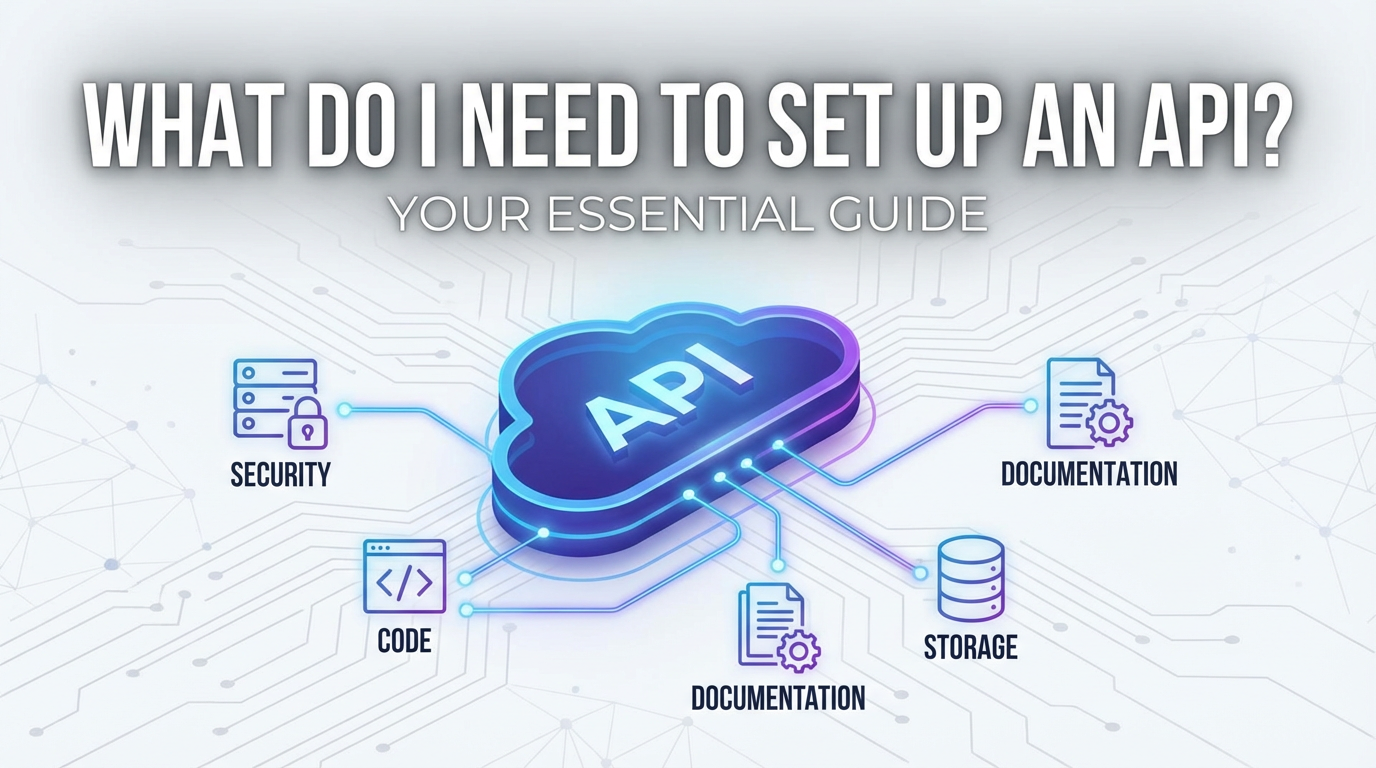


In the intricate tapestry of modern digital infrastructure, Application Programming Interfaces, or APIs, serve as the indispensable threads that connect disparate systems, enabling seamless communication and unlocking unprecedented levels of functionality. From the ubiquitous applications on your smartphone to the complex backend services powering multinational corporations, APIs are the silent orchestrators, facilitating data exchange, automating processes, and fostering innovation across virtually every industry. They are the digital handshake between different software components, allowing them to understand and interact with each other without needing to know the intricacies of their internal workings.
Embarking on the journey of setting up an API is akin to designing a crucial communication highway. It's a venture that demands meticulous planning, rigorous execution, and a forward-thinking approach to maintenance and evolution. This comprehensive guide is designed to demystify the process, walking you through every critical stage, from the initial conceptualization and architectural design to robust development practices, secure deployment, and ongoing management. Whether you're a seasoned developer looking to refine your API strategy, a product manager aiming to understand the technical underpinnings, or an aspiring technologist eager to dive into the world of connected applications, this article will equip you with the knowledge and insights needed to build, deploy, and maintain a successful, performant, and secure API that truly serves its purpose. We will explore the various facets of API development, delve into the nuances of choosing the right architectural style, highlight the importance of security, and emphasize the role of tools like the OpenAPI specification and solutions such as an API gateway in streamlining your efforts. By the end, you'll have a holistic understanding of what it truly takes to establish a thriving API ecosystem.
Chapter 1: Understanding the Core – What Exactly is an API?
Before we delve into the intricate mechanics of setting up an API, it's paramount to establish a crystal-clear understanding of what an API fundamentally is, its core components, and the diverse forms it can take. Often described in technical jargon, an API can be better grasped through relatable analogies that strip away the complexity and reveal its elegant simplicity.
1.1 The Analogy of a Restaurant Waiter
Imagine you're at a restaurant, eager to enjoy a meal. You don't walk into the kitchen and start cooking your food yourself, nor do you need to understand the chef's culinary secrets or how the ingredients are sourced. Instead, you interact with a waiter. You tell the waiter what you want from the menu (your request), and the waiter takes that request to the kitchen (the server). The kitchen prepares your food (processes the request) and sends it back to you via the waiter (the response). The waiter acts as the intermediary, facilitating communication between you (the client application) and the kitchen (the backend service) without exposing the internal workings of the kitchen.
In this analogy: * You (the Customer) represent the client application or user interface that needs information or functionality. * The Menu represents the API documentation, listing what services are available and how to request them. * The Waiter (the API) is the intermediary, taking your request, translating it for the kitchen, and bringing back the result. * The Kitchen (the Server/Service) is where the actual work is done and data is stored. * Your Order is the API request. * Your Meal is the API response.
This analogy effectively illustrates that an API provides a defined set of rules and protocols for how software components should interact, allowing them to communicate and exchange data securely and efficiently, without requiring each component to understand the internal architecture of the other.
1.2 Technical Definition: Application Programming Interface
From a technical standpoint, an API stands for Application Programming Interface. It is a set of defined methods of communication between various software components. An API serves as a contract between a provider and a consumer, specifying how the consumer can request services from the provider and what kind of responses it can expect. This contract typically includes:
- Data Formats: How data will be structured (e.g., JSON, XML).
- Protocols: The communication rules (e.g., HTTP for web APIs).
- Operations: The specific actions that can be performed (e.g., create, read, update, delete).
- Authentication/Authorization: How access is granted and permissions are managed.
The beauty of an API lies in its abstraction. Developers can use an API without needing to know the implementation details of the software or service it connects to. This abstraction fosters modularity, reusability, and greatly accelerates development cycles, as developers can leverage existing functionalities rather than rebuilding them from scratch.
1.3 Key Components of an API Interaction
Every interaction with an API, particularly web APIs, typically involves a request and a response, each comprising several critical elements:
1.3.1 The Request
When a client application wants to interact with an API, it sends a request. This request is a structured message containing all the information the server needs to fulfill the client's operation.
- Method (HTTP Verb): This specifies the type of action the client wants to perform on a resource. Common HTTP methods include:
GET: Retrieve data from the server. Used for reading resources.POST: Send new data to the server to create a resource.PUT: Update an existing resource with new data, replacing the entire resource.PATCH: Partially update an existing resource.DELETE: Remove a resource from the server.
- Endpoint (URL): This is the specific address or path to the resource the client wants to interact with. It uniquely identifies the resource on the server. For example,
https://api.example.com/v1/users/123indicates accessing user with ID 123 in version 1 of the API. The structure of endpoints is crucial for a well-designed API, often following a logical, hierarchical pattern that reflects the resources being managed. - Headers: These are metadata key-value pairs that provide additional context about the request or the client. Common headers include:
Content-Type: Specifies the format of the request body (e.g.,application/json).Accept: Indicates the preferred format for the response from the server.Authorization: Carries credentials (e.g., API key, OAuth token) for authentication and authorization.User-Agent: Identifies the client software making the request.
- Body (Payload): For
POST,PUT, orPATCHrequests, the body contains the actual data being sent to the server. For instance, when creating a new user, the body might contain a JSON object with the user's name, email, and password.GETandDELETErequests typically do not have a request body as their purpose is usually to retrieve or remove a resource identified by the URL.
1.3.2 The Response
After receiving and processing a request, the API server sends back a response to the client. This response also has a defined structure to convey the outcome of the request.
- Status Code: A three-digit number that indicates the outcome of the request. These codes are standardized and categorized:
1xx(Informational): Request received, continuing process.2xx(Success): The action was successfully received, understood, and accepted (e.g.,200 OK,201 Created,204 No Content).3xx(Redirection): Further action needs to be taken to complete the request.4xx(Client Error): The request contains bad syntax or cannot be fulfilled (e.g.,400 Bad Request,401 Unauthorized,403 Forbidden,404 Not Found).5xx(Server Error): The server failed to fulfill an apparently valid request (e.g.,500 Internal Server Error,503 Service Unavailable).- Understanding and properly utilizing HTTP status codes is fundamental for effective error handling and client communication.
- Headers: Similar to request headers, response headers provide metadata about the response. Examples include
Content-Type(telling the client the format of the response body),Date,Server, andCache-Control. - Body (Payload): This contains the actual data or message returned by the server. For a successful
GETrequest, it might contain the requested resource's data. For an error, it might contain a detailed error message explaining what went wrong. The format of this body typically aligns with theContent-Typespecified in the response headers.
1.4 Types of APIs
The term "API" is broad, encompassing various communication interfaces. While this guide primarily focuses on web APIs, it's beneficial to understand the broader landscape:
- 1.4.1 Web APIs: These are the most common type of APIs developers encounter today, designed for communication over a network (typically the internet). They use HTTP/HTTPS as the communication protocol. Web APIs are further categorized by their architectural styles:
- RESTful APIs (REST): The most prevalent style, adhering to the principles of Representational State Transfer. REST APIs are stateless, meaning each request from a client to a server must contain all the information needed to understand the request. They rely on HTTP methods (GET, POST, PUT, DELETE) and uniform resource locators (URLs) to access resources. They typically use JSON or XML for data exchange due to their lightweight nature and readability. The flexibility, scalability, and broad support for REST have made it the de facto standard for building web services.
- SOAP APIs (Simple Object Access Protocol): An older, more rigid, and highly structured protocol based on XML. SOAP APIs require a WSDL (Web Services Description Language) file to describe the available services. They offer robust error handling and built-in security features, making them suitable for enterprise-level applications where strict contracts and formal data exchange are critical, such as banking or legacy systems. However, their verbosity and complexity make them less agile for modern web development.
- GraphQL APIs: A relatively newer query language for APIs and a runtime for fulfilling those queries with your existing data. GraphQL allows clients to request exactly the data they need, no more, no less, from a single endpoint. This contrasts with REST, where multiple endpoints might be needed to gather related data, potentially leading to over-fetching or under-fetching. GraphQL offers powerful features like real-time data with subscriptions and improved versioning capabilities, making it popular for complex applications with evolving data requirements.
- RPC (Remote Procedure Call): This style focuses on executing functions or procedures on a remote server. While REST focuses on resources and actions on those resources, RPC focuses on specific operations. Examples include gRPC (Google's RPC framework) which uses HTTP/2 for transport and Protocol Buffers for message serialization, offering high performance and strong typing.
- 1.4.2 Library APIs: These are local APIs that allow developers to use functions and procedures within a software library. For example, Python's
mathlibrary provides functions likemath.sqrt()ormath.pi(). You invoke these functions directly within your code, and they execute locally within the same application process. - 1.4.3 Operating System APIs: These APIs provide access to the functionalities of an operating system. For instance, Windows API (Win32 API) or POSIX API (for Unix-like systems) allow applications to interact with the OS for tasks like file management, process creation, network communication, and memory allocation. Developers use these to build applications that integrate deeply with the underlying operating system.
- 1.4.4 Database APIs: These APIs enable applications to interact with database management systems. For example, JDBC (Java Database Connectivity) or ODBC (Open Database Connectivity) allow applications to connect to various databases, execute SQL queries, and retrieve results. These APIs abstract away the specific communication protocols of different databases, providing a unified interface for data access.
1.5 The Power of Connectivity: How APIs Enable Data Exchange and Innovation
The true power of APIs lies in their ability to foster connectivity and drive innovation. By offering a standardized interface, APIs dismantle data silos and enable diverse systems to interoperate seamlessly. This capability has profound implications:
- Integration: APIs allow different software applications to talk to each other, enabling features like single sign-on across multiple services, embedding maps from a mapping provider into an application, or connecting payment gateways to e-commerce platforms. This integration creates richer, more functional user experiences.
- Efficiency: Developers can leverage existing functionalities exposed via APIs rather than reinventing the wheel. This dramatically speeds up development, reduces costs, and allows teams to focus on core business logic.
- Innovation: APIs open up possibilities for new products and services. Companies can expose their data and functionalities, allowing third-party developers to build innovative applications on top of their platforms. This creates vibrant ecosystems, as seen with social media platforms, e-commerce giants, and cloud service providers.
- Automation: By programmatic access to services, APIs enable powerful automation workflows. Businesses can automate tasks like data synchronization between systems, triggering actions based on events, or generating reports, thereby increasing operational efficiency and reducing manual errors.
- Data Exchange: APIs are the primary mechanism for exchanging data between applications. Whether it's fetching weather updates, stock prices, social media feeds, or user profiles, APIs ensure data is delivered securely and in a structured format.
In essence, APIs are the foundational building blocks of the digital economy, transforming how businesses operate, how applications are built, and how users interact with technology. Understanding these basics is the first crucial step in mastering the art of setting up your own powerful API.
Chapter 2: The Foundational Stages – Planning Your API
The success of any API project hinges significantly on the meticulous planning and thoughtful design that precedes any actual coding. Rushing into implementation without a clear vision often leads to an API that is difficult to use, hard to maintain, and fails to meet its intended purpose. This foundational stage involves defining objectives, structuring the API contract, selecting the appropriate architectural style, and, critically, embracing a documentation-first approach.
2.1 Define Your API's Purpose and Target Audience
Before writing a single line of code, the most crucial step is to clearly articulate the "why" and "for whom" of your API. This strategic clarity will guide every subsequent design and development decision.
- What Problem Does It Solve? Every successful API should address a specific pain point or fulfill a particular need. Are you aiming to expose internal data for external partners? Are you building a microservice that abstracts complex business logic for other internal teams? Are you providing a public service that enables third-party developers to integrate with your platform? Clearly defining the problem statement ensures the API delivers tangible value. For example, an API might solve the problem of fragmented customer data by providing a unified interface to access customer profiles across CRM, support, and marketing systems.
- Who Will Use It (Target Audience)? Understanding your target audience is paramount. Will your API be consumed by:
- Internal Teams: Often requires less stringent authentication and potentially more specific, less generalized endpoints. Focus might be on speed of integration and internal consistency.
- Partners: Might involve specific data sharing agreements, robust security, and careful versioning to avoid breaking integrations. Documentation needs to be exceptionally clear.
- Public Developers: Requires extensive, user-friendly documentation, SDKs, generous rate limits, and a strong focus on developer experience (DX). Security and stability become paramount. The needs and expectations of each audience type will dictate design choices, documentation depth, error handling strategies, and support mechanisms.
- Business Goals and Technical Requirements Alignment: Your API must align with broader business objectives. Is it meant to generate revenue, improve operational efficiency, foster an ecosystem, or enable new product features? Translating these business goals into concrete technical requirements is essential. For instance, if a business goal is to enable real-time inventory updates, the technical requirement might be a low-latency API endpoint with idempotent update capabilities. This alignment ensures that the API is not just technically sound but also strategically valuable to the organization.
2.2 Designing the API Contract – Schema and Endpoints
The API contract is the formal agreement between the API provider and consumer, outlining how interactions will occur. A well-designed contract ensures consistency, predictability, and ease of use. This involves careful consideration of resource identification, endpoint structure, and data modeling.
- Resource Identification (Nouns vs. Verbs): A fundamental principle of RESTful API design, for example, is to treat everything as a resource, which should be identified by a noun (e.g.,
users,products,orders) rather than a verb (e.g.,getUsers,createProduct). The action to be performed on the resource is conveyed through HTTP methods (GET,POST,PUT,DELETE). This makes APIs more intuitive, predictable, and easier to cache. For example,GET /usersretrieves a list of users,POST /userscreates a new user, andGET /users/{id}retrieves a specific user. - Endpoint Structure: Endpoints should be logical, hierarchical, and consistently structured. They typically follow a pattern that reflects the relationships between resources.
- Collection Endpoints: Represent a collection of resources (e.g.,
/api/v1/users). - Resource Endpoints: Represent a single instance of a resource (e.g.,
/api/v1/users/{user_id}). - Sub-Resource Endpoints: Represent resources related to another resource (e.g.,
/api/v1/users/{user_id}/orders). Consistency in naming conventions (e.g., plural nouns, lowercase, hyphens for separation) significantly improves the developer experience. Avoid deep nesting in URLs, as it can make them unwieldy; generally, two or three levels of nesting are a good maximum.
- Collection Endpoints: Represent a collection of resources (e.g.,
- Data Modeling (JSON, XML): The format in which data is exchanged is a crucial part of the API contract. JSON (JavaScript Object Notation) has become the predominant choice for web APIs due to its lightweight nature, human readability, and ease of parsing across various programming languages. XML (Extensible Markup Language) is still used, especially in older systems or SOAP APIs, but its verbosity often makes it less preferred for modern REST APIs. When designing your data models (the structure of JSON or XML payloads), focus on:
- Simplicity and Clarity: Data structures should be straightforward and intuitive.
- Consistency: Use consistent naming conventions (e.g., camelCase for JSON keys, snake_case for database fields mapped to API fields).
- Completeness: Provide all necessary information but avoid over-fetching by default.
- Evolution: Design with future extensibility in mind, making it easier to add new fields without breaking existing clients.
- Version Control Strategy: APIs evolve, and new features or changes to existing ones are inevitable. A robust versioning strategy is essential to manage these changes without disrupting existing consumers. Common strategies include:
- URL Versioning: Embedding the version number directly in the URL (e.g.,
/v1/users). This is the most common and often simplest approach, clearly indicating the API version being consumed. - Header Versioning: Including the version in a custom HTTP header (e.g.,
X-API-Version: 1). This keeps URLs cleaner but can be less discoverable. - Query Parameter Versioning: Using a query parameter (e.g.,
/users?version=1). While simple, this can sometimes be mistaken for filtering parameters and is generally less preferred for major version changes. Regardless of the chosen method, communicating changes transparently and providing ample notice for deprecation of older versions is vital for maintaining a good relationship with your API consumers.
- URL Versioning: Embedding the version number directly in the URL (e.g.,
2.3 Choosing the Right Architectural Style
The architectural style you choose for your API will fundamentally dictate how clients interact with it, how resources are structured, and how data flows. Each style comes with its own set of principles, advantages, and disadvantages, making the decision highly dependent on your specific use case, performance requirements, and development ecosystem.
- REST (Representational State Transfer): REST has emerged as the most popular and widely adopted architectural style for web services due to its simplicity, scalability, and flexibility. Its core principles, as defined by Roy Fielding, include:
- Client-Server: Decoupling the user interface from the data storage, allowing independent evolution.
- Stateless: Each request from client to server must contain all the information needed to understand the request. The server should not store any client context between requests. This improves scalability and reliability.
- Cacheable: Responses should explicitly or implicitly define themselves as cacheable or not to prevent clients from reusing stale or inappropriate data.
- Uniform Interface: Simplifies the overall system architecture by providing a single, consistent way of interacting with resources. This includes resource identification, resource manipulation through representations, self-descriptive messages, and hypermedia as the engine of application state (HATEOAS).
- Layered System: Allows for intermediate servers (proxies, load balancers, gateways) to be inserted between client and server, enhancing scalability and security without affecting the client or server.
- Code-On-Demand (Optional): Servers can temporarily extend or customize the functionality of a client by transferring executable code. Advantages: Highly scalable, flexible, widely supported, uses standard HTTP methods, easy to cache, generally simpler to develop and consume. Disadvantages: Can lead to over-fetching or under-fetching of data (client receives more or less than needed), lack of strong typing can lead to errors, often requires multiple requests for related resources. When to Use: Ideal for public APIs, mobile applications, web applications, and scenarios where data needs to be highly cacheable and accessible from various clients.
- SOAP (Simple Object Access Protocol): SOAP is an XML-based messaging protocol for exchanging structured information in the implementation of web services. Unlike REST, SOAP is a protocol with strict standards and a formal contract, typically described by a Web Services Description Language (WSDL) file. Advantages: Highly secure (built-in WS-Security), reliable (built-in retry mechanisms), language-agnostic, robust error handling, strong typing through XML schemas. Ideal for enterprise-level applications requiring formal contracts, high security, and transactional reliability. Disadvantages: Complex and verbose due to XML, heavier overhead (larger messages), harder to implement and consume compared to REST, slower performance. When to Use: Legacy enterprise systems, financial services, telecommunications, government applications, or situations where strong transactional integrity and strict security are non-negotiable.
- GraphQL: GraphQL is a query language for your API, and a server-side runtime for executing queries by using a type system you define for your data. It addresses many of the challenges associated with REST, particularly the issues of over-fetching and under-fetching data. Advantages: Clients can request exactly what they need, reducing network payload; single endpoint for all data; real-time data with subscriptions; introspection for easy discovery of API capabilities; strong typing built into the schema. Disadvantages: Can be more complex to set up initially than REST; caching can be more challenging; increased server load due to complex queries; lack of native HTTP caching. When to Use: Mobile applications where bandwidth is a concern, complex data models, microservices architectures where data from multiple sources needs to be aggregated, or applications requiring a highly flexible data querying capability.
- RPC (Remote Procedure Call): RPC mechanisms allow a client program to cause a procedure (subroutine) to execute in a different address space (typically on another computer on a shared network) as if it were a local procedure. Modern RPC frameworks like gRPC use HTTP/2 for transport and Protocol Buffers for efficient message serialization. Advantages: High performance (especially with gRPC), efficient data serialization, strong typing, bidirectional streaming, language-agnostic code generation. Disadvantages: Less standardized than REST, less human-readable message formats (e.g., Protocol Buffers vs. JSON), often requires generated client code. When to Use: High-performance microservices communication, real-time data streaming, mobile clients needing efficient binary serialization, or internal system-to-system communication where efficiency is paramount.
To aid in the decision-making process, here's a comparative table summarizing the key characteristics of these architectural styles:
| Feature/Style | REST (HTTP/JSON) | SOAP (HTTP/XML) | GraphQL | RPC (e.g., gRPC) |
|---|---|---|---|---|
| Data Format | JSON (primary), XML | XML | JSON | Protocol Buffers, JSON |
| Protocol | HTTP/HTTPS | HTTP, SMTP, JMS, etc. | HTTP/HTTPS (typically POST) | HTTP/2 |
| Complexity | Low to Medium | High | Medium to High (schema definition) | Medium (protobuf definition) |
| Performance | Good (cacheable) | Moderate (verbose XML) | Excellent (reduces over-fetching) | Excellent (binary, HTTP/2) |
| Maturity | High (widely adopted) | High (enterprise legacy) | Growing rapidly | Growing rapidly (especially gRPC) |
| Discoverability | Good (readable URLs, OpenAPI) | WSDL for service description | Introspection API | Requires proto definitions |
| Strictness | Flexible | Strict (WSDL contract) | Strict (schema enforces types) | Strict (protobuf enforces types) |
| Use Cases | Public APIs, web apps, mobile apps, microservices | Enterprise, banking, legacy systems, highly regulated | Mobile, complex UIs, microservices aggregation | High-performance microservices, IoT, real-time |
| Caching | Excellent (HTTP caching) | Limited | Challenging (single endpoint, dynamic queries) | Good (stream-based) |
Choosing the correct style is not about picking the "best" but the "most suitable" for your project's specific requirements. Many modern systems employ a polyglot approach, using different API styles for different parts of their architecture.
2.4 Documentation First Approach: The Power of OpenAPI Specification
Once you've defined your API's purpose, target audience, and architectural style, the next critical step is to document its design thoroughly. A "documentation-first" approach means that you write the API specification before you start coding the actual implementation. This practice promotes clarity, consistency, and collaboration.
- What is OpenAPI? The OpenAPI Specification (OAS), formerly known as Swagger Specification, is a language-agnostic, human-readable, and machine-readable interface description language for RESTful APIs. It allows developers to describe the entire API, including its available endpoints, operations (HTTP methods), input parameters, output structures, authentication methods, and contact information. Think of it as the blueprints for your API, detailing every interaction point.
- Benefits of Using OpenAPI:
- Improved Collaboration: A clear, shared specification acts as a single source of truth for frontend, backend, and QA teams, ensuring everyone is on the same page and reducing miscommunication.
- Automated Documentation Generation: Tools can automatically render interactive and user-friendly documentation (like Swagger UI) directly from the OpenAPI file, making it easy for consumers to understand and try out the API.
- Code Generation: From an OpenAPI specification, you can automatically generate client SDKs (for various programming languages) and server stubs. This significantly accelerates development by providing boilerplate code, reducing manual errors, and ensuring client-server consistency.
- Automated Testing: The specification can be used to generate test cases, validate requests and responses against the defined schema, and power integration testing frameworks.
- Design Consistency: Enforces a consistent design across different endpoints and resources, leading to a more intuitive and predictable API.
- API Governance: Provides a standardized format for reviewing and enforcing API design guidelines.
- How to Write an OpenAPI Specification: OpenAPI specifications are written in YAML or JSON format. They typically include sections for:
openapi: The version of the OpenAPI Specification used.info: General API information (title, description, version, contact).servers: The base URLs for the API.paths: The individual endpoints, their HTTP methods, parameters, request bodies, and expected responses (including status codes and schemas).components: Reusable schemas, parameters, security schemes, and headers. This promotes modularity and avoids repetition. The process often starts with a design discussion, translating business requirements into resource structures and operations, and then capturing these in the OpenAPI format.
- Tools for OpenAPI: A rich ecosystem of tools supports OpenAPI:
- Editors: Online and offline editors (e.g., Swagger Editor, Stoplight Studio, VS Code extensions) provide syntax highlighting, validation, and auto-completion.
- Validators: Tools that check if your OpenAPI definition conforms to the specification's rules.
- Documentation Generators: Swagger UI and Redoc are popular choices for rendering interactive documentation.
- Code Generators: Open API Generator and Swagger Codegen can create client SDKs and server stubs.
Adopting a documentation-first approach with OpenAPI isn't just about creating documentation; it's about building a robust, well-defined, and collaborative API development workflow that leads to higher quality and more successful APIs. It's an investment that pays significant dividends throughout the entire API lifecycle.
Chapter 3: Building Your API – Development Best Practices
With a solid plan and a well-defined OpenAPI specification in hand, you're ready to move into the implementation phase. Building an API involves selecting the right technology stack, adhering to core development principles, strategizing data management, and integrating robust security measures from the very beginning. This chapter delves into the practical aspects of crafting a high-quality, performant, and secure API.
3.1 Selecting the Right Technology Stack
The choice of programming language, framework, and database forms the backbone of your API's development. This decision should be based on factors such as team expertise, project requirements, performance needs, ecosystem support, and scalability goals.
- Programming Languages:
- Python: Highly popular for web development due to its readability, extensive libraries, and frameworks (e.g., Django, Flask). Excellent for rapid prototyping, data science, and AI/ML services.
- Node.js (JavaScript): Ideal for real-time applications and microservices, known for its non-blocking, event-driven architecture. Shares the same language across frontend and backend, simplifying full-stack development.
- Java: A robust, mature, and highly performant language, widely used in enterprise environments with powerful frameworks like Spring Boot. Excellent for large-scale, complex applications requiring stability and strong typing.
- Go (Golang): Developed by Google, Go is known for its excellent concurrency features, high performance, and efficiency. Gaining traction for building microservices, cloud-native applications, and high-load APIs.
- Ruby: With the Ruby on Rails framework, it's known for developer productivity and convention-over-configuration. Still popular for web applications and APIs that prioritize rapid development.
- PHP: Powers a vast portion of the web, with frameworks like Laravel providing powerful tools for building APIs quickly. Continuously evolving with performance improvements.
- C#/.NET: A Microsoft-backed ecosystem offering robust frameworks (e.g., ASP.NET Core) for building scalable enterprise-grade APIs, especially popular in Windows environments. The best language is often the one your team is most proficient in, as it minimizes the learning curve and maximizes productivity.
- Frameworks: Frameworks provide a structured way to build applications, offering boilerplate code, libraries, and tools that streamline development.
- Python: Django (full-featured, ORM included), Flask (lightweight micro-framework).
- Node.js: Express.js (minimalist, flexible), NestJS (opinionated, TypeScript-based, robust).
- Java: Spring Boot (enterprise-grade, convention-over-configuration).
- Go: Gin (high-performance, minimalist), Echo (fast, flexible).
- Ruby: Ruby on Rails (MVC, full-stack).
- PHP: Laravel (elegant syntax, robust features), Symfony (flexible, modular).
- .NET: ASP.NET Core (cross-platform, high performance). Choosing a framework that aligns with your chosen language and project scope is crucial for maintaining code quality, leveraging community support, and ensuring long-term maintainability.
- Databases: The choice of database depends heavily on your data structure, scaling needs, and consistency requirements.
- SQL Databases (Relational):
- PostgreSQL: Highly robust, feature-rich, open-source, and known for data integrity and extensibility. Excellent for complex queries and transactional workloads.
- MySQL: Widely popular, open-source, and performant, especially for web applications. Good for general-purpose use.
- SQL Server: Microsoft's relational database, strong for enterprise applications, especially within the .NET ecosystem.
- Oracle: Enterprise-grade, highly scalable, and feature-rich, often used for mission-critical systems. SQL databases are ideal when data relationships are crucial, strong consistency is required, and complex joins are common.
- NoSQL Databases (Non-Relational):
- MongoDB: A document-oriented database, highly flexible, and scalable horizontally. Good for unstructured data, real-time analytics, and content management.
- Cassandra: A wide-column store, known for high availability and linear scalability across multiple data centers. Suitable for big data applications with high write throughput.
- Redis: An in-memory data store, often used as a cache, message broker, or for real-time analytics due to its extreme speed.
- DynamoDB (AWS): A fully managed key-value and document database, offering single-digit millisecond performance at any scale. NoSQL databases are preferred for high scalability, flexible schemas, and when dealing with large volumes of rapidly changing or unstructured data. Many projects employ a polyglot persistence approach, using different database types for different parts of their application to leverage their respective strengths.
- SQL Databases (Relational):
3.2 Core API Development Principles
Adhering to a set of robust development principles is vital for building an API that is not only functional but also maintainable, scalable, and delightful to consume.
- Modularity and Separation of Concerns: Organize your code into distinct, loosely coupled modules, each responsible for a specific function. For instance, separate concerns like routing, data access, business logic, and authentication into different layers or files. This makes the codebase easier to understand, test, debug, and scale. A clear separation also facilitates team development, as different developers can work on distinct modules with minimal conflicts.
- Error Handling: Effective error handling is paramount for a good API. When things go wrong, the API should provide meaningful, actionable error messages that help consumers understand the issue and resolve it.
- Use Standard HTTP Status Codes: As discussed in Chapter 1, utilize
4xxfor client errors (e.g.,400 Bad Request,401 Unauthorized,404 Not Found,429 Too Many Requests) and5xxfor server errors (e.g.,500 Internal Server Error,503 Service Unavailable). - Consistent Error Response Format: Always return error details in a predictable format, typically JSON. This might include an
error_code(internal identifier),message(human-readable explanation), anddetails(additional context or validation errors). - Avoid Leaking Sensitive Information: Error messages should never expose internal server details, stack traces, or sensitive data that could be exploited by malicious actors.
- Use Standard HTTP Status Codes: As discussed in Chapter 1, utilize
- Input Validation: Never trust input from the client. All data received by your API must be rigorously validated before processing or storing. This is a critical security measure and ensures data integrity.
- Schema Validation: Ensure the input data conforms to the expected structure and data types (e.g., an email address is a valid email format, an integer is indeed an integer).
- Business Logic Validation: Verify that the data makes sense within the context of your application (e.g., an order quantity is not negative, a user ID refers to an existing user).
- Sanitization: Cleanse input to prevent common attacks like SQL injection, cross-site scripting (XSS), or command injection. Remove or escape special characters. Implement validation at the earliest possible stage in your API request pipeline.
- Logging and Monitoring: Comprehensive logging and monitoring are crucial for understanding your API's behavior, troubleshooting issues, and identifying performance bottlenecks.
- Structured Logging: Log relevant information in a structured format (e.g., JSON) including timestamps, request IDs, user IDs, endpoint paths, HTTP methods, status codes, and error messages. This makes logs easier to search, filter, and analyze.
- Centralized Logging: Aggregate logs from all your API instances into a central system (e.g., ELK Stack, Splunk, LogDNA) for unified visibility.
- Monitoring: Track key metrics such as request latency, throughput, error rates, CPU/memory utilization, and database query times. Set up alerts for deviations from normal behavior. Tools like Prometheus, Grafana, Datadog, or New Relic can be invaluable. This provides visibility into the health and performance of your API, allowing for proactive issue detection and resolution.
- Idempotency: An idempotent operation is one that produces the same result regardless of how many times it is executed. For example,
GETrequests are inherently idempotent, as retrieving data multiple times has no side effects.DELETEis also idempotent; deleting a resource multiple times results in the same outcome (the resource being absent). For state-changing operations likePOST(creation) orPUT/PATCH(updates), idempotency can be crucial to prevent unintended duplicate actions, especially in distributed systems where network failures can lead to retries. You can achieve idempotency forPOSTrequests by using unique idempotency keys (e.g., a UUID sent in a request header). If the server receives the same idempotency key for aPOSTrequest, it can return the result of the original successful operation without re-processing. - Pagination and Filtering: APIs often deal with large datasets. Returning all data in a single request is inefficient and can overwhelm both the server and the client. Implement pagination and filtering to manage these large collections effectively.
- Pagination: Allow clients to request data in smaller chunks. Common pagination strategies include:
- Offset-based:
?limit=10&offset=20(retrieve 10 items starting from the 21st). Simple but can be inefficient for very large datasets and prone to issues if data changes during pagination. - Cursor-based:
?limit=10&after_cursor=abcde(retrieve 10 items after a specific point). More robust for dynamic data, as the cursor points to a specific item rather than an arbitrary offset.
- Offset-based:
- Filtering: Enable clients to narrow down results based on specific criteria (e.g.,
?status=active,?category=electronics). - Sorting: Allow clients to specify the order of results (e.g.,
?sort=price_asc). These mechanisms improve performance, reduce network traffic, and make your API more flexible for consumers.
- Pagination: Allow clients to request data in smaller chunks. Common pagination strategies include:
3.3 Data Storage and Retrieval Strategies
Efficiently managing data storage and retrieval is central to an API's performance and scalability. The database interacts directly with your API, and optimizations here can yield significant improvements.
- Optimizing Database Queries:
- Indexing: Proper indexing on frequently queried columns dramatically speeds up
SELECToperations. However, too many indexes can slow downINSERTandUPDATEoperations. It's a balance. - Efficient Queries: Write performant SQL queries. Avoid
SELECT *, useJOINclauses effectively, and minimize subqueries where possible. Understand the query execution plan to identify bottlenecks. - ORM Optimization: If using an Object-Relational Mapper (ORM) like Django ORM or Hibernate, learn its features for eager loading related data to avoid N+1 query problems.
- Indexing: Proper indexing on frequently queried columns dramatically speeds up
- Caching Mechanisms: Caching stores frequently accessed data in a faster, temporary storage layer closer to the client or the API server, reducing the need to hit the database for every request.
- In-Memory Caching (e.g., Redis, Memcached): Extremely fast, ideal for frequently accessed data that changes infrequently. Can be used for session management, user profiles, or configuration data.
- CDN Caching: For static assets or public API responses that can be served from geographically distributed servers, reducing latency for global users.
- Database Caching: Some databases have built-in caching mechanisms.
- HTTP Caching: Leverage
Cache-Controlheaders and ETags to allow clients or intermediate proxies to cache API responses, reducing load on your server. Implement cache invalidation strategies to ensure clients receive up-to-date information when data changes.
- Data Consistency Models: Understand the consistency model your database provides and how it impacts your API.
- Strong Consistency: All reads will see the most recent successful write (e.g., traditional relational databases). This is crucial for financial transactions or inventory management.
- Eventual Consistency: Reads may not see the most recent write immediately, but eventually, all replicas will converge to the same state (common in distributed NoSQL databases). Acceptable for social media feeds or sensor data where immediate consistency isn't critical. Choose a model that aligns with your API's functional requirements and user expectations, as it directly impacts perceived data accuracy and system behavior.
3.4 Security Considerations from Day One
Security is not an afterthought; it must be ingrained into every stage of your API development process. A single vulnerability can expose sensitive data, disrupt services, and severely damage your reputation.
- Authentication: Who are you? Authentication verifies the identity of the client making the request.
- API Keys: Simple tokens often passed in headers or query parameters. Suitable for simple, rate-limited public APIs. Less secure than token-based systems as they are generally long-lived and stateless.
- OAuth 2.0: An industry-standard protocol for authorization, allowing third-party applications to access a user's resources on another service (e.g., "Login with Google"). It's not an authentication protocol itself, but often used for it. Provides delegated access without sharing user credentials.
- JWT (JSON Web Tokens): A compact, URL-safe means of representing claims to be transferred between two parties. JWTs are commonly used in conjunction with OAuth 2.0 or for authenticating microservices. They are signed to prevent tampering and can carry user information, making them useful for stateless authentication.
- OpenID Connect: An identity layer on top of OAuth 2.0, providing robust identity verification. Choose an authentication method appropriate for your API's security requirements and target audience.
- Authorization: What can you do? Authorization determines what actions an authenticated client is permitted to perform on specific resources.
- Role-Based Access Control (RBAC): Assign users to roles (e.g., 'admin', 'editor', 'viewer'), and then assign permissions to those roles.
- Attribute-Based Access Control (ABAC): More granular, permissions are based on attributes of the user, resource, and environment.
- Resource-Based Authorization: Permissions tied directly to specific resources (e.g., only the owner of a document can delete it). Implement granular authorization checks at every API endpoint to prevent unauthorized access and data manipulation.
- HTTPS/TLS: Encrypting data in transit. Always enforce HTTPS (HTTP over TLS/SSL) for all API communications. TLS encrypts data exchanged between the client and server, protecting it from eavesdropping, tampering, and message forgery. Using HTTPS is non-negotiable for any API handling sensitive data or operating in a production environment. Free certificates are widely available from services like Let's Encrypt.
- Rate Limiting: Preventing Abuse and DDoS Attacks. Rate limiting controls the number of requests a client can make to an API within a specific timeframe.
- Benefits: Prevents abuse, mitigates DDoS attacks, ensures fair usage, protects backend resources from being overwhelmed.
- Implementation: Typically enforced at the API gateway or reverse proxy level. Responses should include
RateLimit-Limit,RateLimit-Remaining, andRateLimit-Resetheaders to inform clients. Design your rate limits carefully based on your API's capacity and expected usage patterns.
- Input Sanitization: Preventing Injections. Beyond validation, input sanitization involves cleaning or escaping user-supplied data before it's processed or stored, to neutralize potentially malicious content.
- SQL Injection: Escape or parameterize all database queries. Never directly concatenate user input into SQL statements.
- Cross-Site Scripting (XSS): Sanitize any user-generated content that will be rendered in a web browser to remove malicious scripts.
- Command Injection: Ensure user input cannot be used to execute arbitrary commands on the server. Use battle-tested libraries and frameworks that provide built-in sanitization features.
- CORS (Cross-Origin Resource Sharing): Managing Access. CORS is a browser security mechanism that restricts web pages from making requests to a different domain than the one that served the web page. For your API to be accessible from frontend applications hosted on different domains, you need to configure CORS policies.
Access-Control-Allow-Origin: Specifies which origins are allowed to access the resource. Be specific and avoid*in production unless your API is truly public and doesn't handle sensitive data.Access-Control-Allow-Methods: Specifies the HTTP methods allowed.Access-Control-Allow-Headers: Specifies the HTTP headers that can be used. Carefully configure CORS to only permit necessary cross-origin access, minimizing security risks.
Building an API is a continuous process of design, development, testing, and refinement. By embracing these best practices, you lay the groundwork for a robust, performant, and secure API that can withstand the demands of modern applications and evolving threats.
APIPark is a high-performance AI gateway that allows you to securely access the most comprehensive LLM APIs globally on the APIPark platform, including OpenAI, Anthropic, Mistral, Llama2, Google Gemini, and more.Try APIPark now! 👇👇👇
Chapter 4: Deploying and Managing Your API – Beyond Development
Developing an API is only half the battle; successfully deploying it, ensuring its availability and performance, and managing its lifecycle are equally critical tasks. This chapter focuses on the operational aspects, including infrastructure choices, the pivotal role of an API gateway, CI/CD pipelines, and continuous monitoring.
4.1 Infrastructure Choices
The infrastructure hosting your API directly impacts its scalability, reliability, and cost-effectiveness. The decision often boils down to on-premise solutions or various cloud deployment models.
- On-premise Servers: Historically, organizations hosted their APIs on their own physical servers within their data centers.
- Advantages: Complete control over hardware, network, and security; potentially lower long-term costs for very stable, high-volume workloads if infrastructure is already owned.
- Disadvantages: High initial capital expenditure (CAPEX); requires dedicated IT staff for maintenance, patching, scaling, and disaster recovery; limited scalability and flexibility; significant lead time for provisioning resources.
- When to Use: Highly sensitive data with strict regulatory compliance that mandates on-premise hosting, or legacy systems that cannot be easily migrated to the cloud.
- Cloud Providers (AWS, Azure, GCP): Cloud computing has revolutionized API deployment, offering unprecedented flexibility, scalability, and cost efficiency. Major providers offer a spectrum of services:
- IaaS (Infrastructure as a Service): (e.g., AWS EC2, Azure Virtual Machines, GCP Compute Engine)
- Description: You get virtualized computing resources (VMs, storage, networks) and manage the operating system, applications, and middleware yourself. It's like renting virtual hardware.
- Advantages: More control than PaaS or Serverless, scalable, flexible, pay-as-you-go.
- Disadvantages: Still requires significant operational overhead for OS patching, security, and scaling application instances.
- PaaS (Platform as a Service): (e.g., AWS Elastic Beanstalk, Azure App Service, GCP App Engine)
- Description: Provides a complete platform (OS, runtime, database, web server) for developing, running, and managing applications without the complexity of building and maintaining the infrastructure associated with the development and launch of an app. You deploy your code, and the cloud provider handles the underlying infrastructure.
- Advantages: Greatly reduced operational overhead, faster deployment, auto-scaling, integrated tools.
- Disadvantages: Less control over the underlying infrastructure, potential vendor lock-in, may not suit highly customized environments.
- Serverless (Functions as a Service - FaaS): (e.g., AWS Lambda, Azure Functions, GCP Cloud Functions)
- Description: You deploy individual functions (small pieces of code) that run in response to events (e.g., an HTTP request, a database change). The cloud provider fully manages servers, scaling, and capacity. You only pay for the compute time consumed.
- Advantages: Extremely high scalability, cost-effective (pay-per-execution), zero server management, rapid deployment.
- Disadvantages: Cold starts (initial latency for infrequently used functions), execution duration limits, potential vendor lock-in, more complex local development and debugging. Ideal for event-driven architectures and stateless API endpoints.
- IaaS (Infrastructure as a Service): (e.g., AWS EC2, Azure Virtual Machines, GCP Compute Engine)
- Containerization (Docker) and Orchestration (Kubernetes): These technologies provide a layer of abstraction and portability across different infrastructure choices.
- Docker: Allows you to package your API application and all its dependencies into a standardized unit called a container. This ensures that your API runs consistently across different environments (development, staging, production).
- Kubernetes (K8s): An open-source system for automating deployment, scaling, and management of containerized applications. It provides features like self-healing, load balancing, rolling updates, and resource orchestration across a cluster of machines.
- Advantages: Portability, consistency, efficient resource utilization, high availability, simplified scaling, faster deployments.
- When to Use: Microservices architectures, complex distributed systems, hybrid cloud strategies, or when you need fine-grained control over your deployment environment while still leveraging cloud benefits.
The choice of infrastructure should be driven by your API's specific needs regarding scale, performance, budget, and the operational expertise available within your team.
4.2 The Role of an API Gateway
A robust API gateway is a critical component in modern API architectures, especially as the number of APIs and microservices grows. It acts as a single entry point for all client requests, abstracting away the complexities of the backend services.
- What is an API Gateway? An API gateway is essentially a reverse proxy that sits in front of your API services, intercepting all requests and forwarding them to the appropriate backend service. It's more than just a simple proxy; it's an intelligent orchestration layer that provides a host of functionalities that would otherwise have to be implemented in each individual API service. This centralization streamlines management, enhances security, and improves overall performance.
- Key Functions of an API Gateway:
- Traffic Management:
- Routing: Directs incoming requests to the correct backend service based on the request path, headers, or other criteria.
- Load Balancing: Distributes incoming traffic across multiple instances of a backend service to prevent overload and ensure high availability.
- Circuit Breaker: Prevents cascading failures by detecting when a service is unhealthy and temporarily stopping traffic to it.
- Security:
- Authentication & Authorization: Offloads authentication (e.g., API keys, OAuth tokens) and initial authorization checks from individual backend services, centralizing security enforcement.
- Rate Limiting: Enforces request limits per client, protecting backend services from abuse and DDoS attacks.
- IP Whitelisting/Blacklisting: Controls access based on client IP addresses.
- TLS Termination: Handles SSL/TLS encryption/decryption, freeing backend services from this computational overhead.
- Monitoring and Analytics:
- Logging: Centralizes logging of all API traffic, providing a comprehensive audit trail.
- Metrics: Collects performance metrics (latency, error rates, throughput) across all APIs.
- Analytics: Provides insights into API usage patterns, helping with capacity planning and business decisions.
- Caching: Caches frequently requested data or responses, reducing the load on backend services and improving response times.
- Request/Response Transformation: Modifies request or response payloads (e.g., transforming JSON to XML, adding/removing headers) to adapt to client or backend requirements without changing the core service logic.
- Versioning: Facilitates API versioning by routing requests to specific versions of backend services based on version indicators in the request.
- Traffic Management:
- Benefits of an API Gateway:
- Centralized Management: Provides a single control plane for all APIs, simplifying configuration, policy enforcement, and monitoring.
- Improved Security: Consolidates security measures, making it easier to implement and maintain consistent security policies across all APIs.
- Enhanced Performance: Features like caching, load balancing, and connection pooling can significantly improve API response times and overall throughput.
- Abstraction and Decoupling: Hides the complexity of the backend microservices architecture from clients, allowing backend services to evolve independently without affecting consumers.
- Simplified Development: Developers of backend services can focus purely on business logic, offloading common concerns to the API gateway.
For organizations seeking a robust, open-source solution to manage their API lifecycle and specifically integrate AI models, platforms like APIPark offer comprehensive capabilities. APIPark functions as an AI gateway and API management platform, providing features from quick integration of over 100 AI models to end-to-end API lifecycle management, performance rivaling high-end proxies, and powerful data analysis tools. It simplifies the complexities often associated with deploying and maintaining a large fleet of APIs, especially those leveraging artificial intelligence. With APIPark, businesses can unify API formats for AI invocation, encapsulating prompts into REST APIs, and ensure independent API and access permissions for each tenant. Its ability to handle over 20,000 TPS with modest resources and provide detailed API call logging, along with powerful data analysis, positions it as an invaluable asset for optimizing efficiency, enhancing security, and fostering innovation in diverse API ecosystems. APIPark’s emphasis on quick deployment (a single command line in 5 minutes) and open-source nature, backed by Eolink’s extensive experience, makes it an attractive choice for modern API and AI integration needs.
4.3 Continuous Integration/Continuous Deployment (CI/CD)
CI/CD pipelines are essential for modern software development, enabling rapid, reliable, and automated delivery of changes to your API.
- Continuous Integration (CI): Developers frequently merge their code changes into a central repository. After each merge, an automated build and test process runs.
- Benefits: Detects integration issues early, ensures code quality, reduces integration headaches.
- Continuous Deployment (CD): If the CI tests pass, the changes are automatically deployed to production (or a staging environment).
- Benefits: Faster release cycles, reduced manual errors, consistent deployment process, increased confidence in deployments.
- Tools: Popular CI/CD tools include Jenkins, GitLab CI/CD, GitHub Actions, CircleCI, Travis CI, and AWS CodePipeline. Implementing a robust CI/CD pipeline for your API ensures that code changes are thoroughly tested and deployed efficiently, maintaining high availability and reliability.
4.4 Monitoring and Alerting
Once deployed, continuous monitoring is critical to ensure your API remains healthy, performant, and available.
- Metrics: Track essential metrics to gain insights into your API's performance:
- Latency: Time taken for the API to respond to requests.
- Throughput: Number of requests processed per second.
- Error Rates: Percentage of requests resulting in errors (4xx, 5xx).
- Resource Utilization: CPU, memory, disk I/O, and network usage of your API servers and databases.
- Up-time: Percentage of time the API is operational.
- Log Aggregation: Collect and centralize logs from all API instances and related services (e.g., database, API gateway) into a single platform. Tools like the ELK Stack (Elasticsearch, Logstash, Kibana), Splunk, Datadog, or Sumo Logic facilitate searching, analyzing, and visualizing log data.
- Alerting Systems: Configure alerts based on predefined thresholds for critical metrics. For example, if error rates spike above a certain percentage, or latency significantly increases, an alert should be triggered to notify the operations team.
- Tools: PagerDuty, Prometheus Alertmanager, Grafana Alerting, Opsgenie. Proactive monitoring and timely alerting enable quick detection and resolution of issues, minimizing downtime and maintaining a high quality of service for your API consumers.
4.5 API Versioning Strategies
As your API evolves, you will inevitably need to introduce changes. How you manage these changes, particularly breaking ones, is crucial for maintaining developer trust and avoiding disruptions.
- URL Versioning (
/v1/,/v2/):- Description: The API version number is embedded directly into the URL path.
- Advantages: Simple, highly explicit, easy to cache, and discoverable.
- Disadvantages: Requires URL changes for each major version, leading to code duplication on the server-side for handling different versions.
- When to Use: Most common and generally recommended for public-facing APIs due to its clarity.
- Header Versioning:
- Description: The API version is specified in a custom HTTP header (e.g.,
X-API-Version: 1). - Advantages: Keeps URLs clean, allows for different versions of the same resource at the same URL.
- Disadvantages: Less discoverable than URL versioning, harder to cache (as the URL is the same for different versions), requires clients to explicitly set headers.
- Description: The API version is specified in a custom HTTP header (e.g.,
- Query Parameter Versioning (
?version=1):- Description: The API version is passed as a query parameter.
- Advantages: Simple to implement, clean URLs (if the version parameter is optional).
- Disadvantages: Can be confused with filtering parameters, not typically used for major breaking changes, also challenging for caching as different query parameters result in different resources at the same base URL.
- Managing Breaking Changes:
- Backward Compatibility: Strive to make non-breaking changes whenever possible (e.g., adding new fields to a response without removing existing ones).
- Clear Deprecation Policy: When a breaking change is necessary, clearly communicate the deprecation of the old version, provide a transition period (e.g., 6-12 months), and offer guidance on migrating to the new version.
- Semantic Versioning: Follow semantic versioning (
MAJOR.MINOR.PATCH) for your API, where major version increments indicate breaking changes, minor increments add features backward-compatibly, and patch increments fix bugs.
By carefully considering these deployment and management aspects, you transform your developed API into a robust, scalable, and reliable service that can effectively serve its consumers and integrate seamlessly into your broader digital ecosystem. The strategic implementation of an API gateway and adherence to modern operational practices are paramount for long-term success.
Chapter 5: Maintaining and Evolving Your API – The Long Game
An API is not a static entity; it's a living product that requires continuous maintenance, thoughtful evolution, and proactive management to remain valuable and relevant. This final chapter emphasizes the ongoing responsibilities of an API provider, from comprehensive documentation to performance optimization and perpetual security.
5.1 Comprehensive Documentation for Consumers
Beyond the internal OpenAPI specification used during development, providing excellent external documentation for your API consumers is non-negotiable. Poor documentation is a leading cause of developer frustration and adoption failure.
- Interactive Documentation (Swagger UI, Redoc):
- These tools automatically generate beautiful, interactive, and self-explaining documentation directly from your OpenAPI specification. Developers can explore endpoints, view request/response schemas, and even make live API calls directly from the documentation interface. This hands-on experience significantly lowers the barrier to entry for new users.
- SDKs and Code Examples:
- Offer Software Development Kits (SDKs) in popular programming languages (e.g., Python, Node.js, Java). SDKs wrap your API endpoints in language-specific functions, making it incredibly easy for developers to integrate your API into their applications without having to deal with raw HTTP requests.
- Provide clear, copy-paste-ready code examples for various scenarios and languages. Show how to authenticate, make basic requests, handle common responses, and parse data.
- Use Cases and Tutorials:
- Go beyond just endpoint descriptions. Explain common use cases and provide step-by-step tutorials that walk developers through integrating your API to achieve specific business outcomes. For example, "How to integrate our payment API for a shopping cart checkout flow" or "Building a real-time dashboard with our data API."
- Support Channels:
- Clearly communicate how developers can get support. This might include a dedicated support email, a community forum, Stack Overflow tags, or a Slack channel. Responsive support builds trust and helps developers overcome integration challenges quickly.
- Glossary and Best Practices:
- Include a glossary of terms specific to your API domain. Provide best practices for optimal API usage, error handling, and security.
Investing in high-quality documentation is akin to providing a detailed map and instruction manual for a complex machine; it empowers users to operate it effectively and efficiently, fostering adoption and positive developer experience.
5.2 Feedback Loops and Iteration
APIs, like any product, benefit immensely from continuous feedback and iterative improvement. A successful API strategy involves actively listening to your consumers and adapting your offering.
- Gathering Feedback from Developers:
- Set up mechanisms for collecting feedback: surveys, dedicated feedback forms, GitHub issues, or direct conversations in forums and support channels.
- Actively solicit feedback during beta programs or early access phases.
- Analyzing Usage Patterns:
- Leverage your API gateway and monitoring tools to understand how your API is being used. Which endpoints are most popular? What are the common error patterns? Are there specific clients making unusual requests?
- Usage analytics can reveal performance bottlenecks, identify underutilized features, and highlight areas for improvement or expansion.
- Planning Future Enhancements:
- Use feedback and usage data to inform your API roadmap. Prioritize features and improvements that address developer pain points, unlock new use cases, or align with evolving business goals.
- Iterate on your design. Don't be afraid to make improvements based on real-world usage, as long as you manage breaking changes gracefully through proper versioning and deprecation.
This iterative process ensures that your API remains relevant, user-friendly, and continually adds value to its consumers and your business.
5.3 Deprecation Strategies
Eventually, old API versions or specific endpoints will need to be retired. A well-defined deprecation strategy minimizes disruption and maintains trust with your developer community.
- Graceful Deprecation Announcements:
- Communicate deprecations clearly and well in advance. Announce changes through multiple channels: developer blog, mailing lists, API documentation, and specific headers in API responses (
Warningor customX-Deprecatedheaders). - Explain why a feature is being deprecated and what the recommended alternative is.
- Communicate deprecations clearly and well in advance. Announce changes through multiple channels: developer blog, mailing lists, API documentation, and specific headers in API responses (
- Support Periods for Older Versions:
- Establish a clear support timeline for deprecated versions (e.g., 6 months to 1 year). During this period, the old version should continue to function, but no new features will be added. Only critical bug fixes or security patches might be applied.
- This gives developers ample time to migrate their applications to the newer API versions.
- Phased Rollout of Deprecation:
- Consider a phased approach where usage of deprecated features is gradually restricted (e.g., lower rate limits, no new sign-ups for old versions) before eventually removing them.
- Once the support period ends, the old version should be decommissioned, returning appropriate
410 Goneor404 Not Foundstatus codes, possibly with a link to the current documentation.
A transparent and predictable deprecation process is a hallmark of a mature API provider, fostering developer confidence and ensuring a smooth transition to newer API capabilities.
5.4 Performance Optimization
An API that is slow or unreliable will quickly lose its users. Continuous performance optimization is an ongoing effort to ensure your API remains fast and responsive under various loads.
- Benchmarking:
- Regularly measure the baseline performance of your API endpoints under typical loads. This provides a reference point for future optimizations.
- Load Testing:
- Simulate high traffic loads to identify performance bottlenecks and determine your API's breaking point. Tools like JMeter, Locust, k6, or Postman can be used for load testing.
- Test different scenarios, including peak load, sustained load, and stress tests.
- Identifying Bottlenecks:
- Use profiling tools to pinpoint specific areas of your code or database queries that are causing slowdowns.
- Analyze monitoring data (latency, database query times, CPU/memory usage) to identify where resources are being strained.
- Optimizing Database Queries and Code:
- Revisit your database indexing strategy.
- Refine SQL queries or NoSQL data access patterns.
- Optimize application code for efficiency, reducing unnecessary computations or I/O operations.
- Consider using asynchronous processing for long-running tasks to free up API request threads.
- Caching:
- As discussed earlier, strategic caching (in-memory, distributed cache, HTTP caching) can dramatically reduce the load on your backend and speed up responses for frequently accessed data.
- Horizontal Scaling:
- Design your API to be stateless so that you can easily run multiple instances behind a load balancer. This allows you to distribute traffic and scale out your capacity as demand grows.
- Content Delivery Networks (CDNs):
- For global users, CDNs can cache API responses at edge locations closer to consumers, reducing latency and offloading traffic from your origin servers.
Performance optimization is an ongoing cycle of measurement, analysis, and refinement, crucial for delivering a consistently high-quality API experience.
5.5 Staying Secure
The threat landscape for APIs is constantly evolving, making security an ongoing commitment rather than a one-time task.
- Regular Security Audits and Penetration Testing:
- Periodically engage security experts to conduct comprehensive security audits and penetration tests on your API. These can uncover vulnerabilities that might be missed by automated tools or internal reviews.
- Automated security scanners can also be integrated into your CI/CD pipeline to identify common issues early.
- Patching Vulnerabilities:
- Stay vigilant about security vulnerabilities in your chosen programming language, framework, libraries, and operating system.
- Apply security patches and updates promptly to mitigate known risks. Automated vulnerability scanning for dependencies can help here.
- Staying Updated with Security Best Practices:
- Keep abreast of the latest API security best practices and emerging threats (e.g., OWASP API Security Top 10).
- Regularly review your authentication and authorization mechanisms, data encryption methods, and input validation routines to ensure they meet current security standards.
- Incident Response Plan:
- Have a clear incident response plan in place for security breaches. This includes procedures for detection, containment, eradication, recovery, and post-incident analysis.
- Monitoring Security Logs:
- Continuously monitor API access logs for suspicious activity, such as unusual traffic spikes, failed authentication attempts, or access from unexpected geographic locations.
- Tools like Security Information and Event Management (SIEM) systems can help correlate security events and detect threats.
By treating your API as a critical asset that demands continuous attention to security, you protect your data, your users, and your reputation, ensuring the long-term viability and trustworthiness of your service.
Conclusion
Setting up and managing an API is a journey that extends far beyond the initial lines of code. It's an intricate process demanding strategic foresight, meticulous design, rigorous development, and unwavering commitment to operational excellence and continuous evolution. We've traversed the landscape from understanding the fundamental concept of an API as a digital waiter, through the critical planning stages involving purpose definition, contract design using specifications like OpenAPI, and the careful selection of architectural styles. We then delved into the practicalities of building with best practices, including robust error handling, input validation, and paramount security measures from day one.
The journey continues with deployment and management, where infrastructure choices, the indispensable role of an API gateway (such as APIPark for those integrating AI capabilities and seeking comprehensive management), and the efficiencies of CI/CD pipelines come into play. Finally, we emphasized the long game: maintaining a healthy API through exceptional documentation, active feedback loops, graceful deprecation, continuous performance optimization, and an unwavering focus on security.
Ultimately, an API should be viewed as a product in its own right, deserving of the same care and attention as any user-facing application. A well-crafted API not only facilitates technical integration but also acts as a catalyst for business growth, fostering innovation, expanding ecosystems, and creating new revenue streams. As the digital world becomes increasingly interconnected, the ability to design, build, and manage high-quality APIs will remain a cornerstone of technological advancement. By embracing the principles and practices outlined in this guide, you are well-equipped to embark on your API journey, building bridges that connect software, empower developers, and drive the future of digital experiences.
5 Essential API Setup FAQs
Q1: What is the most crucial first step when planning to set up an API?
A1: The most crucial first step is to clearly define the API's purpose, its specific business goals, and its target audience. Understanding what problem the API will solve and who will use it (internal teams, partners, or public developers) will dictate every subsequent design and technical decision, from architectural style to security measures and documentation requirements. Without a clear purpose, an API risks being misaligned with business needs and difficult for developers to adopt effectively. This foundational clarity ensures that the API delivers tangible value and is designed to meet its users' specific needs.
Q2: Why is using an API gateway considered a best practice for API management?
A2: An API gateway acts as a single entry point for all API requests, offering centralized control over a multitude of functions that would otherwise have to be implemented in each individual backend service. Key benefits include enhanced security (centralized authentication, authorization, rate limiting), improved performance (caching, load balancing), simplified traffic management (routing, request/response transformation), and comprehensive monitoring and analytics. It abstracts the complexity of backend services from clients, allowing developers to focus on core business logic while ensuring consistent policy enforcement and greater resilience across the entire API ecosystem. Solutions like APIPark further extend these benefits, especially for managing AI-driven APIs.
Q3: What is OpenAPI Specification and why is it important for API development?
A3: The OpenAPI Specification (OAS), formerly Swagger, is a language-agnostic, machine-readable description format for RESTful APIs. It allows you to document your entire API, including available endpoints, operations, input parameters, response structures, and authentication methods, using YAML or JSON. Its importance lies in promoting a "documentation-first" approach, which fosters collaboration among development teams, enables automated generation of interactive documentation, facilitates client SDK and server stub generation, and supports automated testing. Essentially, OpenAPI acts as the definitive contract for your API, ensuring consistency, clarity, and accelerating the development and consumption process.
Q4: How do I ensure my API is secure from common vulnerabilities?
A4: Securing your API requires a multi-faceted approach from day one. Key practices include: 1. Enforce HTTPS/TLS: Encrypt all data in transit. 2. Robust Authentication and Authorization: Implement strong identity verification (e.g., OAuth 2.0, JWT) and granular access control (RBAC, ABAC). 3. Input Validation and Sanitization: Rigorously validate all incoming data to prevent injection attacks (SQL, XSS, command injection). 4. Rate Limiting: Protect against abuse and DDoS attacks. 5. CORS Configuration: Carefully manage cross-origin resource sharing to prevent unauthorized access. 6. Error Handling: Provide meaningful but non-revealing error messages. 7. Regular Audits: Conduct periodic security audits and penetration testing to identify and patch vulnerabilities.
Q5: What is API versioning and why is it necessary?
A5: API versioning is the practice of managing changes to your API over time to introduce new features or modify existing ones without breaking existing client applications. It's necessary because as an API evolves, making "breaking changes" (changes that require clients to modify their code) is often unavoidable. Common versioning strategies include embedding the version in the URL (/v1/users), using custom HTTP headers (X-API-Version: 1), or using query parameters (?version=1). A clear versioning strategy, combined with a transparent deprecation policy, ensures a smooth transition for consumers when updates occur, maintaining developer trust and the long-term usability of your API.
🚀You can securely and efficiently call the OpenAI API on APIPark in just two steps:
Step 1: Deploy the APIPark AI gateway in 5 minutes.
APIPark is developed based on Golang, offering strong product performance and low development and maintenance costs. You can deploy APIPark with a single command line.
curl -sSO https://download.apipark.com/install/quick-start.sh; bash quick-start.sh

In my experience, you can see the successful deployment interface within 5 to 10 minutes. Then, you can log in to APIPark using your account.

Step 2: Call the OpenAI API.