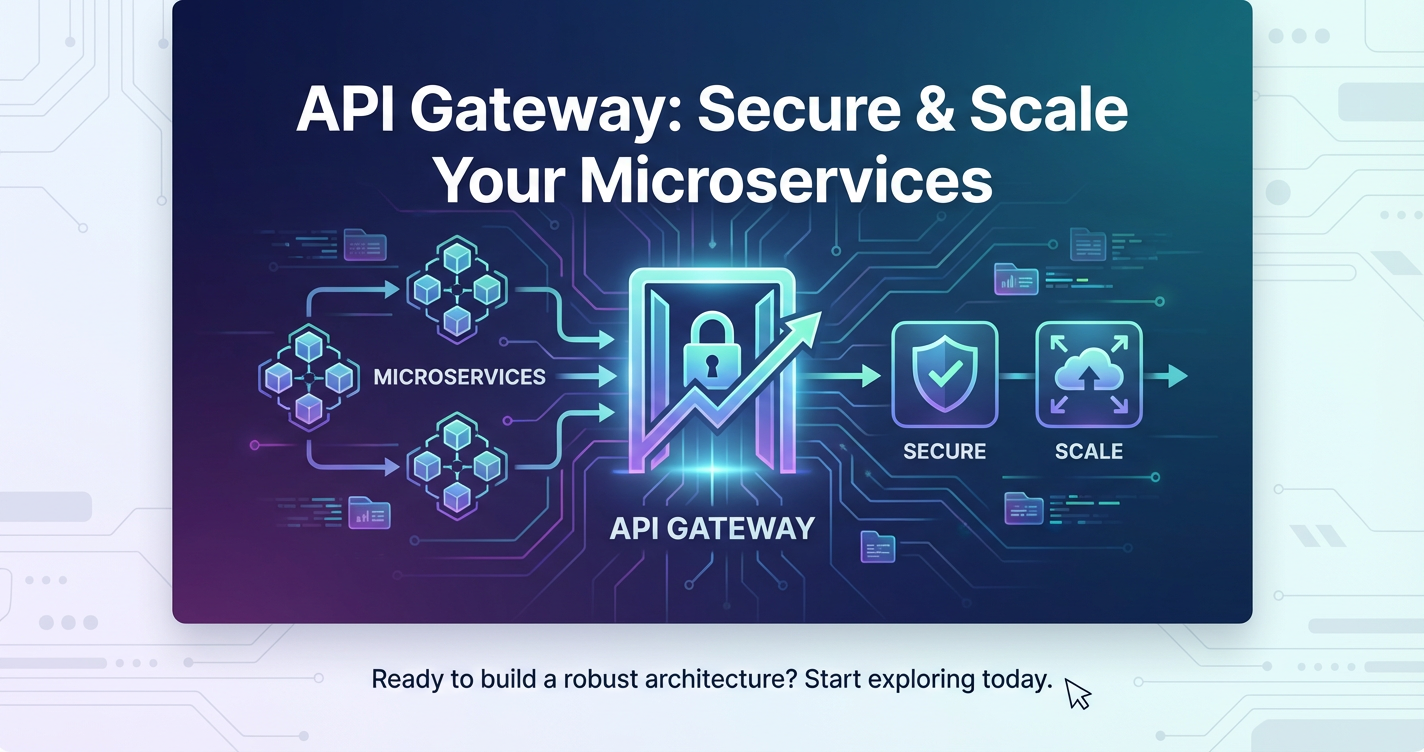
API Gateway: Secure & Scale Your Microservices


In the intricate tapestry of modern software architecture, microservices have emerged as a dominant paradigm, offering unparalleled agility, resilience, and scalability. Yet, this distributed approach, while inherently powerful, introduces a new layer of complexity, particularly in how disparate services communicate, how they are secured, and how their interactions are managed at scale. The promise of microservices — independent deployment, technology diversity, and specialized team ownership — can quickly devolve into a chaotic web of interconnections if not properly governed. This is precisely where the API Gateway steps in, not merely as a simple routing layer, but as a sophisticated traffic cop, a vigilant bouncer, and a shrewd diplomat, orchestrating the complex dance between clients and backend services. It stands as an indispensable component, transforming a fragmented landscape into a coherent, manageable, and highly performant ecosystem.
This comprehensive article delves into the fundamental role of an API Gateway in securing and scaling microservices architectures. We will meticulously unpack its core concepts, explore its multifaceted features, enumerate its undeniable benefits, and discuss strategic implementation approaches. From centralizing critical security policies to enabling seamless scalability and fostering robust resilience, we will examine how an API Gateway acts as the crucial nexus, empowering organizations to harness the full potential of their distributed systems while mitigating inherent complexities. By the end, readers will possess a profound understanding of why this architectural pattern is not just a trend, but a foundational necessity for any enterprise navigating the demands of the digital age.
The Evolving Landscape: Microservices and the Need for a Central Gateway
The journey from monolithic applications to microservices has been driven by a relentless pursuit of agility and efficiency in software development. Traditional monolithic applications, while simpler to deploy in their early stages, often become cumbersome giants, difficult to update, scale, and maintain as they grow. A single change could necessitate redeploying the entire application, leading to slower release cycles and increased risk. Microservices, on the other hand, advocate for breaking down an application into a collection of small, independent, loosely coupled services, each responsible for a specific business capability, running in its own process, and communicating with others over a network, typically via HTTP/REST APIs. This architectural shift enables independent development, deployment, and scaling of individual services, allowing teams to choose the best technology stack for each service and to iterate rapidly.
However, the very advantages of microservices introduce their own set of profound challenges, transforming the once straightforward client-server communication into a many-to-many conundrum. Clients, whether mobile applications, web browsers, or other services, no longer interact with a single, monolithic endpoint. Instead, they often need to consume functionality from dozens, if not hundreds, of distinct backend services. This proliferation of endpoints creates a significant burden: clients must know the network locations of multiple services, handle different authentication mechanisms for each, aggregate data from various sources, and manage a potentially vast number of individual API calls. Direct client-to-microservice communication not only complicates client development but also exposes internal service structure, creating a security risk and tightly coupling clients to the backend implementation details. Moreover, essential cross-cutting concerns such as security, rate limiting, logging, and monitoring, which were once handled within a single application, now need to be addressed consistently across a multitude of services, each potentially developed by different teams and using different technologies. Without a unified approach, these concerns become fragmented, leading to inconsistent enforcement, increased operational overhead, and a higher probability of security vulnerabilities or system failures. It is within this intricate and often chaotic landscape that the indispensable role of an API Gateway becomes not just apparent, but absolutely critical for bringing order, security, and scalability to the microservices ecosystem.
Understanding the Core Concept of an API Gateway
At its heart, an API Gateway acts as the single entry point for all client requests into a microservices-based application. Imagine a bustling city with countless specialist shops and departments, each housed in its own building. Without a central reception or a well-organized road network, visitors would struggle to find the right destination, navigate the maze of streets, and ensure their entry is authorized. The API Gateway serves precisely this purpose for your digital city of microservices. It sits between the client applications (web, mobile, IoT, other services) and the backend microservices, intercepting every request and intelligently routing it to the appropriate service or services.
Crucially, an API Gateway is far more than just a reverse proxy or a load balancer, although it often incorporates these functionalities. It is an API management layer that encapsulates the internal structure of the application, shielding clients from the complexity of microservices. Instead of clients needing to know the specific network addresses and communication protocols for each individual microservice, they simply interact with the gateway's well-defined public API. This abstraction decouples the clients from the evolving backend, allowing microservices to change, scale, and refactor independently without impacting client applications. For instance, if a backend service needs to be split into two new services, or its internal API contract changes, the gateway can handle the necessary transformations or routing rules without requiring any modifications to the client application.
The gateway also serves as a centralized enforcement point for policies and cross-cutting concerns that would otherwise need to be implemented repetitively in each microservice. This includes critical functions like authentication, authorization, rate limiting, caching, and request/response transformations. By centralizing these concerns, the API Gateway simplifies development for individual microservices, reduces code duplication, and ensures consistent application of policies across the entire system. It acts as a primary defensive barrier, inspecting and validating every incoming request before it reaches the more vulnerable backend services, thereby significantly enhancing the overall security posture of the application. In essence, an API Gateway is the intelligent front door to your microservices architecture, providing a secure, scalable, and manageable interface that simplifies interactions for clients and empowers developers to build and evolve backend services with greater agility and confidence. It is the architectural linchpin that transforms a collection of independent services into a cohesive and robust application.
Key Features and Capabilities of an API Gateway
An API Gateway is not a monolithic tool but a versatile platform equipped with a rich set of features designed to address the multifaceted challenges of microservices communication. Its capabilities extend far beyond simple request forwarding, making it an indispensable asset for any modern distributed system. Understanding these features is key to appreciating the profound impact an API Gateway has on security, performance, and operational efficiency.
1. Routing and Load Balancing
One of the most fundamental capabilities of an API Gateway is intelligent request routing. When a client sends a request to the gateway, it determines which backend microservice (or services) should handle that request based on predefined rules, such as the URL path, HTTP method, headers, or query parameters. For example, /users/{id} might be routed to a "User Service," while /products/{id} goes to a "Product Catalog Service." Coupled with routing is load balancing, where the gateway distributes incoming traffic across multiple instances of a specific microservice. This ensures no single service instance becomes overwhelmed, improves response times, and enhances overall system availability and fault tolerance. Advanced gateways often integrate with service discovery mechanisms (like Consul, Eureka, or Kubernetes) to dynamically discover available service instances, making the routing process resilient to service restarts or scaling events.
2. Authentication and Authorization
Centralized security enforcement is perhaps one of the most compelling reasons to adopt an API Gateway. Instead of each microservice having to implement its own authentication and authorization logic, the gateway can handle these concerns at the edge. It can validate API keys, process JSON Web Tokens (JWTs), integrate with OAuth 2.0 providers, or even communicate with identity management systems to authenticate users. Once authenticated, the gateway can then determine if the user or application has the necessary permissions to access the requested resource (authorization). This centralization vastly reduces security implementation complexity, ensures consistent security policies across all services, and provides a single point of entry to defend against unauthorized access, significantly bolstering the application's overall security posture.
3. Rate Limiting and Throttling
To prevent abuse, ensure fair usage among consumers, and protect backend services from being overwhelmed by sudden spikes in traffic, API Gateways offer robust rate limiting and throttling capabilities. Rate limiting restricts the number of requests a client can make within a specific time window (e.g., 100 requests per minute per API key). Throttling, on the other hand, can temporarily delay or drop requests when the system is under heavy load, ensuring that critical services remain responsive. These features are essential for maintaining service stability, preventing denial-of-service (DoS) attacks, and managing resource consumption effectively, especially in scenarios with varying client usage patterns or where monetization of APIs is a factor.
4. Request/Response Transformation
API Gateways can dynamically modify requests before forwarding them to backend services and transform responses before sending them back to clients. This includes adding, removing, or modifying HTTP headers, altering query parameters, or even transforming the entire request or response payload (e.g., converting XML to JSON or vice versa). This capability is invaluable for several reasons: it can normalize requests from diverse clients, adapt to different backend service API contracts without client changes, enrich requests with additional context (like user ID from an authentication token), and simplify the data returned to clients by filtering out unnecessary information.
5. Caching
To improve performance and reduce the load on backend services, API Gateways can implement caching mechanisms. Frequently requested data or responses can be stored at the gateway level, allowing subsequent identical requests to be served directly from the cache without needing to hit the backend microservice. This significantly decreases latency for clients and reduces the computational and network burden on the downstream services, leading to better overall system responsiveness and resource utilization. Caching policies can be configured per API or per resource, with options for time-to-live (TTL) and cache invalidation strategies.
6. Monitoring, Logging, and Analytics
As the central point of entry, the API Gateway is uniquely positioned to gather comprehensive operational data. It can log every incoming request and outgoing response, providing a detailed audit trail of all API interactions. This data is crucial for debugging, auditing, and security analysis. Beyond basic logging, gateways can collect metrics such as request counts, error rates, latency, and throughput, providing valuable insights into API usage patterns and system health. Integrating with external monitoring and analytics platforms allows for real-time dashboards and alerts, enabling proactive identification and resolution of issues. This centralized observability simplifies troubleshooting and ensures that performance bottlenecks or security incidents can be rapidly detected.
7. Circuit Breaker and Resilience Patterns
In distributed systems, failures are inevitable. A robust API Gateway incorporates resilience patterns like the circuit breaker. If a particular backend service becomes unresponsive or starts returning errors consistently, the gateway can "trip" a circuit breaker, temporarily preventing further requests from being sent to that failing service. Instead, it might return a default error, a cached response, or a fallback result. This prevents cascading failures, where one failing service could overwhelm other healthy services, and gives the troubled service time to recover without being hammered by more requests, thus improving the overall fault tolerance of the system.
8. API Versioning
As applications evolve, so do their APIs. Managing multiple versions of an API concurrently (e.g., v1, v2) is a common requirement to allow clients to migrate gradually without breaking existing integrations. API Gateways provide mechanisms to handle API versioning, typically through URL paths (/v1/users), request headers (Accept-Version: v2), or query parameters. The gateway can then route requests to the appropriate version of the backend service, simplifying the deprecation process and ensuring backward compatibility for clients.
9. Protocol Translation and Aggregation
Modern microservices architectures might utilize various communication protocols, such as REST, gRPC, or GraphQL. An API Gateway can act as a protocol translator, allowing external clients to interact using a familiar protocol (e.g., REST over HTTP) while the gateway translates these requests to the internal protocol used by backend services. Furthermore, for complex client requests that require data from multiple backend services, the gateway can aggregate responses from several microservices into a single, unified response before sending it back to the client, thereby reducing the number of round trips and simplifying client-side logic.
When considering the comprehensive suite of features offered by an API Gateway, especially in diverse environments or with emerging technologies like AI, platforms that simplify this complexity become invaluable. For instance, an open-source solution like APIPark stands out by offering a unified management system for authentication and cost tracking across a multitude of AI models, addressing the unique challenges of integrating AI services. It provides a standardized API format for AI invocation, abstracting away model-specific complexities and allowing for prompt encapsulation into REST APIs. This kind of specialized gateway functionality underscores the evolving role of these platforms in managing not just traditional REST APIs but also the burgeoning ecosystem of AI-driven services, ensuring seamless integration and robust lifecycle management.
The Undeniable Benefits of Implementing an API Gateway
Adopting an API Gateway is not merely an architectural choice; it's a strategic decision that yields a cascade of benefits across the entire software development lifecycle, impacting developers, operations teams, and even the business itself. These advantages coalesce to create a more secure, scalable, and manageable application ecosystem.
1. Enhanced Security Posture
By serving as the sole entry point, an API Gateway centralizes security enforcement, which is a monumental advantage. Instead of scattering authentication and authorization logic across numerous microservices, potentially leading to inconsistencies and vulnerabilities, the gateway enforces these policies consistently at the edge. It acts as the first line of defense, validating API keys, processing tokens, and applying access controls before any request reaches the backend. This significantly reduces the attack surface, simplifies security audits, and ensures that all incoming traffic is vetted against established security policies. Furthermore, advanced gateways can integrate with Web Application Firewalls (WAFs) and provide DDoS protection, shielding backend services from common web exploits and volumetric attacks, thereby creating a more robust and impenetrable perimeter for your microservices.
2. Improved Scalability and Performance
The API Gateway plays a pivotal role in optimizing both scalability and performance. Its load balancing capabilities ensure that incoming requests are evenly distributed across multiple instances of backend services, preventing any single service from becoming a bottleneck and allowing for horizontal scaling. Caching mechanisms at the gateway level drastically reduce the load on backend services and decrease latency for clients by serving frequently requested data directly. Rate limiting and throttling protect services from being overwhelmed by traffic spikes, ensuring that resources are available for legitimate requests. By efficiently managing traffic flow and reducing redundant calls to backend services, the gateway helps maintain high performance even under heavy load, ensuring a smooth and responsive user experience.
3. Simplified Client-Side Development and Experience
For client-side developers, the API Gateway acts as a powerful abstraction layer. Instead of needing to manage interactions with potentially dozens of distinct microservices, clients simply communicate with a single, well-defined public API exposed by the gateway. This simplifies client application logic, reduces the number of network requests clients need to make (through aggregation), and shields them from the internal complexities and constant evolution of the backend microservices. If a backend service is refactored, split, or replaced, the gateway can handle the necessary routing and transformation without requiring any changes to the client application, leading to faster client development cycles and a more stable, predictable client-side experience.
4. Centralized Management and Observability
The API Gateway provides a unified control plane for managing all API interactions. This centralization extends to critical operational aspects such as monitoring, logging, and analytics. By collecting comprehensive metrics on request counts, error rates, latency, and resource utilization across all API calls, the gateway offers unparalleled visibility into the health and performance of the entire microservices ecosystem. Detailed logs provide an invaluable audit trail for debugging, compliance, and security analysis. This consolidated view simplifies operational tasks, enables proactive identification of issues, and allows for consistent application of policies across the board, reducing the operational overhead typically associated with distributed systems.
5. Increased Agility and Faster Innovation
One of the core promises of microservices is the ability for independent teams to develop, deploy, and iterate on services rapidly. The API Gateway facilitates this agility by decoupling the client from the backend. Teams can evolve their microservices, introduce new versions, or even entirely replace services without fear of breaking existing client applications, as long as the gateway maintains a stable public API contract. This independence fosters faster innovation, allowing organizations to respond more quickly to market demands and deploy new features with greater confidence and reduced risk. The gateway provides the necessary insulation to allow backend changes to occur smoothly.
6. Cost Efficiency and Resource Optimization
By optimizing traffic management, implementing caching, and protecting backend services from overload, an API Gateway can lead to significant cost efficiencies. Reduced load on backend services means fewer instances are needed to handle the same amount of traffic, lowering infrastructure costs. Centralized security and logging reduce duplicated effort across services, saving development time. The ability to deploy and scale services independently further contributes to optimizing resource allocation, ensuring that computing resources are precisely matched to demand. This smart management translates directly into lower operational expenditures and more efficient use of infrastructure budgets.
7. Enhanced Developer Experience and Productivity
For backend developers, the API Gateway simplifies the task of building microservices by abstracting away cross-cutting concerns. Developers can focus on core business logic, knowing that security, rate limiting, and other policies are handled centrally by the gateway. This reduces cognitive load, accelerates development, and minimizes the chances of introducing errors related to non-functional requirements. Clear API contracts exposed by the gateway, often accompanied by auto-generated documentation, also improve communication and collaboration between teams, further boosting productivity. Platforms like APIPark exemplify this, providing a comprehensive API developer portal that centralizes API services, making it easy for different departments to discover and utilize required APIs, thus enhancing internal team collaboration and developer efficiency.
In summary, an API Gateway is a transformative component that not only addresses the inherent complexities of microservices but also unlocks their full potential. It empowers organizations to build more secure, performant, and agile applications, delivering tangible value across the entire enterprise.
APIPark is a high-performance AI gateway that allows you to securely access the most comprehensive LLM APIs globally on the APIPark platform, including OpenAI, Anthropic, Mistral, Llama2, Google Gemini, and more.Try APIPark now! 👇👇👇
Architecting with an API Gateway: Patterns and Considerations
Integrating an API Gateway into your architecture requires careful consideration of various deployment models, integration points, and strategic choices. It's not a one-size-fits-all solution, and the "right" approach often depends on the specific needs, scale, and existing infrastructure of your organization.
1. Deployment Models
The placement and architectural role of the API Gateway can vary:
- Centralized API Gateway: This is the most common model, where a single gateway instance or cluster serves as the entry point for all microservices in an application or even across multiple applications. It provides a consistent interface and centralized control over all APIs. While offering simplicity and strong policy enforcement, a single gateway can become a potential bottleneck or a single point of failure if not properly scaled and made highly available. Careful resource planning and robust deployment strategies (e.g., active-active clusters, autoscaling) are crucial for this model.
- Decentralized/Per-Service Gateway (Service Mesh vs. API Gateway): In highly complex systems, particularly those with a very large number of services or distinct domain boundaries, some organizations opt for more decentralized approaches. A Service Mesh (e.g., Istio, Linkerd) handles inter-service communication within the microservices fabric, providing features like traffic management, security, and observability at the service-to-service level. While a service mesh can manage granular policies between services, it doesn't typically expose public APIs or handle external client-facing concerns like client authentication, rate limiting, or protocol translation for diverse external clients. Therefore, an API Gateway is still often used at the edge to handle North-South (client-to-service) traffic, while the service mesh handles East-West (service-to-service) traffic. They are complementary, not mutually exclusive.
- Hybrid Models: Many organizations adopt a hybrid approach, using a primary, centralized API Gateway for all external-facing APIs and perhaps smaller, domain-specific gateways for particular sets of internal services or legacy integrations that have unique requirements. This balances the benefits of centralization with the need for domain-specific autonomy and performance optimization.
2. Integration with Other Tools and Systems
An API Gateway rarely operates in isolation; it thrives in a well-integrated ecosystem:
- Identity Providers (IdP): Deep integration with IdPs (e.g., Auth0, Okta, Keycloak, or internal systems) is essential for centralized authentication and authorization. The gateway typically offloads authentication to the IdP and uses the resulting tokens (like JWTs) for authorization decisions.
- Service Discovery Systems: For dynamic routing, gateways often integrate with service discovery mechanisms (e.g., Kubernetes DNS, HashiCorp Consul, Netflix Eureka). This allows the gateway to automatically discover available instances of microservices and update its routing tables without manual configuration, enhancing resilience and scalability.
- Monitoring and Logging Systems: To provide comprehensive observability, the gateway should integrate with enterprise-grade monitoring (e.g., Prometheus, Grafana, Datadog) and logging platforms (e.g., ELK Stack, Splunk, Sumo Logic). This ensures that critical metrics and logs from the gateway are aggregated and analyzed alongside data from other parts of the system.
- CI/CD Pipelines: Automating the deployment and configuration of the API Gateway via CI/CD pipelines is crucial for agility and consistency. Configuration changes, new API routes, or policy updates should be version-controlled and deployed automatically.
3. Choosing the Right API Gateway
The market offers a wide array of API Gateway solutions, each with its strengths and weaknesses. The selection process should consider several factors:
- Open-source vs. Commercial: Open-source gateways (like Kong, Apache APISIX, Tyk, Envoy) offer flexibility, community support, and no licensing costs, but require internal expertise for setup, maintenance, and advanced features. Commercial solutions (like AWS API Gateway, Azure API Management, Google Cloud Apigee, Mulesoft Anypoint Platform) often provide richer feature sets, managed services, professional support, and enterprise-grade capabilities, but come with licensing fees.
- Cloud-native vs. Self-hosted: Cloud-native gateways (provided by major cloud vendors) offer seamless integration with other cloud services, managed infrastructure, and pay-as-you-go pricing. Self-hosted solutions provide greater control over the environment and data residency but require more operational effort.
- Features and Performance: Evaluate the specific features needed (e.g., advanced transformations, specific authentication types, GraphQL support, AI integration). Performance benchmarks under expected load conditions are also critical. Some gateways, like APIPark, specifically cater to emerging needs, offering specialized features for AI model integration and unified API formats, which might be a crucial differentiator for organizations leveraging artificial intelligence. With impressive performance metrics, such as over 20,000 TPS on modest hardware and support for cluster deployment, APIPark stands as a testament to how modern gateway solutions can rival even traditional high-performance proxies like Nginx, while also offering advanced capabilities like end-to-end API lifecycle management, API service sharing, and independent permissions for multi-tenant environments.
- Community and Support: For open-source projects, a vibrant community ensures ongoing development and readily available help. For commercial products, evaluate the vendor's support level and reputation.
- Ease of Deployment and Management: Consider how easily the gateway can be deployed, configured, and managed within your existing infrastructure and operational practices. Solutions that offer quick setup, like APIPark's 5-minute deployment with a single command line, can significantly accelerate adoption and reduce initial overhead.
Careful planning and a thorough evaluation of these considerations will enable organizations to select and implement an API Gateway that perfectly aligns with their architectural vision and business objectives, setting the stage for long-term success in their microservices journey.
Implementation Strategies and Best Practices
Successfully implementing an API Gateway requires more than just choosing the right technology; it demands a thoughtful strategy and adherence to best practices to maximize its benefits and avoid common pitfalls. The gateway sits at a critical juncture in your architecture, making its robust configuration and reliable operation paramount.
1. Start Small, Iterate and Evolve
Resist the urge to implement every possible feature of the API Gateway from day one. Begin by addressing the most pressing needs, such as basic routing, centralized authentication, and perhaps rate limiting for a few critical APIs. As your teams gain experience and confidence, gradually introduce more advanced features like caching, advanced transformations, or protocol translation. This iterative approach minimizes risk, allows for continuous learning, and ensures that the gateway's capabilities evolve organically with your application's requirements. A phased rollout, perhaps starting with non-critical services or a new client application, can provide valuable feedback and prevent disruptions.
2. Define Clear API Contracts
Before exposing any service through the gateway, meticulously define its public API contract. Use standards like OpenAPI Specification (Swagger) to describe the API's endpoints, request/response formats, authentication requirements, and error codes. This clear contract serves as documentation for API consumers and as a blueprint for configuring the gateway. It ensures consistency, reduces ambiguity, and simplifies the integration process for both internal and external clients. The API Gateway should enforce these contracts, validating incoming requests against the defined schemas to prevent malformed data from reaching backend services.
3. Security First: Robust Authentication, Authorization, and Validation
Given its role as the entry point, the API Gateway is your first and most critical line of defense. Implement strong authentication mechanisms (e.g., OAuth 2.0, JWT validation, API Keys) and granular authorization policies. Configure the gateway to validate all incoming data – headers, query parameters, and request bodies – against predefined schemas to prevent injection attacks and ensure data integrity. Regularly review and update security policies. Consider integrating with external security tools like Web Application Firewalls (WAFs) for advanced threat protection. Never trust incoming data; always validate at the gateway and again at the service layer for defense-in-depth.
4. Comprehensive Monitoring, Logging, and Alerting
The API Gateway is a rich source of operational data. Configure it to log every request and response, including details like client IP, user ID, request duration, and status codes. Integrate these logs with a centralized logging system for easy searching and analysis. Collect comprehensive metrics on throughput, latency, error rates, and resource utilization. Set up alerts for critical thresholds (e.g., high error rates, slow response times, unusual traffic spikes) to enable proactive problem detection and resolution. Detailed API call logging, as offered by solutions like APIPark, is invaluable here, recording every detail of each API call to allow businesses to quickly trace and troubleshoot issues, ensuring system stability and data security. Powerful data analysis capabilities, also provided by APIPark, can further leverage this historical call data to display long-term trends and performance changes, aiding in preventive maintenance.
5. Automate Deployment and Testing
Treat your API Gateway configuration as code. Store it in a version control system and integrate its deployment into your Continuous Integration/Continuous Delivery (CI/CD) pipelines. Automate the testing of gateway configurations, including routing rules, security policies, and transformations. This ensures consistency, repeatability, and reduces the risk of human error during updates. Automated functional and performance tests of APIs through the gateway are also crucial to confirm that changes don't introduce regressions or performance bottlenecks.
6. Graceful Error Handling and Consistent Responses
Configure the API Gateway to handle errors gracefully. When a backend service is unavailable or returns an error, the gateway should intercept this, apply a consistent error format, and return a clear, informative (but not overly revealing) error message to the client. This includes implementing circuit breakers to prevent cascading failures and providing sensible fallback responses when services are unhealthy. Consistent error responses improve the developer experience for API consumers and prevent unexpected behavior in client applications.
7. Consider Data Privacy and Compliance
For organizations operating under regulations like GDPR, CCPA, or HIPAA, the API Gateway is a critical control point for data privacy. Configure it to ensure sensitive data is not logged or cached unnecessarily. Implement robust access controls and ensure that data in transit is encrypted (e.g., HTTPS). The gateway can also help enforce data sovereignty rules by routing requests to specific geographical regions based on client or data origin. Features like resource access approval, where callers must subscribe to an API and await administrator approval before invocation, as implemented by APIPark, further enhance security and prevent unauthorized data access, addressing crucial compliance requirements.
8. Comprehensive Documentation and Developer Portal
Even with the best gateway, if developers don't know how to use the APIs, its value diminishes. Provide comprehensive, up-to-date documentation for all APIs exposed through the gateway. A developer portal, potentially integrated with the gateway or part of an API management platform, allows developers to easily discover APIs, read documentation, test endpoints, and manage their API keys. This fosters API adoption and improves the overall developer experience, both internally and externally.
9. Performance Tuning and Scalability Planning
Regularly monitor the gateway's performance metrics and identify potential bottlenecks. Optimize its configuration for maximum throughput and low latency. Plan for scalability by deploying the gateway in a highly available, clustered setup with autoscaling capabilities to handle fluctuating traffic demands. For critical production environments, consider dedicated hardware or highly optimized virtual environments to ensure the gateway itself does not become the performance constraint.
By following these best practices, organizations can transform their API Gateway from a mere traffic controller into a strategic asset that underpins the security, scalability, and operational excellence of their microservices architecture. It becomes the bedrock upon which agile development and reliable application delivery are built.
Advanced Use Cases and Future Trends for API Gateways
The role of the API Gateway is continually expanding, adapting to new architectural patterns, technological advancements, and the evolving demands of modern applications. Beyond its core functions, API Gateways are increasingly becoming intelligent hubs for specialized and emerging use cases, pushing the boundaries of what these central components can achieve.
1. GraphQL Gateway
The rise of GraphQL as an alternative to REST for API development has introduced new requirements for API Gateways. A GraphQL gateway (or GraphQL Federation/Stitching layer) allows clients to query multiple backend microservices through a single GraphQL endpoint. The gateway aggregates data from various sources, resolving the GraphQL query by fetching information from the appropriate microservices (which could be REST, gRPC, or even other GraphQL services). This pattern simplifies data fetching for clients, reduces over-fetching and under-fetching of data, and allows for flexible data consumption without coupling clients to the underlying microservice architecture. The gateway becomes an intelligent query resolver that orchestrates data retrieval across a distributed graph.
2. Event-Driven Gateways and Stream Processing
While traditional API Gateways primarily handle synchronous request/response patterns, the move towards event-driven architectures and real-time data streaming is prompting the evolution of gateways that can manage asynchronous communication. These "event gateways" can expose stream-based APIs (e.g., WebSockets, Server-Sent Events) to clients, subscribing to internal message queues or event streams (like Kafka, RabbitMQ) and pushing real-time updates to connected clients. They might also process incoming events from clients, publishing them to internal message brokers. This allows for more reactive and responsive applications, supporting features like live dashboards, real-time notifications, and collaborative editing experiences.
3. Edge Computing and IoT Gateways
In the realm of Edge Computing and the Internet of Things (IoT), specialized gateways are deployed closer to data sources, often directly on devices or at the network edge. These IoT Gateways perform crucial functions such as data ingestion, protocol translation (e.g., from MQTT to HTTP), security enforcement for device communication, and local data processing/filtering before forwarding relevant information to centralized cloud services. They are designed to handle high volumes of disparate data streams from numerous devices, optimize network bandwidth, and provide a layer of resilience when connectivity to the cloud is intermittent. This distributed gateway pattern is essential for large-scale IoT deployments.
4. AI Gateways: Managing Intelligence at Scale
Perhaps one of the most exciting and rapidly developing areas is the concept of an AI Gateway. As businesses increasingly integrate Artificial Intelligence and Machine Learning models into their applications, managing these models, their invocations, and associated costs becomes a complex challenge. An AI Gateway addresses this by providing a unified interface for interacting with various AI models (e.g., large language models, image recognition, sentiment analysis).
This is where solutions like APIPark truly shine. APIPark functions as an all-in-one AI gateway and API management platform specifically designed for this purpose. It offers the capability to quickly integrate 100+ AI models, providing a unified management system for authentication, access control, and cost tracking across these diverse models. Critically, APIPark standardizes the request data format across all AI models. This means that changes in underlying AI models or prompts do not affect the application or microservices consuming them, drastically simplifying AI usage and reducing maintenance costs. Furthermore, APIPark enables users to encapsulate custom prompts with AI models to create new, specialized REST APIs on the fly, transforming complex AI functionalities into easily consumable services like sentiment analysis or data summarization APIs. This not only democratizes AI capabilities but also streamlines their deployment and management, making the integration of intelligence into applications far more efficient and secure.
5. Serverless Gateways
With the popularity of serverless computing (Function-as-a-Service, FaaS), API Gateways are evolving to integrate seamlessly with these ephemeral functions. A serverless gateway acts as the front door for FaaS functions, triggering them in response to incoming HTTP requests. It handles the routing, security, and transformation of requests before invoking the appropriate serverless function, abstracting away the underlying infrastructure for event-driven computations. This model allows for highly scalable and cost-effective API backends, where compute resources are only consumed when a function is actively processing a request.
6. Policy as Code and GitOps for Gateway Configuration
The future of API Gateway configuration is moving towards "Policy as Code" and GitOps principles. Instead of manual configurations or UI-driven changes, gateway policies, routing rules, and security settings are defined in declarative configuration files (e.g., YAML, JSON) and stored in version control systems (like Git). Automated CI/CD pipelines then deploy these configurations to the gateway. This approach ensures consistency, auditability, and allows for rapid, reliable, and automated changes to the gateway's behavior, treating infrastructure and policy configuration with the same rigor as application code.
These advanced use cases and emerging trends highlight the dynamic and expanding role of API Gateways. From simplifying complex data graphs to managing real-time streams, securing edge devices, and orchestrating AI intelligence, the API Gateway remains at the forefront of architectural innovation, continually evolving to meet the demands of an increasingly distributed, intelligent, and real-time digital world. Its flexibility and strategic placement make it an ideal candidate to absorb new complexities and offer simplified interfaces for a multitude of advanced services.
Case Studies and Real-World Impact
The theoretical benefits of an API Gateway translate into tangible, profound impacts on real-world organizations. From tech giants managing enormous scale to nimble startups building innovative products, the API Gateway has proven to be a cornerstone for robust and evolving microservices architectures. Examining a few high-profile examples can illuminate its strategic importance.
Netflix, often credited with pioneering the microservices architecture, is a quintessential example of API Gateway utilization. As Netflix transitioned from a monolithic application to hundreds of independent microservices, they faced the challenge of managing a staggering number of diverse client applications (smart TVs, gaming consoles, web browsers, mobile apps) that needed to interact with these services. Their solution, Netflix Zuul (now succeeded by a new internal gateway), acted as the crucial gateway. It aggregated requests from clients, performed dynamic routing, applied security policies (authentication, authorization), and provided resilience features like circuit breakers. This allowed Netflix to evolve its backend services rapidly without breaking client applications, ensuring a seamless user experience across a myriad of devices while handling immense traffic volumes. The gateway enabled them to scale their operations globally and maintain an unparalleled level of service availability and reliability.
Amazon, with its vast ecosystem of services powering AWS and its e-commerce platform, leverages API Gateways extensively. AWS API Gateway, as a managed service, allows developers to create, publish, maintain, monitor, and secure APIs at any scale. It handles traffic management, authorization and access control, throttling, monitoring, and API version management. This enables Amazon's internal teams and external customers to build highly scalable and robust serverless and microservices-based applications without worrying about the underlying infrastructure for API management. The gateway is fundamental to how their cloud services communicate and how third-party developers integrate with the Amazon ecosystem.
Beyond the tech giants, numerous enterprises across various industries—finance, healthcare, retail, and manufacturing—have adopted API Gateways to modernize their legacy systems, accelerate digital transformation, and unlock new business opportunities through APIs. For a financial institution, an API Gateway can centralize security for sensitive customer data exposed through banking APIs, ensuring compliance with strict regulations while enabling new digital products. In healthcare, it can facilitate secure data exchange between disparate systems, enabling better patient care and operational efficiency.
The impact of an API Gateway is far-reaching, affecting different stakeholders within an organization in distinct yet equally valuable ways. Here's a summary of how it benefits various roles:
| Stakeholder Group | Key Benefits from API Gateway | How it's Achieved |
|---|---|---|
| Developers (Backend) | Increased Productivity & Focus: Focus on business logic, less on boilerplate. | Gateway handles cross-cutting concerns (security, logging, rate limiting, versioning). |
| Faster Release Cycles: Independent service deployment. | Decouples clients from backend; allows services to evolve without client impact. | |
| Simplified Service Interaction: Clear contracts, less inter-service logic. | Standardized API exposure, aggregation, transformation capabilities. | |
| Developers (Frontend/Client) | Simplified Integration: Single, stable endpoint. | Abstracts complex microservice topology; presents a unified API. |
| Reduced Network Overhead: Data aggregation, caching. | Fewer requests, optimized data delivery. | |
| Consistent User Experience: Stable API, graceful error handling. | Manages API versions, consistent error formats, resilience patterns. | |
| Operations/DevOps Teams | Enhanced Observability: Centralized monitoring, logging. | Single point for collecting metrics and logs across all API interactions. |
| Improved System Stability & Resilience: Traffic management. | Load balancing, rate limiting, circuit breakers protect services from overload and failure. | |
| Simplified Deployment & Management: Automated configuration. | Configuration as code, integration with CI/CD for gateway policies. | |
| Security Teams | Centralized Security Enforcement: Unified policy application. | Single point for authentication, authorization, threat detection, and WAF integration. |
| Reduced Attack Surface: Shields internal services. | All traffic vetted at the perimeter, internal service details hidden. | |
| Faster Incident Response: Detailed logging, audit trails. | Comprehensive logs for forensic analysis and compliance. | |
| Business Leaders/Product Owners | Accelerated Innovation & Time-to-Market: Agile development. | Enables rapid iteration on microservices, faster feature delivery. |
| Scalable Growth & Global Reach: Handles high traffic. | Supports horizontal scaling, distributed deployments, high performance. | |
| Reduced Operational Costs: Efficient resource utilization. | Optimized infrastructure, fewer incidents, streamlined operations. | |
| New Revenue Streams: Monetization of APIs. | Enables controlled access, metering, and policy enforcement for API products. |
The stories from these organizations underscore a universal truth: in the realm of microservices and distributed systems, an API Gateway is not an optional luxury but a fundamental necessity. It is the architectural linchpin that enables organizations to harness the full power of their chosen architecture, driving innovation, ensuring security, and achieving unparalleled scalability. Its real-world impact is visible in the stability of our favorite streaming services, the reliability of our cloud infrastructure, and the agility of countless digital products that define our modern technological landscape.
Conclusion
The evolution of software architecture, from monolithic applications to the dynamic, distributed landscape of microservices, has undeniably transformed how we build and deploy applications. While microservices offer compelling advantages in terms of agility, resilience, and independent scalability, they simultaneously introduce a myriad of complexities in communication, security, and management. It is precisely within this challenging yet promising paradigm that the API Gateway emerges not merely as a convenience, but as an indispensable architectural cornerstone.
Throughout this comprehensive exploration, we have delved into the multifaceted role of the API Gateway, understanding its core concept as the intelligent front door to your microservices. We’ve meticulously examined its extensive array of features, from crucial routing and load balancing to sophisticated authentication, authorization, rate limiting, caching, and robust resilience patterns. Each capability underscores the gateway’s pivotal role in centralizing cross-cutting concerns, thereby simplifying client interactions, safeguarding backend services, and streamlining operational oversight.
The profound benefits of implementing an API Gateway are undeniable, ranging from a dramatically enhanced security posture and superior scalability to simplified client-side development, centralized observability, and increased organizational agility. It empowers developers to focus on core business logic, provides operations teams with unprecedented visibility and control, and enables businesses to accelerate innovation and achieve significant cost efficiencies. Strategic deployment models, careful integration with existing tools, and thoughtful selection of the right gateway solution, considering modern platforms like APIPark for specialized needs like AI integration, are all critical steps toward maximizing its potential.
Looking ahead, the API Gateway continues to evolve, adapting to cutting-edge trends such as GraphQL aggregation, event-driven architectures, edge computing, and perhaps most notably, serving as intelligent AI Gateways that unify and manage complex AI model invocations. This adaptability ensures its continued relevance in a rapidly changing technological landscape.
In essence, the API Gateway stands as the crucial orchestrator in the microservices symphony. It brings order to potential chaos, strengthens security at the most vulnerable point, and provides the scalability necessary to meet ever-growing demands. For any enterprise embarking on or deeply entrenched in a microservices journey, a well-implemented API Gateway is more than just a component; it is the strategic linchpin that transforms a collection of independent services into a cohesive, secure, scalable, and ultimately successful application ecosystem. It is the bedrock upon which the future of agile and reliable software delivery is built.
5 Frequently Asked Questions (FAQs)
1. What exactly is an API Gateway and why is it essential for microservices?
An API Gateway acts as the single entry point for all client requests into a microservices architecture. It sits between client applications (web, mobile, IoT) and your backend microservices, intercepting every request. Its essentiality stems from addressing the complexities introduced by microservices: it simplifies client-side development by providing a unified API, centralizes critical cross-cutting concerns like authentication, authorization, rate limiting, and caching, and ensures robust security and scalability. Without a gateway, clients would need to manage interactions with numerous individual services, leading to increased complexity, security vulnerabilities, and fragmented policies.
2. How does an API Gateway enhance the security of my microservices?
An API Gateway significantly enhances security by centralizing authentication and authorization at the perimeter of your microservices ecosystem. Instead of each microservice needing to implement its own security logic, the gateway becomes the single enforcement point for API keys, OAuth tokens, JWT validation, and access control policies. This centralization reduces the attack surface, ensures consistent security across all services, and provides a robust first line of defense against unauthorized access, malicious traffic, and common web exploits. It also facilitates auditing and monitoring of all API interactions, improving incident detection and response.
3. Can an API Gateway help with scaling my microservices?
Absolutely. An API Gateway is a critical component for achieving scalability in a microservices architecture. It provides intelligent load balancing capabilities, distributing incoming client requests efficiently across multiple instances of your backend microservices, preventing any single service from becoming a bottleneck. Additionally, features like rate limiting and throttling protect your services from being overwhelmed by traffic surges, ensuring stable performance. Caching at the gateway level also reduces the load on backend services and improves response times, allowing your microservices to handle more traffic with fewer resources.
4. What's the difference between an API Gateway and a Service Mesh?
While both an API Gateway and a Service Mesh deal with network traffic in a microservices environment, they operate at different layers and address different concerns. An API Gateway primarily handles "North-South" traffic (client-to-service communication) at the edge of your microservices ecosystem. It focuses on client-facing concerns like public API exposure, client authentication, rate limiting, and request/response transformation. A Service Mesh, on the other hand, handles "East-West" traffic (service-to-service communication) within the microservices fabric. It focuses on internal communication challenges like service discovery, load balancing, traffic management, and observability between services. They are complementary technologies, with the API Gateway acting as the entry point and the Service Mesh managing the internal inter-service communication.
5. How does APIPark contribute to API Gateway capabilities, especially with AI?
APIPark is an open-source AI gateway and API management platform that extends traditional API Gateway capabilities, particularly for integrating and managing Artificial Intelligence services. It offers a unified management system for over 100 AI models, handling authentication, cost tracking, and standardizing the API format for AI invocation. This standardization means changes in underlying AI models or prompts don't affect your applications, simplifying AI usage and reducing maintenance costs. APIPark also allows users to encapsulate custom prompts into REST APIs, creating new AI-powered services on demand. Beyond AI, it provides comprehensive end-to-end API lifecycle management, team service sharing, detailed logging, powerful data analysis, and high performance, making it a robust solution for both traditional and AI-driven API management needs.
🚀You can securely and efficiently call the OpenAI API on APIPark in just two steps:
Step 1: Deploy the APIPark AI gateway in 5 minutes.
APIPark is developed based on Golang, offering strong product performance and low development and maintenance costs. You can deploy APIPark with a single command line.
curl -sSO https://download.apipark.com/install/quick-start.sh; bash quick-start.sh

In my experience, you can see the successful deployment interface within 5 to 10 minutes. Then, you can log in to APIPark using your account.

Step 2: Call the OpenAI API.