FastAPI: How to Handle Null/None Return Values Effectively


APIPark is a high-performance AI gateway that allows you to securely access the most comprehensive LLM APIs globally on the APIPark platform, including OpenAI, Anthropic, Mistral, Llama2, Google Gemini, and more.Try APIPark now! 👇👇👇
FastAPI: Navigating the Nuances of Null/None Return Values Effectively
The modern digital landscape is intricately woven with Application Programming Interfaces (APIs), serving as the backbone for data exchange and service interaction across countless applications. From mobile apps fetching real-time data to microservices communicating within a complex ecosystem, the reliability and predictability of an api are paramount. FastAPI, a high-performance, easy-to-learn, fast-to-code, ready-for-production web framework for building APIs with Python 3.7+ based on standard Python type hints, has rapidly gained traction in this space. Its inherent advantages, such as automatic openapi schema generation, robust data validation through Pydantic, and exceptional speed, make it a top choice for developers. However, even with the most sophisticated tools, a common and often challenging scenario arises: effectively handling None or null return values.
The concept of "null" or "None" (in Python) signifies the absence of a meaningful value. While seemingly straightforward, its implications for an api can range from minor client-side glitches to catastrophic data integrity issues and frustrating debugging cycles. An api that sporadically returns None without clear signaling can leave client applications guessing, leading to crashes, incorrect data displays, or an overall poor user experience. This article delves deep into the strategies and best practices for managing None return values effectively within FastAPI, transforming a potential pitfall into an opportunity for building more resilient, predictable, and user-friendly APIs. We will explore FastAPI's built-in capabilities, advanced patterns, and the broader context of api gateway management to ensure your api not only performs well but also communicates its state with unambiguous clarity.
The Inevitable Presence of None in API Responses
Before dissecting the solutions, it's crucial to understand why None values are an inherent part of API development. They don't always signify an error; sometimes, they accurately reflect the state of data or a logical outcome.
1. Database Queries Yielding No Results: Perhaps the most common scenario. When an api endpoint queries a database for a specific resource (e.g., a user by ID, an item by SKU), and no matching record is found, the database driver or ORM typically returns None or an empty result set. If this None is then directly returned by the FastAPI endpoint, without proper handling, the client might receive an unexpected null or a malformed response.
2. Optional Parameters Not Provided by Clients: Many API endpoints are designed with optional query parameters, path parameters, or fields in the request body. If a client chooses not to provide an optional parameter, Python's default behavior for such parameters is often None. For example, a search api might allow an optional category filter. If no category is provided, the category variable within the endpoint will be None.
3. External API Calls Failing or Returning Empty Data: Modern APIs frequently act as aggregators or proxies, making calls to other internal or external services. If a downstream api call fails, times out, or returns an empty payload (e.g., an empty list, or a null value for a specific field), your FastAPI service must gracefully handle this None before composing its own response. This is where an api gateway can play a crucial role in normalizing responses from diverse backend services, ensuring consistency even when some return None.
4. Business Logic Conditions Leading to No Valid Output: Sometimes, None is the logical outcome of specific business rules. For instance, a function designed to calculate a discount might return None if the input criteria (e.g., minimum purchase amount) are not met. Similarly, an api fetching "active subscriptions" might return None if a user has no active subscriptions. Here, None isn't an error, but a valid representation of "no data" or "no applicable result."
5. Deserialization Issues or Missing Fields: When receiving data from clients or external services, if a field expected to be present is missing or cannot be properly deserialized into the target type, Python's parsing mechanisms might assign None to that variable. Pydantic, FastAPI's data validation library, is excellent at preventing many of these, but it's not foolproof, especially with highly dynamic or poorly defined external data sources.
It's vital to differentiate None from other "empty" representations: * None: The explicit absence of a value. * An empty string (""): A value that is a string of zero length. * An empty list ([]): A value that is a list containing zero elements. * Zero (0): A numerical value.
Confusing these can lead to subtle bugs. For example, a client might interpret {"data": null} differently from {"data": []}. The former explicitly states "no data available," while the latter states "data is an empty collection." FastAPI, through its Pydantic integration and robust response handling, provides powerful tools to manage these distinctions explicitly, ensuring that your openapi specification accurately reflects the possible states and types of your API responses.
FastAPI's Foundational Mechanisms for Handling None
FastAPI, being built on modern Python features and Pydantic, offers several elegant and type-safe ways to manage None values right from its core. These mechanisms not only guide the developer but also automatically generate precise openapi schemas, which are invaluable for client developers.
1. Pydantic Models and Optional Types
Pydantic models are the heart of data validation and serialization in FastAPI. They allow you to define the structure and types of your request and response bodies. When a field in your Pydantic model might legitimately be None, you should explicitly declare it using Optional from the typing module, or more recently, using the Union operator (|).
Example:
from typing import Optional
from pydantic import BaseModel

class UserProfile(BaseModel):
    id: int
    username: str
    email: Optional[str] = None  # Email might be None, default is None
    bio: str | None = None      # Python 3.10+ syntax for Optional

# In your FastAPI application:
@app.get("/techblog/en/users/{user_id}", response_model=UserProfile)
async def get_user_profile(user_id: int):
    # Simulate fetching from a database
    user_data = {"id": user_id, "username": "john_doe"}

    # If email or bio might be missing from the DB
    if user_id % 2 == 0:
        user_data["email"] = "john.doe@example.com"
        user_data["bio"] = "Loves FastAPI and Python."
    else:
        # For odd IDs, email and bio might not be available
        pass # They will default to None as per Pydantic model definition

    return UserProfile(**user_data)
How Pydantic and Optional Work:
- Type Hinting Clarity:
Optional[str](orstr | None) clearly signals that theemailfield can be either astrorNone. This is crucial for static analysis tools and for developers consuming yourapi. - Automatic
openapiSchema Generation: FastAPI leverages Pydantic models to automatically generate your API'sopenapischema. For fields declared asOptional[Type], the schema will includenullable: truefor that field. This provides explicit documentation to client developers that they might receive anullvalue for that particular field, allowing them to implement defensive programming.json { "title": "UserProfile", "type": "object", "properties": { "id": { "title": "Id", "type": "integer" }, "username": { "title": "Username", "type": "string" }, "email": { "title": "Email", "type": "string", "nullable": true // This is the key }, "bio": { "title": "Bio", "type": "string", "nullable": true } }, "required": ["id", "username"] } - Default Values: By setting
email: Optional[str] = None, you ensure that if the field is omitted during model instantiation (e.g., when creatingUserProfile(**user_data)anduser_datadoesn't have anemailkey), it will default toNonerather than raising a validation error for a missing required field. - Serialization: When a Pydantic model with an
Optionalfield containingNoneis returned from a FastAPI endpoint, it will be serialized to JSON as{"email": null}, which is the standard representation for null in JSON.
2. Optional Path and Query Parameters
Similar to Pydantic model fields, FastAPI allows you to define optional parameters directly in your route functions. This is useful when a client might or might not provide certain filtering or pagination parameters.
Example:
from fastapi import FastAPI, Query
from typing import Optional

app = FastAPI()

@app.get("/techblog/en/items/")
async def read_items(q: Optional[str] = None, skip: int = 0, limit: Optional[int] = None):
    results = {"items": [{"item_id": "Foo"}, {"item_id": "Bar"}]}
    if q:
        results.update({"q": q})
    if limit is not None: # Check if limit was provided
        results["items"] = results["items"][:limit]
    return results
Key Points:
- Type Hinting:
q: Optional[str] = Noneandlimit: Optional[int] = Noneexplicitly state thatqcan be a string orNone, andlimitcan be an integer orNone. - Default Value: If the client doesn't provide
qorlimitin the URL, their values inside the function will beNone. openapiDocumentation: FastAPI will automatically document these parameters as optional in theopenapiUI (Swagger UI/ReDoc), indicating that they can be omitted.- Careful Checks: Within your function, you must explicitly check
if q is not None:orif q:(sinceNoneis falsy) andif limit is not None:before using these variables, as they might indeed beNone.
3. Response Models for Endpoint Return Types
FastAPI allows you to specify a response_model directly in your endpoint decorator. This is a powerful feature that guarantees the shape of the data returned by your endpoint, even if your internal logic produces something slightly different. It also ensures that the openapi schema for that endpoint's response is accurate.
When your endpoint might return an object or None (representing "no data found" for that specific request), you can use Optional in your response_model declaration.
Example:
from fastapi import FastAPI, HTTPException
from typing import Optional
from pydantic import BaseModel

app = FastAPI()

class Item(BaseModel):
    id: str
    name: str
    description: Optional[str] = None

# Simulate a database
items_db = {
    "foo": {"id": "foo", "name": "Foo Item"},
    "bar": {"id": "bar", "name": "Bar Item", "description": "The Bar description"}
}

@app.get("/techblog/en/items/{item_id}", response_model=Optional[Item])
async def read_item_potentially_none(item_id: str):
    item = items_db.get(item_id)
    # If item is not found, it will be None. FastAPI will return null.
    return item
Considerations:
response_model=Optional[Item]: This tells FastAPI that the endpoint can return either anItemobject orNone. IfitemisNone, FastAPI will serialize it tonullin the JSON response.- HTTP Status Code: While this approach correctly returns
nullin the body, it typically sends a200 OKHTTP status code. For "resource not found" scenarios, a404 Not Foundor204 No Contentis generally more appropriate than200 OKwithnull. This leads us to the next crucial mechanism.
4. Error Handling with HTTPException and Status Codes
Returning None with a 200 OK status code can be ambiguous for clients. Is null an expected absence of data, or does it signify an error? For situations where a requested resource genuinely doesn't exist, FastAPI's HTTPException is the preferred and semantically correct way to signal this.
Example: Resource Not Found (404)
from fastapi import FastAPI, HTTPException
from typing import Optional
from pydantic import BaseModel

app = FastAPI()

class Item(BaseModel):
    id: str
    name: str
    description: Optional[str] = None

items_db = {
    "foo": {"id": "foo", "name": "Foo Item"},
    "bar": {"id": "bar", "name": "Bar Item", "description": "The Bar description"}
}

@app.get("/techblog/en/items_strict/{item_id}", response_model=Item)
async def read_item_strict(item_id: str):
    item = items_db.get(item_id)
    if item is None:
        raise HTTPException(status_code=404, detail="Item not found")
    return item
Why HTTPException(404) is Better for "Not Found":
- Semantic Clarity: A
404 Not Foundstatus code immediately tells the client that the requested resource could not be located. This is a standard and universally understood signal. - Client Expectation: Clients typically have specific error handling logic for
4xxand5xxstatus codes. Returning200 OKwithnullmight bypass this, leading to client-side crashes if they expect a specific data structure. openapiDocumentation: FastAPI automatically documentsHTTPExceptionresponses in theopenapischema, detailing the possible error codes and their associated messages. This makes yourapi's contract very clear.- Response Body: When
HTTPExceptionis raised, FastAPI generates a standard JSON error response (e.g.,{"detail": "Item not found"}), which is consistent and predictable.
HTTP Status Code 204 No Content:
The 204 No Content status code is ideal when an operation was successful, but there's no data to return in the response body. This is often used for DELETE operations, or perhaps for an api endpoint that performs an action but doesn't need to send back any data. While not directly about handling None in a return value, it's related to scenarios where an endpoint might logically have "no content."
from fastapi import FastAPI, Response, status

app = FastAPI()

@app.delete("/techblog/en/items/{item_id}", status_code=status.HTTP_204_NO_CONTENT)
async def delete_item(item_id: str):
    # Simulate deletion
    if item_id in items_db:
        del items_db[item_id]
        return Response(status_code=status.HTTP_204_NO_CONTENT)
    else:
        raise HTTPException(status_code=404, detail="Item not found")
When returning Response(status_code=status.HTTP_204_NO_CONTENT), the response body will be empty. This is an explicit signal to the client that the operation was successful, and they should not expect any data.
Custom Exception Handlers:
For more complex or application-specific None handling scenarios, you can define custom exception handlers. These handlers can catch specific exceptions (or HTTPExceptions with particular details) and return custom responses. This allows for fine-grained control over how None-related issues are communicated.
from fastapi import FastAPI, Request, status, HTTPException
from fastapi.responses import JSONResponse

app = FastAPI()

class NotFoundError(Exception):
    def __init__(self, name: str):
        self.name = name

@app.exception_handler(NotFoundError)
async def not_found_exception_handler(request: Request, exc: NotFoundError):
    return JSONResponse(
        status_code=status.HTTP_404_NOT_FOUND,
        content={"message": f"Oops! {exc.name} was not found, try a different one."},
    )

@app.get("/techblog/en/custom_items/{item_id}")
async def read_custom_item(item_id: str):
    if item_id not in items_db:
        raise NotFoundError(name=item_id)
    return items_db[item_id]
This approach allows for highly specific and user-friendly error messages tailored to the absence of specific resources, beyond the generic "detail" message of HTTPException.
Advanced Strategies for Robust None Handling
While FastAPI's built-in features provide a strong foundation, complex applications often require more nuanced and centralized strategies to manage None values effectively. These advanced techniques aim to improve consistency, maintainability, and client communication.
1. Custom Response Models for Explicit "No Data" States
Instead of relying solely on Optional[Model] and a 200 OK with a null body for "no data," you can design distinct Pydantic response models that explicitly communicate the absence of data. This pattern is particularly useful when the null body might be ambiguous or when you want to provide additional context.
Example:
from typing import Generic, TypeVar, Optional
from pydantic import BaseModel
from fastapi import FastAPI, HTTPException

app = FastAPI()

T = TypeVar("T")

class ApiResponse(BaseModel, Generic[T]):
    success: bool
    data: Optional[T] = None
    message: Optional[str] = None

class User(BaseModel):
    id: int
    name: str

# Simulate user database
users_db = {
    1: {"id": 1, "name": "Alice"},
    2: {"id": 2, "name": "Bob"}
}

@app.get("/techblog/en/users_custom_response/{user_id}", response_model=ApiResponse[User])
async def get_user_with_custom_response(user_id: int):
    user_data = users_db.get(user_id)
    if user_data:
        return ApiResponse(success=True, data=User(**user_data), message="User fetched successfully.")
    else:
        # Still using 200 OK but with explicit `data: null` and a message
        # Alternatively, could raise HTTPException(404) here.
        return ApiResponse(success=False, data=None, message=f"User with ID {user_id} not found.")

@app.get("/techblog/en/users_with_404_on_none/{user_id}", response_model=ApiResponse[User])
async def get_user_with_404(user_id: int):
    user_data = users_db.get(user_id)
    if user_data:
        return ApiResponse(success=True, data=User(**user_data), message="User fetched successfully.")
    else:
        # This is generally preferred for "not found"
        raise HTTPException(status_code=404, detail=f"User with ID {user_id} not found.")
Benefits of Custom Response Models:
- Explicit Communication: The client always receives a structured response, with
success: Falseand amessageclarifying whydataisnull. - Consistency: All endpoints can adhere to a uniform response structure.
- Flexibility: You can add more fields (e.g.,
error_code,timestamp) to yourApiResponsefor richer error reporting. openapiDocumentation: FastAPI will document theApiResponsemodel, clearly showing thatdatacan benulland thesuccessfield's meaning.
However, it's crucial to decide if {"success": false, "data": null, "message": "..."} with a 200 OK is appropriate for your scenario. Often, a 404 Not Found with a simple error message is more RESTful for truly missing resources. The custom response model is more suited for business logic where the absence of data is a valid "success" outcome (e.g., "no new notifications").
2. Using Union for More Expressive Return Types
Python's Union (or | in 3.10+) allows for more complex type hints, enabling you to specify that an endpoint might return one of several distinct types. This can be powerful for signaling different states without relying solely on HTTP status codes.
from fastapi import FastAPI
from typing import Union
from pydantic import BaseModel, Field

app = FastAPI()

class SuccessUser(BaseModel):
    id: int
    name: str
    status: str = Field("active", const=True) # Explicit status for this type

class UserNotFound(BaseModel):
    message: str
    status: str = Field("not_found", const=True) # Explicit status for this type

@app.get("/techblog/en/users_union/{user_id}", response_model=Union[SuccessUser, UserNotFound])
async def get_user_with_union(user_id: int):
    user_data = users_db.get(user_id)
    if user_data:
        return SuccessUser(id=user_data["id"], name=user_data["name"])
    else:
        # This will still return 200 OK, but with a UserNotFound body
        return UserNotFound(message=f"User with ID {user_id} was not found.")
Trade-offs:
- Pros: Very explicit for clients, as the
response_modelinopenapiwill showoneOfSuccessUserorUserNotFound. - Cons: Still defaults to
200 OKunless you manually raiseHTTPException. Using different Pydantic models with a200 OKcan sometimes blur the line between a "successful data retrieval" and a "successful communication of an absence," which might confuse clients if not well-documented.
3. Custom Decorators or Dependencies for Pre-Check Logic
For recurring patterns where a resource might be None (e.g., fetching an object from a database), you can create reusable dependencies or custom decorators. These can encapsulate the None checking logic and raise an HTTPException if necessary, keeping your endpoint code clean.
Example (Dependency):
from fastapi import Depends, HTTPException
from typing import Callable, TypeVar, Optional

T_Model = TypeVar("T_Model")

def get_resource_or_404(
    resource_getter: Callable[[str], Optional[T_Model]],
    resource_name: str = "Resource"
) -> Callable[[str], T_Model]:
    """
    A dependency factory that returns a dependency.
    The returned dependency takes an ID, calls resource_getter,
    and raises 404 if the resource is None.
    """
    def _dependency(item_id: str) -> T_Model:
        resource = resource_getter(item_id)
        if resource is None:
            raise HTTPException(status_code=404, detail=f"{resource_name} not found")
        return resource
    return _dependency

# Usage in an endpoint:
# Assuming 'get_user_from_db' is a function that returns Optional[User]
# @app.get("/techblog/en/users_deps/{user_id}", response_model=User)
# async def get_user(user: User = Depends(get_resource_or_404(get_user_from_db, "User"))):
#     return user
This pattern centralizes the None check and HTTPException raising, making your endpoints more focused on business logic.
4. The Role of an API Gateway in Harmonizing None Responses
In microservices architectures or systems integrating numerous external apis, an api gateway becomes an indispensable component. An api gateway sits between clients and a multitude of backend services, routing requests, handling authentication, and crucially, managing responses. This is where a platform like APIPark can significantly enhance how None values are handled across a distributed system.
An api gateway can: * Normalize Responses: Different backend services might return None (or its equivalent) in varying formats (e.g., an empty string, an empty JSON object, a null field, or a 404). An api gateway can intercept these, transform them into a consistent format, or even turn a backend's 200 OK with {"data": null} into a 404 Not Found for the client. * Unified API Format for AI Invocation: APIPark, as an AI gateway, specifically helps standardize response data formats across various AI models. This is particularly valuable when integrating diverse AI services, where some might return None if a query is unanswerable or outside its domain, ensuring consistency for the consuming application. * Apply Global Policies: You can configure the api gateway to automatically check for certain None-like conditions in backend responses and apply a global policy, such as injecting a default value, returning a generic error, or caching "not found" results. * End-to-End API Lifecycle Management: By managing the entire lifecycle of APIs, APIPark helps regulate API management processes. This control extends to defining and enforcing consistent API contracts, which naturally includes how None values are represented in responses, ensuring that all published APIs adhere to a common standard.
For complex enterprise environments where multiple FastAPI services (and other services) are exposed, leveraging an api gateway like APIPark allows for a central point of control to manage the complexities of None handling, making the overall API ecosystem more robust and predictable for external consumers.
5. Centralized None Handling with Middleware
FastAPI middleware can intercept requests before they reach your route handlers and responses before they are sent back to the client. This offers a powerful, albeit sometimes blunt, tool for global None handling.
Example:
from fastapi import FastAPI, Request, Response
from fastapi.responses import JSONResponse
from starlette.middleware.base import BaseHTTPMiddleware, RequestResponseEndpoint
from starlette.types import ASGIApp

class HandleNoneResponseMiddleware(BaseHTTPMiddleware):
    async def dispatch(self, request: Request, call_next: RequestResponseEndpoint) -> Response:
        response = await call_next(request)

        # Check if the response body is explicitly 'null' or equivalent
        if response.status_code == 200:
            try:
                # Read the response body
                async for chunk in response.body_iterator:
                    body = chunk.decode("utf-8")
                    break # Assuming body is fully read in first chunk for simplicity

                if body == "null": # FastAPI serializes Python None to JSON 'null'
                    # Optionally, log this event
                    print(f"Intercepted null response for {request.url}. Changing to 204.")
                    return Response(status_code=204) # Or 404, with a message

            except Exception as e:
                # Handle cases where body is not readable or not JSON
                print(f"Error processing response body: {e}")
                pass # Just pass through if we can't process

        return response

app = FastAPI()
app.add_middleware(HandleNoneResponseMiddleware)

# Example endpoint that might return None (which FastAPI turns into 'null')
@app.get("/techblog/en/data_or_none")
async def get_data_or_none(present: bool = True):
    if present:
        return {"value": "some data"}
    return None # This will be intercepted by the middleware
Middleware Considerations:
- Global Impact: Middleware affects all responses, so be cautious. It's best used for very generic transformations.
- Performance: Reading and potentially modifying response bodies can add overhead.
- Clarity vs. Automation: While it automates
Nonehandling, it might obscure the original intent of the endpoint if it was designed to returnnullwith a200 OKfor a specific reason. - Limited Context: Middleware doesn't have the rich context of the individual endpoint (e.g., knowing why
Nonewas returned), making it hard to make highly specific decisions (like differentiating between "resource not found" and "no data for this query").
In most cases, explicit handling within the endpoint (using HTTPException or response_model=Optional[T]) is preferred for clarity, but middleware can be a fallback for legacy systems or very broad policies.
Best Practices and Design Patterns for Consistent None Handling
Building robust APIs isn't just about implementing features; it's about establishing consistent patterns that lead to predictability and maintainability. When it comes to None handling, adopting best practices is paramount.
1. Clear API Contracts through openapi Specification
FastAPI's strongest feature is its automatic generation of openapi (formerly Swagger) specifications. This specification acts as the definitive contract between your api and its consumers.
- Explicitly Document
nullable: true: When a field in your Pydantic response model can beNone, ensure it's declared asOptional[Type](orType | None). FastAPI will automatically translate this intonullable: truein theopenapiJSON schema. This explicitly tells client developers to expectnullfor that field. - Document Error Responses: Use
HTTPExceptionwhere appropriate. FastAPI will document these potential error responses (e.g.,404 Not Found,400 Bad Request) in theopenapiUI, including their status codes and example error bodies. This is crucial for clients to understand when they should expect an error rather than anullvalue in a successful response. - Provide Examples: In your
openapidefinition, provide examples for both successful responses (with data and potentiallynulloptional fields) and error responses. This leaves no room for ambiguity. - Review
openapiUI: Regularly check your automatically generated Swagger UI or ReDoc documentation. Does it accurately reflect all possible return states, includingNonevalues and error conditions? Is it easy to understand?
A well-documented openapi specification reduces integration time, prevents client-side bugs, and clarifies the api's expected behavior, especially regarding the absence of data.
2. Consistency Across Endpoints
Inconsistency is the enemy of developer experience. If one endpoint returns 404 for a missing resource, but another returns 200 OK with {"data": null}, client developers will struggle to predict and correctly handle responses.
- Establish a Guideline: Decide on a consistent strategy for your API. For example:
- "Resource Not Found" =
404 Not Found: This is generally the most RESTful approach for when a specific resource ID doesn't exist. - "No Data Available for Query" =
200 OKwith empty list/object or{"data": null}: For collection endpoints or queries that yield no results,200 OKwith an empty collection ([]) is often preferred overnull. If a specific field might benull, useOptional. - "Action Successful, No Relevant Content" =
204 No Content: For operations likeDELETEor state changes that don't need a response body.
- "Resource Not Found" =
- Code Review and Linter Rules: Enforce these guidelines through code reviews and potentially custom linter rules if your team is large.
- Shared Utilities: Create shared functions or dependencies (as discussed above) to enforce consistent
Nonehandling logic across multiple endpoints.
Consistency minimizes surprises for client developers and simplifies their integration efforts, making your api a pleasure to work with.
3. Client-Side Considerations and Defensive Programming
The responsibility for handling None values isn't solely on the api producer; client applications must also anticipate and gracefully manage them.
- Always Check for
null: Client developers should assume that any field documented asnullable: truemight indeed benulland write code that explicitly checks fornullbefore attempting to access properties or perform operations on that data. - Handle Error Status Codes: Clients should have robust error handling for
4xxand5xxHTTP status codes, especially404 Not Found, as these are the primary signals for missing resources. - Use Fallback Values: Where appropriate, clients can implement fallback or default values when a
nullis received for an optional field (e.g., display "N/A" if a user'sbioisnull). - Good Documentation: The best client-side handling starts with excellent API documentation. The
openapiUI generated by FastAPI is a fantastic tool for this. Make sure it's accessible and up-to-date.
4. Logging and Monitoring for None-Related Issues
While explicitly handling None prevents client errors, monitoring its occurrence can provide valuable insights into your data and application logic.
- Log Unexpected
Nones: If yourapireturnsNonein a scenario that you didn't fully anticipate (e.g., a critical database query unexpectedly returnsNonefor a supposed non-nullable field), log this event. This could indicate data corruption, an upstream service issue, or a bug in your application logic. - Monitor 404/204 Frequencies: A sudden spike in
404 Not Foundresponses for a specific endpoint could indicate that clients are requesting non-existent resources due to outdated IDs, a data migration issue, or even malicious activity. A high number of204 No Contentresponses might signify a legitimate outcome, but it's worth understanding the context. - APIPark's Logging and Analysis Capabilities: This is another area where a platform like APIPark shines. APIPark offers "Detailed API Call Logging," which records every detail of each
apicall, making it easy to trace and troubleshoot issues related to unexpectedNonereturns or frequent error codes. Furthermore, its "Powerful Data Analysis" feature analyzes historical call data to display long-term trends and performance changes. This can help identify patterns inNoneor error responses, enabling preventive maintenance before these issues impact business operations. By providing deep insights intoapitraffic and response patterns, APIPark enhances an organization's ability to maintain system stability and data security across its integratedapilandscape.
A Comparative Table of None Handling Strategies
To summarize the various approaches, here's a table comparing common None handling strategies in FastAPI:
| Strategy | Description | Pros | Cons | Best Use Case |
|---|---|---|---|---|
Optional[Type] in Pydantic Model |
Declaring a field as Optional[str] or str | None in a Pydantic response model. |
Explicitly documents nullable: true in openapi. Clear type hints. Simple. |
Returns 200 OK with {"field": null}. Can be ambiguous for "resource not found." |
Optional data fields that might genuinely be absent within an otherwise existing resource (e.g., optional bio in UserProfile). |
HTTPException(404) |
Raising HTTPException(status_code=404, detail="Not Found") for missing resources. |
Semantically correct for "resource not found." Standard client error handling. Clear openapi documentation. |
Aborts request processing. Not suitable for optional fields within an existing resource. | When a specific resource requested by its ID (e.g., /users/{id}) does not exist. |
HTTPException(204) (or Response(204)) |
Returning Response(status_code=204) for successful operations with no content. |
Semantically correct for "no content to return." Efficient (no body). | Does not carry a body, so cannot convey specific messages. | DELETE operations, successful updates that don't need confirmation data, or actions where response body is irrelevant. |
Custom ApiResponse Model |
Wrapping responses in a generic model like {"success": true, "data": {}} or {"success": false, "message": "..."}. |
Highly flexible for structured responses. Consistent pattern for all responses. | Often returns 200 OK even for "failures" (if success: false). Can be more verbose than needed. |
Complex business logic where absence of data is a specific "state" (not an error), requiring additional context. |
| Custom Dependency/Decorator | Creating reusable logic to check for None from internal functions and raise HTTPException. |
Clean endpoint logic. Centralizes common None checks. Enforces consistency. |
Requires initial setup. Can be over-engineered for simple cases. | Repeated patterns of fetching a resource by ID from a database where "not found" should always be a 404. |
| API Gateway (e.g., APIPark) | Centralized platform to normalize responses, enforce policies, and manage various backend services. | Harmonizes None responses across microservices. Enhances security and observability. |
Adds an infrastructure layer. Not directly a FastAPI code pattern. | Large-scale microservices, integrating diverse backend APIs, needing unified control and monitoring. |
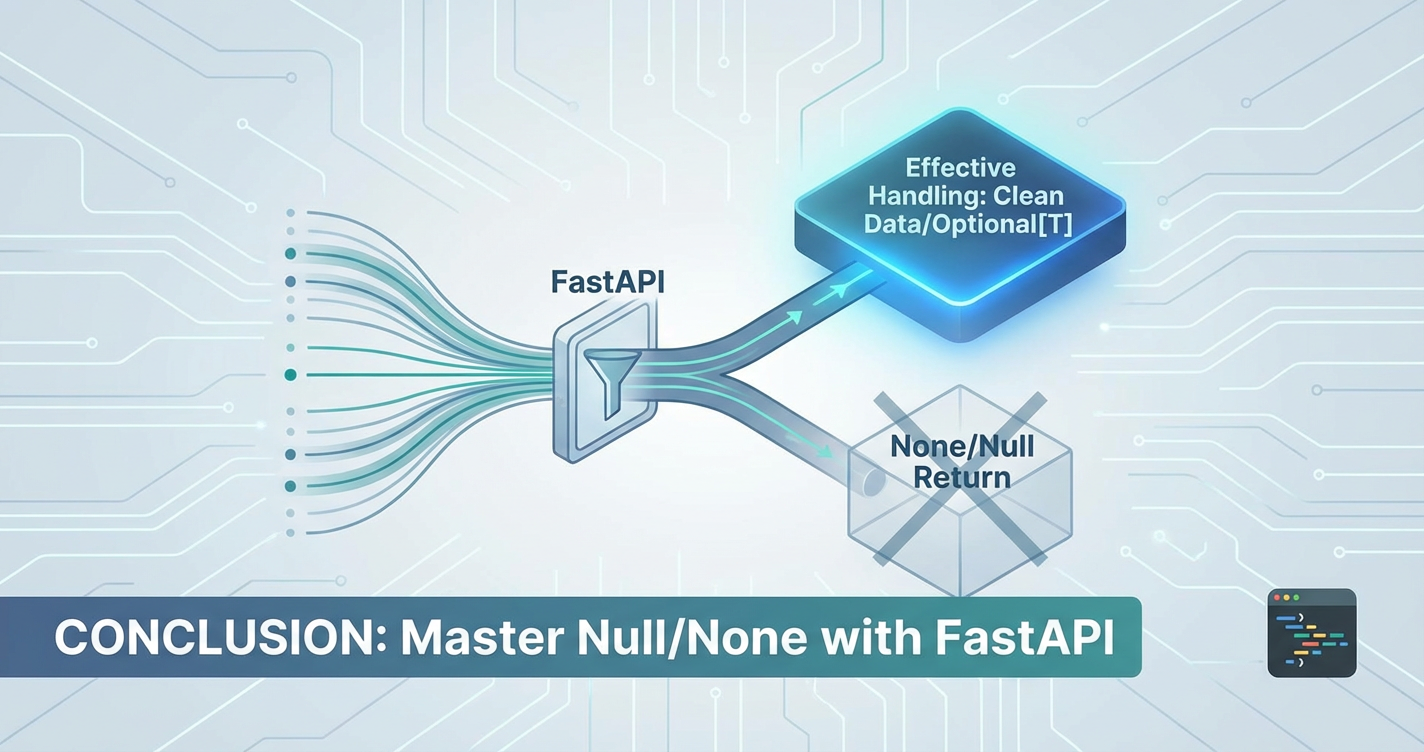
Conclusion: Embracing Clarity and Predictability in FastAPI
Handling None return values in FastAPI is not merely a technical detail; it's a fundamental aspect of designing robust, predictable, and developer-friendly APIs. The Pythonic concept of None for "no value" needs careful translation into the world of HTTP and JSON, where "null" can signify anything from an expected absence to a critical error.
FastAPI, with its strong typing based on Pydantic and Python type hints, provides powerful tools to manage these scenarios. From explicitly marking optional fields with Optional[Type] that translate into nullable: true in your openapi schema, to leveraging HTTPException for semantically correct error signaling, developers have a rich toolkit. Advanced strategies, such as custom response models and centralized dependencies, further enhance consistency and clarity across complex API ecosystems.
Furthermore, in distributed environments, an api gateway like APIPark plays an instrumental role. By providing capabilities for unified API formats, end-to-end lifecycle management, and detailed logging and analysis, APIPark ensures that the complexities of None values across diverse backend services are harmonized and made transparent, bolstering the overall reliability and security of your api landscape.
Ultimately, the goal is to eliminate ambiguity. Every response from your FastAPI api, whether it contains data, null values, or an error message, should communicate its state with crystal clarity. By thoughtfully applying the strategies discussed in this article, you can build APIs that are not only performant and efficient but also a pleasure for developers to consume, fostering greater trust and adoption in your digital services.
Frequently Asked Questions (FAQs)
1. What is the difference between returning None and raising HTTPException(404) in FastAPI? Returning None from an endpoint typically results in a 200 OK HTTP status code with a JSON null body (or {"field": null} if part of a larger Pydantic model). This implies success but with no content or value. Raising HTTPException(404), on the other hand, explicitly signals that the requested resource was not found, resulting in a 404 Not Found HTTP status code and a standard error message. Generally, 404 is preferred for truly missing resources, while None with 200 OK might be acceptable for optional fields or when the absence of data is an expected successful outcome of a query.
2. How does FastAPI's Optional type hint affect the openapi documentation? When you use Optional[Type] (or Type | None in Python 3.10+) for a Pydantic model field or an endpoint parameter, FastAPI automatically generates nullable: true for that field in the openapi schema. This explicitly documents for API consumers that the field might be null, allowing them to implement appropriate client-side handling.
3. When should I use 204 No Content versus 200 OK with an empty body or null? Use 204 No Content when an operation was successful, but there is no need to return any data in the response body. This is common for DELETE operations or status updates. Use 200 OK with an empty JSON object ({}) or an empty list ([]) when the operation was successful and would normally return data, but in this specific instance, there simply isn't any data to provide (e.g., a search query with no matching results). Returning null with 200 OK (via Optional[Model]) is suitable for an optional field within an otherwise successful response.
4. Can an api gateway help with None handling in FastAPI? Yes, an api gateway like APIPark can play a crucial role. It can normalize responses from multiple backend services, including those that return None or null in various formats. For instance, it can transform a 200 OK with a null body from a backend service into a 404 Not Found for the client, ensuring consistent API contracts across your entire ecosystem. Additionally, features like APIPark's detailed logging and data analysis help in monitoring and troubleshooting None-related issues across integrated apis.
5. What are the potential pitfalls of inconsistent None handling in an API? Inconsistent None handling can lead to significant problems: * Client-side bugs: Clients might not correctly anticipate and handle null values, leading to crashes or incorrect data display. * Increased development time: Client developers spend more time debugging unexpected responses. * Poor developer experience: An unpredictable api is frustrating to work with. * Ambiguity: null might be interpreted differently by various client implementations, leading to inconsistent behavior. * Maintenance headaches: Inconsistent patterns make the api harder to maintain and extend over time.
🚀You can securely and efficiently call the OpenAI API on APIPark in just two steps:
Step 1: Deploy the APIPark AI gateway in 5 minutes.
APIPark is developed based on Golang, offering strong product performance and low development and maintenance costs. You can deploy APIPark with a single command line.
curl -sSO https://download.apipark.com/install/quick-start.sh; bash quick-start.sh

In my experience, you can see the successful deployment interface within 5 to 10 minutes. Then, you can log in to APIPark using your account.

Step 2: Call the OpenAI API.