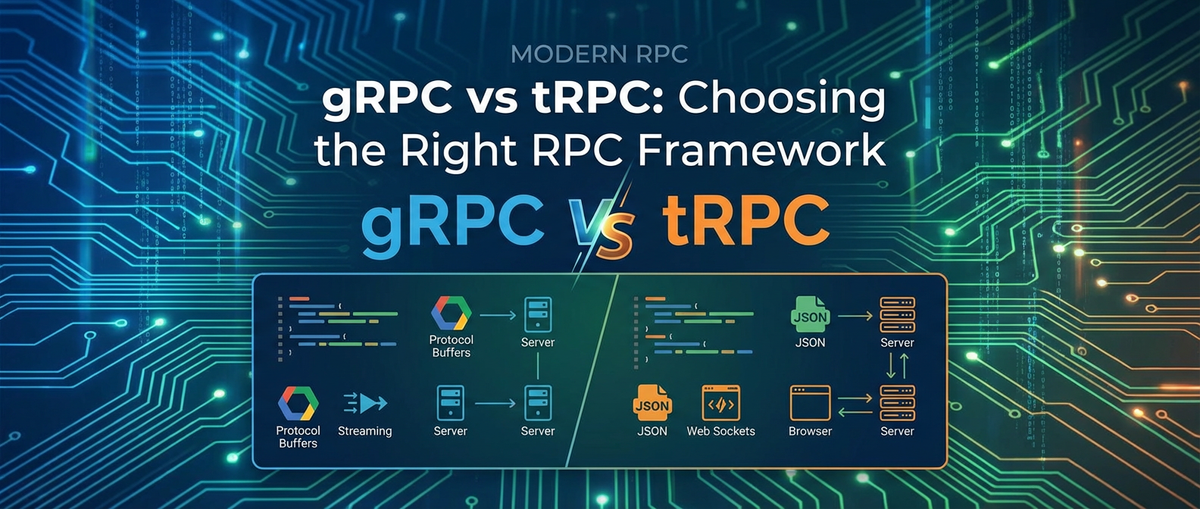
grpc vs trpc: Choosing the Right RPC Framework


In the intricate landscape of modern software development, where distributed systems, microservices, and client-server architectures reign supreme, efficient and reliable communication between different components is paramount. The paradigm of Remote Procedure Call (RPC) has long served as a cornerstone for building such systems, allowing a program to cause a procedure (subroutine or function) to execute in a different address space (typically on a remote computer) without the programmer explicitly coding the details for such remote interaction. This fundamental abstraction simplifies the development of distributed applications by making remote calls appear local. As technology evolves, so too do the tools and frameworks designed to facilitate this crucial communication.
The past decade has seen a proliferation of sophisticated RPC frameworks, each offering distinct advantages tailored to specific use cases and development philosophies. Among the most prominent contenders that developers frequently encounter when designing high-performance, scalable, and maintainable systems are gRPC and tRPC. While both aim to simplify inter-service communication, they approach the problem from fundamentally different angles, leading to divergent strengths and weaknesses. Understanding these differences is not merely an academic exercise; it is a critical decision point that can profoundly impact a project's architecture, development velocity, performance characteristics, and long-term maintainability.
Choosing between gRPC, a battle-tested, high-performance, and language-agnostic framework championed by Google, and tRPC, a modern, developer-experience-focused, type-safe RPC solution deeply rooted in the TypeScript ecosystem, requires a nuanced understanding of their underlying principles, technical implementations, and ideal application scenarios. This comprehensive guide will delve deep into each framework, dissecting their core concepts, exploring their unique features and benefits, and critically evaluating their potential drawbacks. Furthermore, we will present a detailed comparative analysis, culminating in a strategic framework to help developers and architects make an informed decision, ensuring they select the RPC framework that best aligns with their project's specific requirements and future aspirations. Through this exploration, we also touch upon the broader context of API management and the crucial role of an API gateway in orchestrating diverse services, regardless of the RPC framework chosen.
Deep Dive into gRPC: Google's High-Performance, Language-Agnostic RPC Framework
gRPC, short for Google Remote Procedure Call, emerged from Google's decade-long experience in building highly scalable and performant distributed systems. Open-sourced in 2015, it quickly gained traction as a robust and efficient framework for inter-service communication, especially within microservices architectures. Its design philosophy centers around high performance, strong contracts, and language agnosticism, making it suitable for a wide array of demanding applications.
At its core, gRPC leverages two powerful technologies: Protocol Buffers (Protobuf) as its Interface Definition Language (IDL) and message interchange format, and HTTP/2 as its underlying transport protocol. This combination is what gives gRPC many of its distinctive characteristics and performance advantages over traditional RESTful APIs that often rely on JSON over HTTP/1.1.
Core Concepts of gRPC
1. Protocol Buffers (Protobuf): The Language-Agnostic IDL and Serialization Format
Central to gRPC's operation is Protocol Buffers, an open-source, language-neutral, platform-neutral, extensible mechanism for serializing structured data. Unlike JSON or XML, which are text-based and human-readable, Protobuf serializes data into a highly efficient binary format. This binary serialization offers several significant advantages:
- Compactness: Protobuf messages are considerably smaller than their JSON or XML counterparts, reducing network bandwidth consumption. This is particularly beneficial for high-volume data transfers or environments with limited bandwidth, such as mobile or IoT applications.
- Speed: The process of serializing and deserializing Protobuf messages is significantly faster than parsing text-based formats. This contributes directly to lower latency and higher throughput in gRPC communications.
- Strong Typing and Schema Enforcement: Developers define their data structures and service interfaces in
.protofiles using the Protobuf IDL. This contract-first approach ensures that both clients and servers adhere to a predefined schema. Any deviation during development or deployment results in compile-time or early runtime errors, preventing common data mismatch issues. This strong type enforcement is a critical feature for maintaining consistency and reliability across complex distributed systems, especially when multiple teams and programming languages are involved. - Language Agnosticism: From a single
.protodefinition, gRPC tools can automatically generate client and server-side code (stubs and interfaces) in virtually any major programming language, including Go, Java, Python, C++, Node.js, Ruby, C#, and Dart. This eliminates the need for manual data marshaling and unmarshaling across different languages, significantly reducing boilerplate code and potential errors, and fostering true polyglot service ecosystems.
A .proto file typically defines two main components: * Message Definitions: These describe the structure of the data payloads exchanged between client and server. For example, a User message might have fields for id, name, and email. Each field has a type (e.g., int32, string) and a unique field number. * Service Definitions: These define the RPC methods that a server implements and a client can call. Each method specifies its input request message and its output response message. For instance, an UserService might have methods like GetUser(GetUserRequest) returns (User) or CreateUser(CreateUserRequest) returns (User).
2. HTTP/2: The Foundation for High-Performance Transport
gRPC leverages HTTP/2 as its transport protocol, a fundamental upgrade over HTTP/1.1 that brings several performance enhancements crucial for efficient RPC:
- Multiplexing: HTTP/2 allows multiple concurrent requests and responses to be sent over a single TCP connection. In HTTP/1.1, each request typically required a new connection or sequential processing over a keep-alive connection, leading to head-of-line blocking. Multiplexing in HTTP/2 eliminates this, reducing latency and resource consumption by allowing concurrent streams of data.
- Header Compression (HPACK): HTTP/2 employs HPACK compression algorithm for request and response headers. As headers often contain repetitive information (e.g., User-Agent, Accept-Encoding), HPACK significantly reduces the overhead, particularly in scenarios with many small RPC calls, further contributing to bandwidth savings.
- Server Push: Although less directly utilized by gRPC's core RPC model, HTTP/2's server push capability allows a server to proactively send resources to a client that it anticipates the client will need, further optimizing load times in web contexts.
- Binary Protocol: Like Protobuf, HTTP/2 is a binary protocol, making it more efficient to parse and less prone to errors than text-based protocols. This efficiency at the transport layer complements Protobuf's efficiency at the data serialization layer, creating a highly optimized communication stack.
The combination of Protobuf's efficient serialization and HTTP/2's advanced transport capabilities makes gRPC an exceptionally fast and resource-efficient framework, ideal for applications where every millisecond and byte counts.
Key Features and Advantages of gRPC
- Exceptional Performance: As discussed, the binary nature of Protobuf and the multiplexing capabilities of HTTP/2 make gRPC incredibly performant. It often outperforms traditional REST APIs that use JSON over HTTP/1.1, especially in scenarios involving high data volumes, frequent small requests, or resource-constrained environments.
- Strong Contracts and Type Safety: The use of Protobuf IDL enforces strict service contracts. This contract-first approach ensures that the client and server agree on the data structures and method signatures, reducing integration errors and simplifying debugging in complex systems. It's a boon for large teams or open-source projects where multiple contributors or disparate services need to interact seamlessly.
- Language Agnosticism: With auto-generated client and server stubs for a wide range of programming languages, gRPC is perfectly suited for polyglot microservices architectures. A service written in Go can easily communicate with a service written in Java or Python, fostering flexibility in technology choices within different components of a system.
- Built-in Streaming Capabilities: gRPC supports four types of RPC methods, offering powerful streaming paradigms:
- Unary RPC: The client sends a single request and gets a single response (the most common pattern).
- Server-side Streaming RPC: The client sends a single request, and the server responds with a stream of messages. This is useful for scenarios like receiving real-time updates or large datasets chunk by chunk.
- Client-side Streaming RPC: The client sends a stream of messages to the server, and after all messages are sent, the server responds with a single message. This is useful for uploading large files or sending a sequence of events.
- Bidirectional Streaming RPC: Both the client and server send streams of messages to each other independently. This enables true real-time, interactive communication, ideal for chat applications, gaming, or live data synchronization.
- Interceptors: gRPC provides a powerful mechanism for intercepting RPC calls, both on the client and server sides. Interceptors act as middleware, allowing developers to inject common functionalities such as authentication, logging, monitoring, error handling, rate limiting, and request modification without altering the core business logic of the service methods. This promotes cleaner code and better separation of concerns.
- Metadata: gRPC allows arbitrary key-value pairs (metadata) to be associated with RPC calls, similar to HTTP headers. This is commonly used for passing contextual information such as authentication tokens, tracing IDs, or other session-specific data between the client and server.
- Security: gRPC comes with built-in support for SSL/TLS encryption, ensuring secure communication by default. It also supports various authentication mechanisms.
Disadvantages and Considerations of gRPC
While gRPC offers compelling advantages, it also comes with certain complexities and considerations:
- Steeper Learning Curve: For developers accustomed to RESTful principles and JSON, gRPC's contract-first approach, Protobuf IDL, and code generation process can introduce a steeper learning curve. Understanding
.protosyntax, compilation, and the nuances of HTTP/2 requires dedicated effort. - Debugging Challenges: The binary nature of Protobuf messages makes them unreadable to humans without specialized tools. Debugging gRPC communication often requires tools like
grpcurlor proxy servers that can decode Protobuf messages, which can be less straightforward than inspecting plain text JSON payloads in a browser's developer console or network tab. - Browser Support: Direct gRPC communication from web browsers is not natively supported due to browsers' lack of HTTP/2 support for low-level requests and the binary nature of Protobuf. To enable browser clients to interact with gRPC services, a gRPC-Web proxy or gateway (like Envoy, gRPC-Web proxy) is typically required, which translates gRPC-Web requests into standard gRPC and vice versa. This adds another layer of complexity to the deployment architecture.
- Developer Experience (for some): While strong typing is a benefit, the necessity of defining schemas in a separate
.protofile and then generating code can sometimes feel like an extra step or a rigid constraint for developers who prefer a more agile, code-first approach, especially in a homogeneous language environment. - Tooling Maturity: While the gRPC ecosystem is robust, some advanced tooling might not be as mature or universally available as for traditional REST APIs, particularly for less common languages or niche use cases.
Typical Use Cases for gRPC
gRPC shines in scenarios where performance, strict contracts, and cross-language interoperability are critical:
- Microservices Architectures: Ideal for high-performance inter-service communication within a microservices ecosystem, where different services might be implemented in various languages.
- IoT Devices: Due to its compact message format and efficiency, gRPC is well-suited for communication with resource-constrained IoT devices where bandwidth and power consumption are critical.
- Mobile Backends: Provides efficient and low-latency communication between mobile applications and backend services, improving responsiveness and reducing data usage.
- Real-time Services: Its streaming capabilities make it excellent for real-time applications such as live chat, gaming, push notifications, and high-frequency data updates.
- High-Throughput Data Pipelines: Efficiently moving large volumes of structured data between different components of a data processing pipeline.
In summary, gRPC is a powerful, enterprise-grade RPC framework designed for building highly scalable, performant, and reliable distributed systems. Its strengths lie in its efficiency, strong typing, and language versatility, making it a go-to choice for complex, polyglot environments where every optimization matters.
Deep Dive into tRPC: The Type-Safe RPC for TypeScript Ecosystems
tRPC, which stands for "Type-safe RPC," represents a more modern and opinionated approach to inter-service communication, specifically tailored for the TypeScript ecosystem. Unlike gRPC, which emphasizes language agnosticism and a binary protocol, tRPC's primary design goal is to provide an unparalleled developer experience through end-to-end type safety without the need for code generation or schema definition languages. It aims to make API development feel as seamless as calling a local function within a monorepo, drastically reducing boilerplate and integration errors for TypeScript developers.
While tRPC facilitates remote procedure calls, it doesn't aim to replace HTTP/2 or Protobuf with its own binary protocol. Instead, it leverages standard HTTP/1.1 and JSON for its transport, focusing its innovation on the TypeScript type inference system to achieve its core promise: complete type safety from the server to the client.
Core Concepts of tRPC
1. End-to-End Type Safety with TypeScript:
The defining feature of tRPC is its ability to provide full type safety across the entire client-server boundary without manual schema synchronization or code generation. It achieves this by directly inferring types from your server-side TypeScript code and making them available on the client.
- Zero-Config Type Inference: When you define your API routes and their input/output types on the tRPC server, the tRPC client can automatically infer these types. This means that if you change an
apiendpoint's input type on the server, your client-side code will immediately flag a type error at compile time if it's no longer compatible. This eliminates an entire class of runtime errors related to mismatchedapicontracts. - Shared Types in a Monorepo: While tRPC can technically be used in a multirepo setup (by sharing type definitions), its benefits are amplified in a monorepo environment. In a monorepo, the client and server typically reside within the same repository, sharing a common
package.jsonor workspace. This allows the tRPC client to directly access the server's type definitions, making the end-to-end type inference seamless and truly "zero-config." This closeness makes API development feel like calling local functions. - No IDL, No Code Generation: In stark contrast to gRPC's Protobuf IDL and code generation step, tRPC requires neither. Developers simply write their server-side
apilogic directly in TypeScript, defining procedures with their input parsers (e.g., using Zod for validation) and output types. The tRPC client then magically picks up these types. This dramatically reduces boilerplate and eliminates a build step, streamlining the development workflow.
2. Procedure-Based API Design:
tRPC encourages a procedure-based approach, where your server exposes a set of functions (procedures) that clients can call. These procedures are organized into routers, similar to how REST endpoints are grouped.
- Routers: You define individual procedures (queries, mutations, subscriptions) within routers. A query is for fetching data (read-only), a mutation is for modifying data (write operations), and subscriptions (experimental) are for real-time updates.
- Input Validation: tRPC integrates seamlessly with validation libraries like Zod (highly recommended) or Yup. You define schemas for your input data, and tRPC automatically validates incoming requests, providing robust
apiinput handling. - Context: Similar to how middleware works, tRPC allows you to define a context object that is available to all your
apiprocedures. This is typically used for things like authentication status, database connections, or other request-scoped data.
3. Leverages Standard HTTP/1.1 and JSON:
Unlike gRPC, tRPC does not introduce a new transport protocol or serialization format. It operates over standard HTTP/1.1 (or HTTP/2 if the underlying server framework supports it) and uses JSON for data exchange.
- REST-like under the hood: While presenting a procedure-call interface, tRPC's communication often translates to standard HTTP GET (for queries) and POST (for mutations) requests with JSON payloads. This makes it compatible with existing web infrastructure and simpler to understand for developers familiar with REST.
- Familiarity: Because it uses common web technologies, debugging network requests can be done directly in browser developer tools, making the developer experience familiar and less daunting for frontend developers.
Key Features and Advantages of tRPC
- Unrivaled Developer Experience (DX): This is tRPC's strongest selling point. The combination of end-to-end type safety, zero configuration, and intuitive API design leads to an incredibly smooth and fast development workflow. Autocompletion for
apicalls, immediate feedback on type errors, and minimal boilerplate significantly boost productivity. - True End-to-End Type Safety: Catches
apicontract mismatches at compile time, virtually eliminating a whole category of runtime bugs that plague traditional REST APIs or even GraphQL setups without proper tooling. This dramatically reduces the time spent on debugging and enhances code reliability. - Zero-Config & Minimal Boilerplate: No
.protofiles, no schema stitching, no code generation scripts. You write your TypeScript server code, and the types are automatically inferred and available on the client. This translates to less code to write, maintain, and fewer opportunities for errors. - Lightweight and Performant (for its use case): While it uses JSON over HTTP/1.1, which might theoretically be less efficient than gRPC's Protobuf over HTTP/2 for raw throughput, for typical web applications, the performance difference is often negligible. The primary performance gain comes from reduced development time and fewer bugs. The bundles are typically smaller, and the library itself is very lean.
- Excellent Integration with Modern Frontend Frameworks: tRPC plays exceptionally well with React, Next.js, and other modern web frameworks, often providing hooks (like
useQuery,useMutation) that integrate directly into the component lifecycle. Its seamless integration with tools like React Query further enhances client-side data fetching and caching. - Flexibility and Simplicity: Developers are leveraging their existing TypeScript knowledge. There's no new IDL to learn, making it easier for frontend developers to transition into full-stack roles or contribute to backend
apis. - Error Handling: It provides a structured way to handle and propagate errors from the server to the client, again with type safety.
Disadvantages and Considerations of tRPC
While tRPC excels in developer experience, it also has specific limitations:
- TypeScript Only: This is the biggest limitation. tRPC is inextricably tied to TypeScript. If your project involves multiple programming languages (a polyglot microservices architecture), tRPC is not a suitable choice for inter-service communication between non-TypeScript services. It's best suited for a homogeneous TypeScript ecosystem.
- Monorepo Preference: While not strictly mandatory, tRPC's core strength – sharing types – is most naturally realized in a monorepo setup. Sharing types across different repositories can introduce its own set of complexities (e.g., managing shared packages, versioning).
- Ecosystem Maturity: Compared to gRPC, which has been around longer and is backed by Google, tRPC is a newer framework. Its community is growing rapidly, but the tooling, advanced features, and comprehensive documentation might not be as extensive or mature as for more established RPC frameworks.
- Not a Standardized Protocol: tRPC is more of a library or a convention-over-configuration approach for TypeScript RPC rather than a universally recognized wire protocol like gRPC or even REST. This means integrating with external services that don't use tRPC requires building traditional REST or GraphQL adapters. It doesn't offer the same level of interoperability for public APIs or third-party integrations as a standardized
apiprotocol. - Performance (Relative): As mentioned, while often sufficient for web applications, tRPC's reliance on JSON over HTTP/1.1 means it will typically be less performant in raw throughput and latency than gRPC's binary Protobuf over HTTP/2, especially for very high-volume or performance-critical
apis. - Lack of IDL can be a disadvantage for some: While a strength for its target audience, the lack of a formal IDL can be a drawback when trying to generate documentation for non-developers, or when needing to strictly define and enforce an
apicontract across very disparate teams or external integrators who might not be using TypeScript.
Typical Use Cases for tRPC
tRPC is a game-changer for projects that fit its specific niche:
- Full-Stack TypeScript Applications: The ultimate use case. Building web applications (e.g., with Next.js, Create React App) where both frontend and backend are written in TypeScript, ideally within a monorepo.
- Internal Microservices (TypeScript Only): For internal services within an organization where all services or a specific domain of services are implemented in TypeScript.
- Rapid API Development: When developer velocity, ease of use, and compile-time guarantees are top priorities, especially for internal tools or SaaS applications.
- Projects Prioritizing Developer Experience: Teams that value a smooth, type-safe development workflow above all else will find tRPC incredibly rewarding.
In essence, tRPC is a highly opinionated framework that optimizes for the TypeScript developer experience above all else. It's a fantastic choice for those fully committed to the TypeScript ecosystem and seeking to minimize api integration headaches.
APIPark is a high-performance AI gateway that allows you to securely access the most comprehensive LLM APIs globally on the APIPark platform, including OpenAI, Anthropic, Mistral, Llama2, Google Gemini, and more.Try APIPark now! 👇👇👇
gRPC vs tRPC: A Comprehensive Comparison
Having delved into the intricacies of both gRPC and tRPC, it becomes clear that while both aim to facilitate efficient remote procedure calls, they cater to different philosophies and technical requirements. The choice between them is rarely about which one is inherently "better," but rather which one is "better suited" for a specific project's context. To aid in this crucial decision, let's present a side-by-side comparison across key dimensions.
| Feature / Dimension | gRPC (Google Remote Procedure Call) | tRPC (Type-safe RPC for TypeScript) |
|---|---|---|
| Primary Goal | High performance, language agnosticism, strong contracts for polyglot microservices. | Unparalleled developer experience, end-to-end type safety for full-stack TypeScript applications. |
| Underlying Protocol | HTTP/2 | HTTP/1.1 (or HTTP/2 if underlying framework supports) |
| Data Format | Protocol Buffers (Protobuf) - binary, efficient. | JSON - text-based, human-readable. |
| Type Safety | Strong, explicit schema definition (Protobuf IDL) with generated code for compile-time checks. | End-to-end type inference from server to client with TypeScript. No code generation. |
| Language Support | Polyglot: Excellent support for Go, Java, Python, C++, Node.js, C#, Ruby, Dart, etc. | TypeScript only. |
| Schema Definition | Required: .proto files define service methods and message structures. Contract-first approach. |
Not required: Types are inferred directly from TypeScript code. Code-first approach. |
| Code Generation | Required: Generates client/server stubs from .proto files for each language. |
Not required: Leverages TypeScript's type inference. |
| Developer Experience | Structured, robust, but can have a steeper learning curve due to Protobuf/code gen. | Exceptionally smooth, fast, auto-completing, minimal boilerplate, compile-time error catching. |
| Performance | High: Binary Protobuf over HTTP/2 offers superior speed, lower latency, reduced bandwidth. | Good: JSON over HTTP/1.1 (or HTTP/2) is sufficient for most web apps, but less performant than gRPC for raw throughput. |
| Browser Support | Requires a gRPC-Web proxy/gateway for direct browser communication. | Native browser support (since it uses standard HTTP/JSON). |
| Debugging | Requires specialized tools (e.g., grpcurl) to inspect binary Protobuf messages. |
Can use standard browser dev tools to inspect JSON payloads. |
| Ideal Use Case | Polyglot microservices, IoT, mobile backends, high-performance data streams, cross-language interoperability. | Full-stack TypeScript apps (especially monorepos), internal APIs, rapid web app development. |
| Learning Curve | Moderate to High (Protobuf IDL, HTTP/2 concepts, code generation workflow). | Low to Moderate (if already proficient in TypeScript and modern web frameworks). |
| Ecosystem Maturity | Mature, robust, widely adopted in enterprise and open source, strong backing by Google. | Growing rapidly, strong community, particularly within the React/Next.js ecosystem. |
| Public API Exposure | Can expose public APIs, often requiring transcoding to REST for wider accessibility. | Less suited for public APIs due to TypeScript-specific nature and lack of standard IDL. |
This comparison table highlights the fundamental divergences between gRPC and tRPC. gRPC is the workhorse for high-performance, polyglot environments where strict contracts and cross-language communication are paramount. tRPC, on the other hand, is the agile sprint champion for pure TypeScript full-stack development, prioritizing developer velocity and compile-time type guarantees above all else.
Choosing the Right Framework: A Strategic Decision
The selection of an RPC framework is a critical architectural decision that can shape the entire development lifecycle and the long-term maintainability of a system. There is no universally "best" framework; the optimal choice is always contingent upon the specific needs, constraints, and strategic objectives of your project. Let's explore the scenarios where each framework truly excels and how to approach this decision.
When to Choose gRPC
Opt for gRPC when your project's requirements lean towards high performance, multi-language interoperability, and robust, explicit contract enforcement.
- Polyglot Microservices Architectures: This is arguably gRPC's strongest suit. If your ecosystem comprises services written in different languages (e.g., Go for high-performance data processing, Java for business logic, Python for machine learning), gRPC provides a seamless, efficient, and type-safe communication layer across all of them. The contract-first approach ensures that all services adhere to a consistent interface, regardless of their implementation language.
- Performance-Critical Applications: For scenarios demanding the absolute lowest latency and highest throughput, gRPC's binary Protobuf serialization and HTTP/2 transport are unmatched. This makes it ideal for real-time
apis, financial trading platforms, gaming backends, IoT device communication, high-frequency data streaming, or any system where maximizing network efficiency is paramount. - Strict API Contract Enforcement: When maintaining a precise and immutable
apicontract is crucial—especially across large teams, external integrations, or long-lived services—gRPC's Protobuf IDL provides an unparalleled level of strictness. Changes to theapirequire explicit modification of the.protofile, which then necessitates code regeneration and recompilation, ensuring that breaking changes are immediately apparent. - Need for Advanced Streaming Capabilities: If your application requires server-side streaming (e.g., real-time stock updates), client-side streaming (e.g., large file uploads), or bidirectional streaming (e.g., chat applications), gRPC's native support for these patterns is a significant advantage. This capability often simplifies the implementation of complex real-time interactions compared to traditional REST or even WebSocket-based approaches.
- Existing HTTP/2 Infrastructure: If your infrastructure already utilizes HTTP/2, integrating gRPC will be a natural fit, leveraging existing network optimizations and reducing deployment friction.
- Public API Exposure (with caveats): While gRPC is excellent for internal communications, exposing a gRPC
apidirectly to a broad public audience (especially browser-based clients) can be challenging due to browser limitations. However, gRPC services can be exposed viaapi gateways that provide gRPC-Web proxies or HTTP/JSON transcoding (e.g., Envoy proxy, gRPC-Gateway project), offering the best of both worlds: internal gRPC efficiency and external REST compatibility.
When to Choose tRPC
Select tRPC when your primary concerns are developer experience, speed of development, and end-to-end type safety within a predominantly TypeScript ecosystem.
- Full-Stack TypeScript Applications: This is the sweet spot for tRPC. If both your frontend (e.g., React, Next.js, Vue) and backend are written in TypeScript, tRPC provides an incredibly seamless
apidevelopment experience. It makesapicalls feel like importing and calling local functions, complete with autocompletion and compile-time type validation. - Monorepo Environments: While not strictly mandatory, tRPC's benefits are maximized in a monorepo setup where the client and server share a common
package.jsonand type definitions. This setup enables truly zero-config, end-to-end type safety without any extra build steps or shared package management complexities. - High Priority on Developer Velocity and Ergonomics: If your team values rapid iteration, minimal boilerplate, and an exceptionally smooth development workflow, tRPC delivers. The immediate feedback from compile-time errors and the absence of a separate schema definition language dramatically accelerate development cycles.
- Internal Tools and SaaS Backends (TypeScript Focused): For building internal administration dashboards, SaaS backends, or any application where the internal
apis are consumed primarily by TypeScript clients, tRPC is an excellent choice. It simplifiesapimanagement and reducesapiintegration bugs. - Smaller Teams or Startups: For smaller teams that need to move fast and maintain a consistent technology stack, tRPC reduces the cognitive load associated with
apidevelopment and maintenance, allowing developers to focus more on business logic. - Web-First Applications: Since tRPC leverages standard HTTP/JSON, it integrates natively with web browsers and existing web development tooling, simplifying frontend-backend communication for web-centric applications.
Hybrid Approaches and Overarching Considerations
It's also worth noting that gRPC and tRPC are not mutually exclusive in a large ecosystem. A hybrid approach might involve:
- Using gRPC for high-performance, polyglot core microservices that require efficient inter-service communication.
- Using tRPC for specific full-stack TypeScript domains within the larger system, particularly for frontend-backend communication where developer experience is paramount.
Regardless of the RPC framework chosen, several overarching considerations remain vital for any distributed system:
- Team Expertise: The skill set of your development team is a significant factor. If your team is primarily composed of TypeScript developers familiar with modern web frameworks, tRPC might have a shallower learning curve. If you have a diverse team with expertise in various languages and a strong understanding of distributed systems principles, gRPC might be more easily adopted.
- Project Scale and Future Growth: Consider how your system is expected to scale. gRPC's robust performance and language agnosticism might be more future-proof for extremely large, complex, and evolving polyglot architectures. tRPC scales well for full-stack TypeScript applications but might present challenges if polyglot needs arise unexpectedly.
- Ecosystem and Tooling: Evaluate the maturity of the ecosystem and the availability of development, testing, and monitoring tools for each framework in your chosen languages.
- Maintenance Overhead: Factor in the long-term maintenance implications. gRPC's generated code and
.protofiles require management. tRPC's direct type inference simplifies this but ties you closely to TypeScript.
The Indispensable Role of an API Gateway in a Diverse RPC Landscape
Regardless of whether you opt for the high-performance, polyglot capabilities of gRPC or the developer-centric, type-safe environment of tRPC, the overarching challenge of managing these diverse api endpoints remains. In a world of microservices, multiple RPC frameworks, and a constant need for secure, scalable, and observable communication, a robust api gateway or api management platform becomes indispensable. This is where a solution like APIPark steps in to bridge this gap.
An api gateway acts as a single entry point for all client requests, routing them to the appropriate backend service, whether it's a gRPC service, a tRPC endpoint, a traditional REST api, or even an AI model. It centralizes cross-cutting concerns that would otherwise need to be implemented in every service, significantly simplifying api management and improving system resilience.
APIPark is an open-source AI gateway and api management platform designed to help developers and enterprises manage, integrate, and deploy AI and REST services with ease. Its value proposition extends to managing any api, including those built with gRPC (often via protocol transcoding features in the gateway) or tRPC.
Here's how an api gateway like APIPark complements your choice of RPC framework:
- Unified API Access: An
api gatewayprovides a single, consistentapiendpoint for all your services, abstracting away the underlying complexities of different RPC frameworks (gRPC, tRPC, REST) from client applications. This allows clients to interact with your services through a commonapi, simplifying client development. - Security and Authentication: The
gatewayacts as the first line of defense, handling authentication, authorization, andapikey management before requests reach your backend services. APIPark allows for robust access control, including subscription approval features, preventing unauthorizedapicalls and potential data breaches. - Traffic Management: Features like rate limiting, load balancing, caching, and routing are managed at the
api gatewaylevel. This ensures optimal resource utilization, prevents service overload, and enhances the overall reliability and performance of yourapis. APIPark, for instance, boasts performance rivaling Nginx, achieving over 20,000 TPS with modest resources, capable of handling large-scale traffic. - API Lifecycle Management: APIPark assists with managing the entire lifecycle of
apis, from design and publication to invocation and decommissioning. It helps regulateapimanagement processes, manage traffic forwarding, load balancing, and versioning of publishedapis. - Monitoring and Analytics: The
gatewaycan collect detailed logs and metrics for everyapicall, providing invaluable insights intoapiusage, performance, and error rates. APIPark offers comprehensive logging capabilities and powerful data analysis tools to display long-term trends, troubleshoot issues, and enable preventive maintenance. - Protocol Transcoding: For gRPC services, an
api gatewaycan often provide gRPC-Web support or even transcode gRPC calls into traditional HTTP/JSON RESTapis, making internal gRPC services accessible to browser clients or external systems that are not gRPC-aware. - AI Integration: With APIPark's specific focus as an AI gateway, it can unify the
apiformat for AI invocation, allowing quick integration of 100+ AI models and even encapsulating custom prompts into RESTapis. This means your gRPC or tRPC services can easily interact with AI models through a standardized and managedapi.
In essence, whether you're building a high-performance gRPC-powered backend or a developer-friendly tRPC-enabled full-stack application, an api gateway like APIPark enhances the entire ecosystem by providing a centralized control plane for security, performance, management, and observability of all your apis. It allows you to leverage the specific strengths of your chosen RPC framework while ensuring a coherent, secure, and scalable api strategy for your entire enterprise.
Conclusion
The choice between gRPC and tRPC is a nuanced one, reflecting the diverse priorities and architectural patterns prevalent in modern software development. Both frameworks are powerful tools, meticulously engineered to solve specific challenges in distributed systems communication, but they operate on fundamentally different principles and excel in distinct contexts.
gRPC stands as a testament to engineering prowess, offering unparalleled performance, strict contract enforcement through Protocol Buffers, and seamless language agnosticism via HTTP/2. It is the workhorse for complex, polyglot microservices architectures, high-performance computing, and scenarios demanding robust, low-latency inter-service communication across diverse technology stacks. Its strengths lie in its efficiency, scalability, and ability to manage intricate data contracts across a broad spectrum of programming languages, making it a staple for large-scale enterprise systems, IoT backends, and mobile apis where every byte and millisecond matters.
In contrast, tRPC champions developer experience and end-to-end type safety within the vibrant TypeScript ecosystem. By leveraging TypeScript's powerful inference capabilities, tRPC eliminates the need for manual schema definitions or code generation, making api development feel as intuitive as calling local functions. Its focus on reducing boilerplate, providing compile-time error detection, and offering an incredibly smooth development workflow makes it an ideal choice for full-stack TypeScript applications, especially within monorepo environments where developer velocity and type guarantees are paramount.
Ultimately, the decision boils down to a careful evaluation of your project's specific needs:
- Choose gRPC if your system demands maximum performance, spans multiple programming languages, requires strict
apicontracts across diverse teams, or benefits from advanced streaming capabilities. - Choose tRPC if your entire application stack is built with TypeScript, you prioritize an exceptional developer experience, and you seek compile-time type safety across your client-server
apis, particularly within a monorepo setup.
Crucially, regardless of your chosen RPC framework, the complexity of modern distributed systems necessitates a comprehensive api management strategy. An api gateway, such as APIPark, plays an indispensable role by providing a centralized control point for security, traffic management, monitoring, and protocol translation. It ensures that whether your services communicate via gRPC, tRPC, or REST, they are all governed by a unified, secure, and performant api infrastructure. This holistic approach allows developers to leverage the specific advantages of their chosen communication framework while benefiting from a robust and scalable api management layer.
As the landscape of distributed computing continues to evolve, understanding the nuances of frameworks like gRPC and tRPC empowers developers and architects to build resilient, efficient, and maintainable systems, laying a solid foundation for innovation and future growth.
Frequently Asked Questions (FAQs)
1. Can tRPC be used with non-TypeScript clients or services?
No, tRPC is fundamentally designed for the TypeScript ecosystem. Its core strength, end-to-end type safety, relies entirely on TypeScript's type inference system from the server-side code to the client. While the underlying communication uses standard HTTP/JSON, integrating a non-TypeScript client or service would mean losing all the type-safety benefits, effectively turning it into a generic REST-like API without the primary advantages tRPC offers. For polyglot environments, gRPC is a much more suitable choice.
2. Is gRPC always faster than tRPC?
Generally, yes, gRPC typically offers better raw performance in terms of speed, latency, and bandwidth efficiency compared to tRPC. This is due to gRPC's use of Protocol Buffers (a compact binary serialization format) and HTTP/2 (with features like multiplexing and header compression). tRPC, on the other hand, usually relies on JSON (a text-based format) over HTTP/1.1 (or HTTP/2 if the underlying server supports it). For most typical web applications, the performance difference might be negligible, but for high-throughput, low-latency, or resource-constrained scenarios (e.g., IoT, real-time data), gRPC's performance advantages are significant.
3. Does gRPC require HTTP/2?
Yes, gRPC is built on HTTP/2 as its underlying transport protocol. It leverages several key features of HTTP/2, such as multiplexing, header compression, and its binary framing layer, to achieve its high performance and efficiency. While some gRPC implementations or proxies (like gRPC-Web) might allow communication over HTTP/1.1 in certain specific scenarios (e.g., for browser compatibility), native gRPC communication fundamentally relies on HTTP/2.
4. What is the main benefit of end-to-end type safety in tRPC?
The main benefit of end-to-end type safety in tRPC is catching api contract mismatches at compile time rather than runtime. This means that if the server-side api changes, any client-side code that calls that api with incompatible arguments or expects a different response type will immediately show a type error in the developer's IDE or during the build process. This significantly reduces debugging time, minimizes runtime errors, and drastically improves developer confidence and velocity, especially in full-stack TypeScript applications.
5. How does an API Gateway like APIPark help when using gRPC or tRPC?
An api gateway like APIPark acts as a unified gateway or single entry point for all client requests, regardless of whether your backend services use gRPC, tRPC, or other protocols. It centralizes critical functionalities such as: * Security: Handling authentication, authorization, and api key management. * Traffic Management: Implementing rate limiting, load balancing, and routing. * Monitoring & Logging: Providing detailed api call logs and analytics for performance and troubleshooting. * API Lifecycle Management: Streamlining the design, publication, versioning, and decommissioning of apis. * Protocol Transcoding: Potentially translating gRPC calls to HTTP/JSON for broader client compatibility (e.g., browser apis). This allows you to leverage the specific technical strengths of gRPC or tRPC in your backend, while still presenting a secure, manageable, and performant api layer to your consumers.
🚀You can securely and efficiently call the OpenAI API on APIPark in just two steps:
Step 1: Deploy the APIPark AI gateway in 5 minutes.
APIPark is developed based on Golang, offering strong product performance and low development and maintenance costs. You can deploy APIPark with a single command line.
curl -sSO https://download.apipark.com/install/quick-start.sh; bash quick-start.sh

In my experience, you can see the successful deployment interface within 5 to 10 minutes. Then, you can log in to APIPark using your account.

Step 2: Call the OpenAI API.