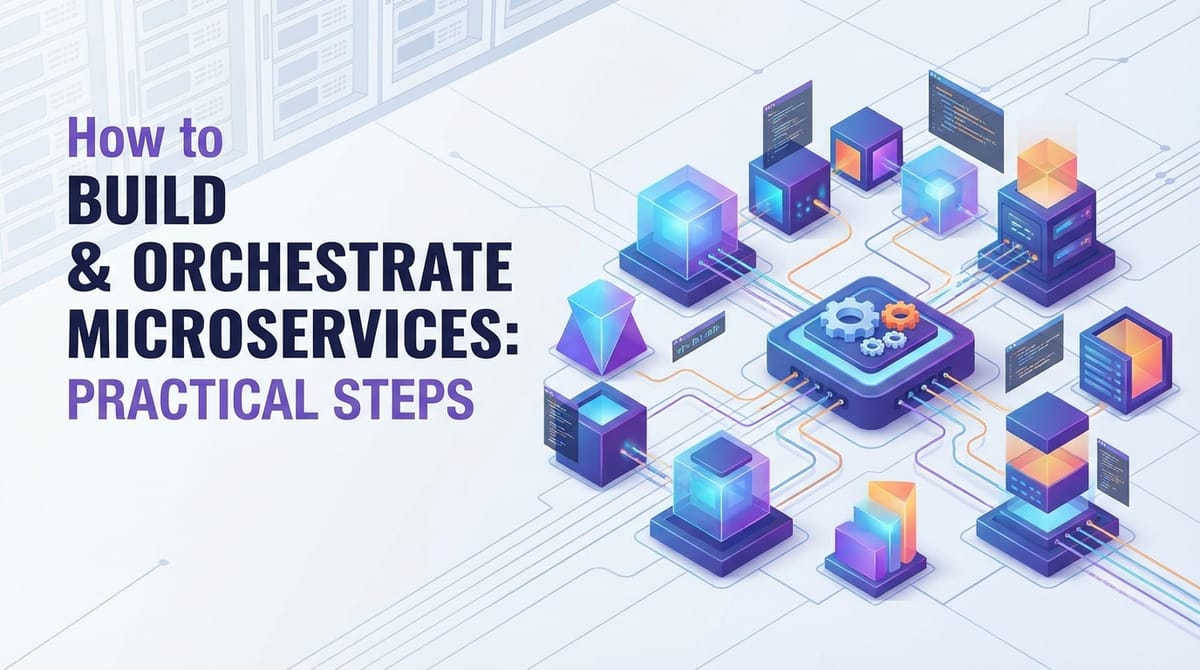
How to Build Microservices & Orchestrate Them: Practical Steps


In the rapidly evolving landscape of software development, the monolithic architecture, once the dominant paradigm, has gradually yielded ground to more agile, scalable, and resilient approaches. Among these, microservices architecture has emerged as a transformative force, fundamentally altering how applications are designed, developed, and deployed. This shift is not merely a technological preference but a strategic business imperative, enabling organizations to achieve unparalleled agility, accelerate innovation, and respond to market demands with unprecedented speed. The journey from a monolithic application to a distributed system composed of independent microservices, however, is fraught with complexities, requiring meticulous planning, robust design principles, and sophisticated orchestration mechanisms.
This comprehensive guide delves into the intricate world of microservices, offering a practical roadmap for building these decoupled components and orchestrating their seamless interaction. We will explore the foundational concepts, delve into architectural patterns, discuss essential communication strategies, and provide a deep dive into the critical tools and practices necessary to manage and scale a microservices ecosystem effectively. From designing domain-driven services to implementing robust API gateways and leveraging container orchestration platforms like Kubernetes, this article aims to equip developers, architects, and operations teams with the knowledge and insights required to navigate the challenges and harness the immense potential of microservices. Our objective is to demystify the process, offering actionable steps and best practices to transform theoretical understanding into tangible, high-performing distributed systems.
Part 1: Understanding Microservices Architecture
The paradigm of microservices architecture represents a fundamental departure from the traditional monolithic approach, advocating for the decomposition of an application into a collection of small, independent, and loosely coupled services. Each service is designed to perform a specific business capability, running in its own process and communicating with other services through lightweight mechanisms, often HTTP-based APIs. This architectural style is not merely about breaking down a large application into smaller pieces; it's about a complete shift in mindset towards greater autonomy, resilience, and operational efficiency. Understanding the core tenets and advantages of microservices is the first crucial step in embarking on this transformative journey.
1.1 Monolithic vs. Microservices: A Fundamental Contrast
To truly appreciate the value proposition of microservices, it is essential to understand the architectural landscape it seeks to improve upon. The monolithic application is built as a single, indivisible unit, where all components – user interface, business logic, and data access layers – are tightly intertwined and deployed together. While simpler to develop initially for smaller applications, monoliths often encounter significant challenges as they grow in size and complexity. Scaling a monolithic application typically means scaling the entire application, even if only a small part of it experiences high load, leading to inefficient resource utilization. Moreover, modifying or adding new features often requires redeploying the entire application, increasing the risk of introducing bugs and prolonging deployment cycles.
In stark contrast, microservices break this single-unit dependency. Each microservice is developed, deployed, and scaled independently. This means that if a particular service, such as a "product catalog" service, experiences a surge in traffic, only that specific service needs to be scaled up, leaving other services unaffected and optimizing resource allocation. The independent deployment characteristic also allows teams to develop and release features much faster, without impacting the stability of the entire system. This agility is a cornerstone advantage, enabling businesses to iterate quickly and deliver value to their customers with greater velocity. The contrast extends to technology choices as well; while monoliths often restrict an organization to a single technology stack, microservices empower teams to choose the best technology for each specific service, fostering innovation and leveraging specialized tools.
1.2 Core Principles of Microservices
The efficacy of microservices architecture stems from adherence to several guiding principles that shape their design and interaction. These principles are not rigid rules but rather a philosophical framework intended to maximize the benefits of distributed systems while mitigating their inherent complexities.
1.2.1 Single Responsibility Principle (SRP) Applied to Services
At the heart of microservices is the principle of single responsibility, borrowed from object-oriented programming but applied at a higher architectural level. Each microservice should be responsible for a single, well-defined business capability. For example, in an e-commerce application, there might be separate services for "Order Management," "User Authentication," "Product Catalog," and "Payment Processing." This narrow focus ensures that each service is cohesive, easier to understand, develop, and maintain. When a service has a clear, singular purpose, its codebase remains small and manageable, making it less prone to errors and simpler for new developers to grasp. This focus also reduces the blast radius of changes; a modification to the "Payment Processing" service is unlikely to affect the "Product Catalog" service, provided their interfaces remain consistent.
1.2.2 Loose Coupling, High Cohesion
Loose coupling implies that services should have minimal dependencies on each other. A change in one service should ideally not necessitate changes in others. This is achieved through well-defined APIs, where services only expose their public interfaces and hide their internal implementation details. High cohesion, on the other hand, means that the elements within a single service should be strongly related and work together to achieve its specific business goal. For instance, all logic pertaining to user authentication (login, registration, password reset) should reside within the "User Authentication" service. This combination of loose coupling and high cohesion makes services independently deployable, testable, and maintainable, significantly reducing the ripple effect of development efforts across the system.
1.2.3 Independent Deployment
One of the most powerful tenets of microservices is the ability to deploy each service independently. This means that a team can develop, test, and release a service without coordinating with other teams or deploying the entire application. Continuous Integration/Continuous Deployment (CI/CD) pipelines become much more streamlined and efficient, as they operate on smaller, self-contained units. This independence accelerates the release cycle, allowing organizations to push updates and new features to production multiple times a day, rather than waiting for weeks or months. It also minimizes the risk associated with deployments; if an issue arises with a new version of a specific service, it can be rolled back quickly without affecting other operational parts of the system.
1.2.4 Decentralized Data Management
Unlike monolithic applications where all components typically share a single, large database, microservices advocate for decentralized data management. Each microservice owns its data store, which can be optimized for its specific needs. For example, a "Product Catalog" service might use a NoSQL document database for flexible schema, while a "Payment Processing" service might rely on a traditional relational database for strong transactional consistency. This autonomy over data allows services to evolve their data models independently without impacting other services. However, it also introduces challenges related to distributed transactions and maintaining data consistency across services, which often necessitates eventual consistency models and sophisticated communication patterns.
1.2.5 Failure Isolation
In a distributed system, failures are inevitable. A key principle of microservices is designing for failure isolation. If one service fails, it should not bring down the entire application. By isolating services, the impact of a failure is contained to the affected service, allowing the rest of the system to continue functioning. This is achieved through various resilience patterns such as circuit breakers, bulkheads, and retries, which prevent cascading failures. This inherent resilience significantly improves the overall fault tolerance and availability of the application, critical for systems that must operate continuously.
1.3 Advantages Revisited: Scalability, Resilience, Agility, Technology Diversity
The principles outlined above collectively contribute to the myriad advantages that microservices offer. * Enhanced Scalability: Individual services can be scaled independently based on their specific load requirements, leading to efficient resource utilization and cost savings. This fine-grained scaling means resources are only allocated where and when they are truly needed. * Improved Resilience: The isolation of services means that a failure in one component does not necessarily lead to a complete system outage. This design for failure makes the overall application more robust and available. * Greater Agility and Faster Time to Market: Independent deployment and smaller codebases enable development teams to iterate faster, deploy more frequently, and deliver new features to users with greater velocity. This responsiveness is a significant competitive advantage. * Technology Diversity (Polyglot Persistence/Programming): Teams are empowered to choose the best technology stack for each service, be it a specific programming language, database, or framework. This flexibility allows them to leverage specialized tools and recruit talent with diverse skill sets, fostering innovation and optimizing performance for specific tasks. * Easier Maintenance: Smaller, focused codebases are simpler to understand, debug, and maintain. New developers can quickly get up to speed on a specific service without needing to comprehend the entire application's complexity.
1.4 Disadvantages Revisited: Complexity, Distributed Data Management, Operational Overhead
Despite their numerous benefits, microservices are not a panacea. They introduce their own set of complexities and challenges that require careful consideration and robust solutions. * Increased Complexity: A distributed system is inherently more complex than a monolith. Managing multiple services, their interactions, deployments, and versions adds significant overhead. Debugging issues across service boundaries can be particularly challenging. * Distributed Data Management: Maintaining data consistency across multiple, independent databases is a non-trivial problem. Transactions spanning multiple services (distributed transactions) are hard to implement and often lead to complex eventual consistency models. * Operational Overhead: Deploying, monitoring, and managing dozens or even hundreds of independent services requires sophisticated infrastructure, automation, and operational expertise. This includes service discovery, load balancing, centralized logging, distributed tracing, and comprehensive monitoring systems. * Inter-service Communication: While lightweight, managing the communication pathways and potential network latency between services adds another layer of complexity. Ensuring secure, reliable, and performant communication is paramount. * Testing Challenges: Testing a distributed system is more complex than testing a monolith. Unit and integration tests are crucial, but end-to-end testing across multiple services, especially with different teams involved, requires sophisticated strategies and tooling.
The decision to adopt microservices architecture should not be taken lightly. It requires a significant investment in tools, infrastructure, and a cultural shift within development and operations teams. However, for organizations dealing with large, complex applications that require high scalability, resilience, and rapid innovation, the advantages often outweigh the challenges, provided the right strategies and practices are put in place. The following sections will guide you through these practical steps.
Part 2: Designing and Building Microservices
Building effective microservices requires more than simply breaking down a large application. It demands a thoughtful approach to design, focusing on clear boundaries, efficient communication, and robust data management. This part delves into the practical aspects of designing and constructing individual microservices, laying the groundwork for a scalable and maintainable system.
2.1 Domain-Driven Design (DDD): Sculpting Service Boundaries
One of the most effective methodologies for identifying and defining microservice boundaries is Domain-Driven Design (DDD). DDD emphasizes understanding the core business domain and structuring software around that domain. Instead of focusing purely on technical concerns, DDD guides developers to speak the "ubiquitous language" of the business and model the software to reflect the business reality. This approach naturally leads to services that align with meaningful business capabilities, making them more stable and less prone to arbitrary changes.
2.1.1 Bounded Contexts
The central concept in DDD for microservices is the "Bounded Context." A Bounded Context defines a logical boundary within which a specific domain model is consistent and unambiguous. Outside this boundary, the terms and concepts of that model might have different meanings or not exist at all. For example, in an e-commerce system, a "Product" in the "Product Catalog" context might have attributes like name, description, and price. However, a "Product" in the "Order Management" context might only care about its ID, quantity, and current price at the time of order. These are distinct bounded contexts, and each often maps naturally to a microservice. Identifying these contexts is crucial for determining service granularity and ensuring that each service owns a specific, well-defined piece of the business logic. Misidentifying or overlapping contexts can lead to tightly coupled services, undermining the benefits of microservices.
2.1.2 Aggregates
Within a Bounded Context, Aggregates are clusters of domain objects that are treated as a single unit for data changes. An Aggregate has a root entity, which is the only object that external entities should hold references to. All operations that modify the Aggregate must go through the root, ensuring transactional consistency within the Aggregate's boundary. For instance, in an "Order" aggregate, the Order entity would be the root, and LineItems would be child entities. Any change to a LineItem would be managed through the Order root. Aggregates help in defining transactional boundaries within a service and are essential for maintaining data integrity in a distributed environment where cross-service transactions are avoided.
2.1.3 Ubiquitous Language
The "Ubiquitous Language" is a shared, domain-specific language developed collaboratively by domain experts and developers. This language is used consistently in all discussions, documentation, and within the code itself. When a team uses a ubiquitous language, ambiguities are reduced, and miscommunications are minimized. For microservices, establishing a clear ubiquitous language for each bounded context helps in defining clear APIs and ensuring that each service's purpose is understood by everyone involved, from business stakeholders to individual developers. It acts as a bridge, ensuring that the software accurately reflects the business domain.
2.2 Service Granularity: How Small is Too Small?
One of the most frequently asked questions in microservices design is about service granularity: how large or small should a microservice be? There is no one-size-fits-all answer, and striking the right balance is crucial. Services that are too large (coarse-grained) might resemble mini-monoliths, eroding the benefits of independent deployment and scalability. Services that are too small (fine-grained), often referred to as "nanoservices," can introduce excessive communication overhead, increased operational complexity, and lead to a distributed monolith, where coordinating many tiny services becomes overwhelming.
The ideal granularity often aligns with bounded contexts – a service should encapsulate a single, cohesive business capability. Considerations for granularity include: * Team Size: A service should ideally be manageable by a small, autonomous team (often cited as the "two-pizza team" rule – a team small enough to be fed by two pizzas). * Deployment Frequency: If a specific part of the system changes very frequently, it might be a good candidate for its own service. * Scaling Requirements: Components with distinct scaling needs are excellent candidates for separate services. * Fault Isolation: Services that are critical and prone to failure or that require high resilience might be isolated into their own microservice. * Data Ownership: A service should ideally own its data, and this often helps define its boundaries.
Finding the right granularity is an iterative process, often evolving as the system matures and business requirements change. It requires a deep understanding of the domain and a pragmatic approach to design.
2.3 Data Management in Microservices
Decentralized data management is a hallmark of microservices but also one of its greatest challenges. Unlike a monolith with a single database, each microservice typically manages its own data store, chosen based on its specific needs.
2.3.1 Database per Service
The "database per service" pattern is fundamental. Each microservice is responsible for its own persistent data, ensuring high autonomy and allowing different data technologies (polyglot persistence) to be used. This avoids the shared database anti-pattern, where changes in one service's data model could impact others. However, it means that direct joins across service databases are not possible, and data integrity between services must be handled programmatically. Services communicate through their APIs, not by directly accessing each other's databases.
2.3.2 Saga Pattern for Distributed Transactions
In a distributed system, traditional ACID (Atomicity, Consistency, Isolation, Durability) transactions across multiple services are extremely difficult to achieve and can lead to tight coupling. The Saga pattern provides a way to manage distributed transactions by sequencing local transactions within each service. If a local transaction fails, the Saga executes compensating transactions to undo the changes made by preceding successful transactions, thereby maintaining overall consistency. There are two main approaches: * Choreography-based Saga: Services publish events, and other services subscribe to these events to perform their local transactions and publish new events. This is decentralized but can be harder to monitor. * Orchestration-based Saga: A central orchestrator (a dedicated service) coordinates the participants of the saga, telling each service what local transaction to execute. This is more centralized and easier to monitor but introduces a single point of failure (though the orchestrator itself can be made highly available).
2.3.3 Eventual Consistency
Given the independent nature of service databases, achieving immediate strong consistency across all services is often impractical and detrimental to performance and availability. Microservices typically embrace "eventual consistency," meaning that all data copies will eventually become consistent, but there might be a delay. This is often achieved through event-driven architectures where services publish domain events (e.g., "OrderCreated," "PaymentSuccessful"), and other services react to these events to update their own data. While this approach adds complexity in terms of reasoning about data states, it significantly improves system scalability and resilience.
2.4 Communication Patterns
Microservices communicate to achieve complex workflows. Choosing the right communication pattern is critical for performance, resilience, and maintainability.
2.4.1 Synchronous Communication (REST, gRPC)
Synchronous communication involves a client sending a request to a service and waiting for a response. * REST (Representational State Transfer): The most common choice, RESTful APIs use standard HTTP methods (GET, POST, PUT, DELETE) to interact with resources. They are stateless, simple, and widely supported, making them excellent for external-facing APIs and many internal service-to-service communications. The simplicity of HTTP and JSON payloads makes REST highly interoperable. * gRPC: A high-performance, open-source RPC (Remote Procedure Call) framework developed by Google. gRPC uses Protocol Buffers for defining service interfaces and message structures, and it operates over HTTP/2, enabling features like multiplexing, header compression, and server push. gRPC is significantly faster than REST for inter-service communication due to its binary serialization and HTTP/2 foundation, making it ideal for high-throughput, low-latency internal communications, especially in polyglot environments.
2.4.2 Asynchronous Communication (Message Queues, Event Streams)
Asynchronous communication involves services exchanging messages without waiting for an immediate response. This decouples sender and receiver, improving resilience and scalability. * Message Queues (RabbitMQ, Apache ActiveMQ, Amazon SQS): A sender posts a message to a queue, and a receiver processes it at its own pace. The sender doesn't need to know who the receiver is or when it will process the message. Message queues provide durability, ensuring messages are not lost if a service is down. They are excellent for background tasks, batch processing, and situations where immediate response is not required. * Event Streams (Apache Kafka, AWS Kinesis): Event streaming platforms are designed for high-throughput, fault-tolerant, real-time processing of streams of events. Services publish events to topics, and other services can subscribe to these topics. Unlike traditional message queues, event streams retain events for a configurable period, allowing consumers to replay past events and enabling various data processing patterns, including event sourcing and Change Data Capture (CDC). Kafka is particularly powerful for building reactive microservices architectures.
The choice between synchronous and asynchronous communication depends on the specific use case. Synchronous is good for immediate requests/responses where the client needs a direct result (e.g., user login). Asynchronous is preferred for long-running processes, notifications, and when decoupling services for scalability and resilience is paramount (e.g., order fulfillment pipelines). Often, a microservices architecture will employ a hybrid approach, utilizing both patterns as appropriate.
2.5 API Design for Microservices
The API is the contract between microservices and between the application and its consumers. Well-designed APIs are crucial for the success of a microservices architecture, promoting loose coupling, clarity, and ease of use.
2.5.1 RESTful API Principles
For synchronous HTTP-based communication, adhering to RESTful principles is paramount: * Resource-based: Design APIs around resources (nouns) rather than actions (verbs). E.g., /products instead of /getProducts. * Standard HTTP Methods: Use GET for retrieving data, POST for creating, PUT for updating entire resources, PATCH for partial updates, and DELETE for removing resources. * Statelessness: Each request from a client to a server must contain all the information necessary to understand the request. The server should not store any client context between requests. * Hypermedia as the Engine of Application State (HATEOAS): While often overlooked, HATEOAS suggests that API responses should include links to related resources, guiding clients on possible next actions. This makes APIs more self-descriptive and discoverable. * Clear Naming Conventions: Use consistent, intuitive URLs and parameter names.
2.5.2 Version Control for APIs
As services evolve, their APIs may need to change. Managing these changes gracefully is critical to avoid breaking existing clients. Common strategies include: * URI Versioning: Including the version number directly in the URL (e.g., /v1/products). This is simple but pollutes the URI. * Header Versioning: Specifying the API version in a custom HTTP header (e.g., X-API-Version: 1). * Content Negotiation: Using the Accept header to request a specific media type that includes the version (e.g., Accept: application/vnd.mycompany.v1+json). * No Versioning / Backward Compatibility: The ideal scenario is to design APIs that are always backward-compatible, only adding new fields or resources and never removing or changing existing ones. This requires careful upfront design but simplifies client consumption.
2.5.3 Documentation with OpenAPI (Swagger)
Clear, up-to-date documentation is indispensable for any API, especially in a microservices environment where many services interact. OpenAPI Specification (formerly Swagger Specification) provides a language-agnostic, human-readable, and machine-readable interface for describing RESTful APIs. It allows developers to define the endpoints, operations, input/output parameters, authentication methods, and data models of an API in a structured JSON or YAML format.
Tools built around OpenAPI (like Swagger UI) can automatically generate interactive documentation, allowing developers to explore and test APIs directly from a browser. This significantly improves developer experience, reduces friction in service integration, and acts as a single source of truth for API contracts, which is crucial for effective collaboration between teams. Generating OpenAPI specifications from code (code-first approach) or generating code from specifications (design-first approach) are common practices.
2.5.4 Idempotency
Idempotent operations are those that produce the same result regardless of how many times they are executed. For example, setting a value is idempotent (PUT), whereas incrementing a value is not (POST). In a distributed system with retries and potential network issues, ensuring idempotency for API calls is vital to prevent unintended side effects (e.g., charging a customer multiple times for the same order). This can be achieved by including a unique "idempotency key" in the request, allowing the service to track and reject duplicate requests within a certain timeframe.
2.5.5 Security Considerations
Security in microservices is paramount and multi-faceted: * Authentication and Authorization: Services need to verify the identity of the caller (authentication) and ensure they have permission to perform the requested action (authorization). OAuth2 and OpenID Connect (OIDC) are standard protocols for this, often managed by an API Gateway. * Service-to-Service Authentication: When one microservice calls another, there must be a secure way to authenticate these internal calls, often using JWTs (JSON Web Tokens) or mutual TLS (mTLS). * Input Validation: All input to an API must be rigorously validated to prevent injection attacks and other vulnerabilities. * Data Encryption: Sensitive data should be encrypted in transit (using TLS/SSL) and at rest. * Least Privilege: Services should only have the minimum necessary permissions to perform their function.
Designing and building microservices is a complex endeavor that requires attention to detail across multiple dimensions. By adhering to DDD principles, carefully considering granularity, implementing robust data management strategies, choosing appropriate communication patterns, and meticulously designing secure and well-documented APIs, development teams can lay a strong foundation for a resilient and scalable microservices ecosystem.
APIPark is a high-performance AI gateway that allows you to securely access the most comprehensive LLM APIs globally on the APIPark platform, including OpenAI, Anthropic, Mistral, Llama2, Google Gemini, and more.Try APIPark now! 👇👇👇
Part 3: Orchestration and Management of Microservices
Building individual microservices is only half the battle; the true complexity and power of this architecture emerge when these independent components must work together seamlessly. Orchestration and management are about bringing order to this distributed chaos, ensuring services can find each other, communicate securely, scale effectively, and maintain operational stability. This part focuses on the essential tools and patterns for orchestrating and managing a microservices deployment.
3.1 The Need for Orchestration: Why Just Building Isn't Enough
Imagine a symphony orchestra where each musician plays their instrument perfectly, but without a conductor, the performance would be chaotic. Similarly, in a microservices architecture, individual services might be perfectly designed and implemented, but without a robust orchestration layer, the entire system would fail to function cohesively. Orchestration addresses the challenges of deploying, linking, discovering, load balancing, securing, and monitoring dozens or hundreds of independent services. It's about automating the operational aspects to unlock the true potential of microservices. Without it, managing a large-scale microservices application would quickly become an unsustainable manual nightmare.
3.2 Service Discovery
In a dynamic microservices environment, instances of services are constantly starting, stopping, scaling up, or scaling down, often with dynamic IP addresses. Clients need a way to find the network location of a service instance to make requests. This problem is solved by "service discovery."
3.2.1 Client-Side Service Discovery
In client-side service discovery, the client (or an API Gateway) is responsible for querying a service registry to obtain the network locations of available service instances. The client then selects an instance using a load-balancing algorithm and makes a request. * Examples: Netflix Eureka, HashiCorp Consul. * Pros: Simpler setup for the service itself, more flexibility in client-side load balancing strategies. * Cons: The client needs to implement discovery logic, client-side libraries are often language-specific.
3.2.2 Server-Side Service Discovery
In server-side service discovery, the client makes a request to a router or load balancer, which then queries the service registry and forwards the request to an available service instance. The client is unaware of the discovery process. * Examples: Kubernetes Services, AWS Elastic Load Balancer (ELB), Nginx configured for discovery. * Pros: Clients are simpler, as discovery logic is externalized. * Cons: Requires an additional infrastructure component (the load balancer/router).
Kubernetes provides server-side service discovery natively. When you define a Service in Kubernetes, it automatically assigns a stable DNS name and IP address, and its internal load balancer distributes traffic to the backing Pods (service instances).
3.3 API Gateway (Critical Keyword)
The API Gateway is a single entry point for all clients accessing the microservices ecosystem. Instead of clients interacting directly with individual services, they send requests to the API Gateway, which then routes them to the appropriate backend service. This pattern is fundamental for simplifying client applications and providing a centralized point for cross-cutting concerns.
3.3.1 What it is and why it's essential
An API Gateway acts as a facade, abstracting the internal complexity of the microservices architecture from external consumers. It's the "front door" to your distributed system. Without an API Gateway, clients would need to know the specific endpoints of multiple services, manage different API versions, and handle various authentication schemes, leading to tightly coupled client applications and increased complexity. The API Gateway alleviates these burdens.
3.3.2 Key Functionalities
The functionalities provided by an API Gateway are extensive and critical for a robust microservices deployment: * Request Routing: Directing incoming requests to the correct microservice based on the URL path, headers, or other criteria. This is its primary function. * Authentication and Authorization: Centralizing security concerns. The gateway can authenticate users, validate tokens, and enforce authorization policies before forwarding requests to backend services. This offloads security responsibilities from individual microservices. * Rate Limiting: Protecting backend services from being overwhelmed by too many requests by enforcing quotas on incoming traffic. * Caching: Storing responses from backend services to reduce load and improve response times for frequently accessed data. * API Composition/Aggregation: Combining responses from multiple microservices into a single response for the client, simplifying client-side development. For example, a dashboard might aggregate data from user, order, and product services. * Protocol Translation: Translating requests from one protocol (e.g., HTTP/REST) to another (e.g., gRPC) if different services use different communication styles. * Logging and Monitoring: Providing a centralized point for capturing request/response logs and metrics, which is invaluable for observability. * Circuit Breaker: Implementing resilience patterns to prevent cascading failures by quickly failing requests to services that are unresponsive. * Load Balancing: Distributing incoming requests across multiple instances of a service to ensure optimal resource utilization and high availability. * API Versioning: Managing different versions of APIs, allowing older clients to continue using an older API while new clients use the latest version.
3.3.3 Advantages and Disadvantages
Advantages: * Simplified Client Development: Clients only need to know the API Gateway's URL, making interaction with the backend simpler. * Enhanced Security: Centralized authentication, authorization, and rate limiting improve overall system security. * Improved Performance: Caching and efficient routing can reduce latency. * Increased Resilience: Circuit breakers and load balancing enhance fault tolerance. * Decoupling: Protects microservices from external exposure and complexity.
Disadvantages: * Single Point of Failure (if not properly managed): If the API Gateway goes down, the entire system becomes inaccessible. Requires high availability configurations. * Increased Complexity: The API Gateway itself is a significant component that needs to be developed, deployed, and managed. * Performance Overhead: Every request passes through the gateway, potentially adding a small amount of latency.
3.3.4 Introducing APIPark: An Open Source AI Gateway & API Management Platform
Beyond traditional API gateway functionalities, the evolving landscape of AI-driven applications presents new demands. This is where specialized platforms like ApiPark come into play. APIPark stands out as an open-source AI gateway and API management platform, designed specifically to help developers and enterprises manage, integrate, and deploy AI and REST services with ease. It extends the core concepts of an API Gateway to encompass the unique requirements of AI models, offering a unified and efficient solution.
APIPark integrates seamlessly into a microservices ecosystem by offering capabilities that are essential for modern, AI-augmented applications:
- Quick Integration of 100+ AI Models: APIPark provides a unified management system for integrating a vast array of AI models, handling authentication and cost tracking centrally. This simplifies the often-complex process of incorporating diverse AI capabilities into microservices.
- Unified API Format for AI Invocation: A critical feature for microservices using AI, APIPark standardizes the request data format across all integrated AI models. This means changes in underlying AI models or prompts do not affect the application or microservices, significantly simplifying AI usage and reducing maintenance costs.
- Prompt Encapsulation into REST API: Developers can quickly combine AI models with custom prompts to create new, specialized APIs – such as sentiment analysis, translation, or data analysis APIs – which can then be exposed as standard REST endpoints, easily consumable by other microservices or client applications.
- End-to-End API Lifecycle Management: APIPark assists with managing the entire lifecycle of APIs, from design and publication to invocation and decommission. It helps regulate API management processes, manage traffic forwarding, load balancing, and versioning of published APIs, which are all crucial for a stable microservices environment.
- API Service Sharing within Teams: The platform allows for the centralized display of all API services, making it easy for different departments and teams to find and use the required API services, fostering collaboration and reuse across the organization.
- Independent API and Access Permissions for Each Tenant: APIPark enables the creation of multiple teams (tenants), each with independent applications, data, user configurations, and security policies, while sharing underlying applications and infrastructure. This improves resource utilization and reduces operational costs in multi-tenant microservices deployments.
- API Resource Access Requires Approval: For enhanced security and control, APIPark allows for the activation of subscription approval features, ensuring that callers must subscribe to an API and await administrator approval before they can invoke it, preventing unauthorized API calls and potential data breaches.
- Performance Rivaling Nginx: With just an 8-core CPU and 8GB of memory, APIPark can achieve over 20,000 TPS, supporting cluster deployment to handle large-scale traffic, ensuring it can keep up with the demands of high-throughput microservices.
- Detailed API Call Logging: Comprehensive logging capabilities record every detail of each API call, allowing businesses to quickly trace and troubleshoot issues in API calls, ensuring system stability and data security – a critical aspect of observability in microservices.
- Powerful Data Analysis: By analyzing historical call data, APIPark displays long-term trends and performance changes, helping businesses with preventive maintenance before issues occur, further enhancing the operational intelligence of the microservices system.
APIPark offers a robust solution for managing both traditional RESTful microservices and the burgeoning class of AI-powered services, making it a valuable asset for organizations building modern distributed applications. Its open-source nature under the Apache 2.0 license further democratizes access to advanced API gateway and management capabilities.
3.4 Containerization (Docker)
Containers have become the de facto standard for packaging and deploying microservices. Docker is the most popular containerization platform.
3.4.1 Benefits for Microservices: Isolation, Portability, Consistency
- Isolation: Each service runs in its own isolated container, which includes everything it needs to run (code, runtime, system tools, libraries, settings). This prevents conflicts between dependencies of different services.
- Portability: A Docker container runs consistently across any environment (developer's laptop, staging, production) that supports Docker. "Build once, run anywhere" is a powerful promise realized by containers.
- Consistency: The environment inside the container is identical every time it runs, eliminating "it works on my machine" issues.
3.4.2 Docker Compose for Local Development
For local development and testing of multi-service applications, Docker Compose allows you to define and run multi-container Docker applications. With a single docker-compose.yml file, you can declare all services, their dependencies, networks, and volumes, and then start or stop them with a single command. This significantly simplifies setting up complex microservices environments on a developer's machine.
3.5 Container Orchestration (Kubernetes)
While Docker is excellent for packaging and running individual containers, managing hundreds or thousands of containers in a production environment across multiple hosts is a massive challenge. This is where container orchestration platforms come in. Kubernetes is the leading open-source system for automating deployment, scaling, and management of containerized applications.
3.5.1 Deployment, Scaling, Self-Healing, Load Balancing
Kubernetes provides powerful capabilities essential for microservices: * Deployment: Automates the process of deploying containerized applications, handling rollouts and rollbacks. * Scaling: Automatically scales services up or down based on demand (e.g., CPU utilization, custom metrics). * Self-Healing: Automatically restarts failed containers, replaces unhealthy nodes, and reschedules containers. * Load Balancing: Distributes network traffic across multiple instances of a service. * Service Discovery: As mentioned, Kubernetes provides native service discovery through DNS and IP addresses.
3.5.2 Pods, Deployments, Services, Ingress
Key Kubernetes concepts for microservices: * Pods: The smallest deployable unit in Kubernetes, typically encapsulating one or more tightly coupled containers (e.g., your microservice container and a sidecar logging agent). All containers in a Pod share the same network namespace and storage. * Deployments: An object that manages a set of identical Pods, ensuring a specified number of replicas are running at all times. It handles updates, rollbacks, and self-healing. * Services: An abstract way to expose an application running on a set of Pods as a network service. Services provide a stable IP address and DNS name, acting as internal load balancers for traffic to your Pods. * Ingress: An API object that manages external access to services in a cluster, typically HTTP. Ingress provides layer 7 load balancing, SSL termination, and name-based virtual hosting, often acting as the cluster's API Gateway or working in conjunction with an external API Gateway.
3.5.3 Service Mesh (Istio, Linkerd): Beyond Basic Orchestration
While Kubernetes handles container orchestration, a "Service Mesh" provides a dedicated infrastructure layer for managing service-to-service communication. It extends Kubernetes' capabilities by addressing advanced networking, security, and observability concerns. * Functionality: Traffic management (routing, retries, circuit breaking), security (mTLS, access policies), and observability (distributed tracing, metrics, logging) for inter-service communication. * How it works: A service mesh typically injects a "sidecar proxy" (like Envoy) alongside each service instance (container) within its Pod. All network traffic to and from the service goes through this proxy, which then handles the mesh's functionalities. The application code itself remains unchanged. * Examples: Istio, Linkerd. * Benefits: Decouples networking concerns from application code, centralizes policy enforcement, provides deep insights into service communication, and enhances resilience. It's particularly valuable for complex microservices deployments with stringent security and performance requirements.
3.6 Distributed Tracing & Logging
Debugging and understanding the flow of requests in a distributed microservices environment can be incredibly challenging. A single user request might traverse multiple services, each generating its own logs.
- Distributed Tracing: Tools like Jaeger and Zipkin allow you to visualize the entire path of a request across all services it touches, providing insight into latency, errors, and the sequence of operations. Each request is assigned a unique trace ID, and spans are created for each operation within a service, linking them together. This is invaluable for pinpointing performance bottlenecks and debugging issues across service boundaries.
- Centralized Logging: Aggregating logs from all microservices into a central log management system (e.g., ELK Stack - Elasticsearch, Logstash, Kibana; or Splunk, Datadog) is essential. This allows developers and operations teams to search, analyze, and visualize logs from all services in one place, enabling faster troubleshooting and operational insights.
3.7 Monitoring & Alerting
Proactive monitoring and alerting are critical for maintaining the health and performance of a microservices system.
- Key Metrics to Track:
- Latency: Time taken for a service to respond.
- Throughput: Number of requests per second.
- Error Rate: Percentage of requests resulting in errors.
- Resource Utilization: CPU, memory, disk, and network usage for each service.
- Business Metrics: Metrics specific to your application's business logic (e.g., number of successful orders, conversion rates).
- Tools:
- Prometheus: A powerful open-source monitoring system and time-series database, excellent for collecting metrics from microservices. Services expose metrics endpoints that Prometheus scrapes.
- Grafana: A leading open-source platform for data visualization and dashboards, often used with Prometheus to create insightful dashboards for monitoring microservices.
- Alerting: Systems like Alertmanager (often used with Prometheus), PagerDuty, or Opsgenie can be configured to send notifications (email, SMS, Slack) when predefined thresholds are breached, enabling rapid response to issues.
3.8 Resilience Patterns
Designing for failure is a core tenet of microservices. Resilience patterns help build systems that can withstand failures gracefully.
- Circuit Breaker: Prevents a service from continuously trying to access a failing downstream service. After a certain number of failures, the circuit breaker "trips," preventing further calls and allowing the failing service to recover. After a configurable period, it attempts to make a single call to see if the service has recovered.
- Bulkhead: Isolates failing parts of the system so that they don't bring down the entire application. For example, using separate thread pools or connection pools for different types of calls to a service, ensuring that a problem with one type of call doesn't exhaust resources needed for others.
- Retry: Automatically retries failed operations a certain number of times, often with an exponential backoff strategy, assuming the failure is transient.
- Timeout: Sets a maximum duration for a request. If a response is not received within this time, the request is aborted, preventing long-running operations from consuming resources indefinitely.
- Chaos Engineering (Netflix's Chaos Monkey): Proactively injects failures into a production system to test its resilience. By intentionally breaking things in a controlled manner, teams can discover weaknesses before they cause real outages. This practice builds confidence in the system's ability to withstand unexpected events.
By thoughtfully implementing these orchestration and management strategies, organizations can transform a collection of independent microservices into a coherent, highly available, scalable, and resilient distributed system. These practices are not just about operational efficiency; they are fundamental to realizing the promise of microservices architecture.
Part 4: Practical Implementation Steps & Best Practices
Transitioning to and operating a microservices architecture is a continuous journey that requires not only robust technical solutions but also significant cultural and process adjustments. This section outlines practical steps and best practices to guide organizations through the implementation phase and ensure the long-term success of their microservices initiative.
4.1 Phased Migration Strategy (if applicable): Strangler Fig Pattern
For organizations with existing monolithic applications, a complete rewrite into microservices is often too risky and expensive. A more pragmatic approach is a phased migration, where the monolith is gradually dismantled and replaced with new microservices. The "Strangler Fig Pattern," popularized by Martin Fowler, is an effective strategy for this.
The idea is to incrementally build new microservices around the existing monolith, diverting traffic from specific functionalities to the new services as they become ready. This is typically achieved using an API Gateway or a reverse proxy. New functionality is always built as a microservice. Over time, the new microservices "strangle" the monolith, taking over its responsibilities until the original monolith shrinks to a point where it can be decommissioned or absorbed into a final set of services. This approach minimizes risk, allows teams to gain experience with microservices gradually, and continues to deliver business value throughout the migration. Each piece of the monolith can be replaced one at a time, allowing for a controlled transition rather than a big-bang rewrite.
4.2 DevOps Culture: CI/CD for Microservices
The success of microservices is inextricably linked to a strong DevOps culture and robust Continuous Integration/Continuous Delivery (CI/CD) pipelines. * Automation is Key: Manual processes are antithetical to microservices. Every aspect, from code commit to deployment, monitoring, and scaling, should be automated. * CI (Continuous Integration): Developers frequently integrate their code into a shared repository. Automated builds and tests run on every commit, quickly identifying integration issues. For microservices, this means separate CI pipelines for each service. * CD (Continuous Delivery/Deployment): Once the code passes CI, it is automatically deployed to various environments (staging, production). Continuous Delivery means the software is always in a deployable state, while Continuous Deployment means every change that passes automated tests is automatically released to production. * Microservices CI/CD Challenges: Managing independent pipelines for dozens or hundreds of services, ensuring consistency across environments, and orchestrating complex deployments where services have interdependencies. * Infrastructure as Code (IaC): Managing infrastructure (servers, networks, databases, Kubernetes configurations) through code (e.g., Terraform, Ansible, Pulumi) ensures consistency, repeatability, and version control. This is vital for managing the complex environments required by microservices. * Monitoring and Feedback Loops: CI/CD for microservices doesn't end with deployment. Continuous monitoring provides real-time feedback on service health and performance in production, feeding back into the development cycle for continuous improvement.
4.3 Testing Strategies
Testing in a microservices architecture is more complex than in a monolith due to the distributed nature of the system. A multi-layered testing strategy is essential.
- Unit Tests: Focus on testing individual components or functions within a single microservice in isolation. These are fast and provide immediate feedback.
- Integration Tests: Verify the interaction between different components within a single microservice (e.g., service talking to its database) or between a microservice and external dependencies (e.g., a message queue).
- Contract Testing: Crucial for microservices. Consumer-driven contract testing ensures that one service (the consumer) relies on the API of another service (the provider) as expected. Tools like Pact allow consumers to define expectations about the provider's API, and these contracts are then verified against the provider's implementation. This prevents integration issues when services evolve independently.
- End-to-End Tests: Test the entire system or a significant workflow, simulating user interactions across multiple microservices. While valuable for verifying overall functionality, these are often slow, brittle, and expensive to maintain. They should be used sparingly and focus on critical user journeys.
- Performance and Load Testing: Essential to ensure services can handle expected (and peak) loads and identify performance bottlenecks.
- Chaos Testing: As mentioned in resilience patterns, deliberately injecting failures to test system robustness.
4.4 Security Best Practices
Security must be built into every layer of a microservices architecture from the ground up.
- OAuth2/OIDC for External API Access: Standard protocols for authentication and authorization. OAuth2 handles authorization (granting access to resources), and OpenID Connect (OIDC) builds on OAuth2 to provide identity verification (authentication). This is typically managed at the API Gateway level.
- Service-to-Service Authentication (mTLS, JWTs):
- Mutual TLS (mTLS): Each service authenticates the other using TLS certificates, providing strong identity verification and encryption for internal communication. Often implemented via a service mesh.
- JSON Web Tokens (JWTs): Can be used for propagating user context and permissions between services. A gateway authenticates the user, generates a JWT containing user information and roles, and passes it to downstream services. Each service can then validate the JWT.
- Input Validation and Sanitization: Every service must validate all incoming data, regardless of its source (internal or external), to prevent common vulnerabilities like SQL injection, XSS, and buffer overflows.
- Principle of Least Privilege: Services should only be granted the minimum necessary permissions to perform their function. This limits the blast radius if a service is compromised.
- Secrets Management: Sensitive information (database credentials, API keys) should not be hardcoded. Use dedicated secrets management solutions (e.g., HashiCorp Vault, Kubernetes Secrets, AWS Secrets Manager) and inject them securely at runtime.
- Network Segmentation: Isolate services into separate network segments or namespaces to restrict communication and reduce lateral movement in case of a breach.
- Regular Security Audits and Penetration Testing: Continuously assess the security posture of the entire microservices ecosystem.
4.5 Scalability & Performance Tuning
Microservices offer inherent scalability, but achieving optimal performance requires deliberate tuning.
- Stateless Services: Design services to be stateless whenever possible. This means a service instance does not store any client-specific session data, making it easy to scale horizontally by simply adding more instances. State should be externalized to a database or cache.
- Caching Strategies: Implement caching at various layers:
- CDN (Content Delivery Network): For static assets and public APIs.
- API Gateway Caching: For common API responses.
- In-Memory Cache: Within a service for frequently accessed, non-critical data.
- Distributed Cache (Redis, Memcached): For sharing cached data across multiple service instances.
- Database Optimization: Optimize database queries, use appropriate indexing, and consider database sharding or partitioning for highly scalable data stores. Ensure database selection is appropriate for the service's data access patterns.
- Asynchronous Communication: Leverage message queues and event streams to decouple services and handle high loads without blocking the client.
- Load Testing and Profiling: Regularly run load tests to identify performance bottlenecks. Use profiling tools to pinpoint inefficient code segments within services.
- Autoscaling: Configure Kubernetes or cloud provider autoscaling groups to automatically adjust the number of service instances based on demand.
4.6 Team Organization: Conway's Law
Conway's Law states that organizations design systems that mirror their own communication structure. For microservices, this implies that teams should be organized around business capabilities, each owning a few related microservices.
- Small, Autonomous Teams: Each team should be small (e.g., 5-9 people), cross-functional (developers, testers, operations specialists), and responsible for the full lifecycle of their services – from development to deployment and operation.
- Clear Ownership: Each service should have a clear owning team. This fosters accountability and expertise.
- Minimizing Inter-Team Dependencies: Teams should be able to work largely independently, reducing communication overhead and coordination bottlenecks. Well-defined API contracts are crucial for this independence.
- Culture of Collaboration and Shared Responsibility: While teams are autonomous, a culture of sharing knowledge, tooling, and best practices across the organization is essential to prevent silos and promote consistency.
By embracing these practical steps and best practices, organizations can effectively build, deploy, and manage a microservices architecture that delivers on its promises of agility, scalability, and resilience. The journey is challenging, but with the right mindset, tools, and processes, it leads to significantly more robust and adaptable software systems.
| Feature | Monolithic Architecture | Microservices Architecture |
|---|---|---|
| Deployment | Single, large deployment unit. Entire application redeployed. | Independent deployment of each service. |
| Scalability | Scales horizontally by replicating the entire application. | Scales individual services based on demand. |
| Development | Slower development cycle, difficult for large teams. | Faster development, smaller teams, higher agility. |
| Technology Stack | Typically single, uniform technology stack. | Polyglot (different technologies for different services). |
| Fault Tolerance | Single point of failure; an issue can bring down the whole app. | Failure isolation; an issue in one service might not affect others. |
| Data Management | Single, shared database. | Decentralized, database-per-service. |
| Complexity | Simpler initially, but grows with size. | Inherently complex due to distributed nature. |
| Communication | In-process function calls. | Network calls (HTTP/REST, gRPC, Message Queues). |
| Maintenance | Difficult for large codebases, high coupling. | Easier due to smaller, focused codebases, low coupling. |
| Operational Costs | Potentially lower for small apps, but higher resource use for scaling. | Higher operational overhead due to distributed management. |
| Team Structure | Large, feature-centric teams often lead to bottlenecks. | Small, autonomous, cross-functional teams owning services. |
| Testing | Easier integration testing, harder to isolate parts. | More complex integration, easier unit, crucial contract testing. |
Conclusion
The journey into microservices architecture is undoubtedly complex, demanding a strategic investment in both technology and organizational culture. From the initial conceptualization of domain boundaries using Domain-Driven Design to the intricate dance of service orchestration with Kubernetes and service meshes, every step requires careful consideration and robust implementation. We've explored the foundational principles that empower microservices to deliver unparalleled scalability, resilience, and agility, contrasting them with the limitations of monolithic systems. The discussion extended to the practicalities of designing communicative APIs, documenting them with OpenAPI, and ensuring secure and efficient interactions across a distributed landscape.
A critical component in managing this distributed complexity is the API Gateway, acting as the intelligent front door to your services. Platforms like ApiPark exemplify how an API Gateway can be extended to not only handle traditional API management but also to seamlessly integrate and orchestrate AI models, standardizing invocation and providing comprehensive lifecycle governance. The emphasis on containerization with Docker, sophisticated orchestration with Kubernetes, and advanced traffic management through service meshes highlights the essential infrastructure layer that underpins modern microservices deployments. Furthermore, we delved into the operational necessities of distributed tracing, centralized logging, comprehensive monitoring, and the implementation of resilience patterns – all vital for maintaining health and performance in a dynamic system.
Finally, the discussion touched upon the strategic migration paths like the Strangler Fig Pattern, the critical role of a pervasive DevOps culture with robust CI/CD pipelines, diligent testing strategies including contract testing, and the paramount importance of security at every layer. Understanding Conway's Law reminds us that organizational structure profoundly impacts architectural outcomes, underscoring the need for small, autonomous, and accountable teams. While the challenges of managing a distributed system are real, the strategic advantages – faster innovation, unparalleled scalability, and enhanced resilience – make microservices a compelling choice for enterprises navigating the demands of the digital age. By meticulously planning, adopting the right tools, and fostering an adaptive culture, organizations can successfully build and orchestrate microservices, unlocking their full potential and charting a course for sustained success in a rapidly evolving technological landscape.
Frequently Asked Questions (FAQs)
Q1: What are the primary benefits of adopting a microservices architecture?
A1: The primary benefits of microservices architecture revolve around enhanced agility, scalability, and resilience. By decomposing a large application into smaller, independently deployable services, organizations can accelerate development cycles, deploy new features more frequently, and adapt to market changes faster. Each service can be scaled independently based on its specific demand, leading to more efficient resource utilization and cost savings. Furthermore, the isolation of services prevents a failure in one component from bringing down the entire application, significantly improving fault tolerance and overall system availability. The ability to use different technologies for different services (polyglot persistence/programming) also fosters innovation and allows teams to choose the best tool for each specific job.
Q2: What are the biggest challenges when implementing microservices, and how can they be mitigated?
A2: The biggest challenges include increased operational complexity, distributed data management, and difficulties in debugging. Managing dozens or hundreds of services, their deployments, and communications requires sophisticated automation and infrastructure (e.g., Kubernetes). Distributed data management necessitates careful handling of eventual consistency and complex transaction patterns like Sagas, as traditional ACID transactions are difficult. Debugging across service boundaries is challenging without centralized logging and distributed tracing tools (like ELK Stack and Jaeger). These challenges can be mitigated by investing heavily in automation (CI/CD, Infrastructure as Code), adopting robust orchestration platforms, implementing comprehensive observability solutions, and embracing a strong DevOps culture.
Q3: How does an API Gateway fit into a microservices architecture, and why is it essential?
A3: An API Gateway acts as the single entry point for all external client requests into a microservices ecosystem. It is essential because it simplifies client applications by abstracting the internal complexity of the distributed system. Instead of clients needing to know about and interact with multiple individual services, they communicate solely with the gateway. The API Gateway centralizes critical cross-cutting concerns such as authentication, authorization, rate limiting, request routing, caching, and API versioning. This offloads these responsibilities from individual microservices, making them simpler and more focused on their core business logic, while enhancing overall security, performance, and resilience of the system.
Q4: What is OpenAPI, and why is it important for microservices development?
A4: OpenAPI (formerly Swagger Specification) is a language-agnostic, standardized format for describing RESTful APIs. It allows developers to define an API's endpoints, operations, input/output parameters, authentication methods, and data models in a human-readable and machine-readable JSON or YAML format. It is crucial for microservices development because it serves as a single source of truth for API contracts between services and external consumers. This enables automatic generation of interactive documentation (e.g., Swagger UI), client SDKs, and server stubs, significantly improving developer experience, reducing integration friction, and ensuring consistency across independent teams working on different services.
Q5: What role does container orchestration play in managing microservices, and which tools are commonly used?
A5: Container orchestration plays a fundamental role in managing microservices by automating the deployment, scaling, management, and networking of containerized applications. While tools like Docker are excellent for packaging individual microservices into containers, container orchestration platforms are necessary to manage these containers at scale in a production environment. They handle tasks like service discovery, load balancing, resource allocation, self-healing (restarting failed containers), rolling updates, and scaling services up or down based on demand. The most commonly used tool for container orchestration is Kubernetes, which provides a robust and extensible platform for running distributed microservices. Other related tools include Docker Swarm, and for more advanced traffic management, security, and observability, service mesh technologies like Istio or Linkerd are often employed on top of Kubernetes.
🚀You can securely and efficiently call the OpenAI API on APIPark in just two steps:
Step 1: Deploy the APIPark AI gateway in 5 minutes.
APIPark is developed based on Golang, offering strong product performance and low development and maintenance costs. You can deploy APIPark with a single command line.
curl -sSO https://download.apipark.com/install/quick-start.sh; bash quick-start.sh

In my experience, you can see the successful deployment interface within 5 to 10 minutes. Then, you can log in to APIPark using your account.

Step 2: Call the OpenAI API.