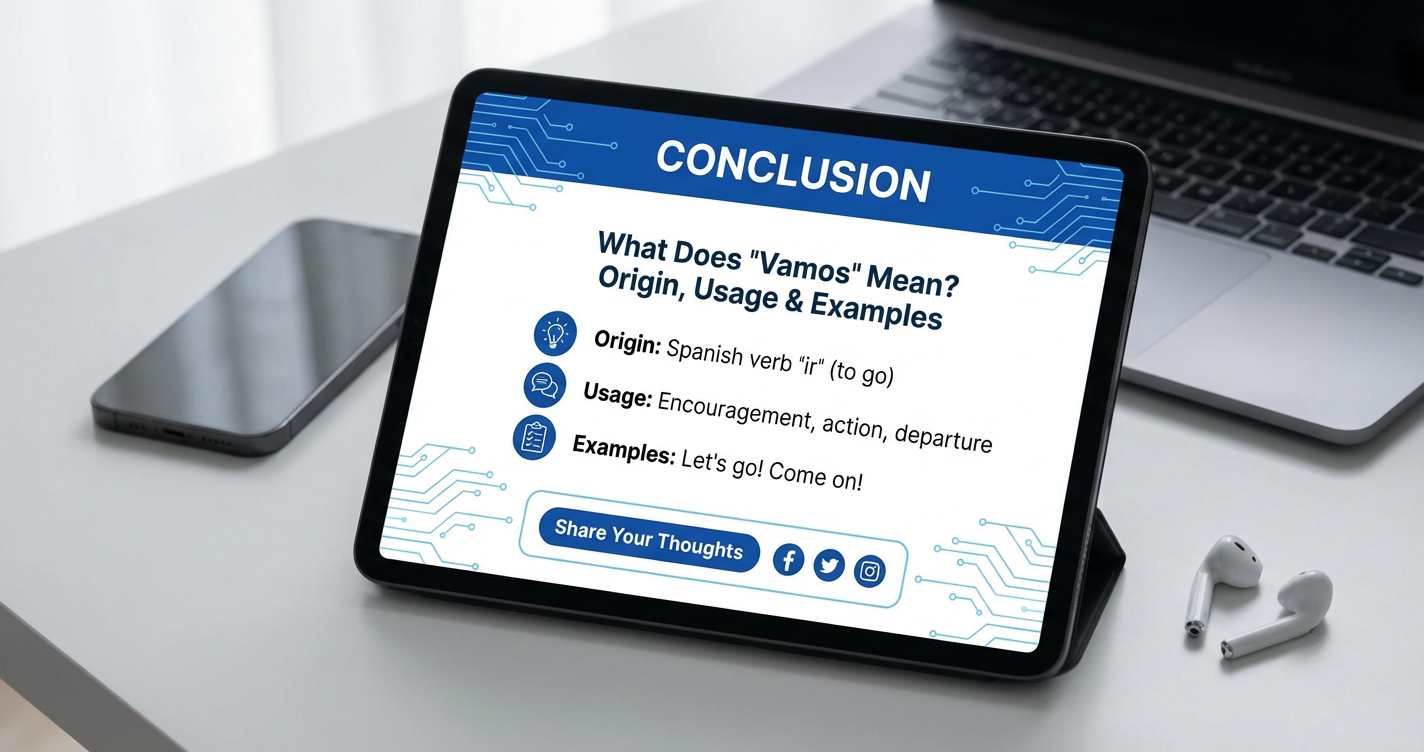
What Does "Vamos" Mean? Origin, Usage & Examples


The following article delves into the multifaceted Spanish word "Vamos," exploring its deep etymological roots, diverse meanings, and wide-ranging usage across various contexts. Despite the article's core linguistic focus, it also briefly touches upon the broader digital landscape where language analysis and processing intersect with technology, acknowledging the role of APIs and AI models in handling such complex data.
What Does "Vamos" Mean? Origin, Usage & Examples
The Spanish language, rich with history and vibrant expression, offers countless words that transcend simple translation, encapsulating layers of meaning, emotion, and cultural nuance. Among these, few words resonate with the universal human spirit of action and camaraderie quite like "Vamos." More than just a casual invitation or a simple command, "Vamos" is a call to action, an expression of solidarity, a surge of encouragement, and a reflection of a collective will to move forward. Its very sound – short, sharp, and resolute – carries an inherent energy that has made it a global phenomenon, recognized and understood even by those with only a rudimentary grasp of Spanish. From the electric atmosphere of a football stadium to the quiet resolve whispered among friends, "Vamos" is a word that pulsates with life, urging us to engage, to strive, and to embark on journeys both literal and metaphorical.
This extensive exploration will embark on its own linguistic journey, tracing "Vamos" from its ancient Latin origins through its evolution into modern Spanish. We will meticulously dissect its manifold meanings, revealing how a single word can convey everything from a direct imperative to a subtle gesture of agreement, from the thrill of encouragement to the gentle nudge of impatience. Furthermore, we will delve into its diverse usage across myriad contexts – from everyday conversations and the fervent world of sports to its indelible mark on music, politics, and the digital realm. Along the way, we will uncover regional variations, cultural implications, and the subtle interplay of intonation and body language that imbues "Vamos" with its unparalleled versatility. Ultimately, by peeling back the layers of this deceptively simple word, we aim to gain a deeper appreciation for the intricacies of language and its profound ability to shape human experience, fostering connection, inspiring action, and reflecting the very essence of collective movement.
I. The Etymological Odyssey: Tracing "Vamos" Back Through Time
To truly grasp the essence of "Vamos," one must first embark on an etymological odyssey, tracing its lineage back through the annals of linguistic history. Like many Spanish words, "Vamos" is a direct descendant of Latin, a language that laid the foundational bricks for all Romance languages. Its journey from ancient Rome to the modern Spanish-speaking world is a testament to the enduring power of linguistic evolution, where sounds shift, meanings expand, and forms adapt to the needs of successive generations. Understanding this historical trajectory not only illuminates the word's current form but also reveals the deep connections it shares with sister languages and the broader Indo-European family.
A. The Immediate Parent: "Ir" (To Go)
At its most immediate level, "Vamos" is a conjugated form of the Spanish verb "ir," meaning "to go." This seemingly straightforward connection, however, hides a fascinating grammatical irregularity that is common in many ancient and frequently used verbs across languages. "Ir" is one of the most irregular verbs in Spanish, meaning its conjugations do not follow the standard patterns of -ar, -er, or -ir verbs. This irregularity is often a tell-tale sign of a verb with a long and complex history, one that has been so central to daily communication that its forms have been preserved, adapted, and sometimes even merged with other verbs over millennia.
Specifically, "Vamos" is the first-person plural form of "ir" in the present indicative tense ("we go") and, crucially, also serves as the first-person plural imperative form ("let's go"). This dual functionality is key to its versatility. The indicative form is descriptive, stating a fact: "Nosotros vamos al parque" (We go to the park). The imperative form, however, is prescriptive or exhortative: "¡Vamos al parque!" (Let's go to the park!). This imperative aspect, a direct command or suggestion to a group including the speaker, is where "Vamos" truly shines and gains its dynamic power. The fusion of these two grammatical roles into a single word amplifies its utility and impact in spoken communication, allowing for seamless transitions between statement and invitation, observation and action.
B. The Latin Roots: "Vadere" and "Ire"
The irregularity of "ir" in Spanish, and consequently of "Vamos," stems from a linguistic phenomenon known as "suppletion," where different stems or roots are used to form the conjugations of a single verb. In the case of "ir," its modern forms are derived from two distinct Latin verbs: "vadere" and "ire."
- "Vadere": To Go, To Walk, To Rush The Latin verb "vadere" primarily meant "to go," "to walk," or "to rush." It conveyed a sense of purposeful movement, often with a degree of urgency or determination. Forms derived from "vadere" are evident in the present tense conjugations of "ir," such as "voy" (I go), "vas" (you go), "va" (he/she/it goes), "vamos" (we go), "vais" (you all go), and "van" (they go). The very sound and rhythm of "vamos," with its clear 'v' and 'a' sounds, directly echo its "vadere" heritage. This root is responsible for the dynamic, action-oriented feel that "Vamos" so powerfully conveys, hinting at its inherent push towards momentum and progress. It speaks to an active, often vigorous form of movement, distinguishing it from simply being in a state of 'going'.
- "Ire": To Go, To Travel The other significant Latin progenitor is "ire," which also meant "to go" or "to travel." "Ire" was a more common and versatile verb in classical Latin, used for general movement. While forms derived from "vadere" dominate the present tense of Spanish "ir," other tenses, particularly the imperfect indicative ("iba," "ibas," "íbamos," etc.) and the future subjunctive, often draw from the "ire" root or other related forms. The merging of these two distinct Latin verbs into a single Spanish verb ("ir") during the evolution from Vulgar Latin to Old Spanish is a classic example of linguistic economy and the natural process of language simplification and recombination. The result is a verb that, while irregular, is exceptionally efficient and broadly applicable, carrying the combined semantic weight of its diverse origins.
C. Proto-Italic and Proto-Indo-European Connections
To delve even deeper, the roots of "vadere" and "ire" themselves can be traced back to even more ancient linguistic strata: Proto-Italic and, ultimately, Proto-Indo-European (PIE). PIE is the hypothesized ancestor of most European and several South Asian languages, and reconstructing its vocabulary allows linguists to see the astonishing interconnectedness of human language.
The PIE root reconstructed as *wéh₁eti (to carry, to convey) is thought to be the ancestor of "vadere," illustrating a fundamental concept of movement and transportation that transcends millennia. Similarly, "ire" likely stems from the PIE root *h₁ey- (to go), another primal concept that forms the bedrock of human locomotion and migration. The persistence of these core ideas through sound changes, semantic shifts, and grammatical evolution is a marvel of historical linguistics.
This deep ancestry also explains the presence of cognates – words with a shared origin – in other Romance languages. The siblings of Spanish "Vamos" include: * Portuguese: "Vamos" (identical in form and meaning). * Italian: "Andiamo" (derived from Latin "ambulare" for 'to walk', but serves the same purpose as 'let's go'). * French: "Allons" (from "aller," also sharing complex Latin roots for 'to go'). * Romanian: "Mergem" or "Haideți" (the former meaning 'we go', the latter 'come on/let's go').
The remarkable consistency of these forms and functions across languages that diverged thousands of years ago underscores the universal human need for expressions of collective movement and shared intention. The journey of "Vamos" is not just a Spanish story; it is a global narrative of how fundamental concepts are woven into the fabric of human communication.
D. Evolution in Old Spanish
As Vulgar Latin evolved into the various Romance languages, Spanish underwent its own unique transformations. During the Old Spanish period (roughly 10th to 15th centuries), the language began to solidify its distinct characteristics. The verb "ir" continued its irregular conjugation pattern, with forms like "vamos" firmly established. Early Spanish texts, from epic poems like the Cantar de mio Cid to legal documents and chronicles, would have featured "vamos" in its various roles, indicating both factual movement and imperative exhortation.
Phonetic shifts over these centuries refined the pronunciation and spelling, moving away from classical Latin sounds towards what we recognize as Spanish today. The 'v' sound in "vamos" maintained its distinction, unlike in some other Romance languages where it might have softened or merged. Grammatically, the imperative use of the first-person plural for collective suggestions became a standard and highly effective linguistic tool. This period was crucial in cementing "Vamos" as an indispensable part of the Spanish lexicon, preparing it for its diverse and powerful role in the modern language. The fact that its form has remained relatively unchanged for centuries speaks to its utility and robust integration into the language's core.
II. Unpacking the Meaning: More Than Just "Let's Go"
While a superficial translation might reduce "Vamos" to a simple "Let's go," this vastly undersells the word's profound depth and flexibility. Its meaning is a kaleidoscope, shifting and expanding based on context, intonation, and the subtle interplay of human emotion. "Vamos" is a linguistic Swiss Army knife, capable of performing an array of functions that enrich communication and imbue it with vitality. To truly understand "Vamos" is to appreciate its spectrum of applications, from the most literal invitation to the most nuanced psychological nudge.
A. The Core Meaning: First-Person Plural Imperative of "Ir"
At its semantic heart, "Vamos" retains its grammatical function as the first-person plural imperative of "ir." This means it inherently carries the meaning of "we go" when used descriptively, and "let's go" when used prescriptively. * Direct Translation: "We go," "Let's go." When someone says, "Nosotros vamos al cine," it translates to "We go to the cinema." This is a factual statement. However, when the context is an invitation or a command directed at a group including the speaker, it becomes "Let's go." For instance, "¡Vamos al cine!" means "Let's go to the cinema!" Here, "Vamos" functions as a direct, collective call to initiate movement or an activity. This is the most straightforward and fundamental application of the word, acting as a clear instruction or proposal to a group.
- The Command/Exhortation Aspect: Beyond a simple suggestion, "Vamos" can often carry the weight of an exhortation, a powerful urging for collective action. It's not just "would you like to go?"; it's "we should go," or "it's time for us to go." This aspect is particularly prominent in situations requiring unity, determination, or a push to overcome inertia. The speaker is not merely inviting but actively mobilizing the group, positioning themselves as part of that collective movement, thereby strengthening the bond and mutual commitment.
B. Nuances of Encouragement and Motivation
Perhaps one of the most widespread and emotionally charged uses of "Vamos" is as a powerful expression of encouragement and motivation. In this role, it transcends literal movement and speaks directly to the spirit.
- Sporting Events: "¡Vamos!" (Come on! Go!) Nowhere is this use more evident than in the fervent world of sports. Imagine a tennis match where a player is struggling, or a football team is pressing for a goal. The fervent cry of "¡Vamos!" from the stands or the coach's bench is not an instruction to physically move from one place to another. Instead, it's a burst of energy, a rallying cry that means "Come on! You can do it! Don't give up! Keep fighting!" It's a psychological boost, an infusion of collective hope and belief, urging the athlete or team to push harder, to find that extra gear. The iconic shout of Rafael Nadal after winning a crucial point epitomizes this usage – it's a self-exhortation as much as a declaration of intent, a release of pent-up determination.
- Personal Challenges: Inspiring Perseverance: Beyond the stadium, "Vamos" serves a similar purpose in personal struggles. When a friend is facing a difficult task, struggling with an exam, or enduring a challenging period, a whispered "¡Vamos!" can be a profound source of solace and strength. It means "You've got this," "Keep going," "Don't lose heart." It acknowledges the difficulty while simultaneously expressing belief in the individual's capacity to overcome it. It transforms into a gentle yet firm hand on the shoulder, a shared understanding of the effort required.
- Collective Effort: Uniting a Group: In collaborative settings, "Vamos" can unite a group around a common goal. During a tough project, a collective "¡Vamos!" can reinvigorate a team, reminding everyone that they are in it together and reinforcing their shared commitment. It fosters a sense of unity and shared purpose, transforming individual efforts into a cohesive, unstoppable force. This use of "Vamos" leverages its inherent plural nature, emphasizing the 'we' in the face of adversity.
C. Expressing Agreement and Assent
"Vamos" can also be a subtle, yet effective, way of expressing agreement or assent, often serving as an informal equivalent to "Okay," "Alright," or "Let's do it."
- "Sí, vamos." (Yes, let's.) If someone proposes an idea – "Should we grab a coffee?" – a response of "Sí, vamos" indicates not just agreement but also a readiness to act on the suggestion. It's a less formal and more action-oriented assent than a simple "Sí." It implies, "Yes, I'm on board, let's proceed." This usage is common in casual social planning, where spontaneity and shared enthusiasm are key.
- Signifying Readiness or Approval: In some contexts, "Vamos" can signal readiness or approval without necessarily implying immediate physical movement. For example, if a group is waiting for a signal to start, an organizer might simply say "¡Vamos!" to indicate that everything is in place and they are ready to commence. Here, it implies, "We're ready to go," or "Permission granted to start." It signifies a collective green light, a unified decision to proceed with a planned action.
D. Indicating Departure or Movement
This is perhaps the most literal interpretation, directly relating to the act of "going" or "leaving."
- Literal Movement: "Vamos a la playa." (Let's go to the beach.) This is the quintessential example of "Vamos" as an invitation to a specific destination. It's a clear, unambiguous call to initiate travel. The inclusion of "a la playa" specifies the destination, making the intent perfectly clear. This usage forms the backbone of countless everyday interactions, from making travel plans to deciding on a local outing.
- Implied Movement: "Vamos a ver." (Let's see/find out.) Here, "Vamos" still implies movement, but it's a movement of thought or discovery rather than physical locomotion. "Vamos a ver" is a common idiom meaning "Let's see," "We'll see," or "Let's find out." It's an expression of open-mindedness, a willingness to explore possibilities or await developments. The "movement" is mental or intellectual, suggesting an upcoming investigation or observation. Similarly, "Vamos a pensar" means "Let's think," suggesting a collective intellectual endeavor. This demonstrates how flexible the concept of "going" can be, extending beyond the purely physical.
E. Conveying Urgency or Impatience
The power of "Vamos" can also be harnessed to convey urgency or, at times, a touch of impatience. The distinction often lies in intonation and context.
- "¡Vamos, date prisa!" (Come on, hurry up!) When paired with phrases indicating haste, "Vamos" takes on a sharper, more insistent tone. It's no longer a gentle invitation but a clear directive to speed things up. This is commonly heard in situations where time is a factor, or someone is delaying progress. The speaker uses "Vamos" to spur the other person(s) into quicker action, often reflecting a personal desire to avoid lateness or inefficiency.
- The Tone and Context as Key Indicators: A friendly, encouraging "Vamos" has a different sound profile than an impatient one. A drawn-out "Vaaamooos..." might signal exasperation, while a sharp, clipped "¡Vamos!" could be a firm command. This illustrates the critical role of paralinguistic features – intonation, volume, pace – in shaping the meaning of "Vamos." Without these cues, the word’s interpretation can be ambiguous, highlighting the richness and complexity of human communication where unspoken elements carry significant weight. The same word, uttered differently, can transition from a warm encouragement to a stern reprimand, showcasing its impressive emotional range.
F. Informal Interjection
Finally, "Vamos" can function as an informal interjection, a conversational filler, or a way to express mild surprise or disbelief, although this usage is less common than its imperative or motivational roles.
- Filling Conversational Pauses: In fast-paced conversations, a casual "Vamos..." might be used to bridge a pause, similar to "Well..." or "You know..." in English. It can signal that the speaker is gathering their thoughts or preparing to transition to a new point, keeping the conversational flow intact. This is a testament to its colloquial integration into everyday speech, where words take on utilitarian roles beyond their dictionary definitions.
- Expressing Surprise or Disbelief (less common but present): In specific contexts, often with a particular intonation, "Vamos" can express mild surprise or a form of gentle disbelief, akin to "Oh, come on!" or "Seriously?" For example, if someone makes an exaggerated claim, a response of "¡Vamos!" might convey a polite skepticism. This usage is highly dependent on context and the speaker's tone, making it one of the more subtle and advanced applications of the word. It showcases how "Vamos" can be bent and shaped to fit a myriad of social and emotional situations, demonstrating its deep immersion in the human experience of interaction.
III. The Versatile Usage of "Vamos": A Linguistic Chameleon
The true magic of "Vamos" lies not just in its multiple meanings but in its extraordinary versatility across an astonishing array of contexts. It is a linguistic chameleon, seamlessly adapting its color and tone to fit the specific demands of any given situation. From the mundane rhythms of daily life to the high drama of international competition, from the intimacy of personal connection to the grand pronouncements of political rallies, "Vamos" plays a pivotal role, enriching communication and embodying the spirit of collective endeavor. Its adaptability is a testament to the organic nature of language, where words evolve to meet the ever-changing expressive needs of its speakers.
A. Everyday Conversations
In the tapestry of daily conversation, "Vamos" is an omnipresent thread, weaving through various exchanges with ease and naturalness. It is often one of the first Spanish words learners encounter, precisely because of its high frequency and immediate utility.
- Greetings and Farewells: While not a direct greeting, "Vamos" can be used in farewells, particularly when a group is leaving. "Bueno, vamos" might mean "Alright, let's go" or "Time to head out." It signals a conclusion to an interaction and the beginning of a collective departure. When planning to meet, "Vamos a vernos" (Let's see each other) acts as an informal agreement.
- Making Plans: This is perhaps its most common daily application. "¡Vamos a cenar!" (Let's go have dinner!), "Vamos al cine esta noche" (Let's go to the movies tonight), "Vamos a dar un paseo" (Let's go for a walk). In these instances, "Vamos" functions as an enthusiastic invitation, a proposal for shared activity, making social arrangements feel collaborative and engaging. It signals shared intention and a desire for companionship.
- Casual Encouragement: A friend struggling with a task at home might hear a supportive "¡Vamos, tú puedes!" (Come on, you can do it!). Here, it's a gentle yet firm push, a boost of confidence in a low-stakes scenario, reaffirming belief in the individual's capabilities and offering moral support without being overly dramatic. This showcases its utility in fostering positive interpersonal dynamics.
B. Sporting Arenas: The Roar of "¡Vamos!"
The world of sports is arguably where "¡Vamos!" achieves its most iconic and visceral expression. It is an intrinsic part of the global sporting lexicon, transcending language barriers through the sheer force of its emotional delivery.
- Football (Soccer), Basketball, Tennis: Across pitches, courts, and fields worldwide, "¡Vamos!" echoes with a singular purpose: to ignite passion, demand effort, and celebrate triumph. In a football match, a chant of "¡Vamos, España!" or "¡Vamos, Barça!" is a fervent declaration of loyalty and an urgent plea for victory. In basketball, a coach might yell "¡Vamos, defensa!" (Come on, defense!) to rally their players.
- Iconic Moments: Rafa Nadal's "¡Vamos!" Few athletes are as synonymous with "¡Vamos!" as Spanish tennis legend Rafael Nadal. His guttural, chest-thumping "¡Vamos!" after winning a crucial point or a challenging match is not merely a celebration; it's a release of immense pressure, a self-affirmation, and a declaration of pure, unadulterated willpower. It embodies his relentless fighting spirit and has become his personal mantra, globally recognized and associated with peak athletic performance and mental fortitude. It captures the essence of pushing through pain and doubt to achieve greatness.
- The Psychological Impact on Players and Fans: The roar of "¡Vamos!" from thousands of fans can be a palpable force, creating an electric atmosphere that both inspires athletes and intimidates opponents. For players, it's an affirmation of support, a reminder that they are part of something larger than themselves. For fans, shouting "¡Vamos!" is a cathartic expression of shared hope, anxiety, and excitement, binding them together in a collective emotional experience. It transforms individual spectators into a unified voice, a powerful force multiplier for team morale.
C. Music and Arts
The inherent rhythm and emotional charge of "Vamos" make it a natural fit for music and other artistic expressions, where it can evoke a wide range of feelings and intentions.
- Song Titles, Lyrics: "Vamos" frequently appears in song titles and lyrics, often signaling themes of movement, celebration, love, or overcoming adversity. Think of the popular Latin dance track "Vamos a la Playa" by Righeira (though Italian, it became a global hit and is often associated with Spanish-speaking cultures due to the language). Countless other songs across genres – pop, rock, reggaeton, flamenco – use "Vamos" to create hooks, build anticipation, or infuse lyrics with a sense of urgency and joy. It's a word that naturally lends itself to catchy rhythms and anthemic qualities.
- Evoking Emotion and Rhythm: In a song, "Vamos" can be a simple call to dance, an invitation to a party, or a profound expression of desire to embark on a shared journey with a loved one. Its directness and inherent energy contribute to the rhythmic drive of music, making listeners want to move, to feel, and to participate in the song's narrative. It serves as an emotional anchor, pulling listeners into the intended mood of the piece.
D. Politics and Social Movements
The unifying power of "Vamos" extends into the realm of politics and social activism, where it can become a potent rallying cry for collective action and change.
- Rallying Cries: In protests, demonstrations, or political campaigns, "¡Vamos!" can be used to galvanize supporters, urging them to continue the fight, to remain unified, and to push forward towards their goals. It acts as a powerful, easily recognizable slogan that can be chanted by large crowds, fostering a sense of solidarity and shared purpose among diverse individuals. It simplifies complex political messages into a clear call for collective momentum.
- Unifying a Cause: When activists shout "¡Vamos!" they are not just encouraging each other; they are declaring their collective resolve and presenting a united front. It's an affirmation of their commitment to a cause, whether it's for social justice, environmental protection, or political reform. It embodies the spirit of collective struggle and the belief that together, change is possible. The "we" in "Vamos" becomes synonymous with the movement itself.
- "¡Sí se puede, vamos!" (Yes we can, let's go!) The famous phrase "¡Sí se puede!" (Yes we can!) often heard in social and political movements, is sometimes paired with "¡Vamos!" to amplify its power. The addition of "vamos" transforms the declaration of capability ("Yes we can") into an immediate call for action ("Let's go and do it!"). This combination is incredibly forceful, turning possibility into imperative, and intention into implementation, leaving no doubt about the collective commitment to progress.
E. Regional Variations and Colloquialisms
While "Vamos" is universally understood across the Spanish-speaking world, like any widely used word, it can acquire subtle regional flavors, specific colloquialisms, or preferred alternatives. These variations add richness to the linguistic landscape and reflect the unique cultural identities of different regions.
- Spain vs. Latin America: In Spain, "Vamos" is heavily used as the standard first-person plural imperative of "ir." However, in many Latin American countries, particularly Mexico, while "Vamos" is understood and used, the form "Vámonos" is often preferred for "Let's go" when referring to leaving a place or setting off.
- "Vámonos" in Mexico (imperative + reflexive pronoun): "Vámonos" is a fascinating example of how "Vamos" can be modified. It combines "vamos" with the reflexive pronoun "nos" (ourselves). While it literally means "Let's go ourselves," it functions as a more emphatic or common way to say "Let's leave" or "Let's go." It implies a stronger sense of departure from a current location or situation. For example, "¡Vámonos de aquí!" (Let's get out of here!) often carries more urgency than "¡Vamos de aquí!" This distinction is crucial for learners to understand in certain regional contexts, as using one over the other can signal a slight difference in nuance or formality.
- Unique Idiomatic Expressions in Different Countries: Beyond "Vámonos," various regions might have their own idiomatic phrases incorporating "Vamos" or similar concepts. For instance, in some parts of Latin America, "¡Dale!" or "¡Dale, pues!" might be used interchangeably with "¡Vamos!" to mean "Come on!" or "Go for it!" These regionalisms demonstrate the dynamic, living nature of language, where local customs and linguistic habits shape expression. Understanding these nuances allows for deeper cultural immersion and more authentic communication.
F. The Role of Intonation and Body Language
No discussion of "Vamos" would be complete without acknowledging the critical role of intonation and body language in conveying its precise meaning. Unlike many fixed expressions, "Vamos" is highly adaptable, and its emotional weight and specific intent are often communicated more through how it's said than just what is said.
- How Emphasis Changes Meaning: A soft, prolonged "Vaaamooos..." might suggest gentle persuasion or shared anticipation. A quick, sharp "¡Vamos!" can be a decisive command. A frustrated, exasperated "¡Vamos!" (often with a sigh) expresses impatience or disbelief. A joyous, shouted "¡Vamos!" is a cheer of triumph. The subtle modulation of pitch, volume, and rhythm transforms the word from a simple phonetic construct into a powerful vessel of emotion and intent. It highlights the non-verbal cues that are so integral to effective human communication.
- Gestures that Accompany "Vamos": Body language often reinforces the message conveyed by "Vamos." A forward motion of the hand or head, a pointing finger, a determined nod, or even a clap can accompany the word, amplifying its call to action. In sports, a fist pump or a passionate gesture towards the field accentuates the encouragement. When expressing impatience, a hand gesture might imply "move it along." These gestures act as visual complements, clarifying the speaker's emotional state and desired outcome, making the communication holistic and impactful. Together, intonation and body language elevate "Vamos" from a mere word to a full-bodied communicative experience.
IV. "Vamos" in the Digital Age: Adapting to New Realities
In an era defined by rapid technological advancement and ubiquitous digital communication, even ancient words like "Vamos" find new homes and new expressions. The digital age has reshaped how we interact with language, creating new platforms for its dissemination and new tools for its analysis. "Vamos" has seamlessly integrated into this modern landscape, from social media shorthand to the complex algorithms of AI language processing. This section explores how "Vamos" navigates and thrives within the digital realm, touching upon the underlying technologies that enable such linguistic interaction and analysis.
A. Social Media and Online Communication
The brevity and emotional punch of "Vamos" make it ideally suited for the fast-paced, character-limited environments of social media and online messaging.
- Hashtags, Memes, Emojis: "¡#Vamos!" is a common hashtag used to express excitement, support for a team or cause, or to simply share enthusiasm for an upcoming event. Its concise nature makes it perfect for digital brevity. It frequently appears in memes, often paired with images that convey determination, encouragement, or a humorous push for action. Emojis, such as the flexing bicep 💪, the high-five 🙌, or the rocket 🚀, often accompany "¡Vamos!" online, visually reinforcing its message of strength, solidarity, or rapid progress, allowing for quick, impactful communication that transcends language barriers.
- Expressing Excitement or Solidarity Online: Whether it's a new product launch, a concert announcement, or a friend sharing good news, "¡Vamos!" serves as a quick, emphatic way to express excitement and shared anticipation. In online communities, it fosters a sense of solidarity, allowing users to collectively cheer for a shared interest or support a fellow member, creating a vibrant and engaged digital atmosphere. It's a digital high-five, a virtual pat on the back, and a collective roar all rolled into one.
B. Language Learning Apps and AI Tutors
The widespread adoption of language learning applications and AI-powered tutors has introduced "Vamos" to a new generation of learners, often in structured, interactive digital environments.
- How "Vamos" is Taught in Digital Contexts: Language apps like Duolingo, Babbel, and Rosetta Stone frequently feature "Vamos" in early lessons, demonstrating its core meaning of "Let's go" in simple sentences. These platforms use audio recordings to teach correct pronunciation and often provide contextual examples through short dialogues or visual scenarios. The interactive nature of these apps allows learners to practice using "Vamos" in simulated conversations, reinforcing its meaning and usage through repetition and immediate feedback. This gamified approach makes learning a word like "Vamos" engaging and accessible, embedding it firmly in the learner's foundational vocabulary.
- The Challenge for AI to Capture its Nuances: While AI can easily translate "Vamos" to "Let's go" or "Come on," capturing its full range of emotional and contextual nuances presents a significant challenge. An AI tutor might struggle to differentiate between a sarcastic "¡Vamos!" and an encouraging one without extensive contextual data, advanced sentiment analysis, and sophisticated understanding of human intonation patterns. Training AI models to discern these subtleties requires vast amounts of nuanced linguistic data and complex algorithms. This highlights the inherent difficulty in replicating human linguistic intuition and emotional intelligence, demonstrating that true mastery of a word like "Vamos" goes beyond mere lexical understanding.
C. The Broader Landscape of Language Processing and Digital Tools
The very act of understanding and analyzing a word like "Vamos" in its myriad contexts, especially across different languages and cultural settings, touches upon the complex world of natural language processing (NLP) and the digital infrastructure that supports it. This is where advanced technologies come into play, enabling the seamless flow and interpretation of linguistic data.
To effectively manage and process the rich tapestry of human language, from its ancient roots to its modern digital expressions, sophisticated technical frameworks are often indispensable. For enterprises and developers building applications that need to manage a multitude of AI models, perhaps for processing diverse linguistic data or generating context-aware responses, a robust platform like APIPark becomes indispensable. APIPark serves as an open-source AI gateway and API management platform, simplifying the integration of over 100 AI models and providing unified API formats. It helps in effectively managing the complex api ecosystem, acting as a powerful gateway to various AI services, ensuring that even nuanced linguistic interactions can be efficiently processed and delivered. Whether it's for sentiment analysis of social media posts containing "Vamos," or for a conversational AI model needing to understand the underlying intention behind such an utterance, APIPark streamlines the deployment and management of the underlying AI capabilities.
Developers frequently rely on APIs (Application Programming Interfaces) to integrate linguistic analysis capabilities into their applications. These APIs act as standardized interfaces for accessing complex language models, translation services, or vast linguistic databases, allowing applications to "speak" to these powerful tools without needing to understand their internal workings. For instance, an application translating text or analyzing emotional tone might call upon an API provided by a large language model.
A critical component in managing these interactions, especially when dealing with multiple AI services or high volumes of requests, is an API gateway. An API gateway acts as a single entry point for all API calls, routing requests to the appropriate backend services, handling authentication, enforcing rate limits, and ensuring efficient communication between different parts of a distributed system. It's the traffic controller and security guard for the digital language infrastructure, ensuring that requests like "analyze this Spanish text" or "translate 'Vamos' into 10 contexts" are handled efficiently and securely.
Furthermore, advanced AI models, particularly Large Language Models (LLMs), strive to understand linguistic context to generate coherent and contextually appropriate responses. This pursuit of contextual understanding is vital to concepts like the "Model Context Protocol" (MCP). While MCP is a specific technical term often associated with frameworks like Claude for maintaining conversational history and relevant information, the underlying principle – ensuring the model retains and applies context – is fundamental to any AI system dealing with human language. For an LLM to properly interpret "¡Vamos!" in a sporting context versus an impatient one, it must be able to understand the surrounding text, the speaker's intent, and the situational cues, much like humans do. This complex dance of data, models, and protocols ensures that the dynamism of human language, as exemplified by "Vamos," can be effectively captured and utilized in the digital sphere.
D. The Future of "Vamos": Will its essence endure in an increasingly digital world?
As communication increasingly shifts to digital platforms, the essence of "Vamos" seems poised not just to endure, but to thrive. Its succinctness, emotional impact, and universal appeal make it an ideal candidate for expression in a world that values instant communication. While AI will continue to grapple with the full depth of human nuance, the fundamental human need to encourage, to invite, and to collectively move forward will ensure that "Vamos" remains a vital, vibrant, and enduring word, continuously adapting to new technologies while retaining its ancient, powerful core. Its very adaptability is its strength, guaranteeing its place in both human and machine-mediated communication for generations to come.
APIPark is a high-performance AI gateway that allows you to securely access the most comprehensive LLM APIs globally on the APIPark platform, including OpenAI, Anthropic, Mistral, Llama2, Google Gemini, and more.Try APIPark now! 👇👇👇
V. Comparative Analysis: "Vamos" vs. English Equivalents
One of the fascinating aspects of language is the challenge of finding perfect equivalents between tongues. While "Vamos" has several English counterparts, none fully encapsulate its entire spectrum of meaning, emotional range, and cultural resonance. The attempt to translate "Vamos" often requires multiple English phrases to convey its various nuances, highlighting its unique linguistic density.
A. "Let's Go": The closest translation, but often lacks the full emotional range.
"Let's go" is undoubtedly the most direct and common translation of "Vamos." It functions perfectly when "Vamos" is used as a literal invitation to move: "Vamos a la fiesta" (Let's go to the party). It accurately conveys the first-person plural imperative. However, "Let's go" often lacks the passionate intensity, the raw encouragement, or the sheer celebratory joy that "¡Vamos!" can convey, especially in high-stakes situations like sports. While you might shout "Let's go!" at a game, it often feels less deeply ingrained in the cultural psyche as a universal rallying cry compared to its Spanish counterpart. It's more of a functional instruction than an emotional outburst.
B. "Come On": Good for encouragement, but can also convey impatience or disbelief.
"Come on" is another excellent equivalent for the encouraging aspect of "Vamos": "¡Vamos, tú puedes!" (Come on, you can do it!). It successfully conveys a sense of urging, prodding, or boosting morale. However, "Come on" is also highly versatile and can carry negative connotations. "Oh, come on!" can express impatience, exasperation, or disbelief ("Are you serious?"). This duality of "Come on" mirrors some of the less common uses of "Vamos" (e.g., expressing mild disbelief), but "Come on" can feel more overtly negative or confrontational in certain contexts than "Vamos," which tends to retain a more positive or neutral core even when conveying impatience.
C. "We Go": Literal, but usually descriptive, not imperative.
"We go" is the literal translation of "Nosotros vamos" (We go) when "Vamos" is used in its indicative sense. For example, "Every Sunday, we go to the market." This is purely descriptive, stating a fact about a recurring action. It lacks any imperative or exhortative quality. Therefore, while grammatically correct in a specific context, it completely misses the dynamic, action-oriented, and encouraging essence that defines most uses of "Vamos." It's merely a statement of fact, devoid of the emotional and motivational punch.
D. "Go!" (as in cheer): Similar spirit, but singular focus.
In the context of sports, "Go!" (or "Go, team, go!") comes closest to capturing the cheering spirit of "¡Vamos!" However, "Go!" often feels more directed at a third party ("Go, player X!") or a general encouragement to an entire team, without necessarily including the speaker in the action. "Vamos," in contrast, intrinsically includes the speaker ("We go," "Let's go"). While "Go!" conveys enthusiasm, it lacks the inherent collective implication that is central to "Vamos." It is also generally less versatile and more limited to the context of cheering or giving a direct command to someone else.
E. Why "Vamos" often feels unique and untranslatable in its full scope.
The difficulty in finding a single, perfect English translation for "Vamos" stems from several factors: 1. Grammatical Nuance: Its dual role as both present indicative ("we go") and first-person plural imperative ("let's go") is streamlined in Spanish in a way that English verb forms rarely achieve with such efficiency for this particular action verb. 2. Cultural Resonance: "Vamos" is deeply embedded in the cultural fabric of Spanish-speaking countries, carrying a weight of collective identity, shared struggle, and spontaneous enthusiasm that "Let's go" doesn't quite replicate for English speakers. It's a fundamental part of the emotional lexicon. 3. Emotional Spectrum: The ability of "Vamos" to convey encouragement, urgency, agreement, impatience, and shared joy—sometimes all subtly intertwined—within a single, short utterance is remarkable. English requires different phrases and often more words to achieve the same breadth of expression. 4. Conciseness and Impact: Its two syllables pack a powerful punch. This conciseness makes it highly effective as a spontaneous interjection, a rallying cry, or a quick signal of intent, without needing additional words to amplify its message.
In essence, "Vamos" is more than just a word; it's an experience. It embodies a particular way of perceiving and engaging with the world – one that prioritizes collective action, shared emotion, and an innate drive to move forward. This makes it a truly unique and powerfully expressive element of the Spanish language, challenging any direct one-to-one translation.
VI. Learning and Mastering "Vamos" for Non-Native Speakers
For non-native speakers, truly mastering "Vamos" goes beyond memorizing its basic translation. It involves understanding its contextual flexibility, absorbing its emotional depth, and learning to wield it with appropriate intonation and timing. It's a journey into the heart of Spanish communication, where nuance often reigns supreme.
A. Listening for Context
The single most important step in mastering "Vamos" is developing a keen ear for context. Since the word's meaning can shift dramatically, paying attention to the surrounding conversation, the situation, and the relationship between speakers is paramount. * Observe the Scenario: Are people making plans? Is there a sporting event on TV? Is someone struggling? Each scenario provides clues about the intended meaning. * Notice Companion Words: Is "Vamos" followed by "a + infinitive" (Vamos a comer - Let's eat)? Or a place (Vamos al parque - Let's go to the park)? This confirms its literal "let's go" meaning. If it stands alone, its meaning is more likely to be encouragement or impatience. * Infer from the Mood: Is the overall mood celebratory, urgent, exasperated, or collaborative? This is a strong indicator of how "Vamos" is being used. A simple exercise could involve watching short clips from Spanish movies or TV shows and pausing to analyze each instance of "Vamos," trying to deduce its meaning before a native speaker's interpretation is revealed.
B. Practicing Intonation
As previously discussed, intonation is crucial for "Vamos." The same two syllables can convey vastly different messages depending on how they are spoken. * Listen to Native Speakers: Pay close attention to the pitch, stress, and length of syllables when native speakers use "Vamos." Record yourself and compare. * Mimic Emotional Delivery: Practice saying "¡Vamos!" with different emotional intentions: * Encouragement: Energetic, rising tone, slightly prolonged 'a'. * Impatience: Sharper, quicker, sometimes with a slight falling tone. * Agreement: Casual, even tone, often with a slight smile. * Departure: Firm, direct, often with a finality. * Focus on Rhythm and Emphasis: Notice which syllable, if any, is emphasized, and how the overall rhythm of the word changes. This practice can be challenging but is vital for authentic communication and for avoiding misinterpretation. Using online resources with audio examples and practicing repetition can be highly effective.
C. Immersing Oneself in Spanish-Speaking Cultures
There is no substitute for authentic immersion when it comes to truly grasping a word like "Vamos." Experience its use in its natural habitat. * Travel and Live in Spanish-Speaking Regions: This is the ideal scenario. Being surrounded by the language forces learners to pick up on nuances instinctively. * Engage with Native Speakers: Participate in conversations, join language exchange groups, or make Spanish-speaking friends. Observe how they use "Vamos" in real-time interactions and try to incorporate it into your own speech. Don't be afraid to make mistakes; they are part of the learning process. * Consume Spanish Media: Watch movies, TV shows, and listen to music and podcasts in Spanish. Pay attention to how characters use "Vamos" in different scenes and songs. This passive immersion helps internalize the word's usage patterns and emotional associations without conscious effort. For sports fans, watching a football match with Spanish commentary is an excellent way to hear "¡Vamos!" in its most fervent and natural context.
D. Common Pitfalls to Avoid
Even advanced learners can stumble when it comes to "Vamos." Awareness of common errors can help. * Overuse: While versatile, "Vamos" shouldn't be used indiscriminately for every instance of "Let's go" or "Come on." Sometimes a simpler "Claro" (Of course) or "De acuerdo" (Agreed) might be more appropriate. * Incorrect Intonation: Using the wrong intonation can completely alter the message, potentially leading to confusion or unintended offense (e.g., sounding impatient when intending to encourage). * Missing Regional Variations: Not being aware of alternatives like "Vámonos" in certain contexts (like Mexico) can make one's speech sound less natural or slightly off to native ears. Understanding that "Vamos" and "Vámonos" are often interchangeable for "let's go," but "Vámonos" specifically implies leaving from the current location, can be a crucial distinction. * Translating Too Literally: Remember that "Vamos a ver" means "Let's see," not literally "We go to see." Idiomatic expressions must be learned as whole units, not broken down word by word.
By diligently focusing on context, intonation, immersion, and avoiding common errors, non-native speakers can move beyond a superficial understanding of "Vamos" and truly master its nuanced power, allowing them to communicate with greater authenticity, emotional depth, and cultural awareness. It transforms from a simple word into a dynamic tool for engaging with the Spanish-speaking world.
VII. Cultural Vignettes: Moments and Stories Behind "Vamos"
The profound cultural impact of "Vamos" is best illustrated through specific moments, anecdotes, and its pervasive presence in literature and public discourse. These vignettes showcase not just how the word is used, but why it resonates so deeply, reflecting shared values of perseverance, collective spirit, and an innate optimism.
A. Historical Accounts of its Use in Key Moments
While specific, documented historical utterances of "Vamos" in pivotal moments might be difficult to isolate without extensive archival research, its omnipresence in Spanish history can be inferred. Throughout centuries of exploration, conquest, resistance, and revolution in the Spanish-speaking world, "Vamos" would undoubtedly have been a constant. * The Reconquista: Imagine Christian soldiers on the Iberian Peninsula, rallying before a battle against the Moors, a commander perhaps crying "¡Vamos!" to inspire his troops forward, embodying a divine mission or a fierce determination to reclaim territory. * Colonial Expeditions: Spanish conquistadors, pushing through unfamiliar landscapes in the Americas, might have used "¡Vamos!" to urge their exhausted men onward, instilling courage in the face of the unknown, a call to persevere against insurmountable odds. * Wars of Independence: In the 19th century, as Latin American nations fought for independence from Spain, revolutionary leaders would have undoubtedly used "¡Vamos!" to ignite the flames of patriotism and mobilize their forces, transforming it into a rallying cry for freedom and self-determination. It encapsulates the shared struggle and the collective will to carve out a new destiny.
B. Famous Quotes or Speeches
While "Vamos" itself might not be the central focus of a famous historical quote, its spirit and frequent appearance in motivational speeches are undeniable. * Political Oratory: In countless political rallies and speeches across Spain and Latin America, "Vamos" has served as a powerful rhetorical device. A politician might end a segment of their speech with "¡Vamos a construir un futuro mejor!" (Let's build a better future!) to galvanize their audience, transforming a proposition into an immediate, collective imperative. It allows the speaker to include the audience in the proposed action, fostering a sense of shared responsibility and empowerment. * Sports Legends: Beyond Rafael Nadal, numerous coaches and athletes have used "¡Vamos!" as part of their motivational rhetoric. A pre-game locker room speech might repeatedly feature "¡Vamos!" to pump up a team, building anticipation and instilling a winning mentality, turning it into a chant that defines an era or a team's spirit.
C. Literary Examples
Spanish literature, from its medieval origins to contemporary works, is rich with examples of "Vamos." Authors use it to add realism to dialogue, convey character emotions, and move narratives forward. * Classical Works: In the works of Miguel de Cervantes, Lope de Vega, or Federico García Lorca, "Vamos" appears naturally in dialogue, grounding the characters in everyday reality. A character might say "¡Vamos a casa!" (Let's go home!) or "¡Vamos, amigo!" (Come on, friend!) to express a simple intention or offer encouragement, reflecting the universality of the word's function in human interaction. * Contemporary Novels and Plays: Modern authors continue to leverage the versatility of "Vamos." It can be used to signal impatience in a tense conversation, to express excitement about an adventure, or to convey the simple camaraderie between friends. Its presence adds authenticity to dialogue, reflecting how frequently and organically it appears in natural Spanish speech, making characters and situations more relatable.
D. The Emotional Resonance: Why it Evokes Such Strong Feelings
The enduring power of "Vamos" lies in its ability to tap into fundamental human emotions and desires. * Shared Purpose: At its core, "Vamos" is about shared purpose and collective action. It instantly creates an "us" mentality, making individuals feel part of a larger whole, whether it's a family, a team, a nation, or a social movement. This sense of belonging is a powerful motivator. * Optimism and Forward Movement: The word inherently looks to the future, to progress, to overcoming obstacles. It carries an implicit optimism, a belief that things can be better, that goals can be achieved, and that movement is inherently positive. It's a word of hope and determination. * Resilience: In the face of adversity, "¡Vamos!" is a declaration of resilience. It's the rallying cry that refuses to accept defeat, that pushes through exhaustion, and that finds strength in unity. It embodies the human spirit's capacity to endure and to triumph against the odds. * Simplicity and Impact: Its two syllables are easy to pronounce, remember, and shout. This simplicity, combined with its profound emotional weight, makes it incredibly impactful. It's a verbal exclamation point, a surge of energy condensed into a single, potent word.
In summary, "Vamos" is more than a linguistic tool; it is a cultural artifact, a living testament to the shared human experience of striving, connecting, and moving forward. Its echoes through history, its presence in art, and its deep emotional resonance make it one of the most powerful and beloved words in the Spanish language, a true reflection of the enduring human spirit.
VIII. Conclusion: The Enduring Spirit of "Vamos"
From the ancient Latin roots of "vadere" and "ire," winding through the formative centuries of Old Spanish, and flourishing into the vibrant lexicon of today's globalized world, the word "Vamos" has completed an extraordinary linguistic journey. This exploration has revealed that "Vamos" is far more than a simple conjugation of "to go"; it is a dynamic, multifaceted expression, imbued with layers of meaning, emotion, and cultural significance. Its journey through time and across continents is a testament to the enduring power of language, constantly adapting yet retaining its fundamental essence.
We have meticulously unpacked its core meaning as the first-person plural imperative of "ir," showcasing its direct translations of "we go" and "let's go." Beyond this grammatical foundation, we delved into its expansive nuances: a powerful beacon of encouragement in the throes of competition, a subtle nod of agreement in casual conversation, a clear signal for departure, and even a sharp jab of impatience. The sheer versatility of "Vamos" allows it to seamlessly navigate the myriad contexts of human interaction, making it a true linguistic chameleon.
Its usage pervades every corner of Spanish-speaking life, from the intimate exchanges of everyday conversations to the electrifying roars within sporting arenas, where it has become synonymous with iconic figures like Rafael Nadal. We've seen its melodic presence in music and its unifying force in politics and social movements, where it transforms into a potent rallying cry for collective action. Furthermore, we acknowledged the rich tapestry of regional variations, like the emphatic "Vámonos," which add distinct flavors to its universal appeal. Crucially, the power of "Vamos" is often amplified by the unspoken — the subtle inflections of intonation and the expressive gestures of body language that imbue it with its precise emotional weight.
Even in the rapidly evolving digital age, "Vamos" has proven its adaptability. It thrives as a concise hashtag on social media, a powerful emoji-laden declaration of solidarity, and a fundamental building block in language learning applications. We also touched upon the complex technological underpinnings that allow digital systems to process and interpret such nuanced language. The mention of tools like APIPark highlighted how such platforms provide a critical gateway for developers to integrate and manage various AI models, utilizing APIs to analyze linguistic data and understand the often intricate Model Context Protocol (MCP) required for advanced language processing. These technological solutions underscore the increasing sophistication needed to handle the vast and complex data generated by human communication, ensuring that the spirit of "Vamos" can be understood and leveraged even by machines.
Comparing "Vamos" to its English equivalents like "Let's go" or "Come on" further illuminated its unique linguistic density. While these phrases capture facets of its meaning, none fully encapsulate the profound blend of grammatical function, cultural resonance, and expansive emotional spectrum that "Vamos" so effortlessly conveys within its two powerful syllables. This untranslatability is precisely what gives it its unique charm and indelible impact. For non-native speakers, mastering this word is not just about vocabulary; it's about immersing oneself in the rhythm, emotion, and cultural heartbeat of the Spanish language.
Ultimately, "Vamos" stands as a testament to the enduring human spirit of collaboration, determination, and forward momentum. It is a word that calls us to action, unites us in purpose, and inspires us to overcome challenges. From ancient battlefields to modern sports stadiums, from intimate whispers to global digital shouts, "Vamos" resonates as a universal invitation – to move, to strive, to connect, and to collectively embrace the journey ahead. It embodies the very essence of human endeavor, reminding us that together, we are always going somewhere, always moving forward.
IX. Frequently Asked Questions about "Vamos"
1. What is the primary meaning of "Vamos" in Spanish? The primary meaning of "Vamos" is the first-person plural imperative of the verb "ir" (to go), directly translating to "Let's go." It serves as a direct invitation or command for a group, including the speaker, to initiate movement or an activity. However, its meaning is highly context-dependent, extending far beyond this literal translation.
2. How is "Vamos" used in sports, and what does it convey emotionally? In sports, "¡Vamos!" is predominantly used as a powerful cheer or exclamation of encouragement. It means "Come on!", "Go!", "You can do it!", or "Keep fighting!" Emotionally, it conveys determination, passion, solidarity, hope, and a refusal to give up. It's a psychological boost for athletes and a rallying cry for fans, symbolizing collective support and belief in victory.
3. Is there a difference between "Vamos" and "Vámonos"? Yes, there's a subtle but important difference, especially in certain regions. "Vamos" is the standard "Let's go" or "We go." "Vámonos" combines "Vamos" with the reflexive pronoun "nos" (ourselves), making it more emphatic for "Let's leave" or "Let's get out of here." While often interchangeable, "Vámonos" specifically implies departing from a current location with a stronger sense of urgency, and it's particularly common in Mexico and some other Latin American countries.
4. Can "Vamos" be used to express impatience or disbelief? Yes, "Vamos" can be used to express impatience, exasperation, or even mild disbelief, similar to "Oh, come on!" or "Seriously?" in English. However, this usage is highly dependent on intonation and context. A sharp, quick "¡Vamos!" can convey impatience, while a sarcastic, drawn-out "Vaaamooos..." might suggest disbelief. It's crucial to pay attention to the speaker's tone of voice and body language to correctly interpret this specific nuance.
5. Why is "Vamos" considered difficult to translate perfectly into English? "Vamos" is difficult to translate perfectly because no single English word or phrase captures its entire range of meaning, emotional depth, and cultural resonance. Its unique blend of grammatical function (first-person plural imperative), its role as a fervent cheer, an expression of agreement, a command, and a signal of shared purpose, all within a concise two-syllable word, gives it a linguistic density that English equivalents struggle to match. It's deeply embedded in the cultural identity of Spanish-speaking communities, making its full impact hard to convey without multiple descriptive English phrases.
🚀You can securely and efficiently call the OpenAI API on APIPark in just two steps:
Step 1: Deploy the APIPark AI gateway in 5 minutes.
APIPark is developed based on Golang, offering strong product performance and low development and maintenance costs. You can deploy APIPark with a single command line.
curl -sSO https://download.apipark.com/install/quick-start.sh; bash quick-start.sh

In my experience, you can see the successful deployment interface within 5 to 10 minutes. Then, you can log in to APIPark using your account.

Step 2: Call the OpenAI API.